
An ANNIVERSARY SPECIAL, by a 13th Dimension reader…
—
Before reading this, you might want to check out Aaron’s HOW I FELL IN LOVE WITH SUPERMAN — Though He Did Need a Refresh by 1986. Click here. — Dan
—
By AARON HAMMONDS
I love Superman. His costume, his powers, his friends, his city… everything about him. Superman is the ultimate example of the best we can be, with or without powers.
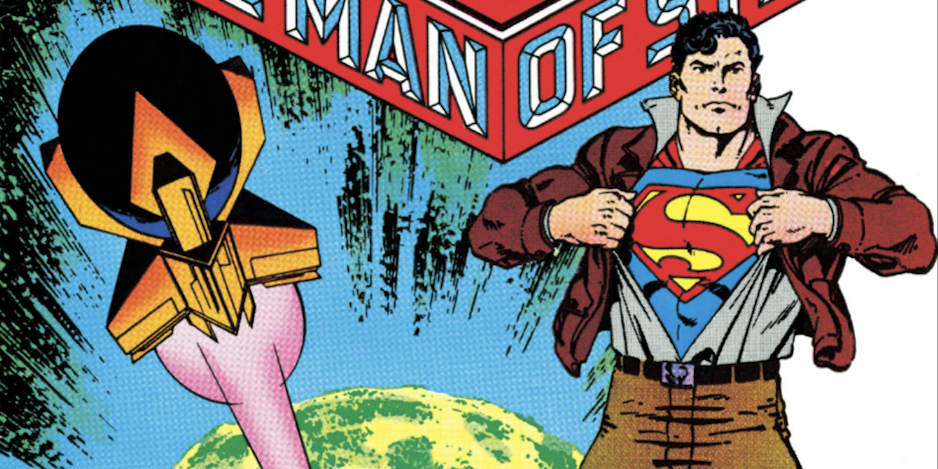
He’s had numerous incarnations over the decades, from the printed page to cinema, from television to Broadway, but one particular iteration of the character holds a special place in my heart. He goes by many names: the post-Crisis Superman, the reboot Superman, the Modern Age Superman, the Iron Age Superman, the Dark Age Superman… the John Byrne Superman.
Byrne was a comics juggernaut by the mid-1980s; his work on The Avengers, The X-Men, and Fantastic Four had made him a superstar at Marvel. Since he was both a writer and artist, his name was often spoken in the same breath as both Stan Lee and Jack Kirby. He was possibly the most revered creator working at Marvel at the time… and then he quit.
Marvel’s Distinguished Competition had lured him over to work on its flagship hero: Superman.
—
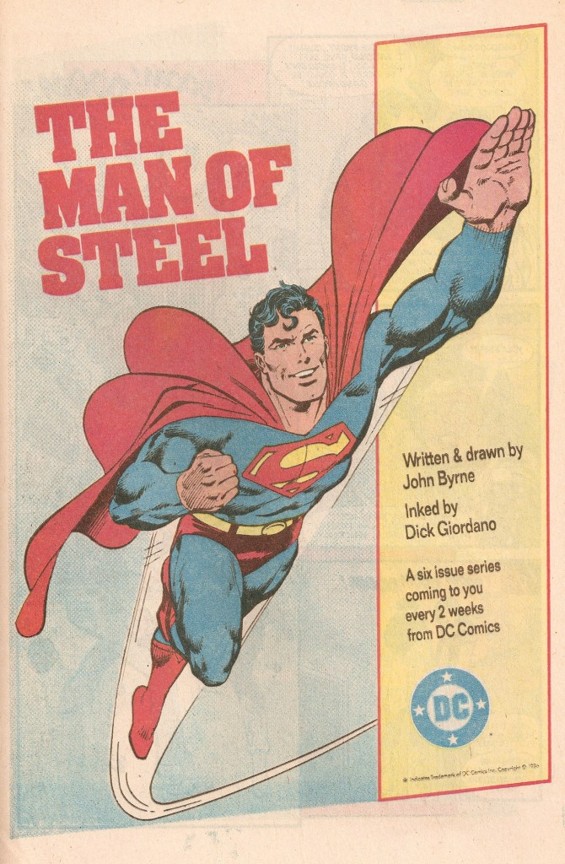
In the early months of 1986, I read in Dick Giordano’s Meanwhile… column that DC was going to launch a revamp of Superman, spearheaded by John Byrne from Marvel Comics. I was intrigued: What did that mean, exactly? Was Superman getting a new costume? New powers?
I eventually found out that this would be a complete re-interpretation of the character, after DC used Crisis on Infinite Earths to clear its slate. I was curious about this new Superman we would be getting — he’d become dull, I thought — and decided to check him out.
The grand unveiling followed the end of the current Superman continuity — Alan Moore’s “Whatever Happened to the Man of Tomorrow?” which to this day remains one of my all-time favorite Superman stories. It was pencilled, fittingly, by Curt Swan, the king of the Super-illustrators.
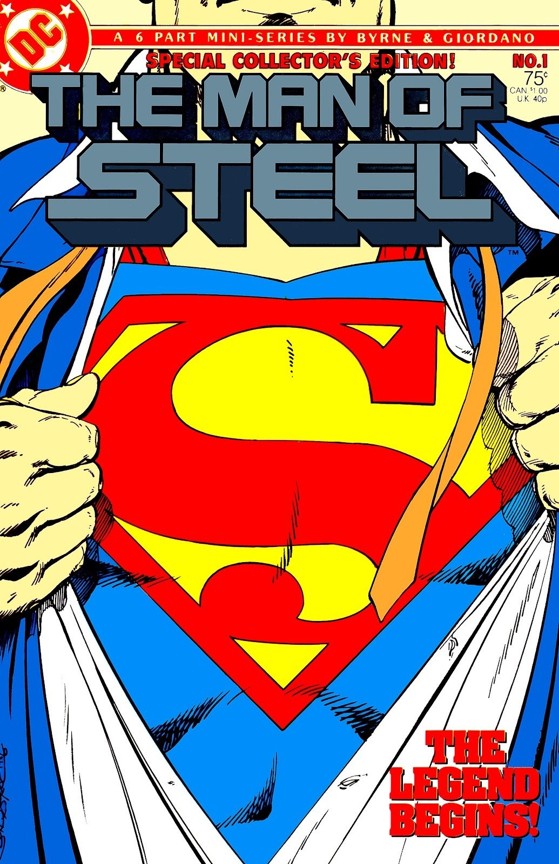
Then came June and Byrne’s The Man of Steel #1. I was so excited when I got my copy, I immediately had to tell myself to temper my expectations; I remembered the many disappointing Superman stories I had read over the past couple of years.
The moment I opened it, I recognized immediately that everything I knew about Superman was out the window. Gone were Krypton’s flying cars and the multi-color suits that looked like someone had put Buck Rogers and The Jetsons in a blender.
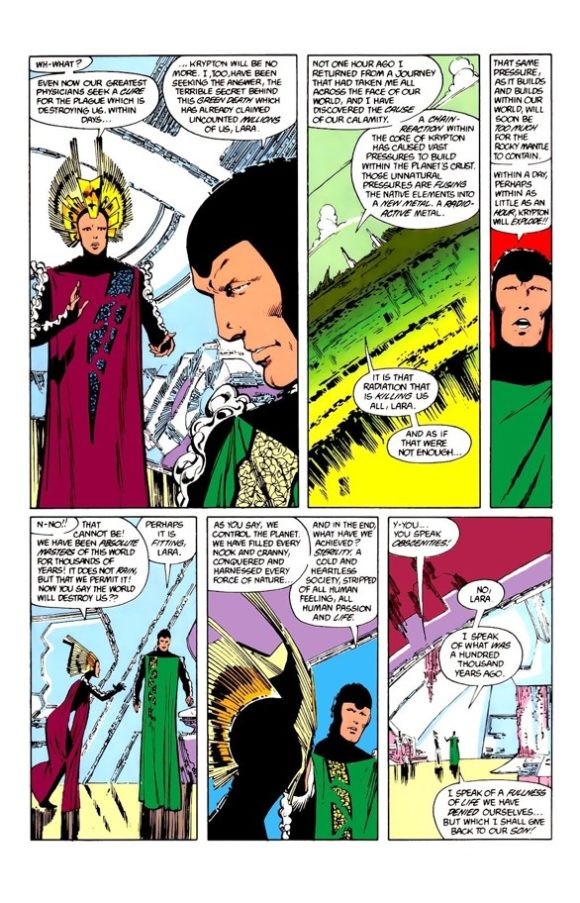
Instead, we were presented with Krypton as an arid, lifeless, dystopian landscape that really felt like science fiction, especially the science fiction of the 1980s, the era of Aliens, Dune, Blade Runner,and Enemy Mine. It felt like what I imagined an alien world would look like, rather than the pseudo-utopian fever dreams of writers and artists who conceived of Krypton before space travel was even a reality.
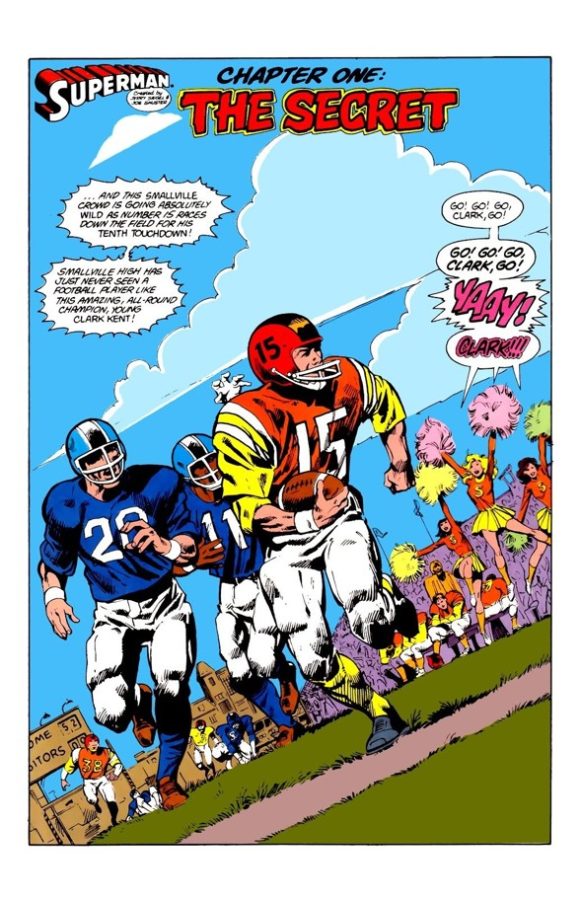
Suddenly, 18 years later! We jump to Clark playing football… wait, what was that? Clark Kent a star athlete? Quarterback of the football team? Where are his glasses? Why aren’t the football players pushing him around and laughing at him? Isn’t someone going to figure out he’s Superboy? Wait, he’s not Superboy, either? And the Kents are alive into Clark’s adulthood? The hell?
This was an even bigger paradigm shift than Krypton! Clark was popular, confident, tall, muscular… he looked like a regular guy, albeit an athletic one, very much like George Reeves on The Adventures of Superman, which was still big in syndication during my elementary school days. As much as I adored, and still adore, Christopher Reeve’s performance, I’ve always been far more partial to the Clark Kent of George Reeves: a competent, confident guy who was still a leader, with or without the cape.
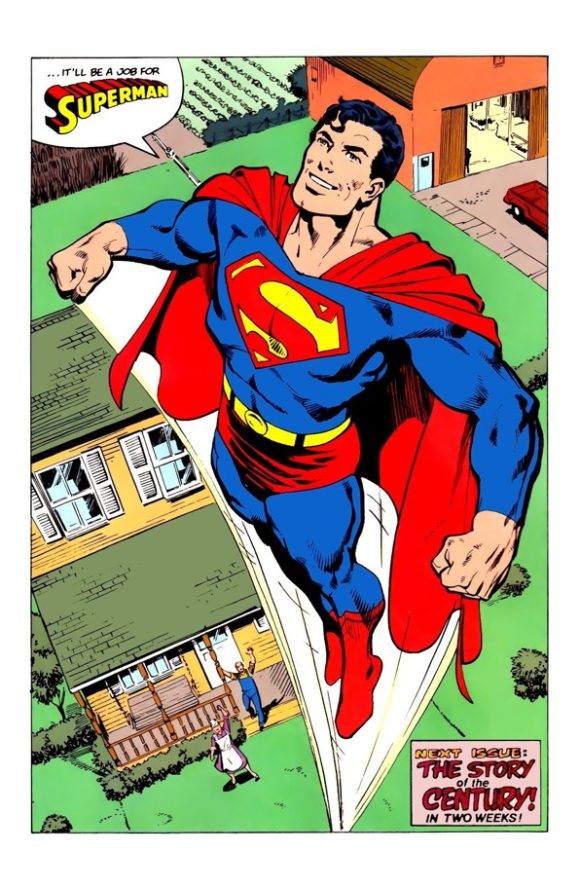
And I know this is going to get some hate from some of my fellow Superman fans, but I’ve never been crazy about him putting on a costume at the age of 8, 12, 15, or whenever your Superboy head canon says he did; I greatly prefer him first donning the suit as an adult. Needless to say, as of the end of the first issue, this new version of Superman was checking all my boxes. When he took off from his parents’ farm in full costume and called himself Superman for the first time (here comes one of those tried-and-true cliches), I swear I could hear the John Williams theme in my head.
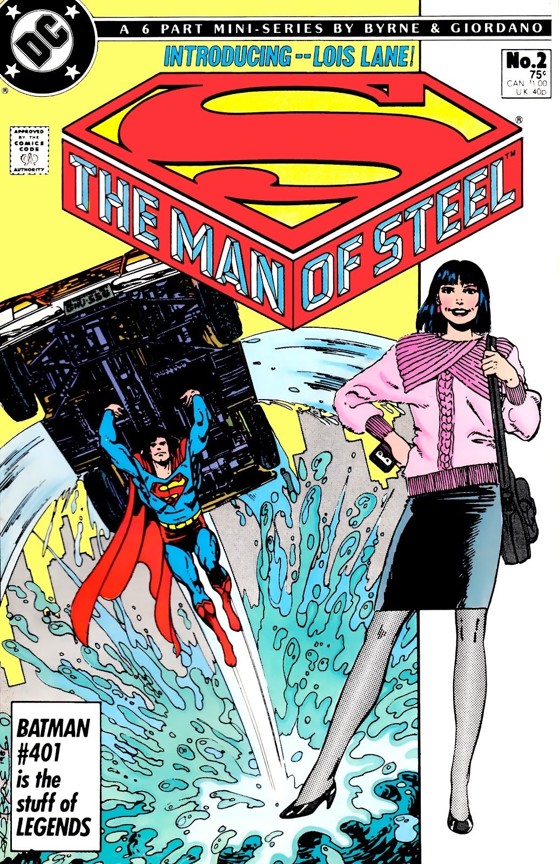
The next two weeks couldn’t go by fast enough for me to get the next issue, which introduced us to Margot Kidder… uh, I mean Lois Lane. Lois had been portrayed as a strong woman before, but her history was unfortunately tinged with a lot of man-craziness in the ’40s, ’50s, and ’60s. She was constantly swooning over Superman, crying when there was the slightest hint he might be interested in another woman, acting like her sense of self-worth depended on becoming the Metropolis Marvel’s ball and chain.
None of this was present in the new Lois, who was all about her career, and being the best at it. She spends the entire issue chasing Superman not as a romantic interest, but because he’s news. We even see her brush off the richest guy in Metropolis, one of the richest guys in the world, in pursuit of the story (more on him later).
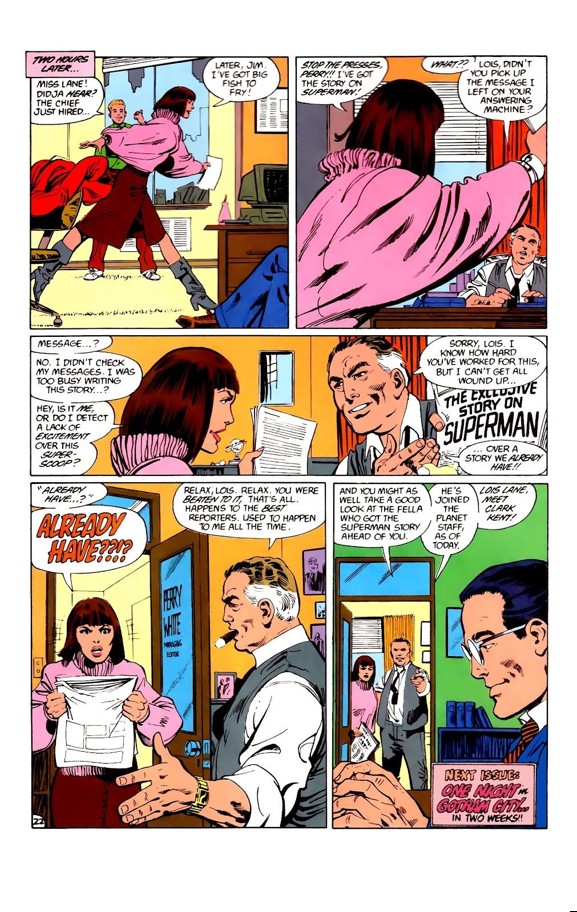
This was the first era of strong female action characters (Ellen Ripley’s a big example, or Sara from Day of the Dead), and the new Lois fit right into that mold — which explained why she was so pissed at the end when she finally got the interview she wanted… only to find out some new guy named Kent had beaten her to it, leading to years of resentment and professional rivalry. This was very much an ’80s Lois Lane.
* * *
Issue #3… this was the one I was probably the most excited about. I finally got to see the new version of Superman and Batman’s first meeting. Unfortunately, this was the one that let me down the most, possibly because the guest star was my favorite character at the time and maybe my expectations were a little too high.
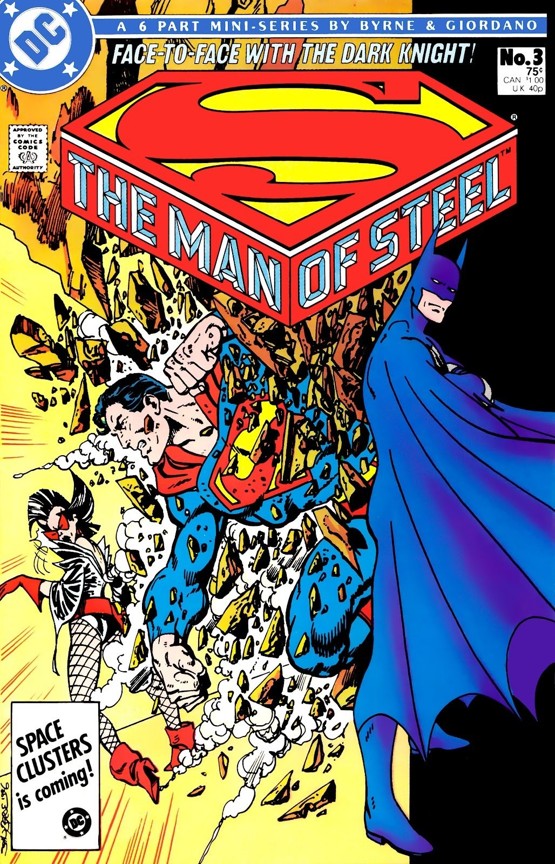
Don’t get me wrong, it had its highlights: Batman managing to disappear from Superman’s view just by knowing the city like the back of his hand; Batman surreptitiously using himself as a human shield to keep Superman at bay; and of course, Magpie was a bit of a letdown as a villain for the World’s Finest to tackle.
But the biggest impression this one left on me, and a change that I instantly loved and embraced, was the establishment that Superman and Batman were no longer friends. We were seeing this in The Dark Knight Returns, but that was set at some indeterminate point in the future; they could have been friends in the past and had a falling out at some point.
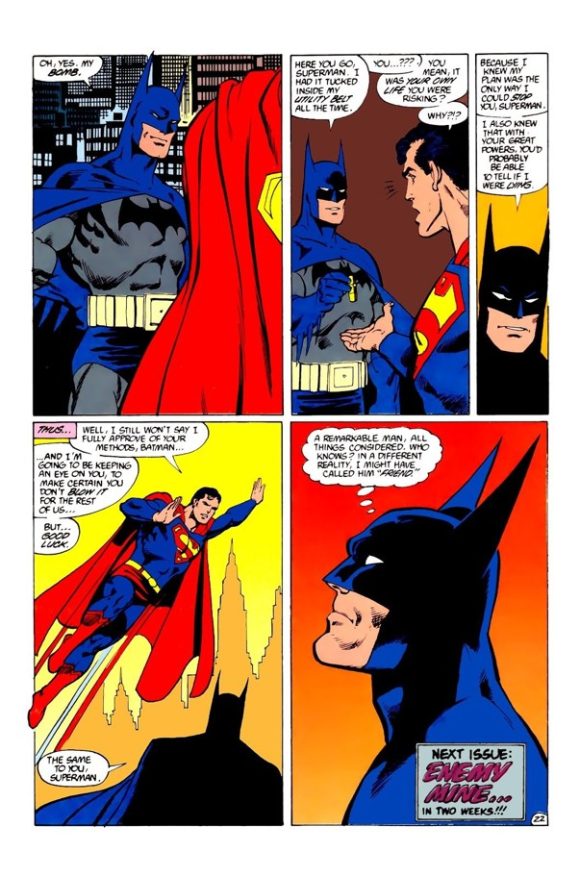
The Man of Steel #3 established that this was the new status quo; they are, at best, uneasy allies, which I found made total sense given their radically different worldviews and methods. Clark is the eternal optimist, always trying to see the good in people; Bruce eyes everyone with at least a hint of suspicion, expecting the worst in people and usually finding it.
When I glanced at the cover for Issue #4, I wondered, “Who is this red-headed guy in the suit, smoking a cigar?” Then I saw the caption at the top of the cover: “Lex Luthor Strikes!” My mind went back to Issue #2, when Lois blew off Lex’s offer of a ride in his limo, our first hint of the new Luthor’s background — a rich megalomaniac who thinks he can buy or sell anything and anyone… until he encounters Superman.
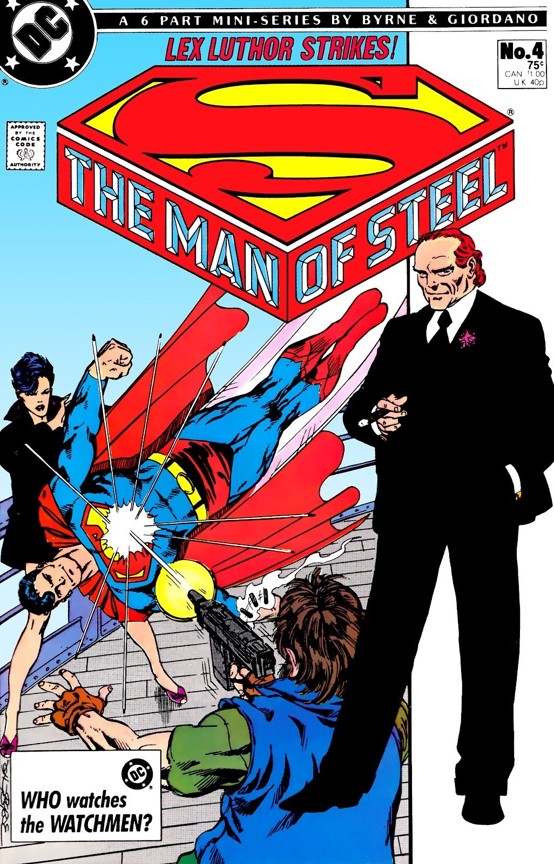
This was the perfect villain for the ’80s: not a hokey mad scientist breaking out of prison every 10 minutes to attack Superman with some sort of fantastical machine that could just as easily make him rich if he just patented it, but an utterly corrupt businessman who would stop at nothing to get what he wanted. The real-life news was full of guys just like this. The following year, when I saw Wall Street (still one of my all-time favorite movies), I almost immediately thought of Gordon Gekko as a thin Lex Luthor.
* * *
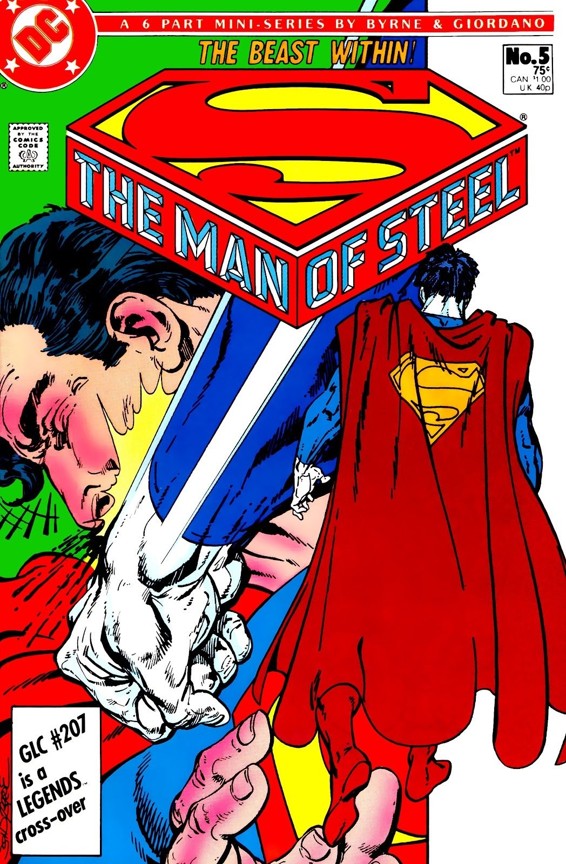
Issue #5 was a perfect story for the era, dealing with the inherent dangers and questionable ethics of cloning. Bizarro as a failed experiment rather than born from an imperfect duplicator ray was a brilliant update. No more crude, giant medallion with “Bizarro #1” on it, no more cube-shaped Bizarro World, just a pitiful creature who doesn’t realize the threat he poses: He actually thinks he is Superman and that the real one is some kind of imposter to be attacked.
The final issue serves as a perfect bookend for the series by returning to both of Clark’s homes: the one that raised him, and the one that spawned him.
The brilliant juxtaposition of Clark visiting the farm where he grew up, then being bombarded with strange images of the alien world on which he was conceived, echoes cinematic classics such as War of the Worlds and Close Encounters of the Third Kind, and predates later films like Super 8 and Signs.
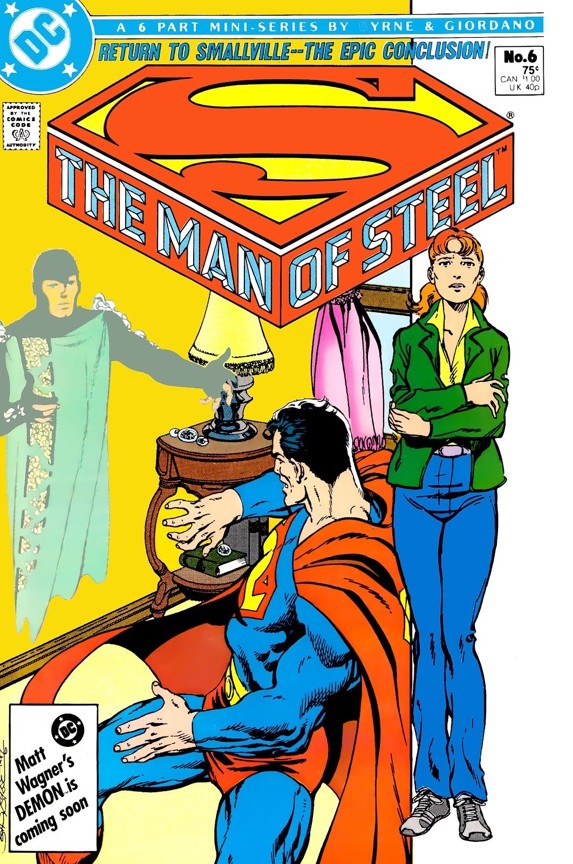
It was also compelling to see the now-adult Lana Lang and to hear from her how knowing Clark’s secret unintentionally damaged her life. 13-year-old me, already having spent years on a steady diet of The Twilight Zone and The Outer Limits, was riveted by stories of normal people dealing with the abnormal. This issue, sometimes seen as a throwaway or one of the weaker of the series, was a perfect ending to me.
* * *
One other important aspect of this final issue is how Clark deals with the information he has received; he now knows everything about Krypton, but he doesn’t really care. He knows where he came from, but his emotional attachment is to the loving farm couple who raised him. We’ll no longer see exclamations of “Great Krypton!” or “Great Rao!” in the coming pages of his monthly adventures, because this guy has no emotional connection to them.
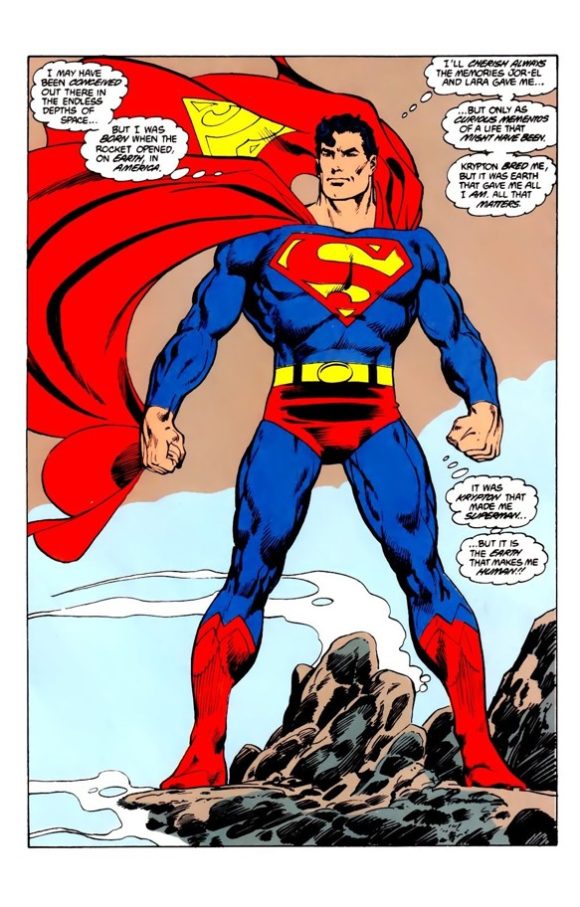
The Man of Steel was, in many ways, a product of its time, but, then again, so was I. The comics, movies, and literature I was absorbing primed me to buy exactly what Byrne was selling that summer. I’m not saying that other iterations of Superman’s origin are invalid, or useless, or wrong, but no other version will hit me quite the way this one did. It came at the perfect time in my life when I wanted to love Superman, but just couldn’t latch on to the one appearing monthly in the mid-’80s up to that point.
Byrne made Superman fresh, original, and exciting again. It wasn’t my introduction to the character, but it was the one that made me want to stay. John Byrne made me a Superman fan, and for that, I will forever be in his debt.
—
MORE
— HOW I FELL IN LOVE WITH SUPERMAN — Though He Did Need a Refresh by 1986. Click here.
— Why JOHN BYRNE’S SUPERMAN Was the Greatest Man of Steel Ever. Click here.
—
AARON HAMMONDS fell in love with comics and superheroes over 40 years ago; his passion was reignited in 2025 by James Gunn’s Superman. He resides in Pensacola, Florida, with his beautiful wife.

June 17, 2026
Great article! This makes me want me to break out my issues and read it all over again!
June 17, 2026
Thanks, Phillip! I revisit it often…
June 17, 2026
I enjoyed it when it came out and the art was undoubtedly gorgeous. In hindsight, however, a lot of what Byrne did to “Marvelize” Superman hurt the character greatly: the complicated rebooted continuity; elimination of Supergirl, etc.; and, most significantly, removing the all important “disguised as Clark Kent” dichotomy that stripped the character of some great thematic power. Ultimately, the best-and most significant-part of the reboot was revamping Lex and even that (Lex as billionaire businessman, albeit disguised) was something first toyed with by Elliot S! Maggin in the “Last Son of Krypton” novel.
June 17, 2026
While I loved that era of Superman & DC in general, I do agree that their gradual roll-out approach caused a lot of problems down the road. It might have been best if DC had taken the New 52 approach & done a hard reboot starting the month after Crisis.
June 17, 2026
Great article. I remember collecting this in 1986. I had already joined the Army, but I hadn’t left for basic training yet. This was such a great era for Superman, and I missed some of the early phases of it due to being overseas for two years, but I eventually got caught up. Yeah, this is also my Superman.
June 17, 2026
Glad you were able to catch up, Jon; we only had Byrne on Superman for 2 years, but what an exciting run it was. Thank you for your service!
June 17, 2026
Even though I’m about 8 years older than the author, I agree completely. Superman was a great character who started to get some better writing in the early Bronze Age (e.g. “Kryptonite No More”). However, DC eventually went back to almost a Silver Age plotting style with him. While I’ll always love the “Superboy and the Legion of Superheroes” 1970s era, Byrne’s reinterpretation was essential to modernizing Superman and making him a compelling character. So, the loss of the Legion, Kandor, etc. was sad, but necessary.
June 17, 2026
>>…was sad, but necessary.
>
Especially if DC’s goal was to chase away fans who had stayed beyond the typical 2–3 year readership cycle, it worked on me. I stopped buying a lot of titles after changes like the ones mentioned. If only publishers could see that multiple versions can coexist just fine, as long as they have strong writers and artists telling good stories.
June 17, 2026
Hey, Bob! You’re only about a year older than my brother Chris; he was 20 when The Man of Steel came out. Superman was already his favorite DC character (he had been reading Superman since the beginning of the ’70s) and he also says that the Byrne revamp is his favorite version…
June 17, 2026
John Byrne’s Superman is my Superman too. Though, I have learned to love Curt Swan’s art in the years prior.
Thank you for the article.
June 17, 2026
You’re welcome, Frank; thank you for reading it! While I can find something to love in every era of Superman (I’m particularly fond of his stories from the ’70s), Byrne’s version will always feel like home…
June 17, 2026
Not only was this a tremendous reset, the Superman books changed as well. Superman was the main book, Action became a team-up book and Adventure Comics became Adventures of Superman. Certainly a call back the the TV show, but I was sad to see Adventure Comics fall by the wayside
June 17, 2026
Actually, Jim, Adventure Comics ended in the Fall of 1983; Adventures of Superman was a continuation of the original Superman title, which had ended with #423 in June 1986 & the first issue of Adventures of Superman being #424, in October 1986 (cover dates September 1986 & January 1987, respectively)…
June 17, 2026
Great write-up! I really appreciate your enthusiasm for the subject. For me, Byrne’s take on Superman became a jumping off point for me. I had grown up with the Bronze Age Superman and loved so much of the elements of his lore that Byrne dismissively referred to as “barnacles”. In my eyes Byrne and DC shrank Superman’s mythos to the point that I just didn’t care anymore. I loved his history with the Legion, Bizarro World, Kandor, Krypto, Supergirl, and all the rest. But the thing that turned me off the most was the depiction of Clark as a popular high school jock which totally missed the charm of the secret identity. I know this version is seminal for many, but I still miss “my” version
June 17, 2026
I totally understand, Lloyd; it’s hard to embrace a new version of a character to whom you’ve been so loyal for so long. I had similar feelings about Superman: Birthright retconning most of Byrne’s version of Superman’s origin, and don’t even get me started on the New 52 lol…
June 17, 2026
No, no, Jim. The original Superman comic was retitled Adventures of Superman and continued its numbering. Adventure Comics had become a digest before it was canceled.
June 17, 2026
I did a re-read of the entire Byrne (and Wolfman and Ordway) Superman run about a year ago in the recent-ish hardcover collections. It was my first complete reading of the material since the 1980s. It was…mostly (but inconsistently) good. The three regular series (Superman, Adventures, and Action) weren’t as good as I remembered. But the original six-issue Man of Steel mini-series mostly holds up remarkably well.
It’s not perfect, but this mini-series took some bold chances in reinventing core parts of the character that really streamlined the property and set it apart from the tired, paunchy Bronze Age version of the character that preceded it (and which I never liked). Byrne’s Superman had a swagger and a confidence about him. His characters (especially his Lois) had a sense of style about them that still feels fresh today. And his (and Marv Wolfman’s) reinvention of Lex Luthor is the archetype of the version of the character that I most prefer.
I also really liked Dick Giordano’s slick inks. I generally prefer when Byrne inks himself, especially in his post-1990s work, but his inks in the 1980s, while good, were a little too fussy for my tastes. Giordano’s inks (or, as Byrne has griped, Giordano and his staff of assistants) brought a level of simplicity and boldness to Byrne’s artwork that really elevated it.
But, like I said, it wasn’t perfect. What didn’t work?
— Too much expository dialogue. Frank Miller, Alan Moore, and Howard Chaykin deserve most of the credit for radically reinventing the prose style used in mainstream American comics. But MoS was being created simultaneously with a lot of Miller, Moore, and Chaykin’s work, so Byrne’s writing was still mired in a lot of Bronze Age tropes, and this was most evident in his use (or overuse) of thought balloons to do massive, inartful exposition dumps (see especially the last several pages of issue 6).
— No central narrative spine. Unlike the other post-Crisis reboots of the time (Miller and Mazzucchelli’s Batman; Perez’s Wonder Woman; Grell’s Green Arrow; Chaykin’s Blackhawk; Truman’s Hawkworld; etc.) which were novelistic in their narrative structure with a clearly defined beginning, middle, and end, MoS was very episodic in its structure. The events of each issue happen sequentially, but there’s not narrative thread holding everything together. In retrospect, this keeps MoS from reaching the same tier and being held in the same esteem as the other books mentioned above.
— The coloring. I’m not sure who colored MoS, but it’s not a good coloring job. The color choices and color combinations are just downright garish and not the work of someone who understands color theory. In comparison, the coloring on Superman, Adventures, and Action which followed is pretty good for Bronze Age coloring. This is not a gripe against old school coloring. There are ways to use the limited pre-computer color palette in an artful way (see the coloring of Kevin Nowlan, Klaus Janson, and Tom Palmer (oddly, the best Bronze Age colorists were inkers)), but I don’t think the coloring in MoS did that. Again, I think this is something that keeps MoS from being in the top tier of 1980s post-Crisis reboots.
All that said, I cannot wait until Man of Steel is released in a remastered Absolute Edition later this year. The perfect can often be the enemy of the good, so for all its faults, it’s still my favorite Superman comic book story, even 40 years later.
June 17, 2026
Thanks for the thoughtful response, Daniel! I know it may be a matter of seeing it through nostalgia glasses, but none of the points you mentioned have ever bothered me; The Man of Steel is still my Superman bible. One thing we definitely agree on: I can’t wait for the Absolute Edition.
June 18, 2026
I remember a friend trying to explain to me the relaunch of Superman – how he was different from the Superman I’d grown up with. I had lost interest in Superman years ago, but decided I’d try the mini-series. If nothing else, it was the opportunity to get in on the ground level of what was to be Superman’s second life. And after buying the first issue of Man of Steel, I was hooked. I collected the entire series. Then I began collecting the three available Superman titles that would develop this new Superman: “The Adventures of Superman”, “Superman” and “Action Comics” (which had become a team up series featuring Superman and a different DC character each month). And I loved every minute of it. The John Byrne era was and still is my favorite version of Superman.
June 18, 2026
That’s a great story, Allen! So glad Byrne was able to bring you back. I hope you stayed for the Triangle Era; the 90s were an exciting time for Superman…
June 18, 2026
I appreciate the Byrne revamp mainly for what came after the man himself left, the Triangle Era. There was some good stuff in the Man of Steel and couple of years of Byrne Superman/Action that followed – especially the art – but his Lois was pretty unpleasant at times, and I hated the loss of Superboy, for his own adventures, and for the Legion. His Krypton was intriguing but I love the corny pulp version, and while I don’t need Superman thinking of himself as Kryptonian, to glimpse its (arguable!) glory and not care makes no sense. And Luthor as a Trump type has only so many legs, as was proven.
It was exciting, to see how things were reintroduced.
Anyway, Aaron, I enjoyed reading your views!
June 18, 2026
Thanks, Martin! It annoyed me at first, but I came to enjoy the imaginative methods of reintroducing certain Silver Age elements with a modern spin. I was less excited about Byrne’s revamped origin being retconned out of existence by Birthright & later by Secret Origin…
July 16, 2026
I was in my mid 20s when the Crisis hit and John Byrne re-introduced Superman. I was blown away. Superman was less Kryptonian and more human. I loved the idea that his powers grew slowly the longer he was on earth (instead of flipping on and off depending on the color of the sun). I liked Clark Kent the jock, who really didn’t know he wasn’t from earth. I liked the idea that Clark Kent is who he really is; Superman is how he hides from the public.
Like you, I was less-than-thrilled with all of this being retconned out of existence. I did not care for Birthright or for Secret Origin (although I love both Mark Waid and Geoff Johns). Byrne’s Superman will always be my Superman.
Thank you for your memories! They track mine so well!