
A 40th ANNIVERSARY SPECIAL: Alan Moore’s era-ending Superman classic resonates — for good and for bad…
By PAUL KUPPERBERG
“This is an imaginary story… Aren’t they all?” — Prologue to “Whatever Happened to the Man of Tomorrow?” written by Alan Moore, Superman #423 (released May 20, 1986)
I have to confess, that line annoyed me then and still makes my left eye twitch a little now. It read to me like a trendy, post-modernistic wink at the reader, a pre-emptive apology for the silliness ahead.
Or was that just me?
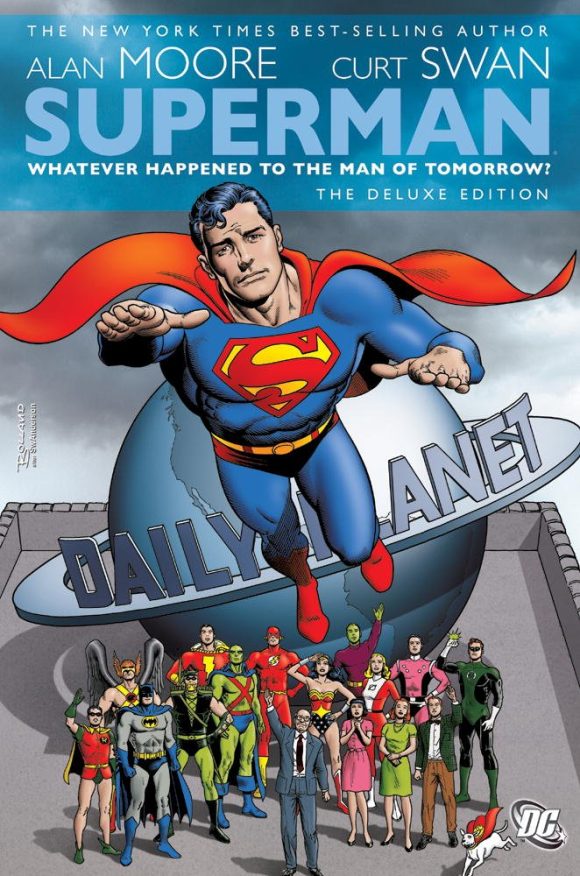
Another confession: There were parts of the introduction for 2009’s Superman: Whatever Happened to the Man of Tomorrow? collected edition where I may have written some things that didn’t exactly line up with my own feelings on the story. I toed the company line about the necessity of Crisis on Infinite Earths to streamline the DC Universe and eliminate the confusion of “many different Earths set in many different dimensions, each host to many different versions of Batman or Flash or Wonder Woman or Superman” so that readers would no longer need to be “conversant with fifty-plus years of characters and continuity in order to read a title. There was to be only one Earth, existing in one universe, featuring (for the most part) only one version of any given character,” but deep in my heart I knew those 50-plus years of characters and continuity were both the company’s charm and legacy.
Version 1.0.0
I thought that was ridiculous, and I offer as validation for my belief that 40 years down the line from Crisis, the DCU is more convoluted and twisted than it ever was pre-Crisis.
But there’s no denying that if a “last” Superman story was needed, departing Man of Steel editor Julie Schwartz chose a writer for the project who would bring the maximum exposure to the story. I interviewed Julie for the introduction and he said, “I ask this at comic conventions: ‘Who would you, sitting in my editorial chair, mid-1985, ask to write that story?’ He wrote the first one, let him write the ‘last’ one—Jerry Siegel!”
At that year’s San Diego Comic-Con, Julie popped the question to Siegel, a fellow guest at the show, who responded, “Oh… boy, well, I have to think about that… no, no need to think about it. I would love to write it!” Unfortunately, the ongoing legal disputes between the Superman creators and DC made that impossible, but fortunately, he found a resolution to his problem the next morning.
“I happened to be having breakfast with Alan Moore,” Julie recalled in 2009. “So, I told him about my difficulties. At that point he literally rose out of his chair, put his hands around my neck, and said, ‘If you let anybody but me write that story, I’ll kill you.’ Since I didn’t want to be an accessory to my own murder, I agreed.”
Whatever Happened to the Man of Tomorrow? — which began 40 years ago in May 20’s Superman #423 and ended in June’s Action Comics #583 — was a tough story for me to read, much less write about objectively. DC Comics was essentially killing off “my” Superman. Yes, it might be difficult to see the connection between the juvenile stories of the Mort Weisinger era that I was raised on and this darker version, but the connective tissue was all there, in the comfortable familiarity of the Curt Swan art (here inked by George Perez and Kurt Schaffenberger), and the characters and concepts originally created, let’s face it, to appeal to 10-year-old readers.
I had been part of that lineage not just as a reader since around 1960 but as a writer as well, having contributed countless pages of stories to the pre-Crisis Superman family of titles and the syndicated newspaper strip in the early 1980s. Man of Tomorrow represented a clear break from that lineage, a fatal finale to a 48-year-run that left no doubt everything I knew and loved about Superman, all the stories I wrote about him, were going away.
And yet, for all its darkness, there was something satisfying about Whatever Happened to the Man of Tomorrow? I may not have liked what it represented, but I could appreciate that Moore had been handed a lot of plot threads that had become loose ends to be tied up, and he did the job, offering thorough and often shocking closure to the old guard.
Superman wasn’t going to go out with a whimper, that was for sure.
Here then, MY 13 FAVORITE THINGS ABOUT WHATEVER HAPPENED TO THE MAN OF TOMORROW?:
—
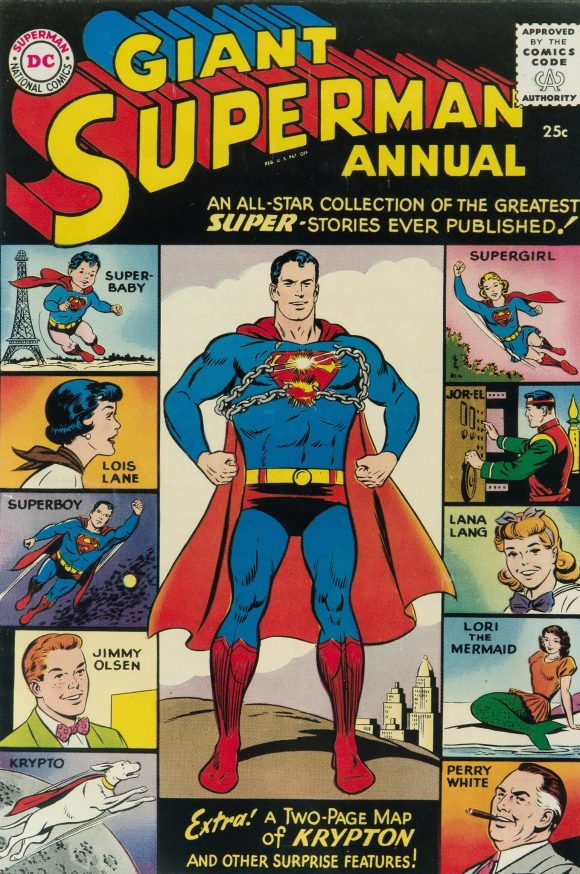
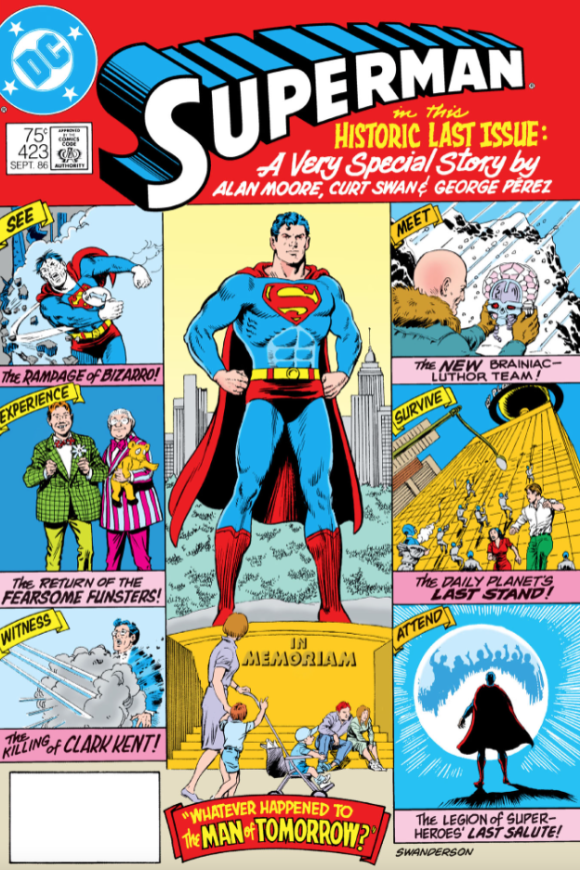
1. The Superman #423 Cover. Curt Swan and Murphy Anderson — the “Swanderson” art team of legend — offer a loose homage to 1960’s Superman Annual #1.
—
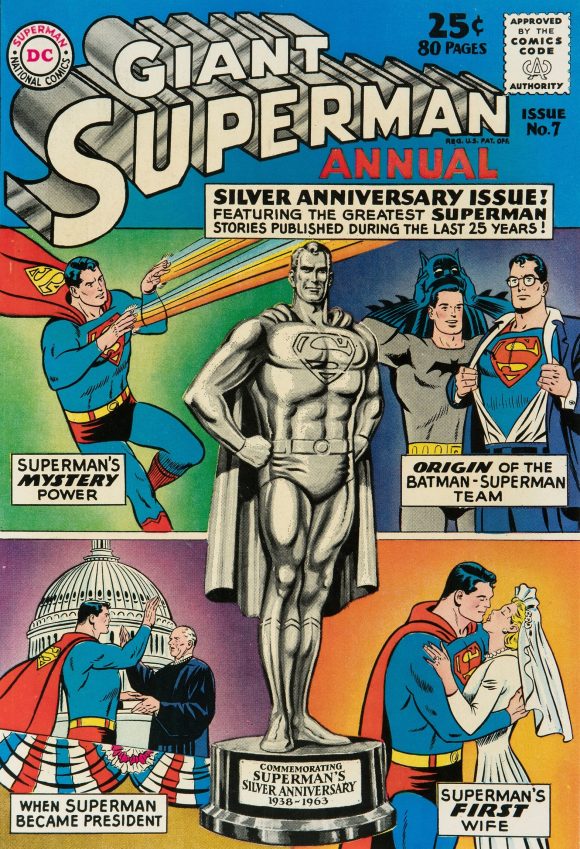
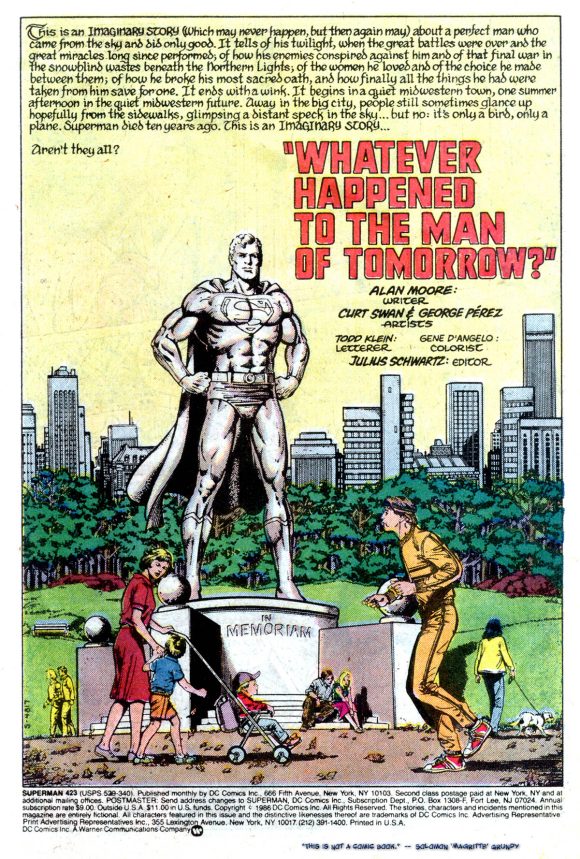
2. That issue’s splash page features another nod to another of those early giants, 1963’s Superman Annual #7, the classic 25th Silver Anniversary Issue that sported an eye-catching silver statue of the Man of Steel at its center.
—
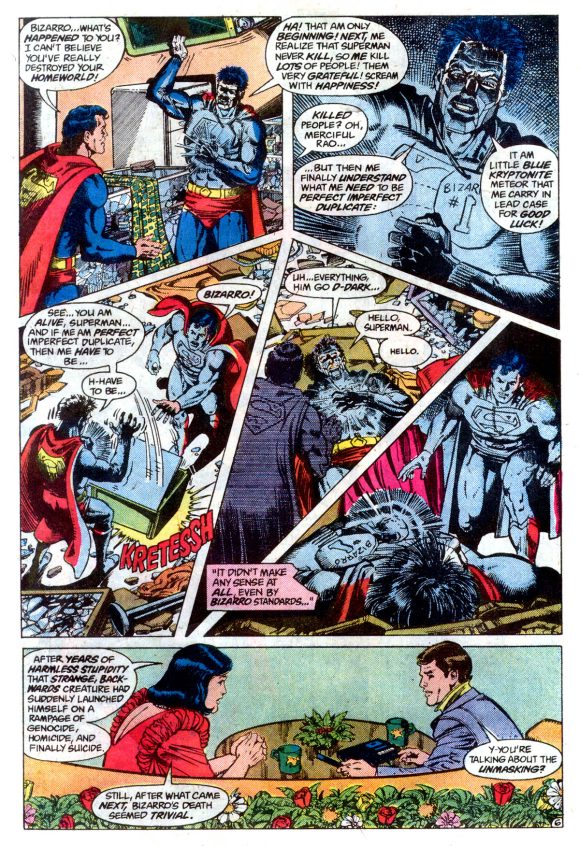
3. I admit it: I was jealous that Moore got to do the Bizarro story I always wanted to do, taking the credo of these imperfect duplicates — “Us do opposite of all Earthly things!” — and having him realize that the true opposite of existence was nonexistence. Hello!
—
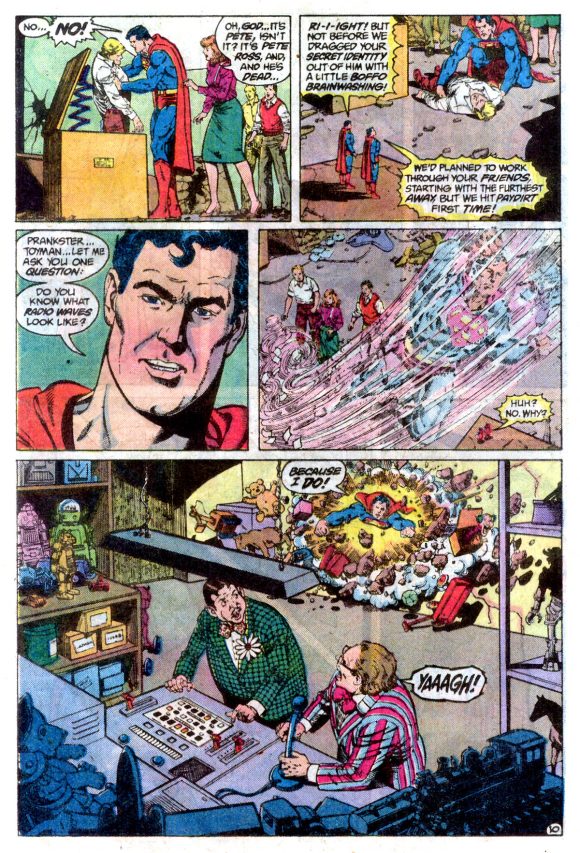
4. An awesome use of superpowers! “Prankster… Toyman… Let me ask you one question: Do you know what radio waves look like? Because I do!”
—
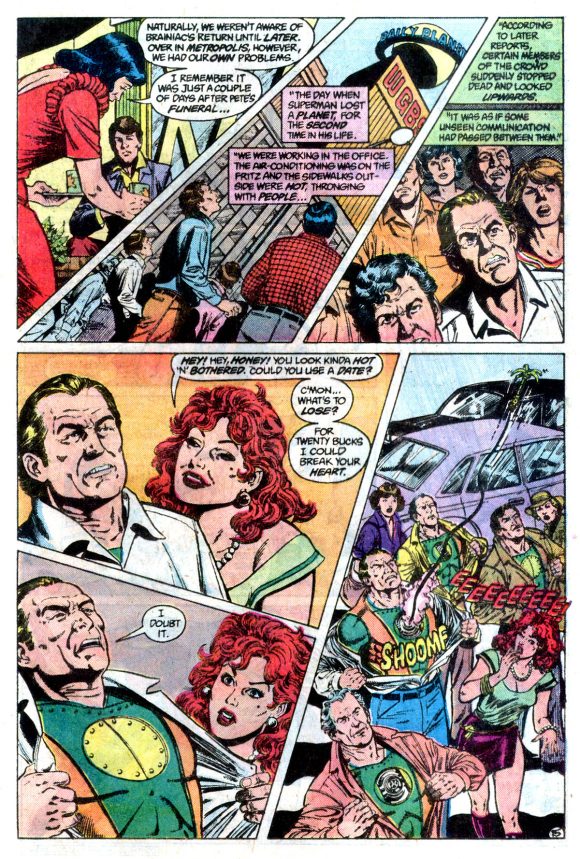
5. The prostitute who approaches a guy outside the Daily Planet building, offering that “For twenty bucks I could break your heart,” just so Moore could reveal him to be Metallo so he could tell her, “I doubt it.” See, ’cause… Metallo doesn’t have a heart. Get it?
—
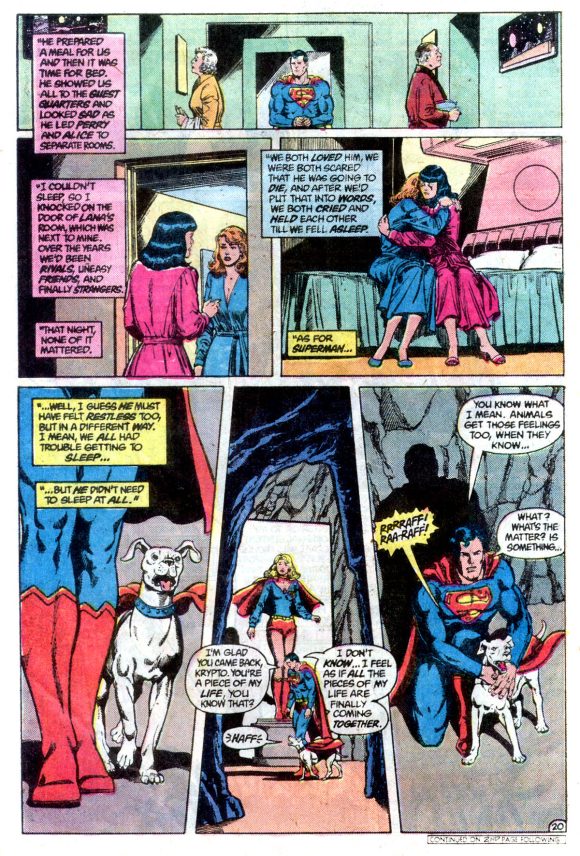
6. It was just a couple of panels, but the rapprochement between Lois and Lana in the Fortress was kind of touching and cool.
—
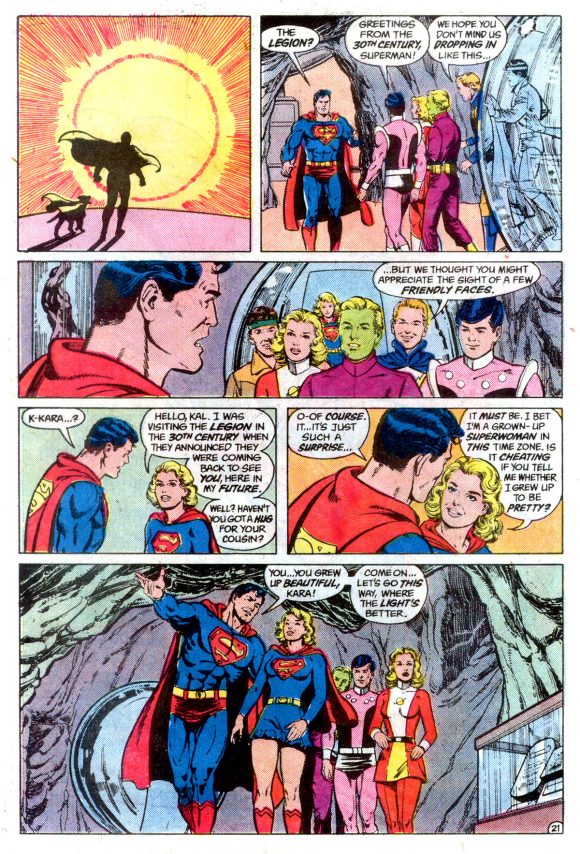
7. It was great seeing Swan drawing the Legion of Super-Heroes again, as he’d done once upon a time, long ago and far away, in Adventure Comics in the 1960s.
—
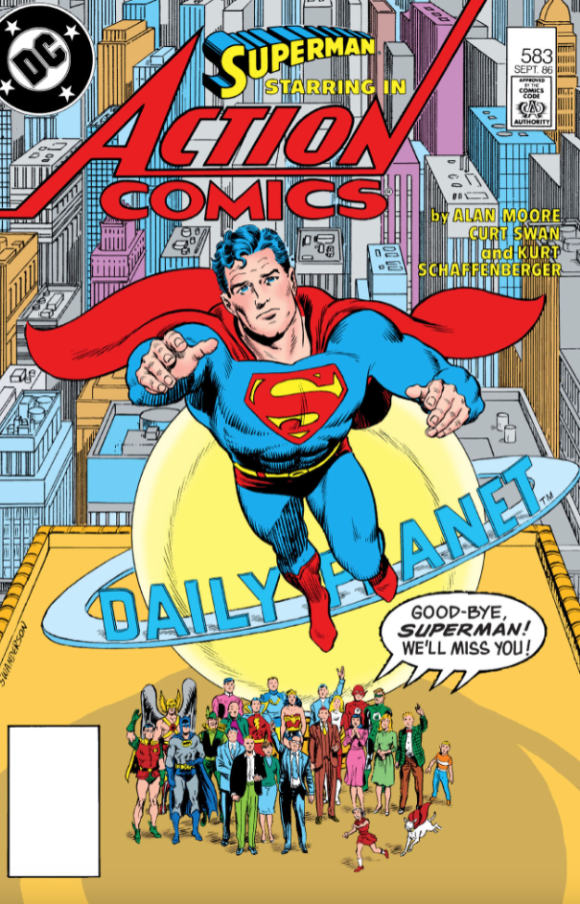
8. The Swanderson cover for Action Comics #583. Superman isn’t crying! You’re crying!
—
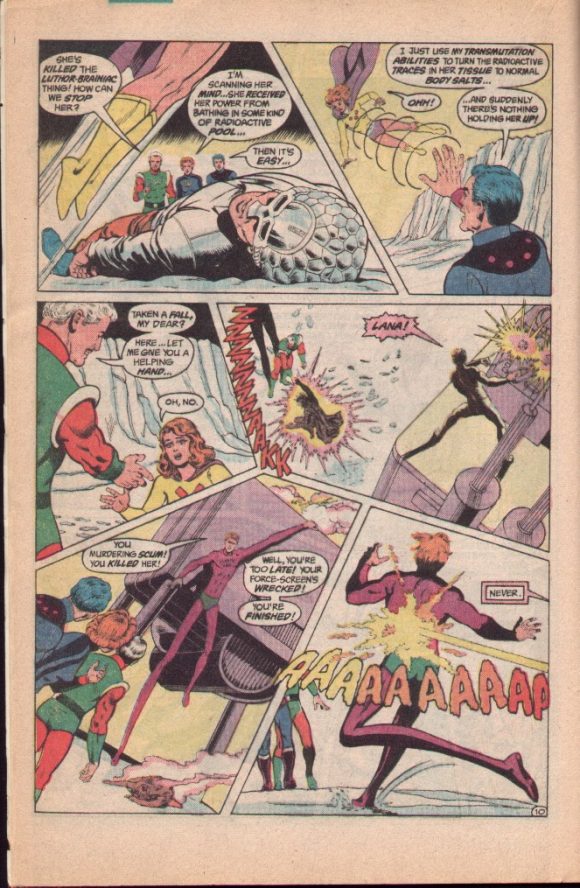
9. The mounting tension of Part 1 explodes, beginning with the super-powered Lana Lang snapping the Brainiac-possessed Lex Luthor’s neck and Jimmy Olsen/Elastic Lad being murdered by Luthor’s animated corpse under Brainiac’s control.
—
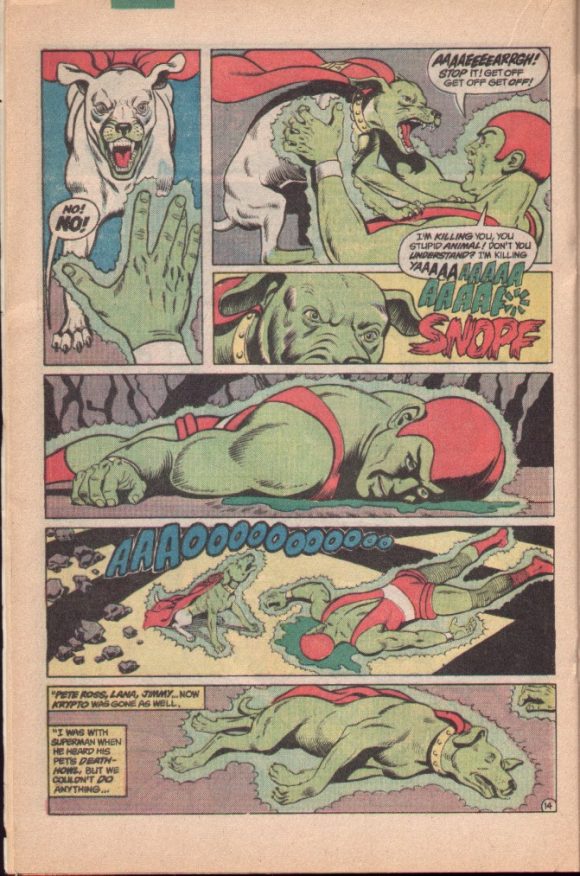
10. Good boy! (>Sniff! Choke!<)
—
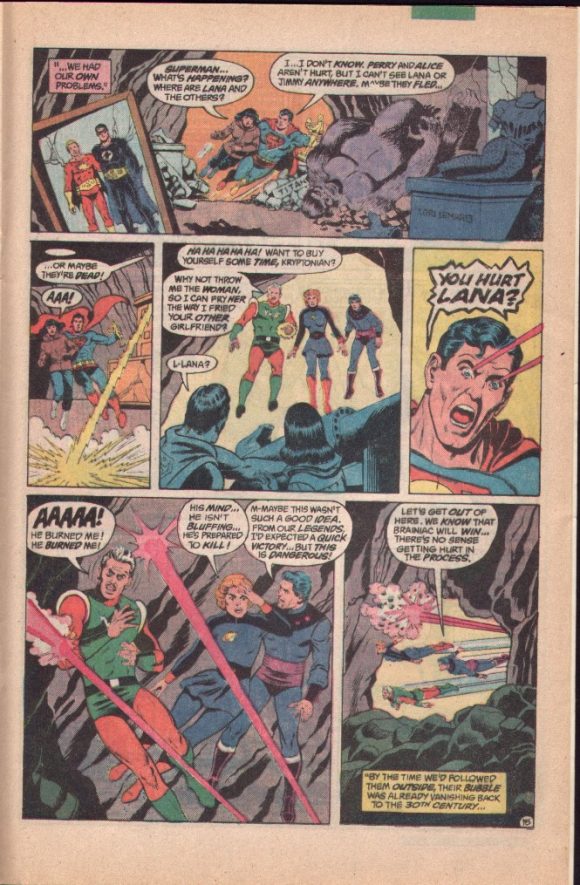
11. Criminals are a superstitious and cowardly lot, and the Legion of Super-Villains proved to be no exception!
—
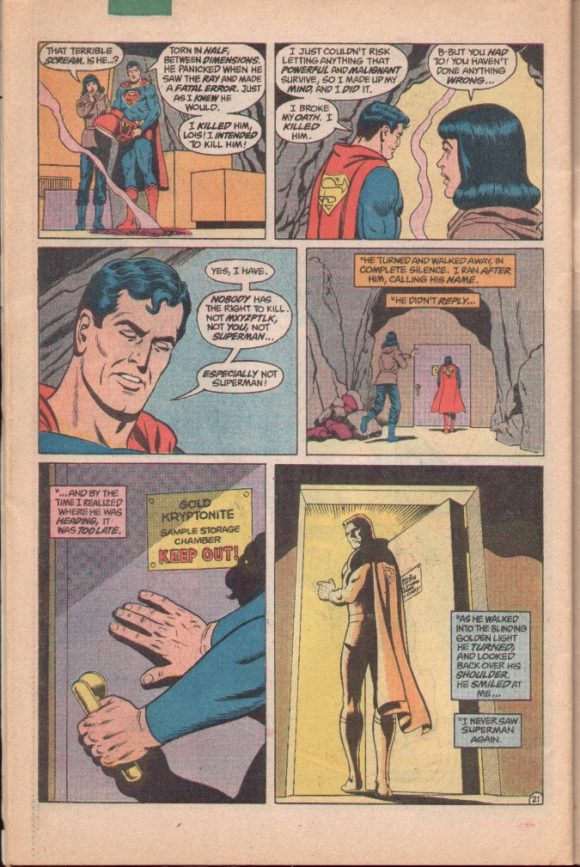
12. The instigator of all of Superman’s woes is revealed to be — SPOILER ALERT! — Mr. Mxyzptlk, whom the Man of Steel defeats with the Phantom Ray Projector, the idea given him by the golden statue of himself holding said Projector that was gifted him by Brainiac 5 on the Legion’s visit to the past. It was a very Mort Weisinger/Julie Schwartz denouncement, complete with Superman’s musing, “(Mxyzptlk was) Torn in half between dimensions. He panicked when he saw the ray… just as I knew he would.”
—
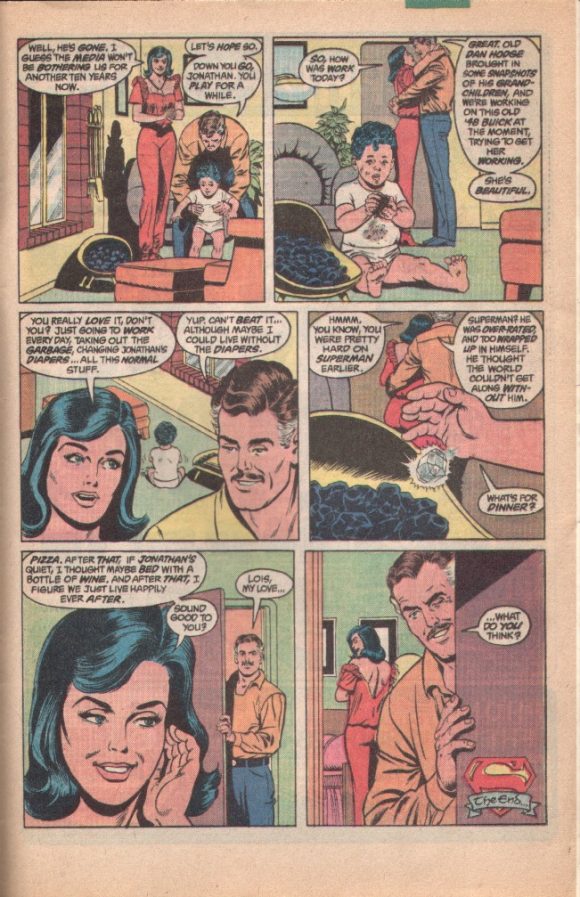
13. The story, published in 1986, is supposedly set in 1997, so the only reason I can imagine why the “Elliots” would have a bucket of coal in their living room was so their toddler son — who looked nothing like baby Kal-El — could squeeze them into big old diamonds. >Wink!<
—
MORE
— 1986: Comics’ Watershed Year — 40 YEARS LATER. Click here.
— DARK KNIGHT RETURNS TURNS 40 — But 1986 Was Even Bigger for BATMAN Than You Realize. Click here.
—
PAUL KUPPERBERG was a Silver Age fan who grew up to become a Bronze Age comic book creator, writer of Superman, the Doom Patrol, and Green Lantern, creator of Arion Lord of Atlantis, Checkmate, and Takion, and slayer of Aquababy, Archie, and Vigilante. He is the Harvey and Eisner Award nominated writer of Archie Comics’ Life with Archie, and his YA novel Kevin was nominated for a GLAAD media award and won a Scribe Award from the IAMTW. Check out his memoir, Panel by Panel: My Comic Book Life.
Website: https://www.paulkupperberg.net/
Shop: https://www.paulkupperberg.net/shop-1

May 20, 2026
A wonderful tribute to a landmark story, Daddy-O….
May 20, 2026
Moore understood something that no one at DC/WB since has: Once Lois learns Superman’s secret identity and marries him, the story is over. Everything after that is an epilogue at best.
May 20, 2026
I could not disagree more. I think the secret identity has outlived its usefulness, relevance, and even the most basic plausibility.
May 20, 2026
Except that Lois and Clark have been married–twice!–since the 1970s and the story has kept going. The current marriage had a brief blip where it disappeared, but it was restored in 2015 and the pair is doing just fine with a child. Check out Peter Tomasi’s Kent family stories–Clark moves into the Pa Kent role and does great with it.
May 20, 2026
Completely agree. I will never understand why people want a married (with children) Superman. If that’s what you need to be able to read superhero comics, you’re probably just too old to be reading them.
May 21, 2026
That’s the case with a lot of the people who want domestic Superman. Many are in their 40s or older and have families of their own, so domestic Daddy Superman is now their fantasy superhero, dull as he is.
May 20, 2026
Minority opinion here. I totally get why people who grew up with Silver and Bronze Age Superman love this story. But for me, a Gen-Xer who never liked pre-Crisis Superman, this story was…fine. Unlike a lot of Alan Moore’s other work which is genuinely well crafted and stands on its own as great works of art, this story gets a big boost from nostalgia fumes. Take those away and the story is…fine.
May 20, 2026
My feelings are largely the same as yours Paul. I like this story quite a bit, but I don’t like the reason behind why it had to be published. Even though I do think DC benefited from the shot-in-the-arm of Crisis and the revamps that followed. But ultimately, it is way messier now than if they’d just kept their original mutliverse intact.
My one gripe about the story was that I never bought that Superman would be so self-centered that he’d leave the world without its greatest champion just to appease his own moral code. Erasing his own powers because of something he HAD to do always seemed out of character to the Superman in my mind.
May 20, 2026
I was eight years old when this story came out and I was still getting my Superman comics at Newsstands. The larger implications of Crisis was beyond me–all I knew was that a larger story was happening in the background and I didn’t have access to it. Anyway, one day, I had the Curt Swan version, the next, John Byrne was revamping the character. I wasn’t bothered by this. I was eight.
One thing this story fundamentally cements is the difference between the Silver/Bronze Age Superman and the post-Crisis version. Moore’s story confirms: Clark Kent is a facade. When the Trickster and Toyman expose his identity, Clark’s identity is unceremoniously thrown in the trash. The only possible tie to his life as Clark is his relationship with Lana, and Superman heartbreakingly reveals that it just isn’t going to happen–his heart is with Lois. That’s it. Superman is Kal El and Clark was just a front. Byrne’s revisions fundamentally make Clark Kent a real person, the kid who grew up in Smallville and still loves his Earth parents. This has remained an irreconcilable split between Bronze and Modern age Superman fans–whether Clark or Kal is the true identity (persisting even into last year’s film and the question of whether the immigrant Kal-El should identify more with his birth world or his adopted one).
One thing I still can’t resolve is whether Lois KNOWS at the end of this story that Jordan is Superman (as well as whether Superman still has his powers). It can be read either way. Lois may be lying to the reporter and Superman never went into the gold kryptonite chamber (or did, but remained in hiding until later). Or she may be completely naive and Superman is putting up a really good front (although she’s going to be in for a surprise when she starts finding diamonds in the coal bucket). The adult reader in me thinks that Lois knows and is contributing to “Jordan’s” front. The kid in me still wonders about the ambiguity.
May 20, 2026
Paul, thank you so much for your two confessions. Admission is the first step. Long live DC’s Gold/Silver/Bronze legacy, multiverse and all.
May 20, 2026
S-Tier Superman. When Moore put his hands into Superman you knew he had an excellent grasp of the character (and maybe Julie’s neck?).
May 20, 2026
I just recently reread this story (hurrah for the Facsimile series) and just like when I first read the story, I ugly cried when Krypto died. Great article!
May 20, 2026
I disagree about the opening; I’ve always taken the “aren’t they all?” line to mean that even though the story was billed as ‘imaginary’, it has just as much validity as anything else…and could be ‘real’ if you wanted it to be. A lot of readers (myself included) consider this the end of Superman, so it’s about as real as it gets!
May 20, 2026
Love! I need to re-read this classic again! For the 20th time! Thanks for sharing
May 20, 2026
Paul, this is an enjoyable article. I love the two-parter finale unreservedly, so I appreciate thinking about it again. And as for the now-rather-famous quote, “This is an imaginary story… Aren’t they all?” – well, I must say that yes, Paul, I do think that is just you. I mean this respectfully, of course! I found that quote and the entire first page text to be affectionate, not annoying. And celebratory, not sarcastic. I think Moore is honoring the past, not making a trendy, post-modern gesture.
Not only that, but it’s true.
May 20, 2026
The Crisis just made things confusing. I never had any trouble keeping up with DC continuity pre-crisis. Now, I have no idea which stories are real and which are imaginary.
May 21, 2026
I agree. One of the reasons I loved DC was the multiple worlds and used well it was wonderful. Do not have all the superheros on one Earth – the Shazam family are on one world and the Freedom Fighters on another. Earth 2 had a different history. I loved it from age 11 until they destroyed it when I was 19. It was fun to learn about it all. Crisis was the end of my love for DC – I still bought the books by creators I Iiked , but the charm had gone.
I love this farewell to the Superman who I had known (I had found a copy of Superman from the 30s to the 70s at a second hand bookshop for equivalent of 30c when I was 12). Krypto’s death was like a punch in the heart.
May 21, 2026
“I have to confess, that line annoyed me then and still makes my left eye twitch a little now. It read to me like a trendy, post-modernistic wink at the reader, a pre-emptive apology for the silliness ahead.
Or was that just me?”
It was just you. I read it as a “don’t rain rain on our parade, move on and let us have fun” warning to all the anal-retentive ueber-fans, some of them turned pros, that insisted that the DC Universe had become too complicated to follow, while we had no trouble following… our own wim, enjoyed what entertained us and forgetting the rest. But that move was never about making it easier for readers, it was about cultivating for DC the same kind of extreme following Marvel had already got, making it all about the “shared universe” experience, wanting desperately to buy all the issues from all the books and knowing all the minute details, the ones that took Marvel through the growing desert of seventies newstand to the promised land of the direct market where they would become an empire.
May 22, 2026
This story was a nice farewell to the Man of Steel when I first read it in 1986. Reading the pages now after a lifetime of love, loss and life I gotta admit the page with Supergirl and the Legion choked me up. I loved it that Mxyzptlk was behind it all; I always liked his stories. I felt the Crisis shafted a lot of those characters and a lot of us readers, but we all have to grow up sometime, right? Oh wow…Jerry Siegel might have written the farewell to “our” Superman story! Maybe on some parallel Earth (separated from our own Earth by some strange editorial whim…) he did!
June 6, 2026
I loved this story; it was a fantastic send-off to the longest-lasting version of the character (30+ years)…