
It’s the eve of the 40th anniversary of John Byrne’s Man of Steel, and a 13th Dimension reader has thoughts…
By AARON HAMMONDS
Superman hit movie screens again in a big way last summer, and director James Gunn’s blockbuster did something none of the other films starring the Man of Steel have done in the past 20 years: It reignited my passion for comics in general and the Big Blue Boy Scout in particular.
In the last few months, I’ve begun rebuilding my comics collection with a special emphasis on a certain strange visitor from another planet, and it’s gotten me thinking: Where did all this begin?
—
MY FIRST GLIMPSE OF THE LEGEND
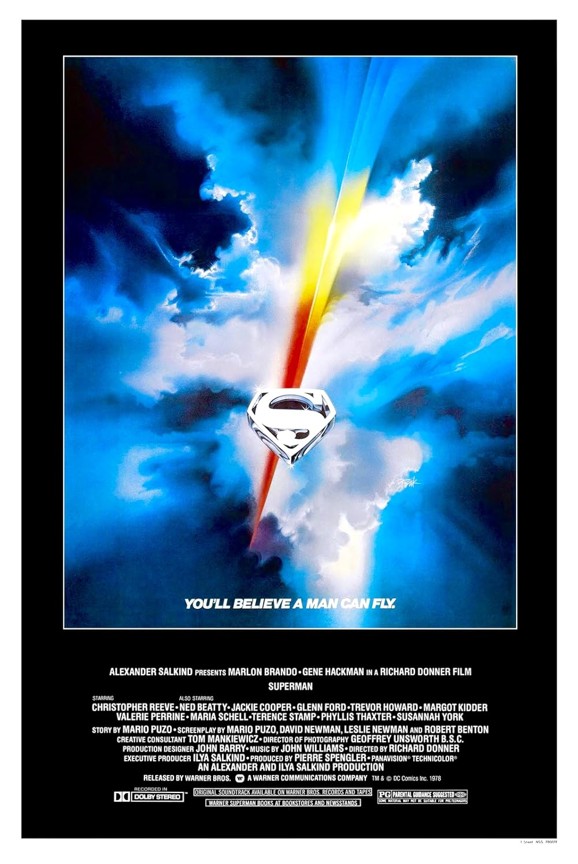
I was 5 years old in 1978 when my mom took my brother (he was 12) and me to see Superman: The Movie. I thought it was fun, but I also thought it was just a movie; my brother later showed me his comic-book collection and I learned that Superman had a history going back years before. Shortly after that — not sure how I had never seen it — I discovered the Super Friends show on ABC Saturday mornings.
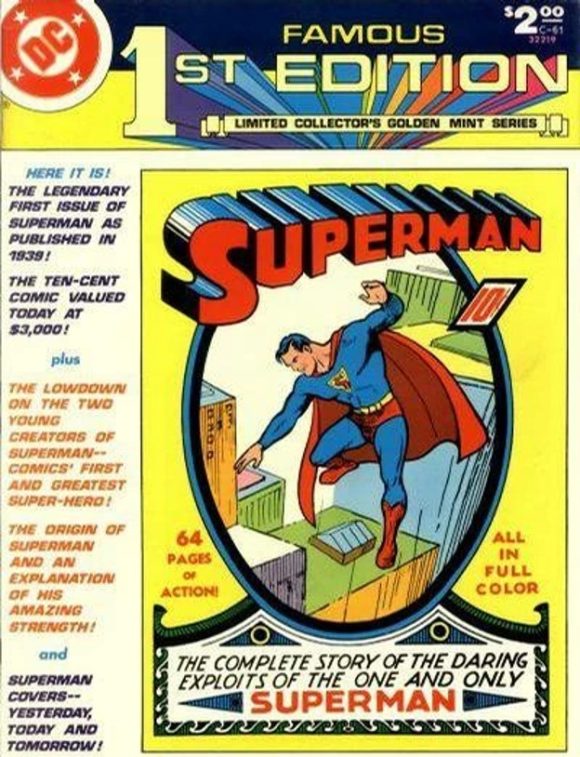
Over the next couple of years, as I learned to read, I perused my brother’s Famous First Edition treasury of Superman #1, featuring a Man of Steel with whom I was decidedly unfamiliar. This guy beat people up! My brother explained to me the concept of the Multiverse, Earth-One, Earth-Two, etc., and I then understood why this early Superman was so much rougher.
Through a trivia book of his, I also learned some of the rich tapestry of lore that had been woven around the character, primarily since the 1950s: the bottle city of Kandor, his college girlfriend Lori Lemaris (who just happened to be a mermaid), his time with the Legion of Super-Heroes in the 30th century, the vast history of Krypton and the Phantom Zone, etc.
I expanded my palette by reading his Famous First Editions of Flash Comics #1 and All-Star Comics #3, introducing me to most of the rest of DC’s Golden Age lineup. Next, I found his issues of DC Comics Presents, the Superman team-up title launched in the spring of 1978. (I remember the exact issues he had: 1-6, 9 and 14, because I read them ad infinitum).
—
GETTING HOOKED — BUT NOT ON SUPERMAN
A few years later, Superman II came out and we finally got to see Christopher Reeve fight super-powered villains! As time went on, I bought (or, rather, would beg my parents to buy) a Flash here, an Action Comics there, but nothing consistently. I enjoyed comics, but I wasn’t hooked yet…
In the spring of 1984, with the purchase of Green Lantern #178 off the spinner rack at my local grocery store, my comics collecting career officially began. Two months later, Detective Comics #541, written by the great Doug Moench in the middle of his classic run on both Batman and Detective Comics, forever turned me into a fan of the Caped Crusader, a true addiction for the next several years.
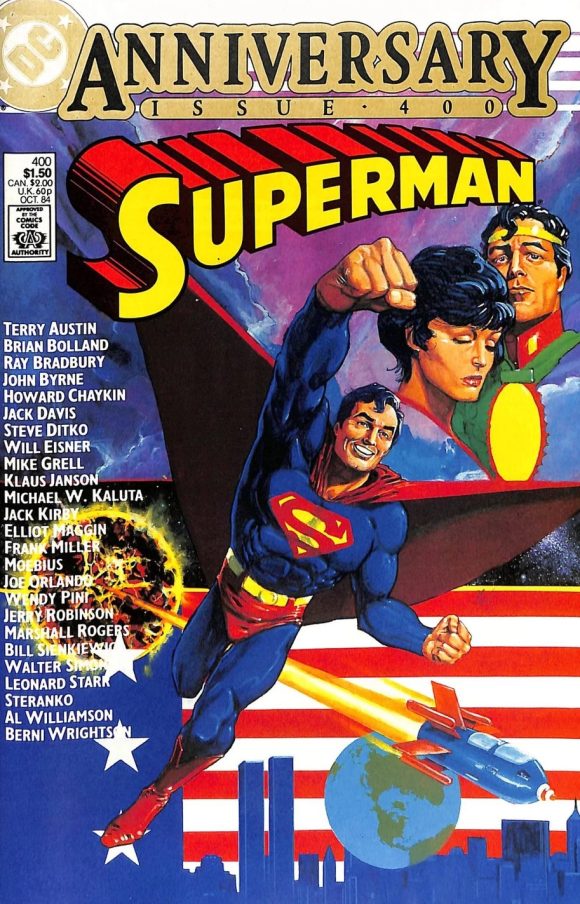
And then, in June, Superman #400 came out and I was drawn to that beautiful “Anniversary” banner DC put on all their landmark issues at the time. I bought it and was blown away by all the talent. This was a fascinating concept: an anthology issue centered around one character, and how his fictional world perceived him over the centuries. This was what made me decide to try adding Superman to my monthly comics haul…
…but that didn’t last very long. I quickly discovered that Superman, on a monthly basis, was dull. Gone were the exciting tales I had read from the late ’70s, with Superman teaming up with the Flash, Green Lantern, and the Metal Men; now, virtually every issue was a one-and-done story based on the flimsiest of premises.
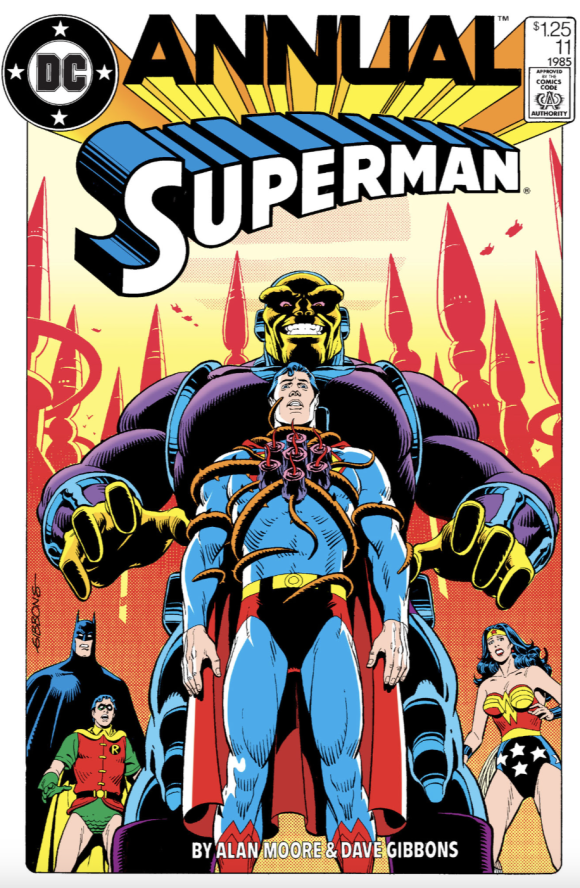
Sure, there were some diamonds, but you had to sift through a lotta coal to get to them. For every “For the Man Who Has Everything” (Superman Annual #11) there was a story about a pan flute that made Clark grow horns.
It was like the Superman titles decided to spend what turned out to be the last couple of years of the Bronze Age vacationing in the Silver Age, embracing the sillier parts thereof. I quickly decided to buy Superman sparingly; my heart was with the Dark Knight and the Emerald Warrior (both Hal Jordan and his replacement, John Stewart). Then, just months after I began collecting and reading about the DC Universe on a regular basis, DC did the unthinkable: They destroyed it.
—
THE END OF THE WORLD AS WE KNOW IT
In December 1984, DC released Crisis on Infinite Earths, promising that worlds would live, worlds would die, and that the DC Universe would never be the same. My 12-year-old mind was blown over the course of 1985, as I watched the Crime Syndicate of America, Supergirl, the Flash, Alexei Luthor, Earth-Two’s Robin and Huntress, Dove, and so many other characters bite the four-color dust. I realized that I had gotten into DC just in time to see everything about DC… change.
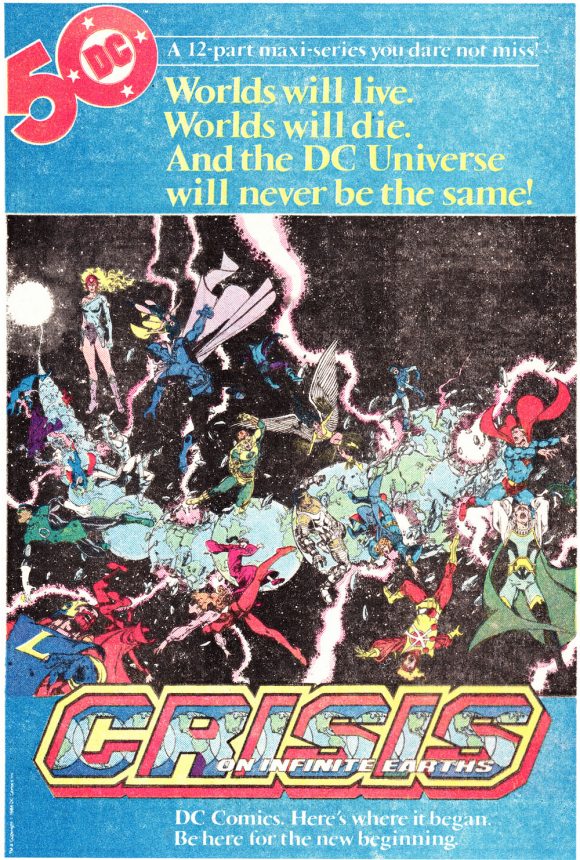
That being said, when the new, post-Crisis era began as 1985 turned to 1986, things didn’t really seem all that different. To a young, adolescent kid, post-Crisis Earth basically just seemed like Earth-One with some new characters added. Things appeared to have settled… until I saw an ad for a miniseries starring a certain Man of Steel (hint, hint).
But that’s another column.
—
MORE
— THE MAN OF STEEL AT 40: Why John Byrne’s Superman Will Always Be MY Superman. Click here.
— PAUL KUPPERBERG: My 13 Favorite Things About WHATEVER HAPPENED TO THE MAN OF TOMORROW? Click here.
—
AARON HAMMONDS fell in love with comics and superheroes over 40 years ago; his passion was reignited in 2025 by James Gunn’s Superman. He resides in Pensacola, Florida, with his beautiful wife.

June 16, 2026
Thanks for sharing this! For me, my first exposure to Superman comics was the cover to the Man of Steel #1 when I was 8 years old. It was a very striking cover, and though I didn’t get the issue (for some reason it was behind the cashier), the image would stick with me for years.
June 16, 2026
Man of Steel #1 was a great introduction to Superman! You’ll see my thoughts on it next time…
June 16, 2026
I’ve never been a fan of Bronze Age Superman, but that said, I LOVE Superman 400. Such an amazing collection of artists. I wish DC would publish it as a hardcover Deluxe Edition.
June 16, 2026
Agreed! I would love to see a reprint of Superman #400, even as a Facsimile…
June 16, 2026
>>even as a Facsimile…
>
Yes. I checked one online (large) source of resale copies and there aren’t many options, none that were very affordable. That tells me there is a demand.
June 16, 2026
Count me in as a GenXer who was first exposed to Silver/Bronze Age Superman but really came into the character with Byrne’s reboot. I was eight in 1986 and had a subscription to Superman (later Adventures of Superman) that I got by sending in the form from a Super Powers figure. One minute, I was reading the Swan version, and then “Whatever Happened to the Man of Tomorrow?” hit and then bam, continuity reboot.
(I also had a subscription to Batman, but not Detective. Same thing when we jumped from issue #400 to the Legends crossover and then Year One. The Post-Crisis changes to Batman were, believe it or not, a lot less jarring than those to Superman.)
The only thing I’ll highlight here is that there seems to be an unspoken cultural split between those who think the Silver Age Superman was the apex of the character, and those who are fine with Superman’s primary identity being a Kansas farmboy makes sense. Or really, the split is between those who think Superman is Kal-El, and those who think he’s Clark Kent. (This is really solidified for me by the scene in Whatever Happened to the Man of Tomorrow where Superman’s identity is exposed. “Clark Kent” is unceremoniously dumped in the trash. In the Silver Age, Clark was a facade.)
I really grew up with the adult contemporary Clark of the 1990s, being a normal guy who eventually married Lois and went on to have a kid with her while still maintaining a superhero life. I’m fine with this. Silver Age Superman is a bit too wooden for my tastes, a god masquerading as a man. He’s fine. He’s not *my* Superman, though.
This is an irreconcilable cultural split. To each their own.
June 16, 2026
Great thoughts, Adam, and I couldn’t agree more; while I’ve grown to appreciate & can still find entertainment in a Silver / Bronze Age Superman story (a lot of his 70s stories are among my favorite), my heart will always be with the Kansas farmboy out to make the world a better place. Pre-Crisis Superman was a Kryptonian masquerading as a human; Post-Crisis Superman was a human who just happened to be from Krypton.