
An ANNIVERSARY CELEBRATION of the comic-book landmark…
By AARON HAMMONDS
In 1986, DC Comics was in the midst of rebuilding their continuity from the ground up in the aftermath of Crisis on Infinite Earths. DC saw this as an opportunity to give a facelift to some of their oldest characters, and the first to receive this treatment was the company’s flagship character, Superman, with John Byrne’s The Man of Steel miniseries. Next up on the revamp agenda was Batman.
Batman was riding high in the fall of ’86; earlier in the year, Frank Miller had shared with us his grim vision of an older Batman coming out of retirement after Gotham had gone to Hell in a hand basket in The Dark Knight Returns, which had attracted attention not only among comics fans, but the mainstream press (receiving write-ups in publications such as The Village Voice, Rolling Stone, and The Los Angeles Times). DC was eager to capitalize on the success of DKR and tapped Miller to give us the post-Crisis version of Batman’s origin story, to be told within the confines of the hero’s flagship title.

Since Batman was already pretty popular just the way he was (in the early days of comics’ “grim and gritty” era), Miller wisely chose to avoid going the Man of Steel route and rewriting Batman’s entire history; instead, he focused on Batman’s first months in Gotham, as he identifies the city’s problems and forges the alliances he’ll need to fight them. Miller was also influenced by real-world events: Since this was being written in 1986 and was going to be based roughly 7-10 years earlier, that would put it in the mid- to late-1970s, a time when urban decay and rising crime was being felt in every major metropolitan area in America. Thus, Batman: Year One was born.
(NOTE: Spoilers abound in this article; hey, the story is 40 years old — Batman #404 was released Oct. 21, 1986.)
—
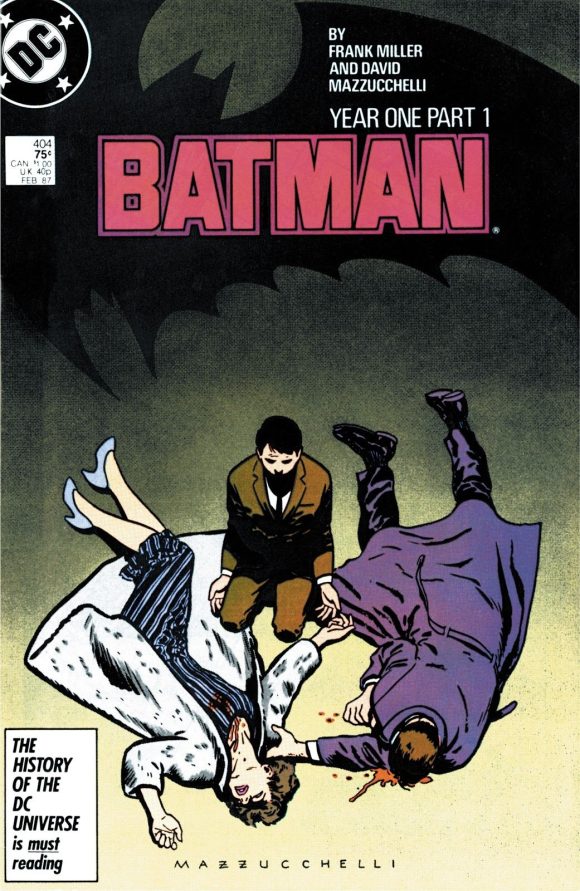
Batman #404’s Part 1 sets up a parallel narrative that will last throughout the story: Lieutenant Jim Gordon, until recently a cop in Chicago, is arriving in Gotham City by train, having transferred to the Gotham Police Dept. after a scandal of an unexplained nature, while, high above, idle rich jet-setter Bruce Wayne flies back to Gotham after having spent 15 years traveling the world, apparently doing nothing more than… being rich. Gordon meets his new partner, Lieutenant Flass, and his superior, Commissioner Loeb, and instantly understands why Gotham has its reputation as a cesspool of corruption.
Meanwhile, we see that Wayne is not the rich playboy he pretends to be; when not talking to his late parents’ headstones (one almost wonders if he hears them talking back), he is destroying trees on his estate with karate kicks and writing in his journal about a mission. The introductions for both men eventually come to a head: Gordon is attacked by a group of corrupt cops who expect him to toe the line, leading Gordon to single out one of his attackers (Flass) for a beating and a message that he won’t back down (shameless Tom Petty reference), while Bruce, severely wounded on a reconnaisance mission into the Gotham underworld (and a brief encounter with a prostitute named Selina; more on her later), limps back home and begs his father for guidance as to how to scare the criminals he wants to bring down. Suddenly, a bat crashes through the window and perches on a bust of his father.
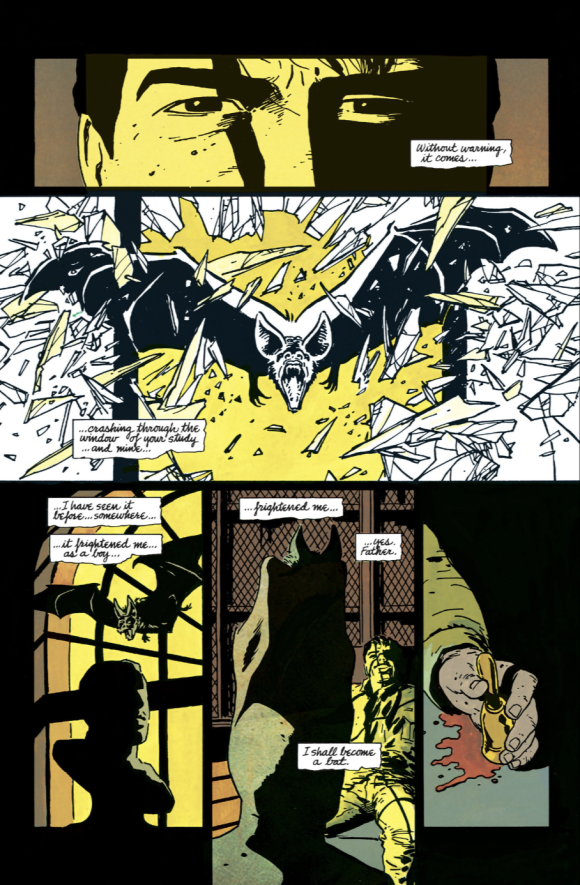
This issue was an amazing opening. The parallel narrative showing each man’s struggle with his own inner demons and “life at a crossroads” moment; the vague hints that Gordon was possibly run out of Chicago for asking the wrong questions of his superiors and fellow officers; our view of Bruce’s inner thoughts via his journal showing that his internal world does not match the façade he projects to the external; his obsessive drive to mete out punishment to the criminals who took away his mother and father, symbolically avenging their murders, expanding to a realization that he’ll have to fight the corruption in Gotham on all levels, not just the streets. By the end of this first issue, we know that both men are dedicated to making the world a safer place; they both just need the right inspiration.
—
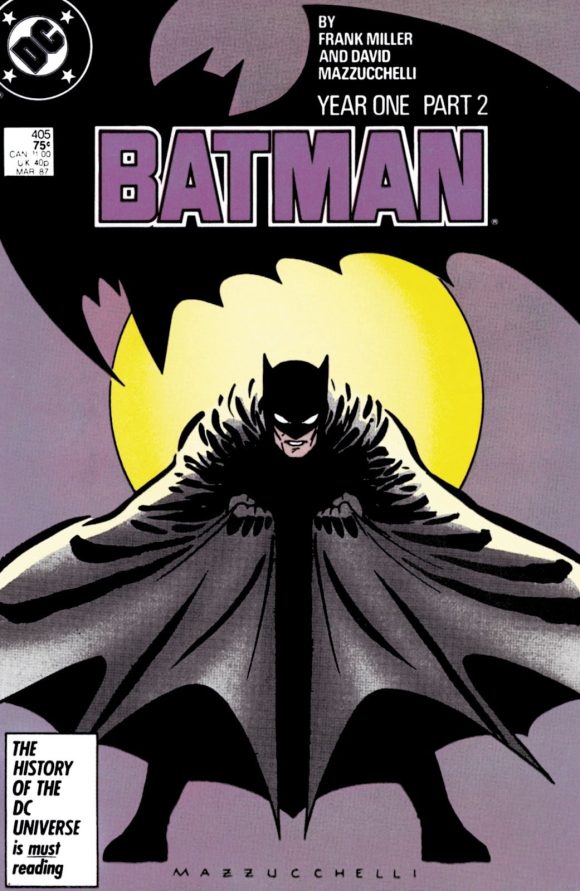
The cover for Part 2 makes no bones about it; Bruce has found his path. A giant bat has been spotted prowling the Gotham night, randomly assaulting various criminals throughout the city. Gordon has been put in charge of the task force assigned to catch “the Batman,” who has “apparently committed 78 acts of assault in the past 5 weeks.” Loeb is indifferent to the Batman’s activities, telling Gordon that the Batman’s exploits are pacifying the citizens who constantly complain about the police doing nothing to stop crime while telling his mob associates that Batman is only hitting their low-level competitors.
All this changes when Batman attacks a party at Loeb’s rather large house (far too large for a police commissioner’s salary) and puts Gotham’s elites on notice that “none of you are safe.” Loeb now makes catching (and preferably killing) Batman top priority. The issue concludes with Batman cornered in an abandoned warehouse with the SWAT team closing in.
The tension in this one is ratcheted up to 11. We get to see Batman confronting the thugs of Gotham in costume for the first time, Gordon demonstrating in a hostage situation that he is possibly the only cop in Gotham who knows what the hell he’s doing, and we see Batman not only going after street punks but the big fish at the top of the criminal food chain: corrupt city officials and organized crime bosses (besides the assault on Loeb’s party, he leaves the “Godfather” of Gotham, Carmine Falcone, naked and hogtied in his bedroom while stealing Falcone’s car and driving it into the Gotham River). We also see him forge a quick alliance with young Assistant DA Harvey Dent, all the more tragic considering what we know of Dent’s future.
The real star of the issue is Gordon, though. He’s responsible for catching the Batman, all while protecting the city from an insane SWAT team commander who wants to napalm every situation; tending to a pregnant wife; and being confronted at every turn with evidence that Batman may actually be a better man than most of the officers he works with.
—
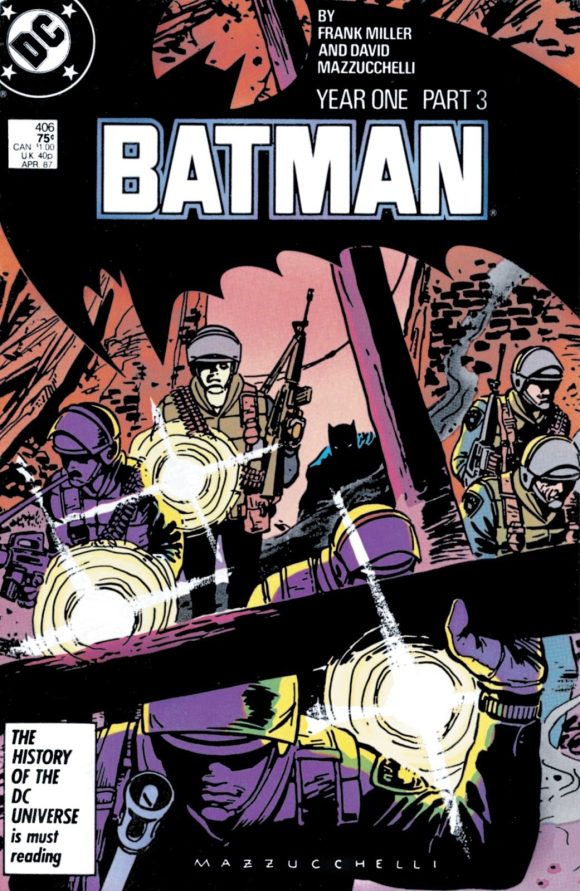
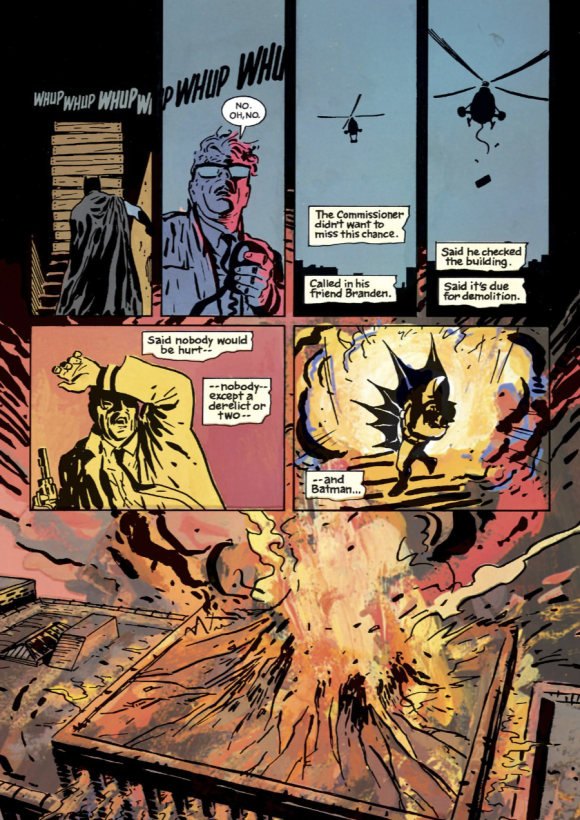
Things don’t look good for our man in tights at the beginning of Part 3: The issue opens with him trapped in the burning warehouse (flames courtesy of the Gotham PD SWAT team), with Gordon recognizing that the only reason they have him cornered is because he paused while being pursued to save the life of a homeless lady. After several pages of a tense cat-and-mouse game with the police (and the wounding of some bystanders outside by “friendly fire” from said police), Batman eventually escapes by way of a method so badass, Christopher Nolan and David Goyer shamelessly stole it for the 2005 film Batman Begins. The issue ends with the intro of another iconic Batman character when Selina, from Part 1, inspired by the Batman, dons a costume of her own.
Part 3 is even more bonkers than Part 2, and packs all of its action and developments into far less pages since the police stalking Batman through the warehouse takes up at least half the issue. Gordon finds out about Bruce’s parents’ murder, shooting young Mr. Wayne to the top of his suspect list; shortly after, we see the beginnings of an affair between Gordon and Detective Sarah Essen, his closest (obviously) associate on the Batman task force (they’ll actually marry in the early ’90s, after Gordon’s marriage falls apart).
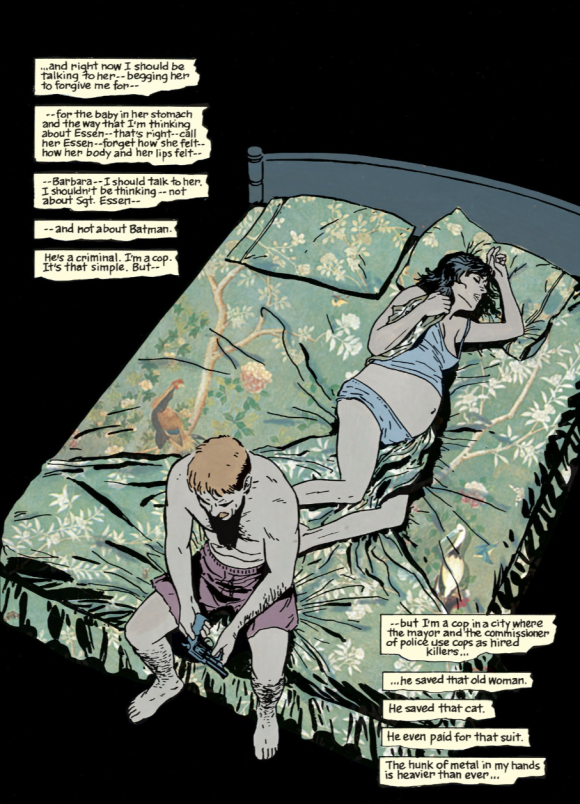
Selina’s debut as Catwoman was a welcome surprise, considering she appeared a bit later in Batman’s career in previous continuity. Her debut in this issue establishes her, post-Crisis, as Batman’s first costumed antagonist, fitting perfectly with the constant yin/yang, back-and-forth nature of their relationship. The final page perfectly epitomizes that this is as much a Jim Gordon story as it is a Batman tale: Gordon in his boxers, cradling the heft of his gun along with the weight of what he has done earlier that evening, sitting on the edge of his bed, at the feet of his extremely pregnant and obviously uncomfortable wife. You can almost feel the sweltering heat coming off the page.
—
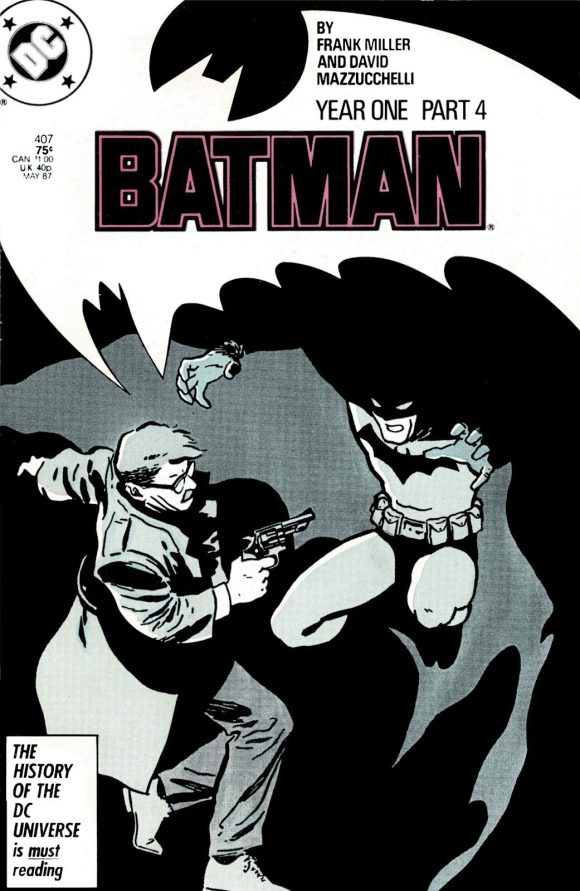
The cover of Part 4 shows Batman and Gordon face-to-face, a perfect image for the concluding chapter, in which our dual protagonists’ lives rapidly approach a collision. Gordon apprehends Jefferson Skeevers, a notorious narcotics dealer, and is hailed in the local media as a hero; he is then baffled when Assistant DA Dent, who he is certain is not on the take, does nothing to oppose Skeevers being granted bail. By a remarkable coincidence (please note the sarcasm), Skeevers is visited that very night by Batman in his apartment.
By yet another remarkable coincidence, Skeevers shows up in Gordon’s office the next morning ready to cut a deal and testify against Flass. This puts Gordon firmly in Loeb’s gunsight — and the commissioner shows Gordon pictures of him kissing Essen. After interrogating Bruce about possibly being the Batman, Gordon is forced to come clean with his wife about Sarah to remove that bullet from Loeb’s chamber. Meanwhile, a series of events, both fortunate and unfortunate: Skeevers is poisoned, yet still plans to testify against Flass (apparently more afraid of Batman than dying); Gordon’s son is born; Selina is perturbed that the Batman is getting credit in the media for her early crimes (reminds me of the Joker having the same reaction in Batman ’89) and decides she needs to up the ante, leading to their first meeting.
Ultimately, Falcone’s men kidnap Gordon’s wife and baby to force him to back off; Gordon manages to rescue Barbara, but the thugs speed off with his son. Fortunately, a lone figure on a bicycle, of all things, dives off a bridge to catch the boy before he is hurt. Gordon now fully recognizes this is the hero Gotham needs.
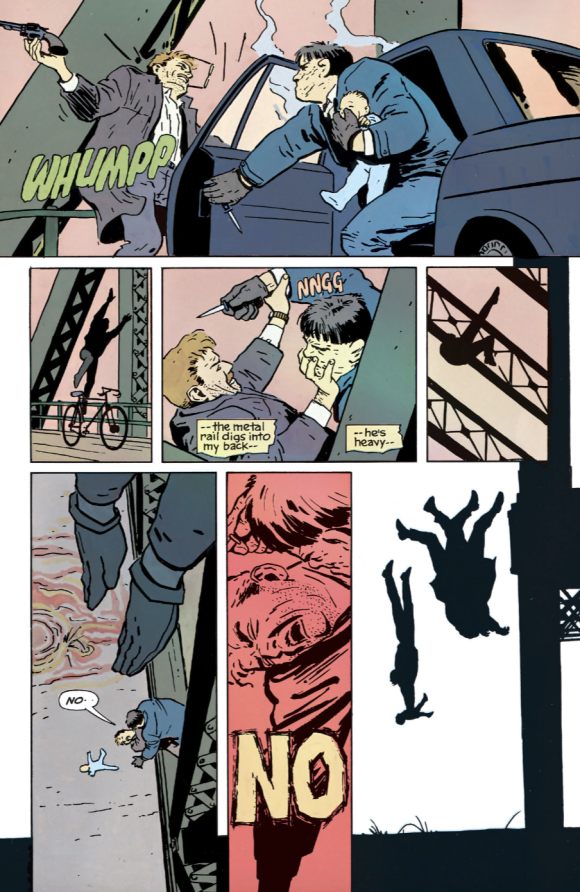
A damn great wrap-up for a damn fine story. It almost feels like I’m cheapening it to pick out highlights (the entire issue almost feels like one big highlight reel): Gordon’s break-up with Sarah (we feel her pain and know she loves this man); Dent just smiling as Gordon goes off on him for letting Skeevers get out on bail, Dent knowing that Skeevers will be getting a surprise visit; Bruce’s hysterical performance as a drunken playboy when Gordon and his wife visit him at the manor; Alfred’s brilliant line/Easter egg: “I suppose you’ll take up flying next—like that fellow in Metropolis” (that line has stuck with me for 40 years now); Dent’s smile when Gordon tells him that Skeevers is still willing to testify even after someone has tried to kill him (“Whatever he’s scared of, it’s—what’s so funny, Dent?”); Gordon standing face-to-face with Bruce, unmasked, and claiming he can’t see a thing without his glasses (another subtle hint in the ongoing debate as to whether or not Gordon knows); and the ultimate tease, when Gordon mentions someone called the Joker threatening to poison the Gotham reservoir — and that he’s waiting on a friend who may be able to help.
Yep, this was one of the greats.
***
Year One quickly became one of the most celebrated Batman tales in the character’s history. After its initial publication 40 years ago in Batman #404-407, it almost immediately went into publication as a graphic novel, with editions being released in 1988, 1989, 2005, 2007, 2012, 2014, 2015, 2016, 2017, 2022, and 2024, rivalling Watchmen for number of re-releases. In terms of continuity, despite the timeline tinkering of events such as Zero Hour and Infinite Crisis, Year One remained the canonical story of Batman’s early months in Gotham until the launch of DC’s New 52 in 2011, when it was eventually replaced by Batman: Zero Year, although elements of Year One were revived in the wake of DC Rebirth.
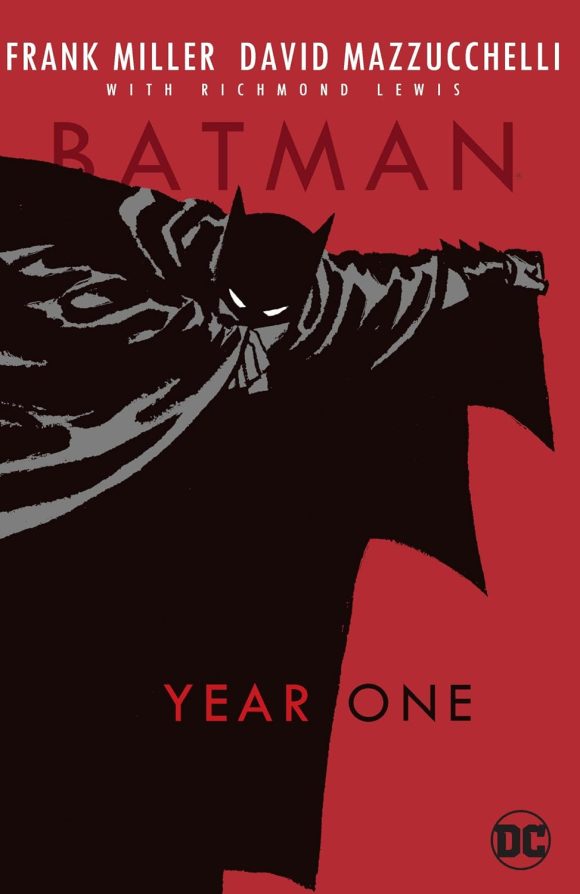
Batman was my favorite character in the 1980s; I had begun reading Batman and Detective Comics during Doug Moench’s early-’80s run, and was a little depressed when he left the titles after Batman #400, but this was just what I needed to keep me invested.
Batman’s no longer my favorite hero (that honor goes to “that fellow in Metropolis”), but Batman: Year One will forever be one of my all-time favorite stories.
—
MORE
— 13 PANELS That Capture the Brilliance of BATMAN: YEAR ONE. Click here.
— RETRO HOT PICKS! On Sale This Week — in 1986! Click here.
—
AARON HAMMONDS fell in love with comics and superheroes over 40 years ago; his passion was reignited in 2025 by James Gunn’s Superman. He resides in Pensacola, Florida, with his beautiful wife.
