
A 60th ANNIVERSARY SALUTE: The one-time second-rate Batman villain debuted in April 1966…
By CHRIS FRANKLIN
Poison Ivy first bloomed 60 years ago in Batman #181, on sale April 19, 1966, with a cover by Carmine Infantino and Murphy Anderson, a story by Robert Kanigher, and interior art by Sheldon Moldoff and Joe Giella.
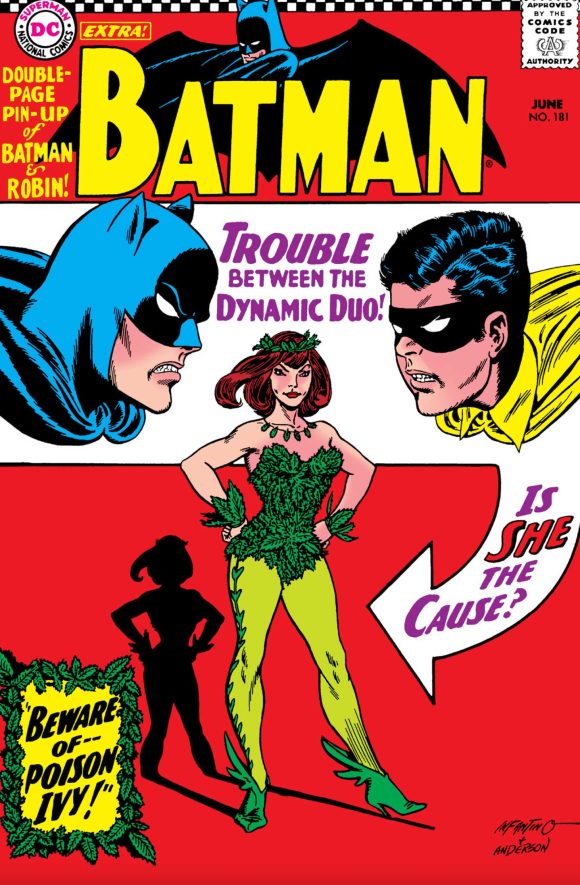
After first using her seductive, poison kiss on the Caped Crusader, she returned just two issues later in Issue #183, and then largely disappeared. She’d been created with the Batman TV show in mind — the producers wanted more female villains — but never made it on screen. (She was, however, written as Catwoman’s assistant in an early draft of the two-parter that guest-starred Lesley Gore. By the time the show aired, she’d evolved into “Pussycat.”)
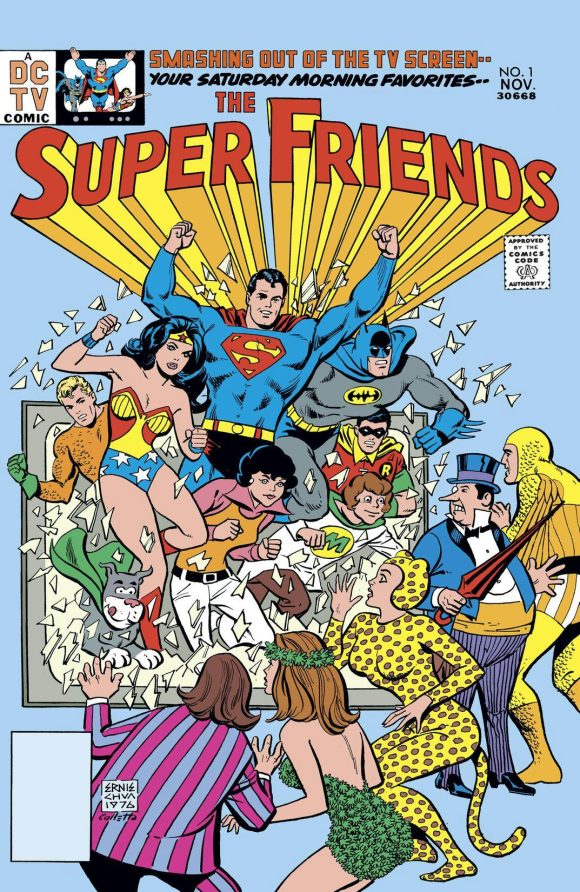
So while Ivy didn’t take root in Gotham right away, she did spread throughout the DC Universe — but not until the ’70s. Even then, she rarely made solo appearances, instead popping up on various teams of bad-guys: She appeared in Superman’s Girlfriend Lois Lane battling the Thorn, joined the Injustice Gang, the Super-Foes and the Secret Society of Super-Villains across issues of Justice League of America, Super Friends and the SSSOV’s own title. She even fought Wonder Woman in a pair of tales in World’s Finest Comics.
But other than a few appearances together with other Bat-rogues and a one-off confrontation with Batgirl and the Huntress in Batman Family, she was more of a utility villain, rather than a true foe of the Masked Manhunter.
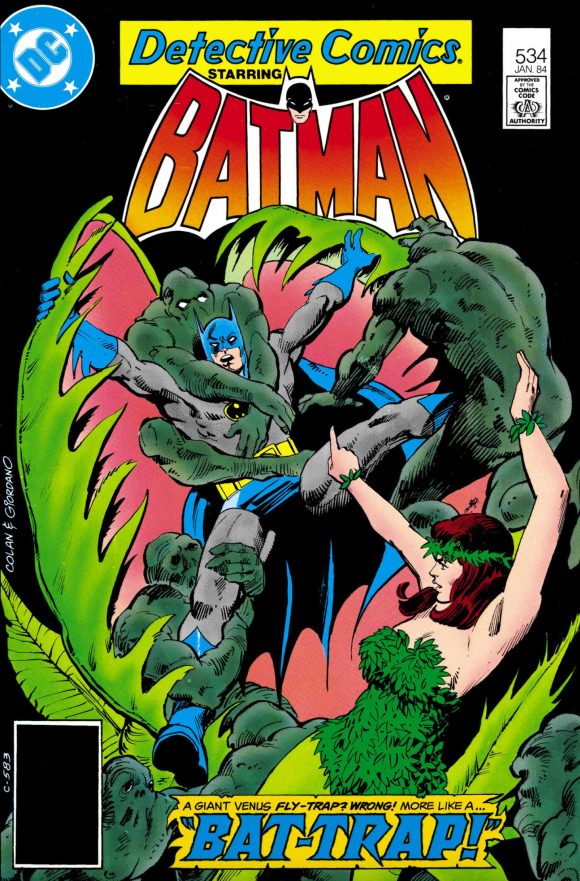
1983’s Detective Comics #534. Gene Colan pencils, Dick Giordano inks.
In the 1980s, she returned to Gotham City, even with a fair amount of hype, matching wits with Batman in his own title and Detective Comics. But then Crisis on Infinite Earths came, and in its aftermath, Ivy got a new origin — but one tied to the Atom villain and Swamp Thing supporting character Jason Woodrue. She appeared in Swamp Thing, Secret Origins, the acclaimed Black Orchid mini-series, and joined the Suicide Squad.
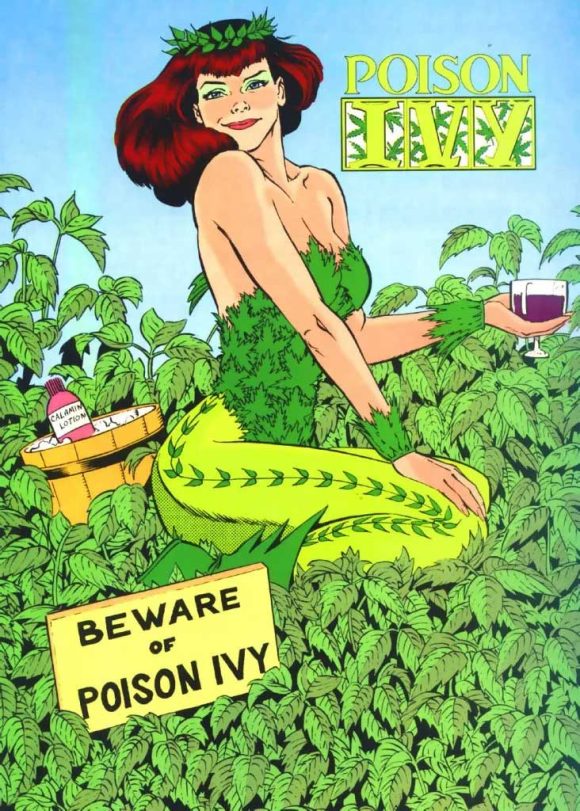
Poison Ivy page from 1990’s Who’s Who in the DC Universe #5. Pencilled by Kevin Maguire and inked by Joe Rubinstein.
So, what made her one of the definitive Batman villains who spring to mind when you get past the eternal four of Joker, Catwoman, Penguin and Riddler? Batman: The Animated Series.
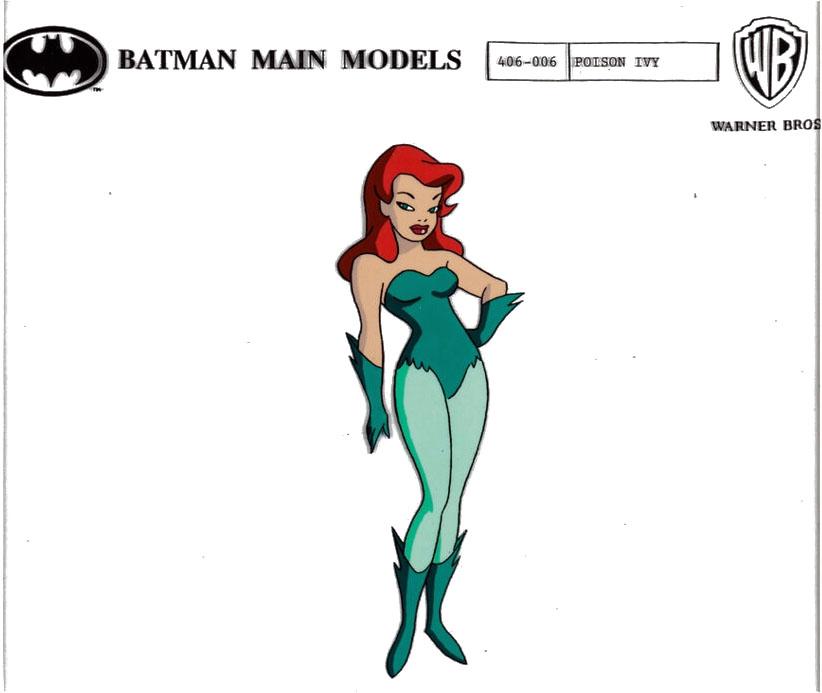
Poison Ivy model from Batman: The Animated Series, designed by Lynne Naylor
Poison Ivy’s inclusion as one of the Dark Knight’s recurring foes firmly planted her in the upper echelon of his rogues gallery. As with many lesser-developed villains, the showrunners rethought the character and conceived of a Poison Ivy who was every bit the seductress, but whose love for plants bordered on insanity, casting her as a fanatical eco-terrorist. Her environmental concerns, however, evoked sympathy despite those extremes.
BTAS co-creator and chief designer Bruce Timm struggled with creating some of the female characters and so turned to artist and animator Lynne Naylor for contributions. With Timm’s input, Naylor delivered the final Poison Ivy design, drawing inspiration from Tex Avery’s sexy red-haired heroine from his 1940s MGM cartoons like Red Hot Riding Hood, animated by Freddie Moore. The women of Will Eisner’s The Spirit and Al Capp’s Lil’ Abner were also influences on Ivy’s look.
Veteran voice actor Diane Pershing gave Pamela Isley an alluring purr of a voice, but she could switch to full-on madness at the drop of a leaf. All the while she projected herself as a powerful, independent woman who suffered no one.
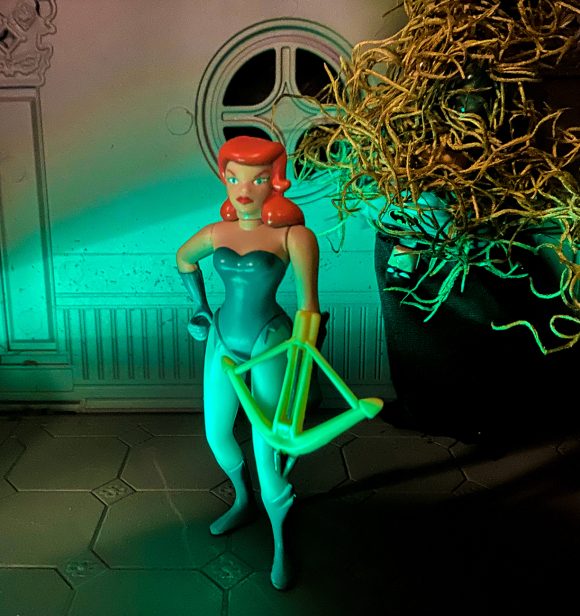
Kenner’s Poison Ivy figure from their Batman: The Animated Series toy line
Over the course of the series, its follow-ups, and her other appearances in what is now known as the DC Animated Universe (DCAU for short), Ivy met her companion Harley Quinn, got a redesign courtesy of Timm, and spread to other shows such as Static Shock, Justice League, and the web series Gotham Girls.
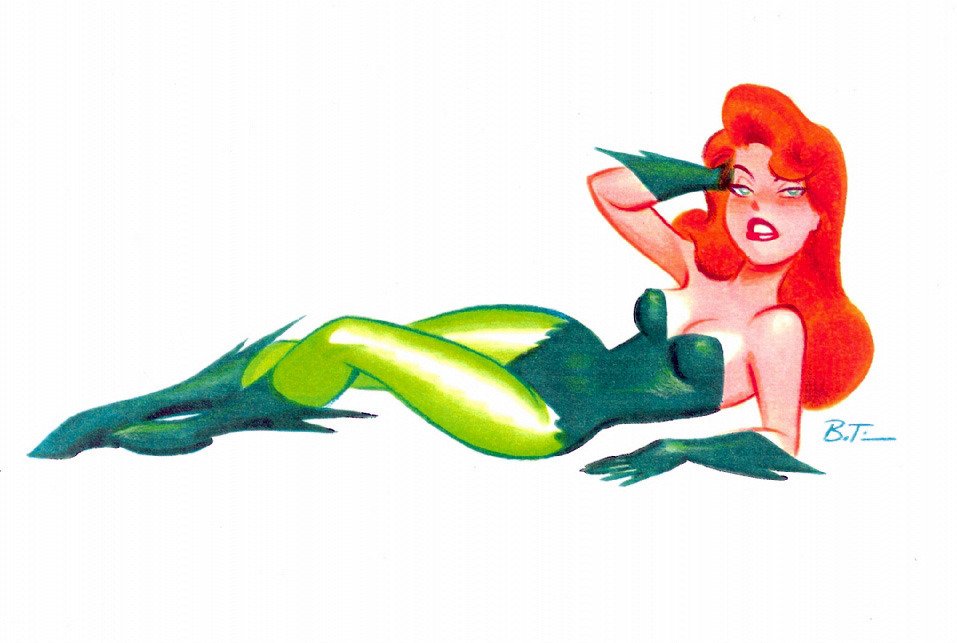
Bruce Timm
For the first time, she was heavily featured in Batman merchandise, such as Kenner’s excellent action-figure line based on BTAS. And of course, her increased popularity led to her being one of the main villains in the 1997 film Batman & Robin, played by Uma Thurman.
She has since appeared in nearly every iteration of Batman put to media and was even awarded her own ongoing comic series in 2022 — closing in on 50 issues. She has become an icon of feminism and ecology, and a character representative for the LGTBQ+ community, thanks to her romantic relationship with Harley Quinn.
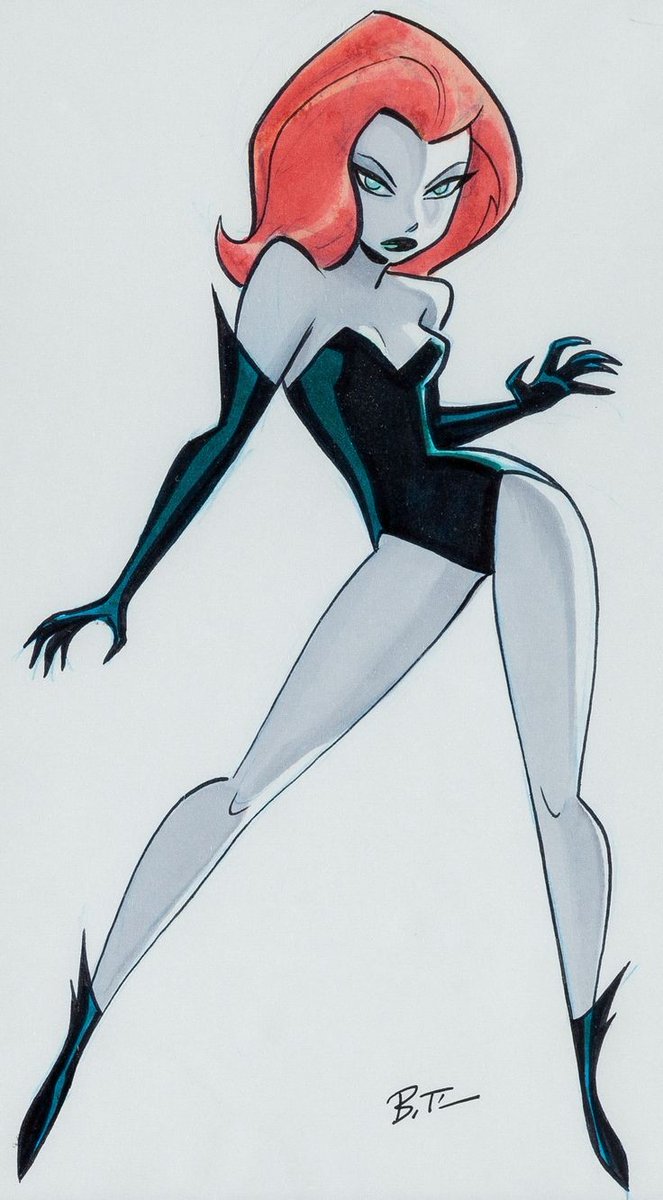
Timm, TNBA version
So, let’s take a look at the 13 animated appearances that infected, and infatuated, the world with a permanent case of Poison Ivy.
In chronological order:
—
Batman: The Animated Series — “Pretty Poison” — Original Airdate: Sept. 14, 1992
Story by Paul Dini & Michael Reeves • Teleplay by Tom Ruegger • Directed by Boyd Kirkland
When District Attorney Harvey Dent is poisoned by a plant-based toxin, Batman investigates Harvey’s girlfriend and potential fiancée, botanist Pamela Isley.
Introducing Pamela Isley first and setting up the mystery of who poisoned Harvey Dent wass a great hook for the uninitiated. Comics fans knew from the start this had to be Poison Ivy, out for revenge against Dent for championing the building of Stonegate Prison on the habitat of a rare wild rose.
Diane Pershing is wonderful as the seductive Pamela, and the truly mad Ivy, so obsessed with plants her advocacy resorts to attempted murder. When Batman kills her Venus flytrap-like monster (which Timm has stated looks vaginal) and accidentally sets fire to her greenhouse, Ivy loses it, determined to save the last remaining wild rose, at any cost. A great debut for the character.
—
Batman: The Animated Series — “Eternal Youth” — Original Airdate: Sept. 23, 1992
Written by Beth Bornstein • Directed by Kevin Altieri
Bruce Wayne is invited to an exclusive rejuvenation spa but sends Alfred and his girlfriend Maggie instead. The two stumble on a plot to punish the rich who dare to defile the Earth, led by Poison Ivy. Her plans are truly petrifying.
This episode strangely seems to build a mystery behind who is running this spa and torturing the rich for their crimes against the Earth, as if the MO and the outfit weren’t a dead giveaway. But beyond that it’s a fun spotlight episode for Alfred, who receives a girlfriend in Maggie, a character who is oddly never seen or mentioned again. When Ivy reveals to Batman that she has turned the rich attendees, including Alfred, into actual petrified trees, it’s shocking and disturbing.
—
Batman: The Animated Series — “Almost Got ‘Im” — Original Airdate: Nov. 10, 1992
Written by Paul Dini • Directed by Eric Radomski
Five of Batman’s rogues gather to play poker and swap stories about their near victories against the Dark Knight. But the Joker has an ace up his sleeve, and Batman has a big surprise for all of them.
One of the best episodes of a series that has no shortage of excellent installments, “Almost Got ‘Im” is the first and best villain team-up episode, with an all-star cast. Ivy enters the game late, and the exchange between her and her ex-beau Two-Face is hilarious.
Ivy’s tale of almost beating Batman takes place at Halloween, and we see in the flashback she’s strangely dressed in a dark green one-piece bathing suit, with no gloves, boots or leggings. This has always puzzled me. Either way, it’s a fun vignette like the rest of the villain’s stories are. The twists at the end are surprising on first viewing, and equally exciting on repeat watches.
—
Batman: The Animated Series — “Joker’s Wild” — Original Airdate: Nov. 19, 1992
Written by Paul Dini • Directed by Boyd Kirkland
When a billionaire opens an unsanctioned Joker-themed casino, the Clown Prince of Crime breaks out of Arkham Asylum and plans to destroy it.
This is of course a Joker episode, but Poison Ivy has a significant cameo at the beginning and the end. She’s watching a show on plants when Joker walks into the Arkham rec room and changes the channel. The two squabble, with Joker eventually seeing the news broadcast of the infringing casino’s opening. The banter between Mark Hamill and Pershing is fun, and establishes that these two really dislike each other. That animosity will only grow in future episodes.
—
Batman: The Animated Series — “Harley and Ivy” — Original Airdate: Jan. 18, 1994
Written by Paul Dini • Directed by Boyd Kirkland
When Joker throws Harley Quinn out, she teams up with Poison Ivy for a mad crime spree that gets the Crime Clown’s attention… as well as Batman’s.
A seminal episode for the series, and for the characters of both Poison Ivy and BTAS’ breakout creation Harley Quinn. After they meet in separate robberies at the same museum, the two become a super-criminal Thelma and Louise in a hilarious romp of a story. Ivy empowers Harley to forget her abusive paramour, the Joker, and she almost succeeds, but Harley isn’t quite ready to drop her “Puddin’.”
The two would team-up several more times in the DCAU, and, in other media, become a romantic couple, such as on the Harley Quinn animated series.
—
Batman: The Animated Series — “House and Garden” — Original Airdate: May 3, 1994
Written by Paul Dini • Directed by Boyd Kirkland
When young, wealthy bachelors are robbed and poisoned, Batman suspects Poison Ivy, only to find she has settled down and is living with a husband and his two sons in suburbia. But when Dick Grayson is kidnapped, the Masked Manhunter begins to wonder if Ivy’s perfect life may hide some dark secrets.
Probably the most horrific episode of BTAS, “House and Garden” pushed the boundaries of the Broadcast Standards and Practices offices at Fox Kids, where the series original aired. The reveal of the true nature of Ivy’s idyllic family is just as shocking upon repeat viewings, and no less chilling. But like Batman, by episode’s end the viewer is left feeling for Ivy, and her legitimate desire to have a family to love, despite her psychotic actions. This is due in large part to Pershing’s moving performance.
—
Batman: The Animated Series — “Trial” — Original Airdate: May 16, 1994
Story by Paul Dini and Bruce W. Timm • Teleplay by Paul Dini • Directed by Dan Riba
Gotham’s new crusading district attorney, Janet Van Dorn, believes Batman created the villains he battles. But when both she and the Dark Knight are kidnapped by the inmates of Arkham Asylum, she’s forced to defend him against the very same charge.
This is another villain team-up episode, and a great one at that. Originally conceived as a possible story for the film that became Batman: Mask of the Phantasm, “Trial” begins with Pamela Isley before the judge, sentenced once more to Arkham.
She and Harley Quinn are the ones who capture Batman, with Ivy disguised as the Lady Justice statue in front of Gotham’s courthouse. When Van Dorn cross-examines Ivy, she proves Batman isn’t the basis of her psychosis by destroying a flower in front of her, causing Ivy to assault her in the kangaroo courtroom.
—
The New Batman Adventures — “Holiday Knights” — Original Airdate: Sept. 13, 1997
Written by Paul Dini • Directed by Dan Riba
The series premiere of The New Batman Adventures, the revamped version of BTAS, after it moved from Fox Kids to Kids WB. The episode features three holiday vignettes starring Batman and his rogues, based on the comic Batman Adventures: Holiday Special #1.
Harley and Ivy kick off the episode by drugging and kidnapping Bruce Wayne, taking him on a mad holiday shopping spree. The montage of the ladies trying on new clothes and products is hilarious, as is Harley’s desire for a Christmas tree, much to Ivy’s ire.
Timm redesigned nearly all the characters in a more streamlined style, partially for a visual refresh, as well as to aid overseas animation studios in sticking closer to the model sheets. Ivy now seems even smaller and more nymph-like than before, with dead white skin and dark green bodice, gloves and boots.
—
The New Batman Adventures — “Joker’s Millions” — Original Airdate: Feb. 21, 1998
Written by Paul Dini • Directed by Dan Riba
A cash-strapped Joker goes legit when he inherits the fortune of a deceased rival gangster. Although Joker really does try to go straight, he soon learns his good fortune is a cruel joke from beyond the grave. Based on the story from Detective Comics #180 (Feb. 1952) by David Vern and Dick Sprang.
This is another Joker episode with an Ivy cameo, and it’s a very small one. Joker leaves Harley holding the bag from a robbery at the beginning of the episode. In Arkham, she’s happy to see he has his newfound fortune, until Ivy calls her pathetic, and points out that he’s holding auditions for a new henchgirl. This of course sets Harley off on a quest for revenge, which she gets by episode’s end.
—
The New Batman Adventures — “Girls’ Night Out” — Original Airdate: Oct. 17, 1998
Written by Hilary J. Bader • Directed by Curt Geda
While Batman is out of town, Superman’s foe Livewire comes to Gotham. The Dark Knight sends a message to the Man of Steel, but Supergirl answers instead, and she and Batgirl team up to stop Livewire, and her new partners in crime, Harley and Ivy.
This fun episode is a great showcase for the female characters and begins the Batgirl/Supergirl friendship in the DCAU. Livewire was created for Superman: The Animated Series, no doubt in the hopes of replicating the success of Harley Quinn. While she never caught on like her predecessor, she has managed to stick around in Superman canon.
Ivy and Livewire hit it off, but the latter has no time for the goofy Harley, making for some humorous tension. Ivy’s live topiary animals are a great visual treat and cause quite a bit of trouble for the distaff World’s Finest duo.
—
The New Batman Adventures — “Chemistry” — Original Airdate: Oct. 24, 1998
Written by Stan Berkowitz • Directed by Butch Lukic
Bruce Wayne takes a bride! After only a few weeks of courtship, Bruce marries his new love Susan and abandons his Batman identity. But Susan and other new heirs to Gotham’s elite have something in common: a startling connection to Poison Ivy.
This is Poison Ivy’s last solo showcase in the DCAU, and it’s a good one, continuing with some of her horrific creations as seen in “House and Garden.” Bruce is initially captivated by Susan due to Ivy’s patented pheromones, but the whirlwind romance and Bruce’s willingness to give up Batman have always seemed too rushed to me. Ivy seemingly perishes in the sinking of a chartered cruise ship, but she does resurface in other DCAU entries.
—
Static Shock — “Hard as Nails” — Original Airdate: Jan. 25, 2003
Written by Paul Dini • Directed by Rich Collado, Fred Miller, and Swinton O. Scott III
Static’s friend Ally seeks help with her burgeoning superpowers in Gotham City, but she’s shocked to find her patrons are Poison Ivy and Harley Quinn. They coerce Ally, now called Nails, to help them in their criminal pursuits in exchange for a cure. Static teams up with Batman to save his friend and stop the green and red duo.
This is the second crossover appearance Batman made on the Static Shock animated series, based on the Milestone comic. Like many of the other episodes on this list, it’s written by animated maestro Paul Dini, so everyone is in character, other than maybe the strange bit where Bruce Wayne reveals his secret identity to Static at episode’s end.
Harley and Ivy seem seedier (pun intended) than usual, playing the role of predators who lure and entrap a confused minor via the internet. And they have no compunctions about disposing of her once she’s fulfilled their needs.
—
Justice League — “A Better World, Part 2” — Original Airdate: Nov. 1, 2003
Written by Stan Berkowitz • Directed by Dan Riba
The Justice League is trapped on a parallel world, where their doppelgangers, the Justice Lords, are fascist rulers.
In the second part of perhaps the best arc in the Justice League series run, the Leaguers visit this other world’s strangely bucolic Arkham Asylum to rescue the injured Hawkgirl. Flash picks a rose from the garden, despite signs telling him not to do so. When he finds out the gardener is none other than Poison Ivy, he fears the worst. But Ivy says that sort of thing doesn’t bother her anymore. In fact, nothing does.
Flash then notices the two holes in her forehead — remnants of the lobotomy Justice Lord Superman performed with his heat vision. She’s suffered the same haunting fate as many of Batman’s foes, including the Joker, Two-Face, and the Ventriloquist and Scarface, an indicator of the Justice Lords’ disregard for free will.
—
MORE
— INSIDE LOOK: The BATMAN #181 Facsimile Edition. Click here.
— ‘LIKE A KISS YOU CAN’T RESIST’: You Don’t Need Mistletoe When POISON IVY Is Around. Click here.
—
13th Dimension contributor CHRIS FRANKLIN is a graphic designer, illustrator, writer, and podcaster, who co-hosts and produces several shows on the Fire and Water Podcast Network, including Superman Movie Minute. Check out his illustrative and design work at chrisfranklincreative.com.

October 4, 2026
“With exploding pumpkins…”
Ironically, Mark would voice the Hobgoblin on one of the Spider-Man cartoons just a few years later.