
EXCLUSIVE: From the new Marvel Masterworks: Super-Villain Team-Up, Vol. 1…
Marvel Masterworks, the beloved line of high-end reprint collections, is finally back — officially.
MMW, as it’s fondly known, was halted by the House of Ideas a while back but now Clover Press has taken the reins and is continuing the series in the same format, funding the line through Kickstarter — which has finally gone live today.
So, now, for the first time. you’ll be able to get your hands on Marvel Masterworks: Super-Villain Team-Up, Vol. 1; Marvel Masterworks: The Uncanny X-Men, Vol. 18; Marvel Masterworks: The Mighty Thor, Vol. 25; and Marvel Masterworks: The Tomb of Dracula, Vol. 6,
Head on over here for all the ordering info, but below we present an EXCLUSIVE EXCERPT — Roy Thomas’ introduction to Marvel Masterworks: Super-Villain Team-Up, Vol. 1, in which he reveals the complete history of the Bronze Age cult-favorite series.
Dig this.
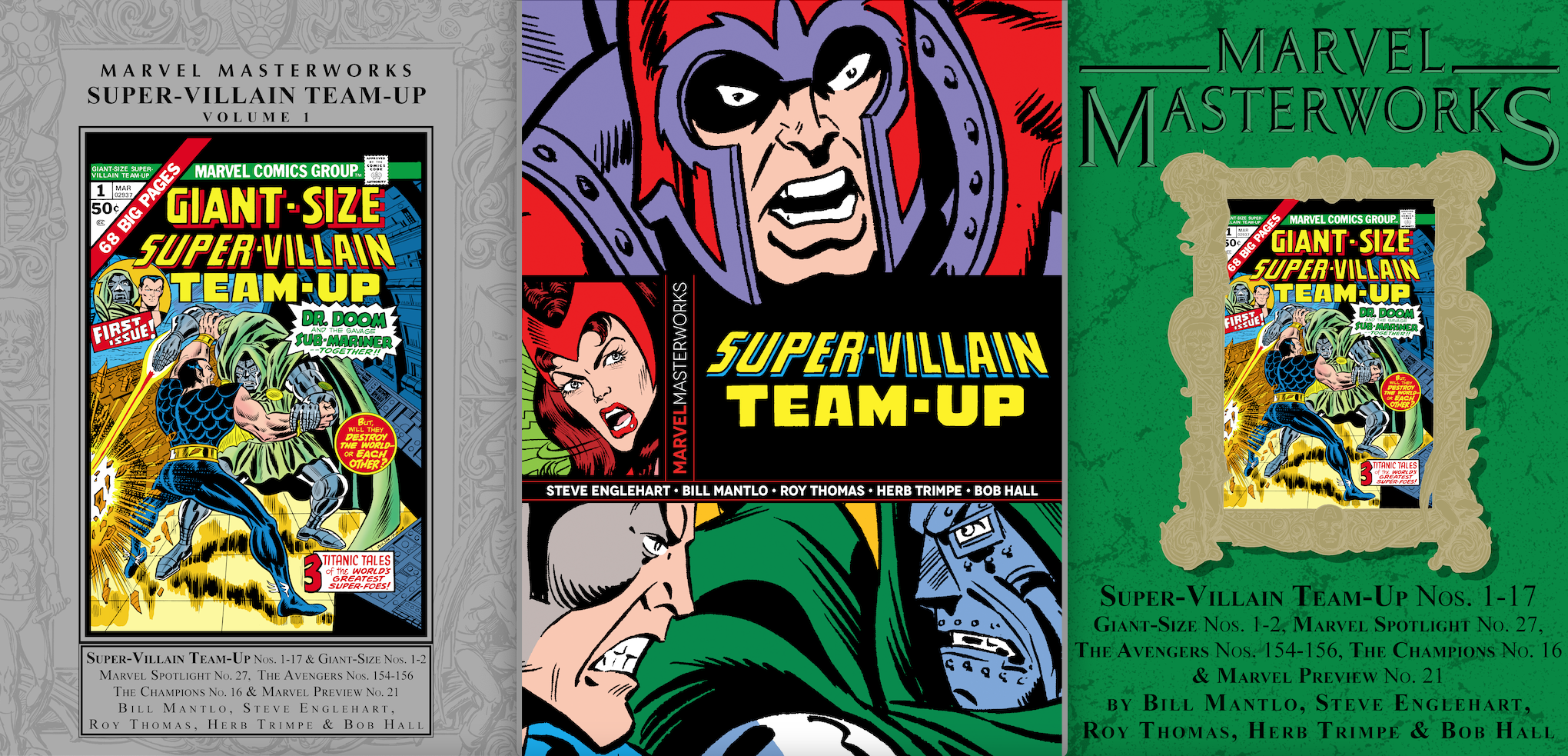
The three available covers for Marvel Masterworks: Super-Villain Team-Up, Vol. 1
By ROY THOMAS
Super-Villain Team-Up was my idea? And here I was thinking it was Stan’s!
However, a glance at my gabby little editorial piece, reprinted on Page 52 of this volume, reminded me of what I wrote back in the waning days of 1974 — and I assume my memory of that comic’s origins was far sharper then than it is now, a half-century plus later.
I shouldn’t be surprised. Like most people, I remember some ancient actions of mine (like coining the word “adamantium” or selling Marvel neo-publisher Stan Lee on the name and notion of The Invaders) as clearly as if they’d happened yesterday—while other events might as well have happened on the dark side of the moon, and during an eclipse, at that!
Still, I’ve no reason to doubt that, as I say on that text page, it was the accidental juxtaposition of reprint-bound pinups of the Sub-Mariner and Doctor Doom that suddenly made me conceive of a “super-villain team-up” mag as one answer to publisher Stan’s recent request for me, as his editor- in-chief, to dream up a few new, and hopefully salesworthy, titles.
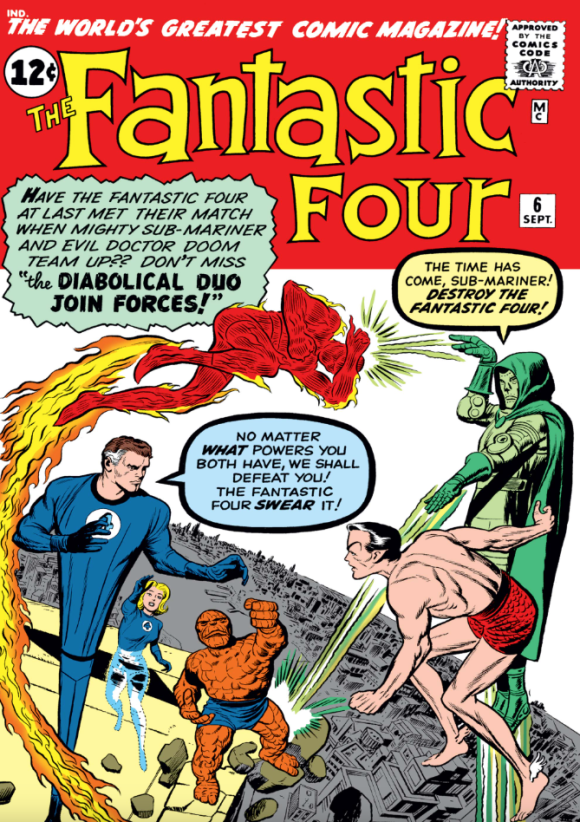
The love/hate relationship of Prince Namor and Victor von Doom was a natural, of course. I could still recall how, after Subby had returned to comics (temporarily as at least a quasi-villain) in Fantastic Four #4 and Doom had made his diabolical debut the very next issue, then FF #6 immediately had that imperious pair gang up on Reed Richards and company. They’d been Silver Age Marvel’s very first pairing of bad guys against the heroes—and what had been a good idea in 1962 was still a good one a dozen years later.
While he loved the idea from the get-go, Stan delayed starting up the new comic until, not long afterward, he launched a number of extra-thick titles. When he did, of course, he faithfully adhered to the long-established Marvel tradition that nearly every new comic, on the day it was scheduled, was already a month late!
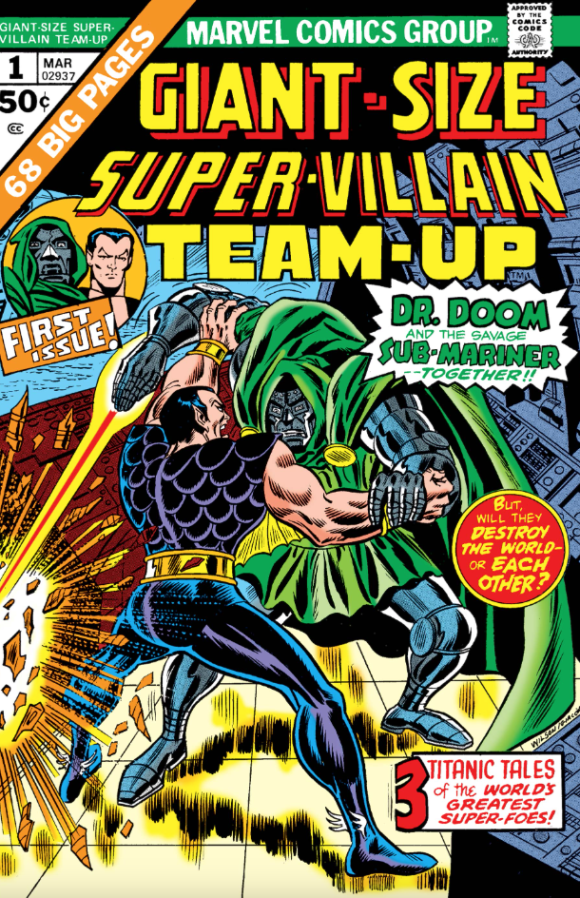
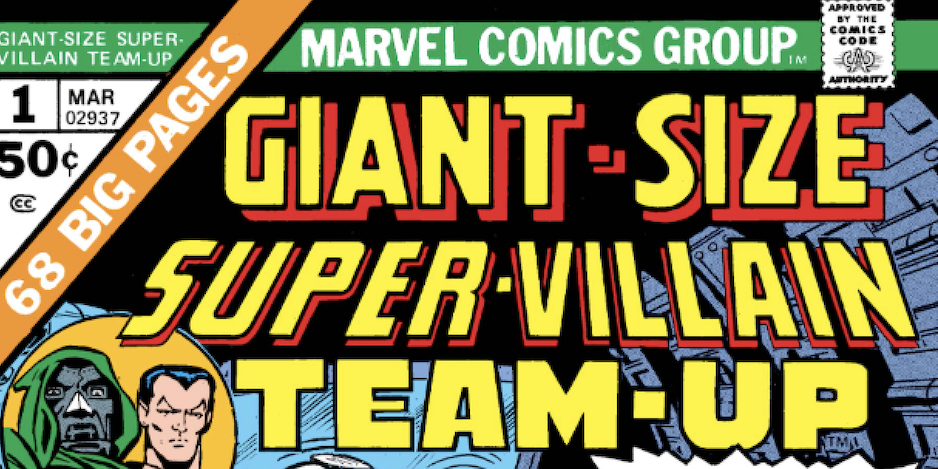
Thus, 41 of Giant-Size Super-Villain Team-Up #1’s 51 pages were reprints (half from an earlier Subby-Doom battle I’d written, the rest from a Doctor Doom solo outing whose scripting Larry Lieber and I had divided as a matter of necessity). I was lucky that artistic ace John Buscema was available to pencil the 10 new pages of the 64-page quarterly—since I was the guy Stan wanted to scribe that material.
I was on hand for GSSVTU #2 as well, with its 32-page original-material lead story (and an Amazing Spider-Man #8 reprint to fill out the book)—but alas, Big John wasn’t. Behind an action-packed Gil Kane cover, the interior penciling fell this time to a relatively recent migrant to Marvel: Mike Sekowsky, a 1940s-’50s alumnus of Timely/Atlas who later pioneered DC’s Justice League of America. Over the decades, his drawing style had mutated in directions a bit afield from the brand of Marvel mayhem provided by Buscema, Kirby, Romita, et al.; but he was a good storyteller, and inker Sam Grainger provided a Joe Sinnott-influenced slickness.
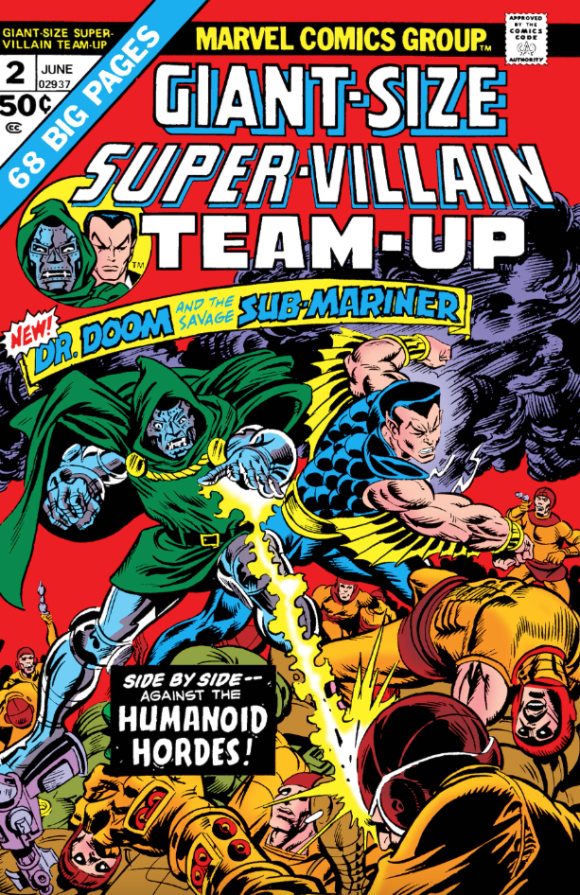
To keep things tied into Doctor Doom continuity, I brought in as the issue’s major super-villain (maybe I should say “third major super-villain”) an upgraded version of the Doomsman android earlier introduced by artist/plotter Wally Wood, Larry, and myself in Astonishing Tales #1-4.
That I enjoyed scripting that story is apparent to me when I read the dialogue between a couple of supertanker sailors in its opening pages, or the back-and-forth between Namor and Doom. Still, I decided to leave after that one full-length effort.
Now that I was no longer editor-in-chief, I wanted to divorce myself from Marvel continuity for a while—and a magazine co-starring Namor and Doc Doom would’ve required cross-checking things with the then-current FF writer. So, the new title wound up being scripted by the up-and-coming Tony Isabella, who was eager to make a name in the wacky world of comic books. Each of what was intended to be Giant-Size Super-Villain Team-Up #3’s chapters were penciled by a different George— Tuska and Evans, in that order. (Bill Everett, who had passed away in 1973, is listed as co-penciler; apparently, the story utilized a bit of artwork from the Namor creator’s last Sub-Mariner job.)
I frankly don’t recall if Stan and I ever intended that Namor and Doom would continue forever as the series’ dueling co-stars. Most likely, we’d elected to start out with that pair and see how it went. If more bad guys were needed to spell our original headliners down the line—no problem.
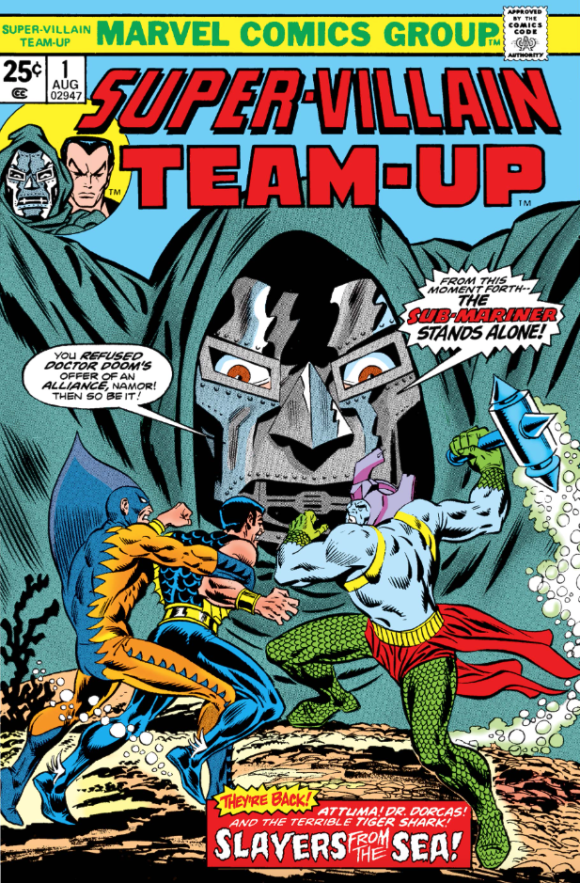
At this point, though, Stan decided 64-page “Giant-Size” comics weren’t the way to go, so the series dropped back to 32 pages, with a shorter title—Super-Villain Team-Up—which gave Marvel an excuse to make Tony and the Georges’ story a new #1.
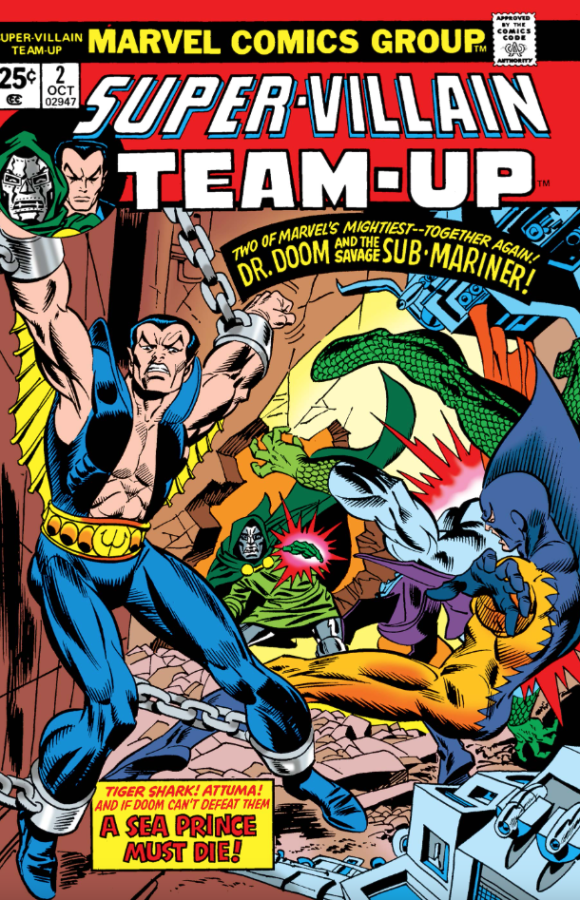
With SVTU #2, Sal Buscema stepped in as penciler. That made five interior pencilers in four issues (not counting reprint material in the initial Giant-Size outing). Playing musical chairs with writers and/or artists rarely bodes well for a title. Thankfully, Tony stuck around to provide some continuity. I feel a bit of sadness perusing this tale, since Namor’s 1940s-’50s ladyfriend Betty Dean (whom I’d turned into a widow, last name Prentiss, back in ’68) breathes her last in it. (At least, she’s dead if no writer in desperate need of a plot hasn’t resuscitated her since then!)
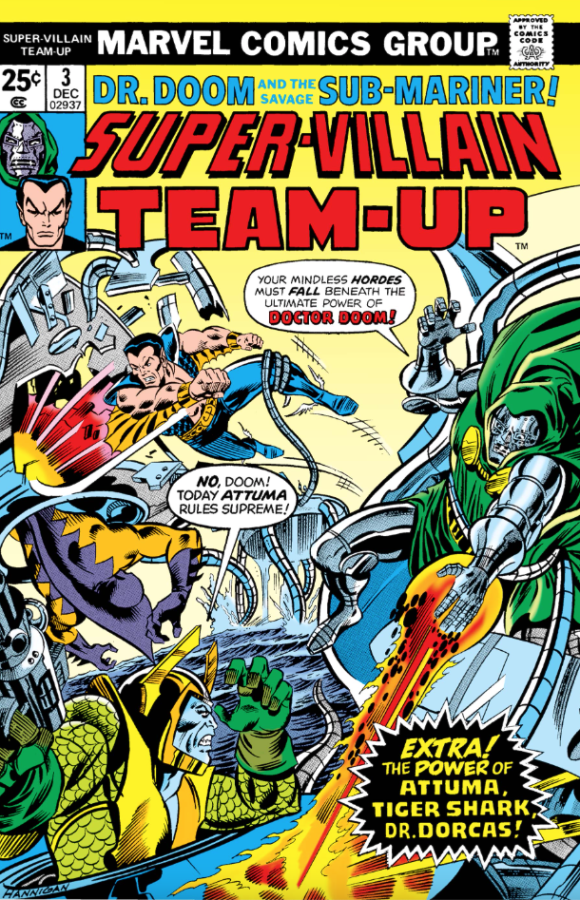
The third issue of the 32-page series hailed a third scripter in five issues—none other than Jim Shooter, who a couple of years later would become Marvel’s editor-in-chief. Jim had cut his eyeteeth at DC on features like Legion of Super-Heroes, so he was certainly up to the task of handling a series with two lead villains plus a bunch of good and bad guys they had to fight. Still, I’m sorry he killed off Saru-San, the Atlantean court fool John Buscema and I had co-created when we were handling the Sub-Mariner title. (Oh well, maybe he got revived later.) George Evans was back as penciler this time…
…But with #4, the mighty Marvel musical chairs rocked again—and wound up with Bill Mantlo as writer and Incredible Hulk veteran Herb Trimpe penciling. This one was mostly a slugfest between Namor and Doom. It was a fairly good one, but by now I suspect readers wanted a bit more variety out of the series. The two lead villains—one of whom was actually more hero than villain—needed some opposition star power, and they’d soon get it…
…Following an issue of Marvel Spotlight (#27) that featured the Sub-Mariner, whose own title had been canceled two years earlier. Handled by the team of Mantlo and Jim Mooney, it served as a set-up for SVTU #5. However, when the latter hit the stands, it boasted a new writer… the fifth in seven issues.
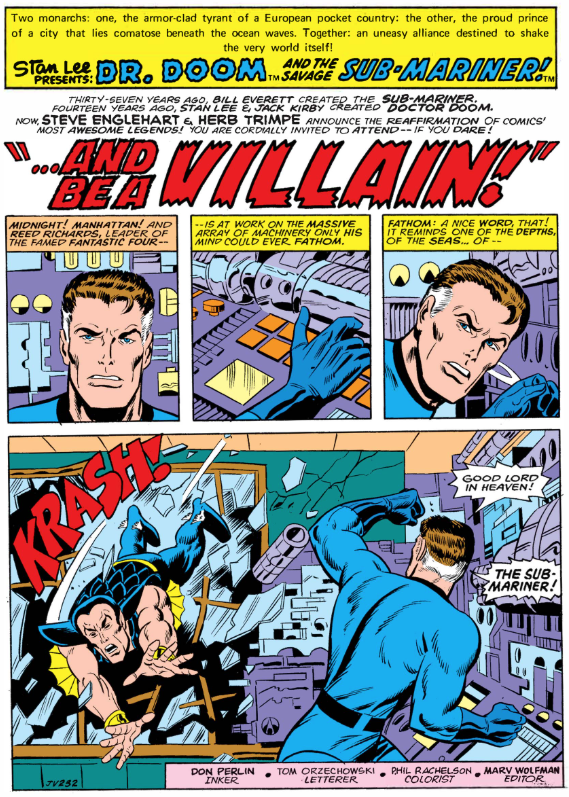
Steve Englehart heralded his own arrival (and his teaming with Happy Herbie) on SVTU #5’s splash page, “announc[ing] the reaffirmation of comics’ most awesome legends!” And, truth to tell, Steve’s tenure as scripter would be the longest on the title so far.
Right away, he brought in more of Marvel’s big guns—and introduced a brand-new character destined to make a splash. The FF dropped in to battle Doom to save Namor’s life—while a dark- clad character called the Shroud made his dramatic debut. Whether he would be hero, antihero, or another super-villain remained to be seen. Also in that issue, Steve ditched the costume that I’d had John Romita design for Namor three years earlier, restoring to him the scaly swimming trunks. Myself, I preferred the costume, but that was his and his editor’s decision now. In any kind of garb, the Sub-Mariner was one of the great comic book heroes of all time.
The FF’s involvement carried over into #6, as Namor (under Doom’s command, naturally) battled Marvel’s flagship quartet… while “the mysterious Shroud” was given a special shout-out on the cover. Just for good measure, the cover also announced “the most unexpected guest star of all!” And come on, admit it—you didn’t expect U.S. Secretary of State Henry Kissinger to suddenly join the cast of Super-Villain Team-Up for a couple of issues!
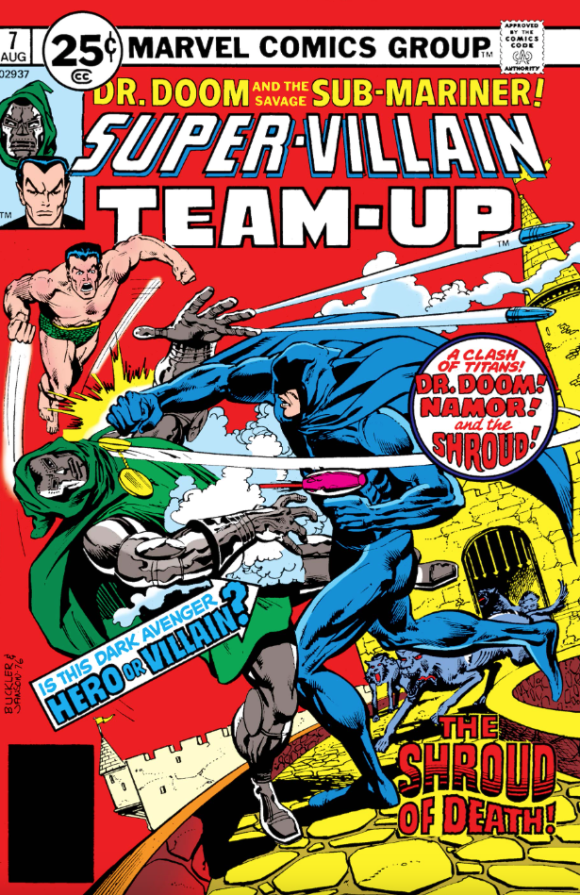
Issue #7 spotlighted Doctor Doom in battle with the Shroud, who was certainly getting his place in the sun — or perhaps we should say, in the shade. This time, he was even given an origin.
SVTU #8 reintroduced two of the supporting cast from the later issues of Sub-Mariner, his nimble niece Namorita and the crimson-hued Tamara of the Sisterhood. That pair had become joint rulers of Atlantis since Namor had gotten involved with Doom, and now insisted the master of Latveria set their prince free. Naturally, Victor had other ideas, and the stage was set for a physical disagreement.
After Herb Trimpe’s run, #8 introduced a new penciler, Keith Giffen, then near the start of his own storied career. He proved daring from the outset, not afraid to use multiple panels (and figures) on any given page. And, just to make a true circus out of things, Steve and Keith brought the Ringmaster and his Circus of Crime to town.
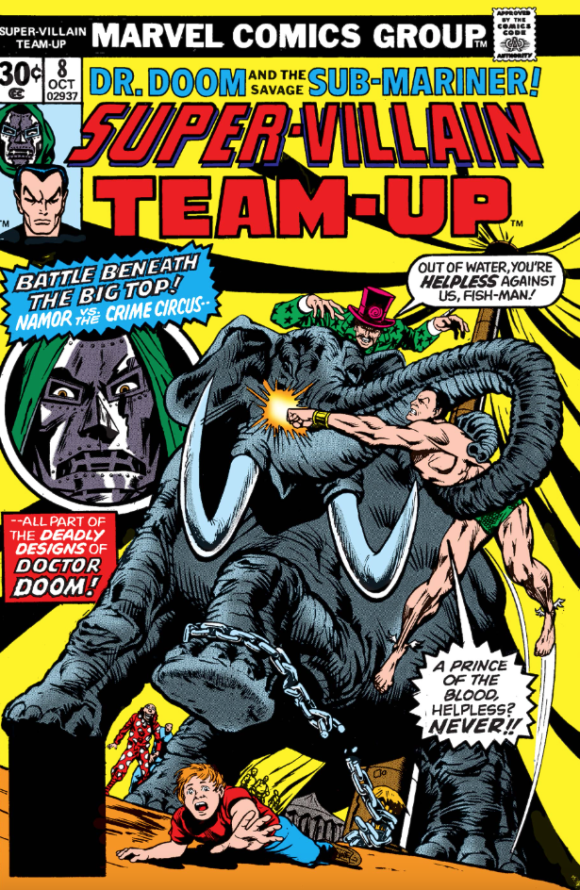
At this point, number of crucial events occurred. One was that Super-Villain Team-Up started playing story-arc hopscotch with none other than The Avengers; another was that Steve Englehart left both those comics, and Marvel itself. In the tumult, Gerry Conway briefly became Marvel’s editor-in-chief and The Avengers wordsmith. All this as the SVTU storyline bounced back and forth between the two mags!
The crossover began with The Avengers #154, which served to get the assemblers involved with Sub-Mariner’s arch-foe Attuma — followed by SVTU #9, which wound up being scripted by a returning Bill Mantlo, and penciled, surprisingly, by Jim Shooter. Does all that make your head spin? Never mind. The main point is that the story bounced between those two titles, and then things returned to normal—or at least as close as Super-Villain Team-Up ever got.
New SVTU writer Mantlo, though, would begin to vary the formula that had kept Namor and Doom as the main super-villains of the title. Working with new penciler Bob Hall, he introduced none other than the Red Skull into the mix— and nobody ever deserved the cognomen of “super-villain” more than Captain America’s decades-long nemesis. Matter of fact, Cap himself stuck around in SVTU #10 just to help heat things up to fever-pitch. Oh, and the Shroud made a darkly triumphant return, too.
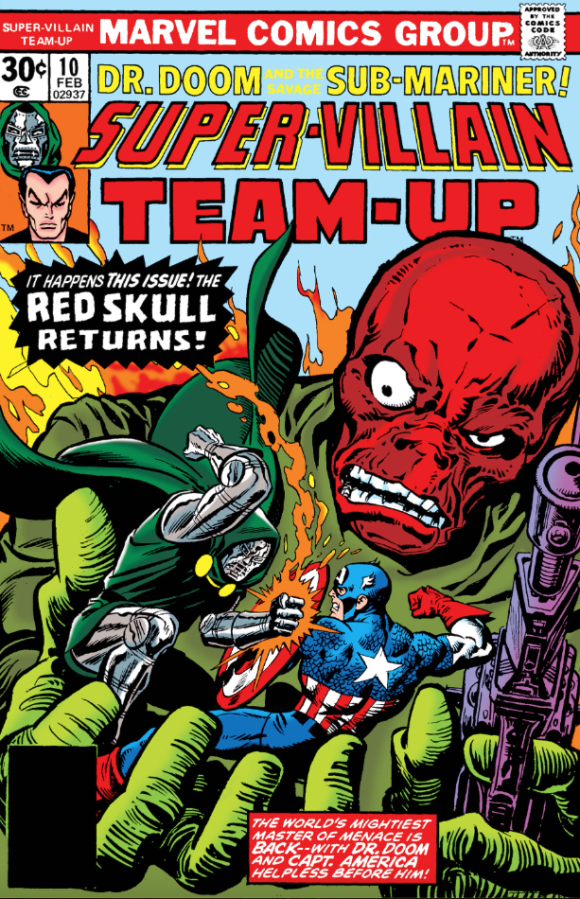
It all worked out fairly well… at least for a few more issues. But the sands of time were running out for Super-Villain Team-Up.
The new cover heading above the mag’s title for Issues #11 and #12 now read “Doctor Doom and the sinister Red Skull”—even if Sub-Mariner, Captain America and the Shroud were all on-site as well. But, over the next few months, even as Doom and the Skull fought it out on the moon, no less—while another Namor enemy, the warlord Krang, joined the fray—Marvel pulled the plug on Super-Villain Team-Up. Maybe all the musical chairs had finally caught up with it.
In its final issue, #14, Mantlo and Hall pulled out all the stops. The topline now read “Doctor Doom and Magneto!”—but the malignant mutant wasn’t depicted on the cover, which pictured the Avengers and the relatively new group the Champions bowing down to Doom. Inside, it was wall- to-wall action, as you can imagine.
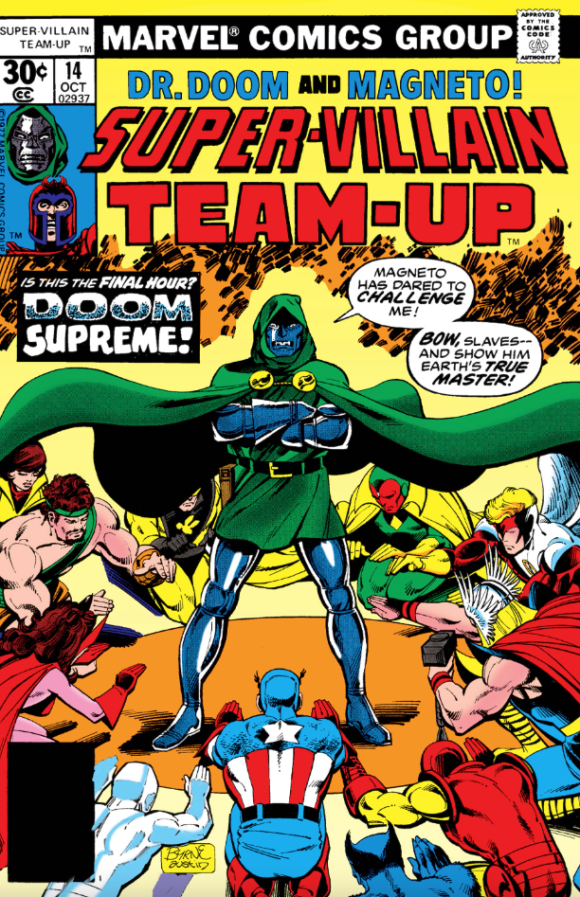
And then it was all over but the shouting for Super-Villain Team-Up. Fortunately, the Champions’ own mag was around long enough to allow the Doom-Magneto-Avengers-Champions storyline to be wound up in its 16th (and, as it happened, penultimate) issue, again under Mantlo and Hall.
As for SVTU, it turned out that its death, like those of so many deceased heroes and villains in the wonderful world of comics, wasn’t quite as final as might have been suspected. Marvel wanted to keep it alive, after a fashion—reportedly to protect its joint trademark with DC on the term “super- villain.” So SVTU rose from the dead a year later, still following the original numbering system!
1978’s Super-Villain Team-Up #15 was all-reprint inside, so we’ve settled for just re-presenting the exciting new cover by George Pérez and Joe Sinnott. In 1979, though, writer Peter Gillis and penciler Carmine Infantino served up a truly unexpected repast in #16, which this time co-starred Doctor Doom with none other than the Hate-Monger, who had made his first (and memorable) appearance in 1963’s Fantastic Four #21.
There, as all true Marvel aficionados know, it was left unresolved at the end whether the deceased Hate-Monger was indeed Adolf Hitler or “one of his many doubles.” This time around, however, the story seemed to leave little doubt. It was a strong entry in the series… but still, merely a lead-in to the next year’s payoff.
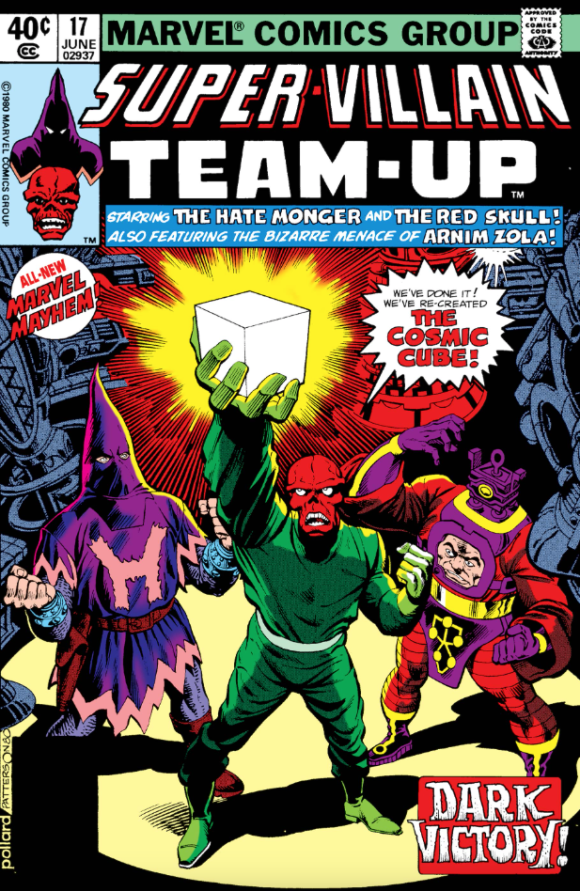
SVTU #17 (1980), again written by Gillis, this time with Arvell Jones penciling, was stuffed with enough classic Marvel names and concepts to fill a comic book-lover’s cornucopia. Let’s see — there’s MODOK… the Overkill Horn… adamantium (always glad to see my own addition to the periodic table pop up!)… AIM… Arnim Zola… and the Cosmic Cube. The final fate of the Hate-Monger was chillingly effective… and made a fitting conclusion to Super-Villain Team-Up.
It had a nice run, and gave a number of artists and writers plenty of opportunity to strut their stuff.
But wait—there’s more! Because occasionally there’s a Marvel gem that doesn’t fit automatically into any particular Marvel Masterworks volume — although, in this case, maybe this one does: a solo story of the Shroud. Written by the team of Mark Gruenwald and Steven Grant and drawn by Spider-Man co-creator Steve Ditko, it comes from the pages of the black-and-white magazine Marvel Preview #21, dated Spring 1980. It’s a first-class story, introducing a villain perfect for Ditko to draw: the Crooked Man. Assuming you count the oft-ambiguous Shroud as a bad guy, it works nicely as a coda to a collection of Super-Villain Team-Up.
One of these fine days, Super-Villain Team-Up has to make a 21st-century comeback. In this day and age, it’s just too perfect a title — and, may I immodestly admit, far too all-embracing a concept — not to deserve a second shot at taking the comics-reading world by storm.
—
Clover Press’ Marvel Masterworks Kickstarter is now live.
—
MORE
— The Beloved MARVEL MASTERWORKS Line Is Finally Back — RIGHT NOW. Click here.
— VOLUME 2 of Cult-Favorite 1980 SPIDER-MAN Paperback Series Also Gets FACSIMILE EDITION. Click here.
—
ROY THOMAS has been a writer in comics, most often for Marvel, since 1965. He was the company’s editor-in-chief from 1972-74, scripted exclusively for Marvel from ’65 to ’80, and again as a freelancer to varying degrees from 1986 to the present.

September 16, 2026
Thanks for the nice words, Roy. That Shroud story was a lot of fun to do, & we designed it specifically for Ditko, while setting up a new status quo for The Shroud, remaking him in the Green Hornet “hero playing a villain” mold, which sadly wasn’t much picked up by Marvel. (Steve & I later did another Shroud story that ultimately appeared in some extra length ’90s Marvel comic – Marvel Super-Heroes? – that I again tailored specifically for Ditko. We didn’t share much in common politically but I was always a sucker for The Question, Mr A & The Avenging World, so I knew how to shape a Ditko story…)
September 17, 2026
I never accepted this book simply because I’d spent many a day in preschool watching the Grantray-Lawrence cartoons and “knew” Subby wasn’t a supervillain.
September 18, 2026
I’m way too modest to mind Roy doesn’t know about me and Francis Portela’s revival of SVTU in the 21st century (2007), but then our book is much better known by its subtitle: https://www.marvel.com/comics/series/1857/supervillain_teamupmodoks_11_2007
September 18, 2026
A favorite of mine for sure, and like was alluded to in the article a plethora of creators young and old that encapsulates the seventies.
The Moon battle between Doom and the Skull ranks in my top five fight scenes all-time.
September 18, 2026
Always thought The Shroud was an interesting character.