
REEL RETRO CINEMA: New looks at old flicks and their comic-book connections…
By ROB KELLY
On September 28, 1955, a rocket crashed into a quiet country field in England and changed the course of cinematic horror forever.
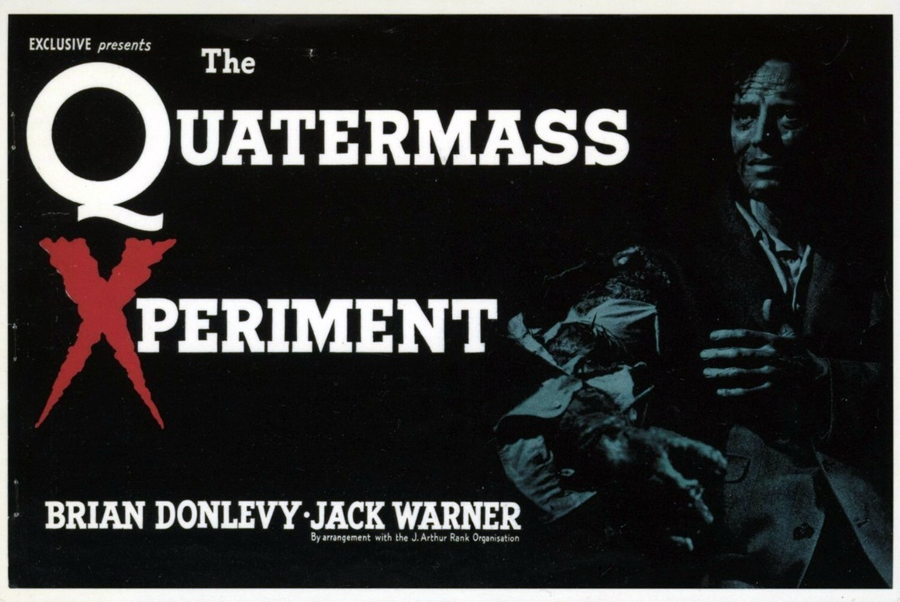
Directed by Val Guest, The Quatermass Xperiment stars Brian Donlevy (The Great McGinty, Beau Geste) as the ornery Professor Bernard Quatermass, who was the lead in an (e)xperiment sending a manned rocketship into space. Communications with the rocket were lost, leading to its sudden crash landing in the middle of the night.
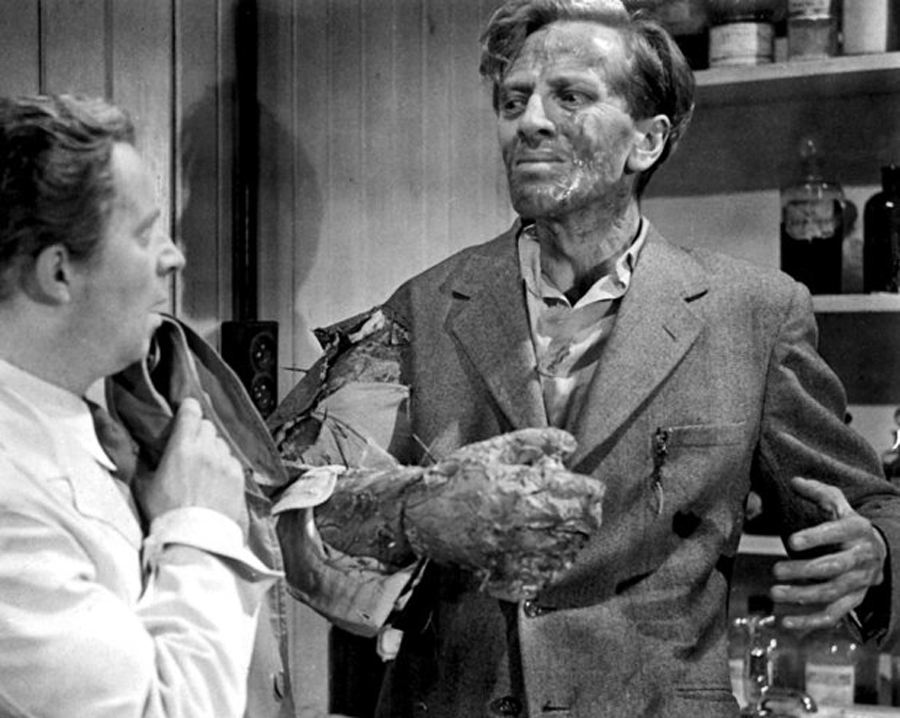
Of the three crewmen, only one has survived—Victor Carroon. He is near catatonic, only able to speak the words, “Help me.” He is taken not to a hospital, but the laboratory of Dr. Briscoe, a member of the rocket team, on the hunch that a normal hospital will not know how to treat Carroon. And boy, are they right—the astronaut has come back with odd patterns on his skin, and no fingerprints!
Quatermass, Briscoe, and Scotland Yard’s Inspector Lomax review a film of the expedition, and watch as some unseen force hits the rocket. The three men collapse, and the film ends. Meanwhile, Judith Carroon, unhappy with the treatment her husband is getting, sneaks him out of Briscoe’s lab—big mistake! Her husband, transforming rapidly into something other than human, kills the man Judith hired to sneak him out, leaving the corpse a shriveled husk.
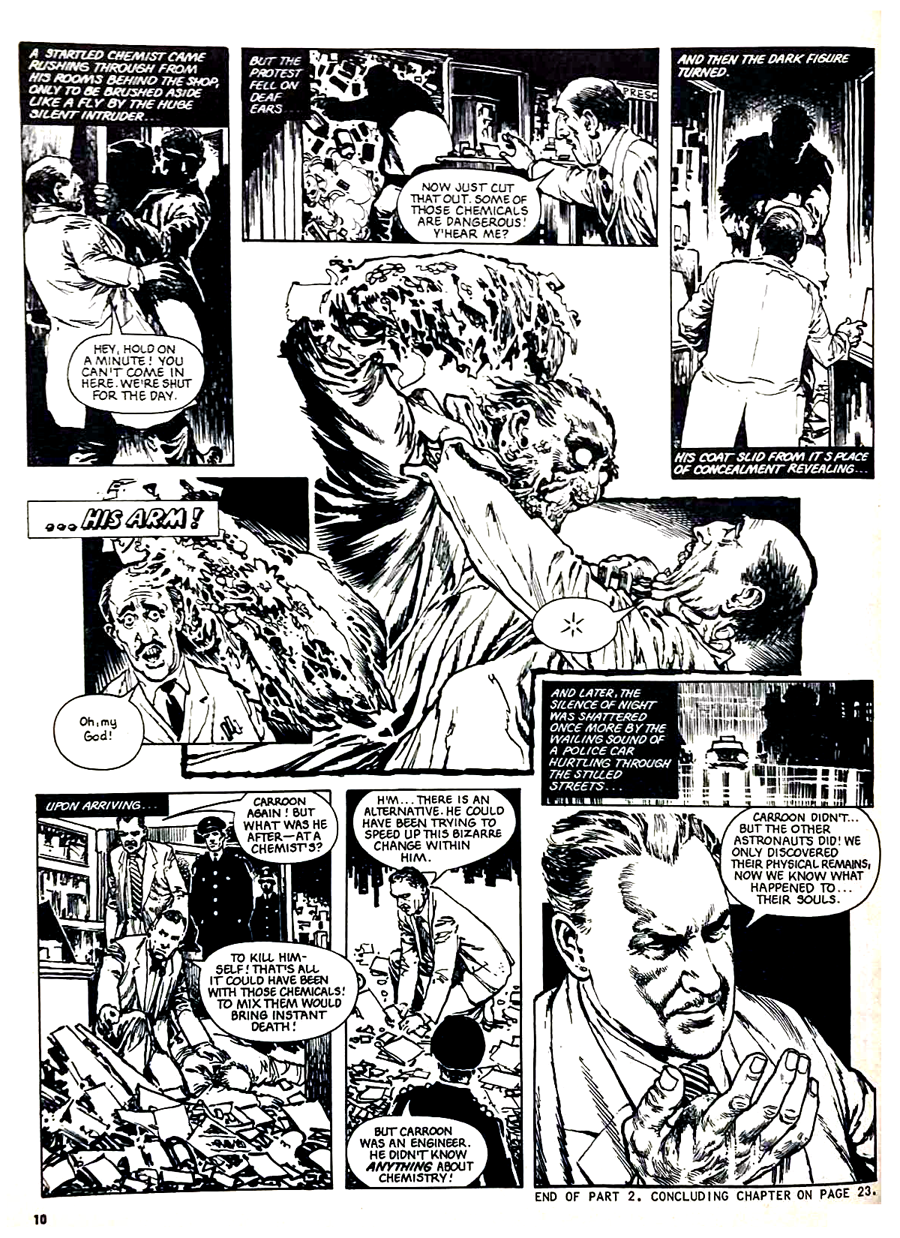
Carroon wanders his way to a nearby pharmacist, killing the chemist. He runs (well, staggers) into a little girl, but leaves her unharmed. Decaying rapidly, he hides in a local zoo, with the animal inhabitants not as lucky as the girl. Quatermass discovers a sample of Carroon left behind, and after they examine it they determine he’s been infected by some sort of alien spore that absorbs its host, killing it and then moving on.
The creature has now grown into a massive, many tentacled beast hiding in the shadows of Westminster Abbey, where a live TV broadcast is taking place! Quatermass and his team follow, and electrocute the monster before it has the chance to release its spores. Within moments of the crisis having passed, Quatermass turns on his heel and walks out of the building. Marsh asks what he plans to do, and Quatermass brusquely answers, “I’m going to start again.” The film ends with another rocket heading into space.
The Quatermass Xperiment was based on a BBC mini-series that was enormously popular at the time (it reportedly “emptied the streets and pubs”). One of its viewers was Hammer producer Anthony Hinds, who snapped up the rights immediately. To that point, Hammer had been around for almost 20 years, and at the time had a deal with American producer Robert L. Lippert to get their films to play in the United States. Lippert used his muscle to get American stars into the leads of many Hammer productions, which is how Donlevy ended up as Quatermass.
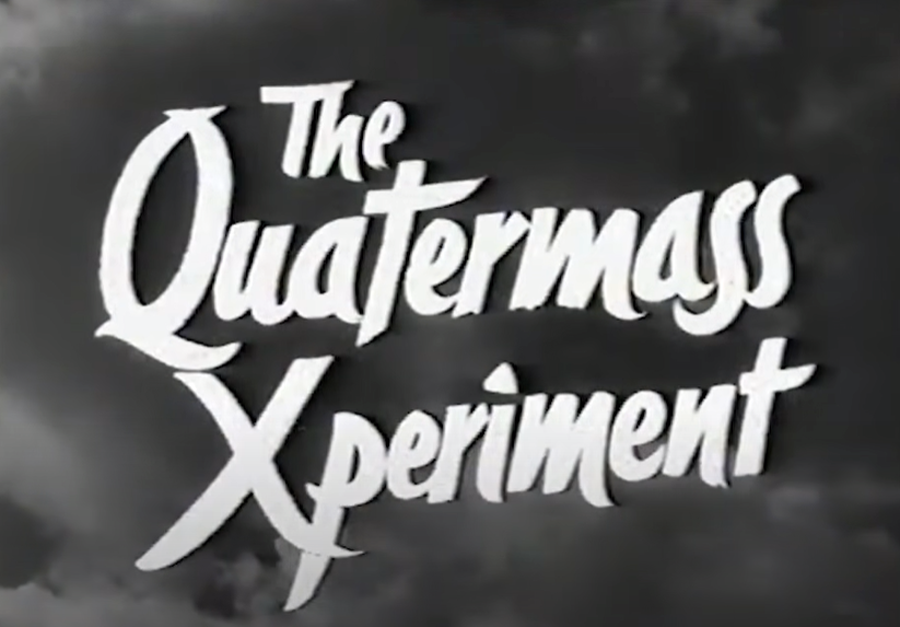
Hammer was savvy enough to realize it had a property with enormous built-in name recognition, so when the British censors gave Quatermass an “X” rating for the violence, they leaned into the controversy, dropping the “e” from the title and branding the movie The Quatermass Xperiment (released in the US with the more lurid, but more generic, title The Creeping Unknown). The film was an enormous hit, leading to a sequel just two years later. Hammer would repeat this formula—push the envelope on violence and then if the film was a hit, start cranking out sequels—with other established properties like Frankenstein and Dracula. They ended their deal with Lippert and signed a new one with some major Hollywood studios. The era of “Hammer Horror” had begun.
Even 70 years later, Quatermass remains a cracking good horror/sci-fi thriller. At just 82 minutes, it moves at a lightning pace, led by Donlevy’s terse title character. Donlevy brings his best 1940’s Golden Age of Hollywood style of acting to the movie, talking at twice speed and often not even letting any of his more polite British co-stars finish a sentence before he’s moved on to the next thing. Quatermass believes in capital-S “Science!” and won’t let any small details like a murderous, zombified astronaut get in his way.
Carroon is clearly not OK, but hardly anyone in the movie seems to acknowledge that. Sneaking him out of the hospital unsupervised is an incredibly blinkered thing to do, but his wife Judith treats Carroon like he’s got just a really bad case of the flu. With more than half a century of horror movies under our belt, modern audiences can see just how wrong this is all going to go. That gives Quatermass an inevitably downbeat tone, one of the things horror fans love most—the catharsis of watching people go through something they will never have to deal with (in this case, having to deal with a loved one slowly turning into a giant plant monster).
Hammer followed up with two sequels, 1957’s Quatermass II and 1967’s Quatermass and the Pit. So when the black-and-white magazine The House of Hammer started in 1976, with each issue featuring a comic book adaptation of a film from their stable, it didn’t take long for editor Dez Skinn to get to The Quatermass Xperiment.

The adaptation is broken up into two parts, over issues 8 and 9, with the latter featuring an all-new Quatermass cover. Written by Les Lilley and Ben Aldrich and drawn by Brian Lewis, this 16-page version takes an already briskly paced movie and cuts it down to the very bone (stem?).
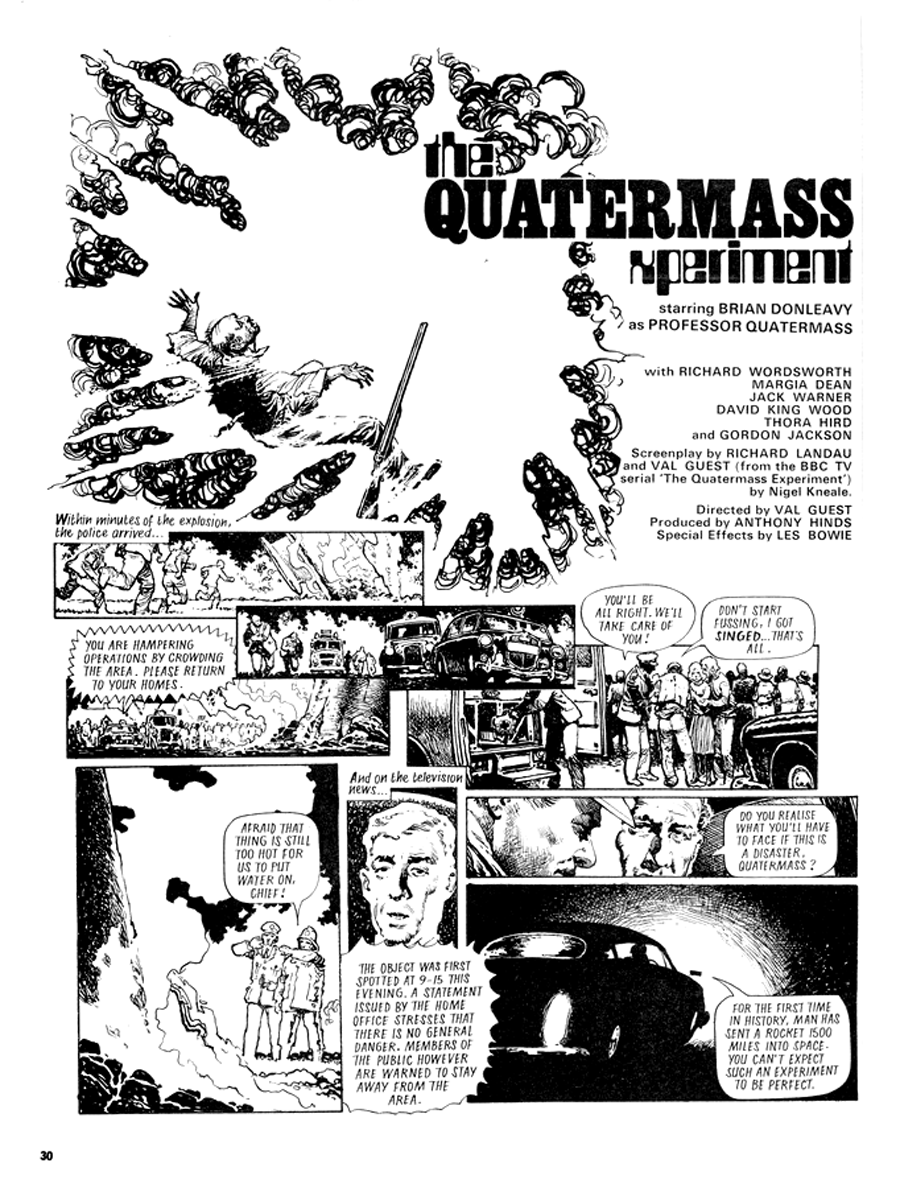
Lewis manages to cram a ton of action (and many, many panels) into any given page, while also delivering decent likenesses of the actors (he really nails Brian Donlevy’s impatient scowl, aimed at nearly everyone he meets). With both in black and white, the comic feels more like the movie than a lot of movie adaptations, which makes for a fun read. And since the comics version wasn’t limited in the make up and special effects department, Carroon in his plant zombie form gets to move a little more briskly and grandly than he did in the movie. The only major scene not included is when Quatermass and the others watch the rocket’s recording of the flight, which really doesn’t make that much difference in the plot, anyway.
We’ve covered these House of Hammer comic adaptations once before, with Curse of the Werewolf. That one was a lot of fun, too, and made for quite a fun feature in the middle of the magazine. There was an American version of the magazine, initially called House of Horror, but I never saw it on the stands as a kid. I wish I had, because from what I’ve seen so far, these are a blast.
If Hammer had never produced The Quatermass Xperiment, would the studio have had the same box office and cultural impact with their classic monster features a few years later? No way to know, but it doesn’t matter, because this film belongs on any list of Hammer Horror classics.
—
MORE
— REEL RETRO CINEMA: Hammer’s CURSE OF THE WEREWOLF. Click here.
— REEL RETRO CINEMA: 13 Great CHRISTOPHER LEE Horror Roles That Aren’t DRACULA — RANKED. Click here.
—
ROB KELLY is a podcaster, writer, illustrator, and film commentator. You can find his work at robkellycreative.com.

September 29, 2025
TwoMorrows’ CRYPTOLOGY Magazine #2 features a comprehensive story about the entire Quatermass series, including the movies, TV series and comics. You can order it here: https://twomorrows.com/index.php?main_page=product_info&cPath=98_194&products_id=1807&zenid=8tj9h1a3ga0qrdh82643po6lm3
September 29, 2025
Great article, Rob! Despite my love for Hammer, I have never seen the Qatermass films from start to finish. I have kept them in “reserve” so my supply of unseen Hammers doesn’t run out. But I think I will dip in and watch this one sometime over the next month, based on your work here!
September 29, 2025
May I suggest 13th Dimension do an article on the comic book Flesh and Blood by Robert Tinnell and Neil Vokes? This was a 3-issue series from 2011 and it does an absolutely amazing job of giving Hammer Film fans the “monster rally” we never got. Although it’s not officially connected to Hammer, the series’ likenesses of Dracula, werewolf, Dr. Frankenstein, etc are all similar to the Hammer versions we love (especially Dr. Frankenstein). The backup feature in each issue is also very similar to Quatermass. The first issue is easy to get but the second and third are a bit more pricey. Every Hammer horror fan would love this series and it’s unfortunate that there was nothing about the series to alert Hammer horror fans to pick it up.
September 29, 2025
You’ve definitely piqued my interest! Never heard of it, unfortunately.