
GERRY CONWAY (1952-2026): A comprehensive exploration of the career of the man who killed Gwen Stacy — and did so much more…
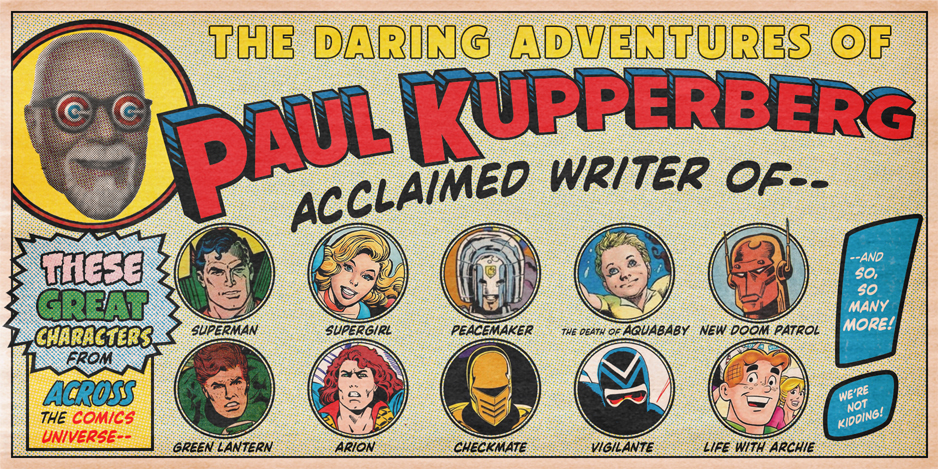
By PAUL KUPPERBERG
For Direct Creativity, my book on the creative influences of my fellow comic book creators, I knew I had to speak with writer Gerry Conway, one of the creators who influenced me with the comics he wrote. Gerry was only a few years older than me, but he had a six-year head start on turning pro by making his first professional sale at 16 in 1969, and by the time I started writing for DC in 1975, Gerry was one of the writers I regularly read while trying to figure out how to do the job.
Our conversation was one of the most enjoyable of the project. Gerry was as open about his failures as he was was his successes, and I learned about aspects of his life and career I’d never known.
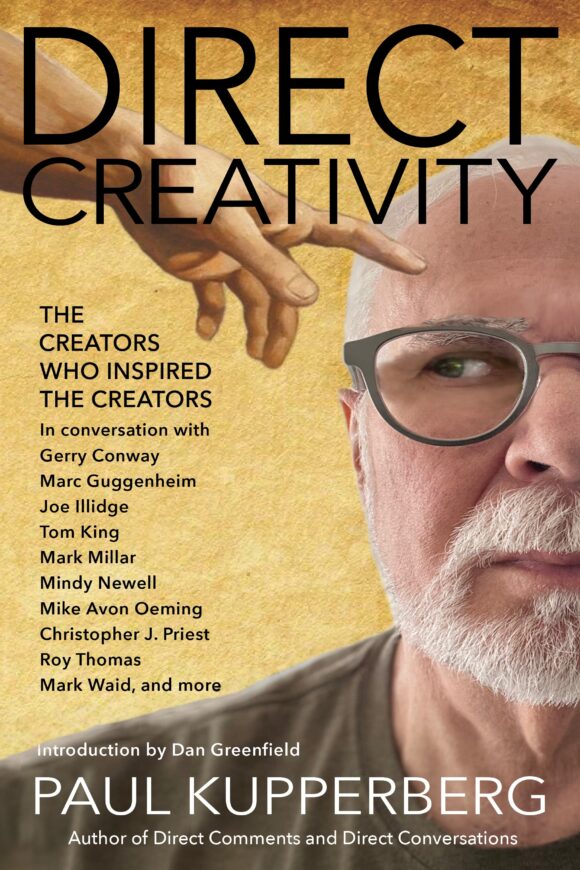
Gerry’s passing Monday wasn’t a complete surprise. Late last year, he emailed many of us after being diagnosed with Stage 4 pancreatic cancer, three years after his initial diagnosis, to share the news and say good-bye, sounding every bit like one of the heroes he had spent his life writing about.
There are a lot of good comic books in the world today thanks to Gerry Conway, and for those of us who knew him, even more good thoughts. He ended his email thusly:
“In the words of Captain Spaulding, ‘Hello, I must be going.'”
Now, read Gerry in his words from our talk for Direct Creativity:

Gerry Conway, portrait by Adam Wallenta
Gerry Conway (September 10, 1952) is one of the more prolific comic book writers of his generation and the co-creator of such characters as the Punisher, the Scarlet Spider, and the first Ms. Marvel for Marvel Comics, and Power Girl, Firestorm, and Jason Todd for DC Comics, as well as for writing the landmark DC/Marvel crossover Superman vs. The Amazing Spider-Man and the groundbreaking “Death of Gwen Stacy” storyline in The Amazing Spider-Man. Gerry is also a published novelist and produced screenwriter (Fire and Ice, Conan the Destroyer) and has served as both a writer and/or producer on such TV fare as Diagnosis: Murder, Matlock, Perry Mason, Law & Order: Criminal Intent, and others.
—
KUPPERBERG: You were at the sort of leading edge of new writers getting into comics in the late 1960s, starting with Roy (Thomas), Denny (O’Neil), Mike Friedrich, and Jim Shooter, and through to Len (Wein) and Marv (Wolfman). And except for Jim, who was writing the Legion of Super-Heroes a few years earlier at fourteen, you were one of the younger guys to break in at fifteen years old. How did that happen for you?
CONWAY: It was the summer before I turned sixteen that September, so I can claim a fifteen, but it’s a bit disingenuous. But that was actually in the tradition of the Golden Age creators, many of whom, you know, started in their mid-teens. Joe Kubert, of course, being a prime example. As is Gil Kane. Jerry Siegel and Joe Shuster were in their late teens when they created Superman. But that was the way it was in those days. When he was sixteen, my father dropped out of high school to get a job to help support his family. In his case, he started working in a shipyard, but the guys who could do it found work in comics.
KUPPERBERG: Sure, the list is endless. Will Eisner, Jack Kirby, Bob Kane, they were all still teenagers when they were inventing the business in 1936 and 1940, but by the time we came around as readers and fans, it had become more of an old man’s profession.
CONWAY: Those fifteen- and sixteen-year-olds got older and, more and more, the people who got into the field were coming into it sideways, from commercial art or as a job until they could sell or land a syndicated strip. A newspaper strip was what all the artists were shooting for in the 1950s and ’60s. Neal Adams, who’d had a strip (Ben Casey, 1961–1964), was one of the first people who moved from commercial art to comic art, but Neal went into comic books because he wanted to do them, not because he didn’t have any other choice. For a lot of artists, comics was not their first choice. But Neal, and Roy and all the rest of my generation of writers in particular, we were fans and we really wanted to tell complex stories and build these rich stories for the companies we loved. Which I think was a passion that the older writers just literally couldn’t understand.
KUPPERBERG: There was a stigma attached to the job in those days. Stan (Lee) wrote about how he would lie to people he met at parties about what he did for a living out of embarrassment. Enthusiastic twenty-year-old me once said to Bob Haney that writing comics was my dream, and he gave this rueful chuckle and said something about it becoming a nightmare. It wasn’t the career a lot of then imagined for themselves.
CONWAY: Robert Kanigher used to brag about all the things that he’d done that weren’t comics. “I’ve seen the Sistine Chapel! I’ve skied the Swiss Alps! I’ve written plays! I’ve done this! I’ve done that!” Well, okay, Bob, but you’re writing comics now. Live the life you’re living.
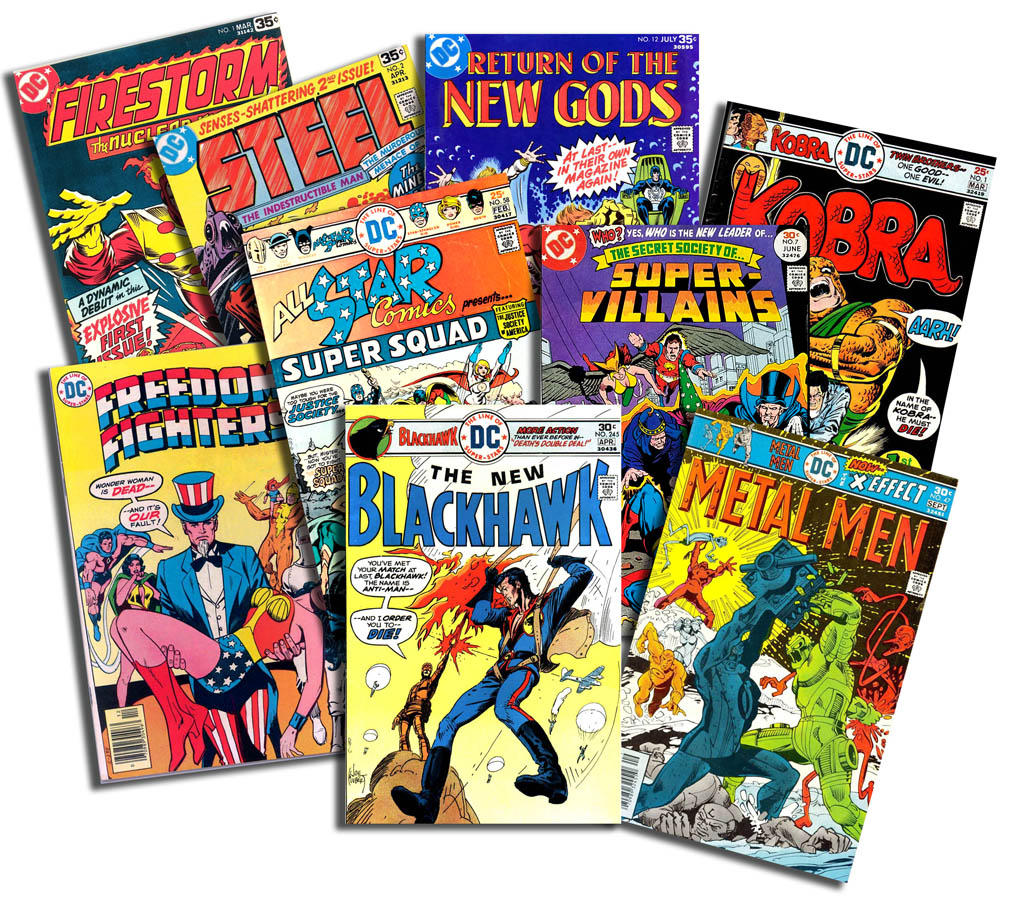
Conway’s Corner, late-’70s DC
KUPPERBERG: When I was new to the business, I couldn’t understand how these guys couldn’t love it too, you know? But I didn’t have Bob’s thirty years history with DC and I was still too starry-eyed to see how exploitative the comics industry was to talent, especially in the days before royalties and profit participation, which was the case for most of his career.
CONWAY: Those guys had it much worse than we ended up having it, but it’s still exploitation. The publishers don’t value the creatives; they know there’s a steady supply of people who are desperate to get into the business to draw from. There are many superstar writers now, many more than there were when I was working, but now their ambition is to build up a reputation on DC or Marvel properties and then take their new work to Image or some other independent, or to Substack, and exploit the work for themselves.
KUPPERBERG: And there’s also more of a path between comics and television and movies than ever before. You were one of the rare guys to make that jump from comics to television. Comics have become almost a calling card in Hollywood and there’s a pretty steady back and forth between mediums.
CONWAY: Yeah, but when Roy Thomas and I started writing movies, we were encouraged not to let people know that we’d previously worked in comics. It was considered, at best, an unfortunate period in your career. It was definitely not something to brag about the way it is now where TV writers and screenwriters and National Book Award–winners like Ta-Nehisi Coates writing comics is front-page news. That’s understanding that flip has been the biggest challenge for me as a creator in the field. I get it because I think the potential for comic book writers to write for TV and film was always there. And when it finally happened, it happened so rapidly, in the early 2000s, when someone like Joss Whedon who wrote for TV and film could cross back and forth between that and comics.
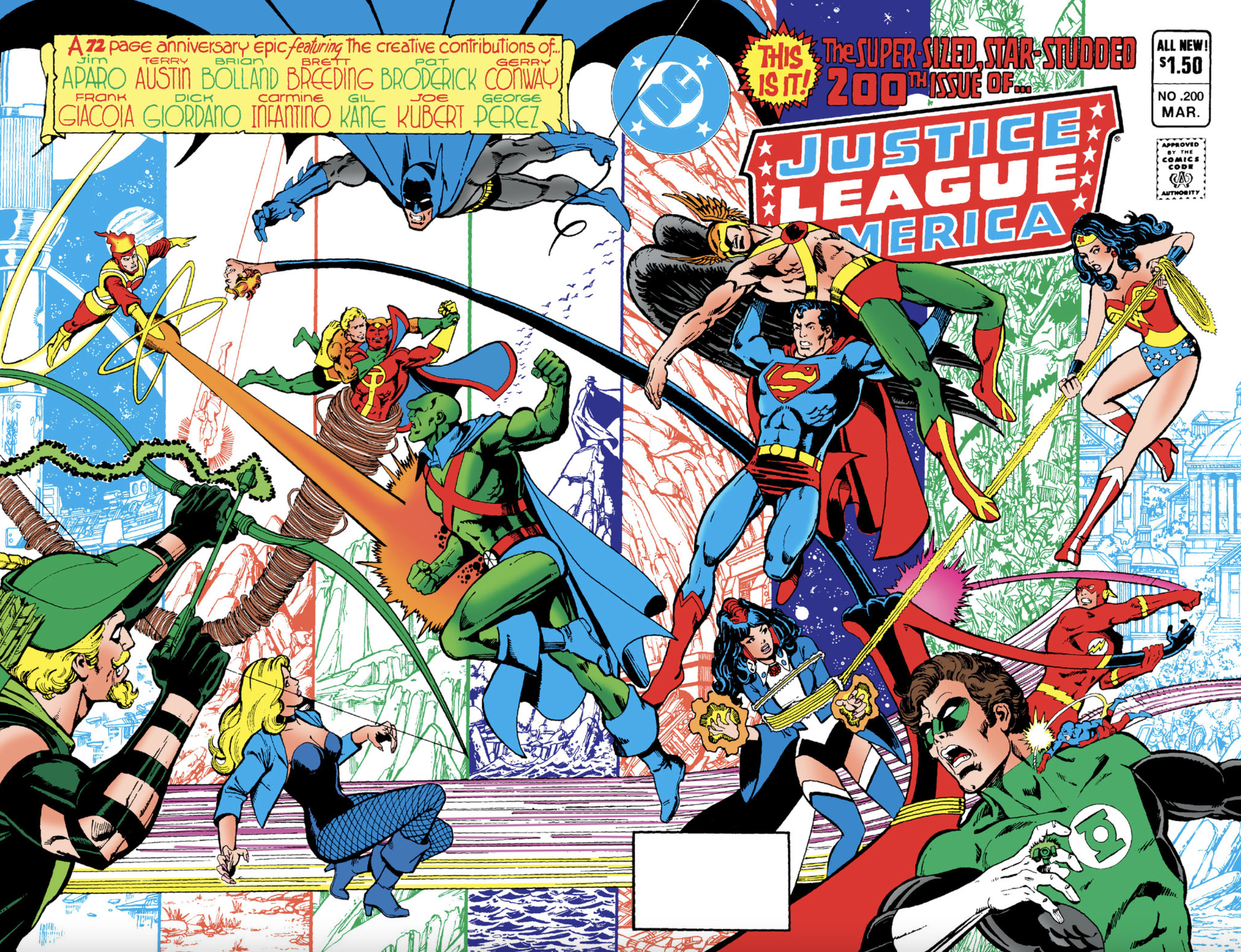
Written by Gerry Conway
KUPPERBERG: It used to be a one-way street. Comics were a thing you did when you were starting out to make a few bucks, like (novelist) Patricia Highsmith and (Mike Hammer creator) Mickey Spillane, and you got out of as soon as you could.
CONWAY: They were making a quick buck and that was basically all it was worth, given the quality of the work being done. Which isn’t terribly surprising. It took decades for the work in comics to rise to the level that serious writers wanted to work in it. Then it took a couple more decades for them to actually work in it.
KUPPERBERG: I date the dawn of that popular acceptance of comics to the (1986) New York Times Book Review piece on Art Spiegelman’s Maus: A Survivor’s Tale (Pantheon, 1986). Once The Times gave graphic novels its stamp of approval, the rest of the world started to accept the idea it’s possible for them to not only be a legitimate form of storytelling, but literature as well.
CONWAY: Right. And now my daughter’s advanced high school English class gets assigned four graphic novels to read.
KUPPERBERG: Cool. When we were in school, we had our comic books confiscated.

Written by Gerry Conway
CONWAY: Absolutely. And getting back to your question of my breaking in so young, I loved the material and I didn’t want to write it. I wanted to immerse myself physically in that environment. I wanted to hang out with the creators. I wanted to be part of the office, back in a time when it was still possible to do that to a degree that I don’t think today’s creators really understand.
KUPPERBERG: Yeah, it was a whole different place and attitude. Once upon a time, DC gave weekly tours of the offices and the first time I went on one when I was twelve or thirteen, I was hooked. I loved comic books and already knew I wanted to be in the business, but being allowed into the inner sanctum, into the Fortress of Solitude, was an amazing feeling.
CONWAY: We were part of a community. There’s so many barriers, now. Physical barriers and attitude barriers. The separation between creators and editors is, I think, more distance than it was when we were starting out because many of the editors we were working with were also creators. Dick Giordano, Joe Orlando, Joe Kubert, Carmine Infantino . . . for God’s sake, Carmine, an artist, became DC’s publisher. Stan Lee was a creator. Even someone like Mike Friedrich, who started one of the first independent companies, Star*Reach, was a writer. There was a back and forth there, an understanding between creators and editors who knew what it was like to create something, as opposed to editors whose only skillset is editing. Not that there’s anything necessarily wrong with that, but I think it helps to work with editors who understand the creative process.
KUPPERBERG: DC had a history of hiring artists and writers as editors, all the way back to one of their first editors, cartoonist Vin Sullivan. Sheldon Mayer, Mort Weisinger, Jack Schiff, Whitney Ellsworth, Kanigher, were all also writers or cartoonists. I think Julie (Schwartz) was one of the few non-writers on staff, but he’s had a decade as a literary agent for science fiction writers.
CONWAY: Murray Boltinoff too. He’d written for radio; he’d written comic books. There was more continuity between the creators and the editors.
KUPPERBERG: And then Stan and Marvel Comics came along and brought that sense of community and continuity to the readers. I’m assuming since you’re exactly the right age for it that you were an early adopter of Marvel.
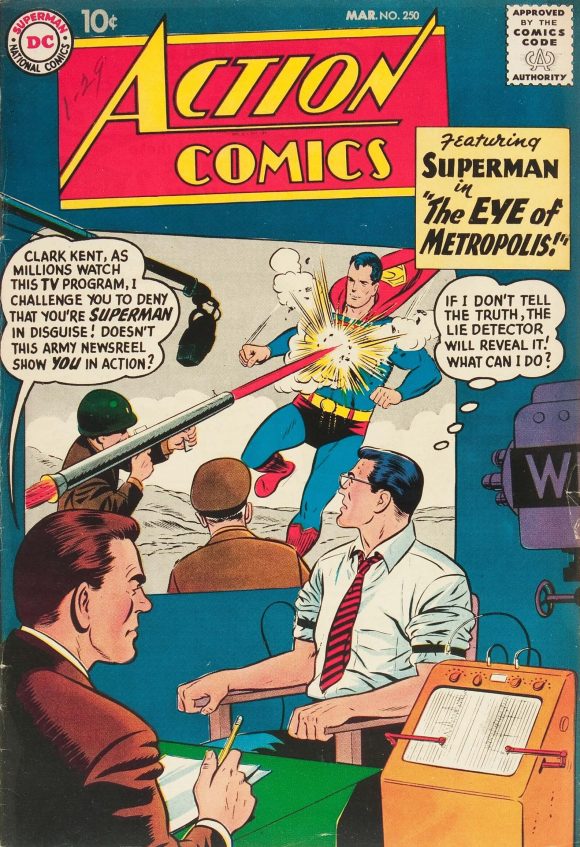
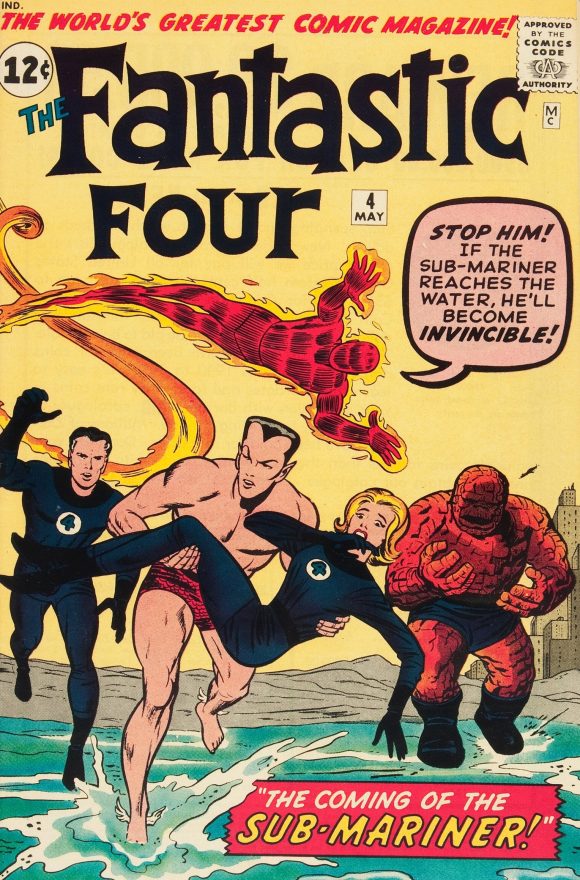
CONWAY: I started reading comics, I guess, when I was in single digits. I can remember the first comic that I was completely aware of, it was an issue of Action Comics (#250, March 1959), the one where Clark Kent has to pass a lie detector test, which he does by using his super-breath or something to freeze the machine’s needle. I remember picking that up . . . literally finding a coverless copy on the street and reading it and enjoying it. The first Marvel Comic I ever picked up was Fantastic Four #4 (May 1962).
KUPPERBERG: Oh, sure. That would do it! [Laughter]
CONWAY: You bet! I went back to the newsstand and found Fantastic Four #3 still on sale and never looked back. So, I’m a very early adopter. And I was an Adventures of Superman follower, probably even before I read that issue of Action Comics. I also remember issues of The Flash and that first 80-Page Giant Batman Annual (1960), which was a revelation with the Dick Sprang art and those crazy stories with the giant typewriters. I just loved it, and they were always part of life, preadolescence on.
KUPPERBERG: When did you develop the creative itch and start making your own comics?
CONWAY: Almost immediately. I started drawing and making my own Fantastic Four comic books that I shared with my cousin. It must have been pretty early when I read in a letter column about Jim Shooter, who was about the same age as me and writing the Legion of Super-Heroes for DC. And I just thought “Well, if he can do it, I can do it.” Fortunately, I lived in New York City, so it was a subway ride to the DC offices for the tour, which I went on frequently and harassed different editors to look at my stuff until I eventually inadvertently tricked Murray Boltinoff into buying my first story.
KUPPERBERG: How did you manage that? Murray was famous for never wanting to buy anybody’s first story.
CONWAY: Yeah. He didn’t realize that I was a new writer. The editors used to share offices, so Murray sat across from Dick Giordano. And Dick was kind enough to talk to me and let me bring in my latest failed attempts at writing an Aquaman story or whatever. Years later, he told me, “You know, when you first came in, I thought it was hopeless, that you weren’t very good and would never be a writer.” [Laughter] But Murray saw me coming in every week and I went to a Catholic high school with a dress code so I was always wearing a jacket and tie on my after-school visits, which must have made me look older than I was.
On one visit, Dick wasn’t at his desk when I got there, so Murray beckoned me over and said, “So, you’re working with Dick?” I said, yes, I was doing stuff with Dick, and Murray said, “All right, would you like to do a story for me?” And I spent a summer writing and rewriting a three-page story for Murray, which Paul Levitz eventually put in a compendium about ten years later because Murray would never run it. At the end of this process of writing and rewriting the story I don’t know how many times with Murray’s extensive notes, when he finally accepted it, he said, “Okay, I think we’re done. What’s your page rate?” I said, “I don’t know.” “What do you mean you don’t know?” “Well, I’ve never sold a story before.” And he went white when he realized he had inadvertently bought my first story.
But after that, Dick saw me as somebody who could write. It was like the sale to Murray validated me. And you have to be validated before you’re accepted. This is what I’ve learned in every field that I’ve ever worked in, that you need somebody to acknowledge your worth before people will actually accept you as worthy.
KUPPERBERG: It was a real Catch-22 situation.
CONWAY: It meant you had to trick people. Joe Straczynski once said that when a producer asks you if you’ve ever written something before, some genre, some format, you always say “You bet! No problem!”
KUPPERBERG: You were around for the last few years of Mort Weisinger’s time as editor of the Superman books. He retired in 1970s and was already gone by the time I started going up to DC with any regularity, but I grew up on the Superman comics under his editorial run and absolutely loved them as a kid. He brought in most of the elements readers of the era associate with the character, from Bizarros and Brainiac to Supergirl and the Phantom Zone, but he has a reputation as something of a tyrant. Did you ever write for him?
CONWAY: He was a great world-builder and a horrible human being. He was one of the editors that I approached to write for. I can’t remember what exactly I showed him. I think I wrote a spec Legion of Super-Heroes script, and he savaged it. I was a fourteen-, fifteen-year-old kid and he just savaged it. In the end, I never actually wrote directly for him. I worked with Nelson, but never Mort.
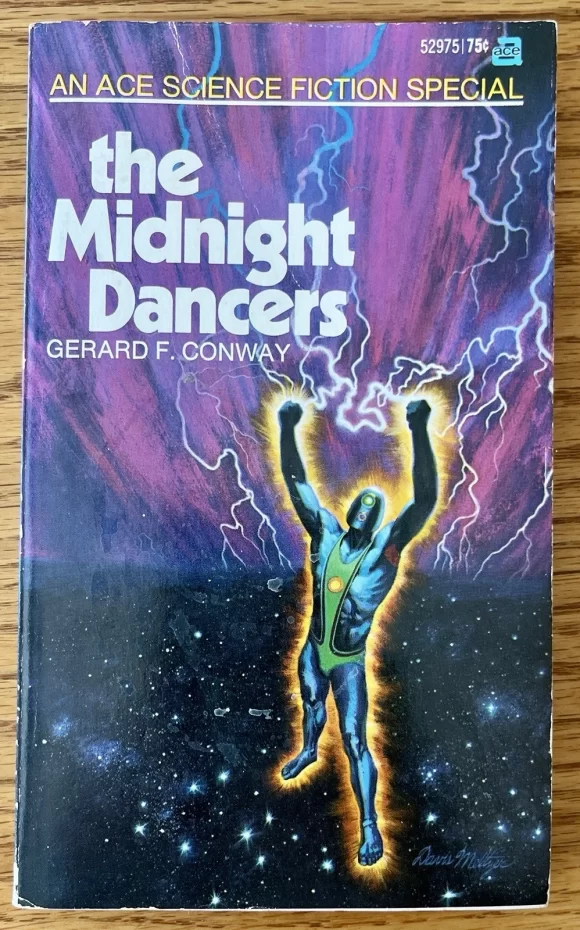
KUPPERBERG: You weren’t just trying to break into comics at the time. You were also writing science fiction prose, including a couple of novels (The Midnight Dancers in 1971, Mindship in 1974). Did you have a preference for one over the other, science fiction or comic books?
Written by Conway
CONWAY: No, it was all-encompassing. I’m a fan of science fiction and fantasy in any form. I don’t actually like much fantasy that comes out today, but I like hard science fiction, what used to be called mainstream science fiction, and the New Wave science fiction, which is what I read. I transitioned from Robert Heinlein to Harlan Ellison, and you can’t make more of a jump than that, and I loved J.R.R. Tolkien and Kurt Vonnegut, but comics were always my first love. I think, in a lot of ways, breaking into comics was more approachable for a young teen, and even as a stunted adult I still love the field. I don’t read as much from the two main companies as I used to because I find most of what they do these days retreading, and not very imaginatively.
But I was a huge fan of Stan’s early work on Fantastic Four (1961) and Amazing Spider-Man (1963), particularly the stuff in the mid-’60s. I consider the peak period of FF to be #45 through #60. He was inspired, obviously, by the work that Jack and Steve Ditko were doing, but it even carried over to the second-tier books, like Iron Man. It was a wonderful period for Captain America too. Stan had gotten into a rhythm and that stuff was just unbeatable. At the same time at DC, Gardner Fox and John Broome were dominating. The stories might have been silly, but they kept you reading. Justice League of America (1960) was one of my favorite books.
KUPPERBERG: In a way it’s too bad the readership aged out of that kind of storytelling and started taking their superheroes so seriously. It can get more and more difficult to sustain your suspension of disbelief when you have to shoehorn these god-like beings into a real-world setting. How do you continue to create dramatic tension with a character like Superman, or any ongoing serialized character, who you know can’t die? Or if they do die, will eventually “get better” and return.
CONWAY: The companies did that to themselves. Once they “killed” Superman and it made front-page news all around the world, DC got hooked on repeating it. It was the same with Crisis on Infinite Earths (1985). Suddenly, there was a new crisis every year. Now it feels like they’re rebooting every six or ten issues, with runs just long enough to collect into trade paperbacks. Come on, pick a direction, make up your mind. They think that these stunts entice new readers, but for every new reader that you pick up with a rebooted number one, I think you lose a reader, who says, “Why did I just spend a year investing in this only to have them throw the continuity out the window?”

Written by Conway
KUPPERBERG: There was something to be said for the consistency of the comics when we were growing up. Even with the rise of Marvel, readers always knew what they were getting. Stan and Jack on the Fantastic Four and (Steve) Ditko on Spider-Man, Curt Swan on Superman, (Ross) Andru and (Mike) Esposito on Wonder Woman, (Mike) Sekowsky on JLA. Those were givens through most of the 1960s, certainly at DC, until 1968, when they started to try and shake things up.
CONWAY: I remember Julie Schwartz telling me once that the average comic reader read comics for three or four years, from nine or ten to thirteen. What changed is that people kept reading past that age, then accessibility to comics switched from local newsstands to comic shops, prices went up, and comics stopped being a cheap impulse buy at the checkout line. Mom and Dad aren’t going to buy a kid those five comic books that could trigger a lifelong love at five bucks each. And from an economic point of view, it makes more sense for readers to wait for the trade to be collected, which disincentivizes the floppies, which means the publishers have to hike the cover price to pay for the better-quality paper the older audience insists on. Everything in the comic business these days pushes away younger readers.
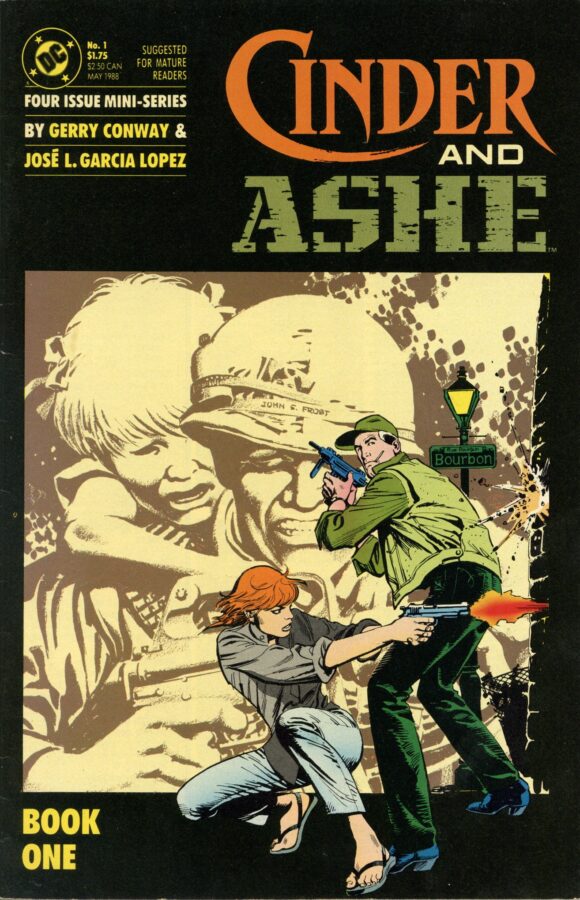
KUPPERBERG: It was pretty much the opposite for us in the 1960s. Everything was aimed at catching some kid’s attention on the newsstand or spinner rack. That’s what made the runs of some of those Silver Age titles so memorable, like the Flash turning into a puppet or getting super-fat on those Infantino covers, or that amazing run of Avengers covers by John Buscema; they had to stand out from the crowd and make a twelve-year-old want to find out what was going on inside.
CONWAY: I was mostly a Marvel fan, I read the Schwartz books and picked up the occasional Murray Boltinoff book, and even the Jack Schiff Batman (1940) title. I actually really liked the dumb science fiction strips, like Dial H for Hero. I mean, I didn’t read them all the time, but I’d pick them up occasionally. But I read all the Marvel superhero titles. I wasn’t into the Westerns and I’d read the war books now and then, but I’d plunk down my 20¢ for any Marvel superhero book. I was addicted to them. And I loved Julie’s books almost in spite of themselves. They were inherently silly and self-contradicting, and I loved them. Gardner Fox and Stan Lee were my two favorite writers.
KUPPERBERG: I never met Fox, but I did get to at least meet a lot of the creators whose work I grew up loving, and in some cases get to work with them, and even now when I’m in my sixties, I can still get that fannish thrill at knowing these people. I remember I was waiting to get into a DC screening for Superman Returns (2006) once and Neal (Adams) passed by and greeted me, and even though I was a fifty-six-year-old grown-up, the twelve-year-old inside me geeked out. “Neal Adams knows my name!” I didn’t know Stan very well and he usually called me “Alan.” [Laughter] He was still around and active when you were starting, wasn’t he?
CONWAY: Stan was a mixed bag. He wasn’t a huge fan of mine when I started working on the Marvel superhero books. But he came to appreciate me, which I thought was great. I worshipped his writing and I admired the man from afar, so it meant a lot to me when he finally passed on the writing of Spider-Man to me. Thor, too, although he was a little critical of some of the Thor (1966) work I did, which is probably justified. But as I got to know him and saw some of his flaws, I got a bit disillusioned and disappointed, which was unfair. Stan operated on several different levels. As a writer, he was always trying his best. I don’t think he ever slacked on anything, although he had limitations as a writer. And he was a pretty darn good editor, mostly because he chose great people and let them find their own styles. He didn’t put a straitjacket on anybody’s creativity. As a self-promoter, there was nobody to beat him. Nobody. And that was the part of the job that Jack Kirby never understood and resented, which was very unfair.
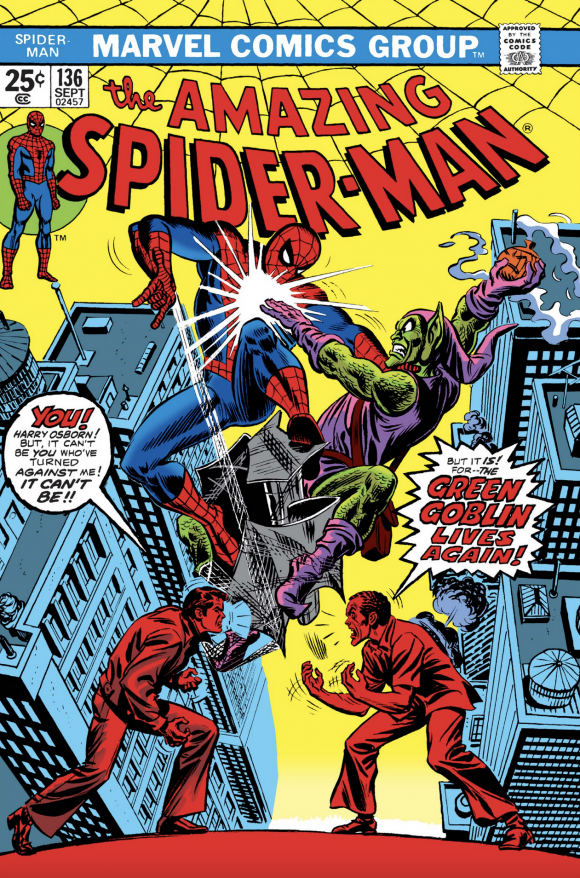
Written by Conway
KUPPERBERG: Stan was naturally garrulous in a way that Jack, or Steve Ditko for that matter, couldn’t match.
CONWAY: And Stan did promote his collaborators. He would talk about Jack’s work in interviews. It wasn’t his fault that most media outlets focused on Stan because they want a simple story. They want to know: Who’s in charge? Who is the person we should be talking to? They’re lazy and don’t look past that person they’re talking to, to the credits, so Stan became the story. But if you just look at the credits, Jack’s name was right there: “by Stan Lee and Jack Kirby.” He gave Ditko plotting credit on Amazing Spider-Man. But it was also his job as editor to keep Ditko’s Spider-Man in line with the character they’d already established. And when he wouldn’t let Ditko inject his Objectivism philosophy into the strip, eliminating the gray areas so there would have been no sense of Peter as a tragic figure, the stuff that humanized him and made him an identifiable and compassionate character, Ditko quit.
KUPPERBERG: I was in my twenties when I first wrote Superman and that was intimidating enough, even though I wasn’t following so closely on the heels of the original creators. What was it like taking over from Stan?
CONWAY: Well, I like to say I was an overconfident nineteen-year-old. I didn’t know what I didn’t know and I definitely had more confidence than I probably deserved. However, I had a great partner in John Romita, whose job it really was to mentor and guide me through that first eight months or so that we worked together. And he did a great job. He taught me a lot about plotting. He taught me a lot about storytelling. Just by taking my plots and turning them into usable material, he pushed me to raise my bar as a storyteller. I think I did reasonably good work on those issues, and that set me up to do much better work when I was on my own without Romita. I mean, I was always very fortunate and ended up working with great collaborators, like Gil Kane and Ross Andru. Those guys were magnificent.
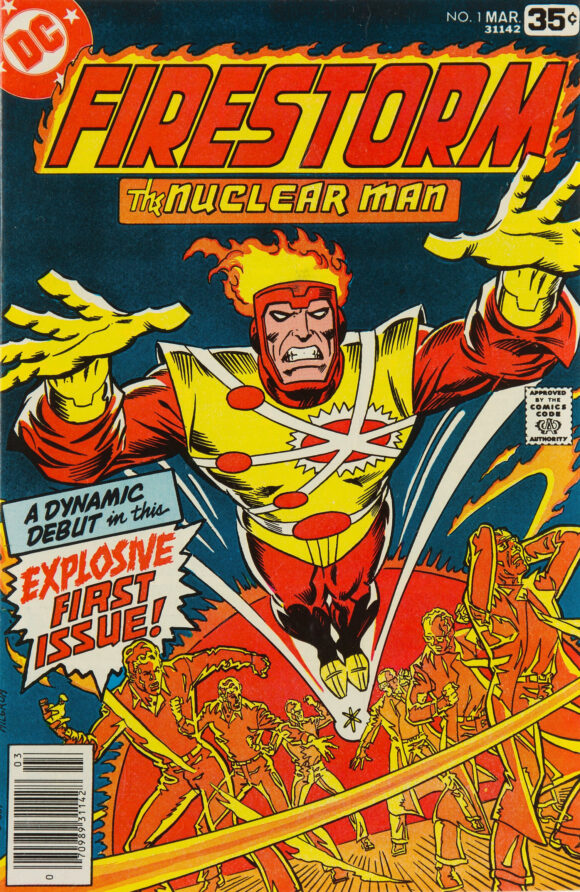
Written by Conway
KUPPERBERG: How were you working with the artists? I’m assuming it was plot first, the so-called Marvel method, but were you giving them a few sentences, paragraphs, page-by-page breakdowns?
CONWAY: It depended on the artist. If I was working with a new artist that I didn’t know very well, I usually did what amounted to blocks of pages. I would say that pages one to four this happens, this happens, then pages five to eight, that happens. With others, it might be an extended conversation, with the two of us sitting down and working it out together. That was how I eventually started working with Ross on Spider-Man. We would develop a story together based around some idea that I had or some suggestion from Ross for a venue that he wanted to draw. It was very collaborative.
KUPPERBERG: You didn’t get that experience writing full scripts, which was the usual approach at DC. I get asked “What was it like to work with Jack Kirby on Super Powers (1984)?” and the answer is, “I didn’t. I wrote a script, handed it to an editor, he sent it to Jack.” I didn’t speak to Jack once during the entire six issues.
CONWAY: That was the big advantage of the “Marvel style.” It forces you into a close, much closer collaboration than a full script. I mean, you’re still in a collaboration with your editor, but you’re at a remove from the artist. Sometimes you don’t even know who the artist is going to be, so you can’t tailor the story to an artist’s interests or strengths. You know, I found out fairly quickly that writing a loose plot for Gene Colan was a bad idea. Gene needed the story broken down for him into three-, four-page chunks to keep him on track. On the other hand, with an artist like Ross, we could meet up once a week on the Superman vs. Spider-Man book (1976) and discuss the next five to ten pages. I could throw out ideas for splash panels and Ross would describe how we wanted to stage a sequence. We would talk about where the emotional beats should come. It was really collaborative.
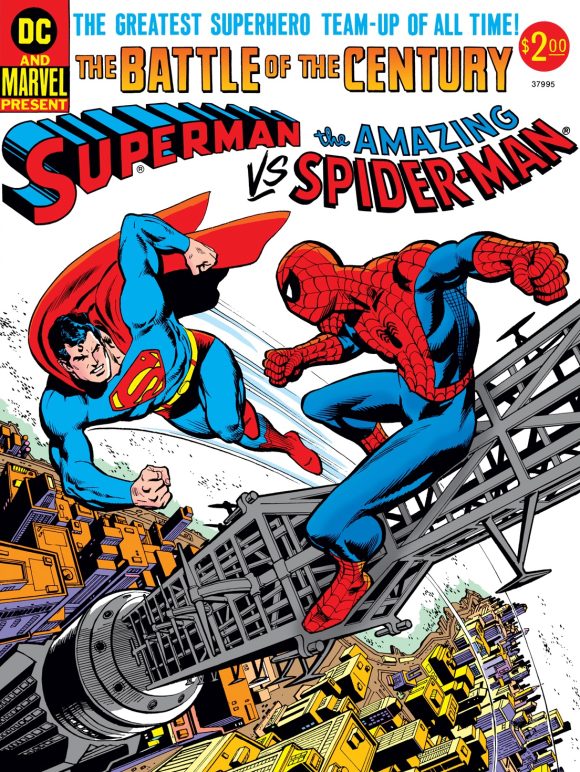
KUPPERBERG: Wow, so you were coming up with Superman vs. Spider-Man on the fly? I would have thought because it was an inter-company crossover, the script would have been worked out and approved by both sides before anything was drawn.
CONWAY: Well, we knew where the story was going, just not exactly how we would get there. Part of the challenge of that book was giving equal time to both Superman and Spider-Man. Same number of pages, same number of panels, same number of characters and supporting characters. It was ridiculous how many boxes we had to check. And you could really only do that in close collaboration over a period of time, although we also had a deadline. We had to get it done within a given timeframe based on Ross’s availability, because he had to get back to work on the Spider-Man monthly. So, you could say it was on the fly, but the story was pretty much set.
KUPPERBERG: It was a groundbreaking book, a meeting fans never thought would happen and very much of its time, but I think it holds up well after all these years. But at the other end of the spectrum, did you ever experience any professional glitches or failures that you didn’t think you’d recover from?
Written by Conway
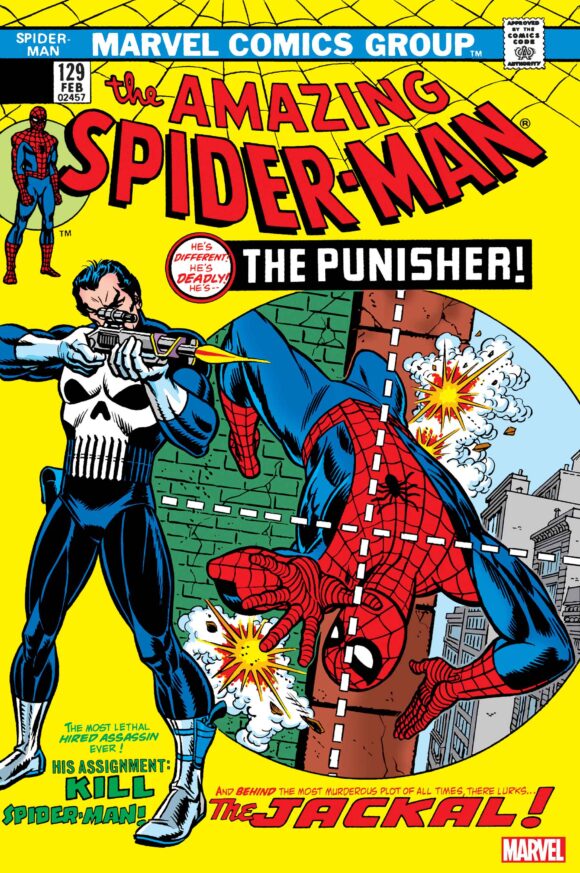
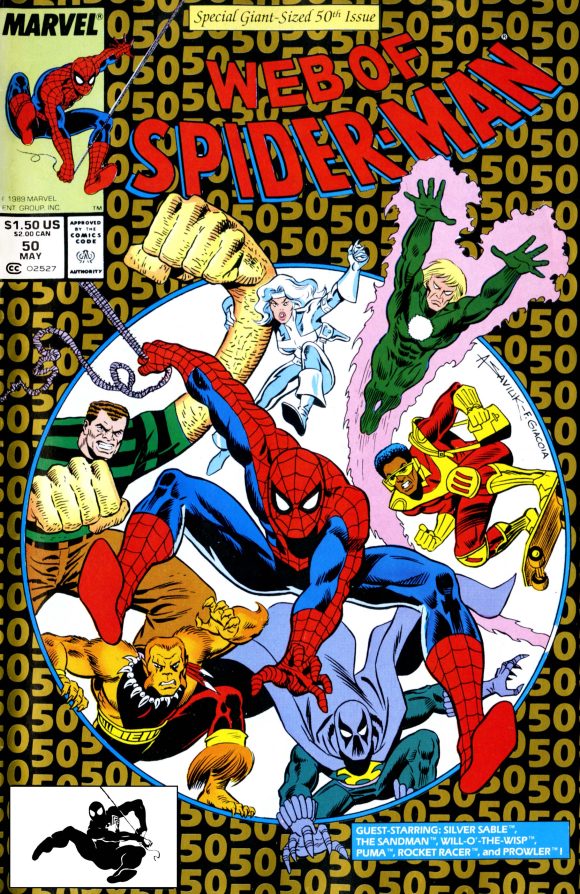
CONWAY: Well, I got a major writer’s block, where I was barely able to write in the mid-’80s. It was towards the end of my career at DC, and they weren’t helpful or supportive and eventually fired me. I was out of work in comics for I don’t know how long, many months until Don Daley, an editor at Marvel gave me an assignment to write Thundercats (1985) for their Star Comics imprint. My failure at DC and my behavior there . . . I was pretty obnoxious, so it forced me to reappraise myself, to value my work and to take it on with gratitude, even if I was writing a comic based on a cartoon show. I worked as hard on Thundercats as I could, which eventually led to working on some of the New Universe titles, which in turn got me the Web of Spider-Man (1985) and (Peter Parker, the) Spectacular Spider-Man (1976) gigs, my return to Spider-Man after over a decade away. I think I did some of my best work on the character in Spectacular and Web because I was approaching the work with an attitude of gratitude, as the saying goes.
The experience also made me see that I would eventually hit a wall in comics. Even though I was doing pretty well at that point and could basically pick up assignments whenever I wanted at Marvel, I knew that I was reaching the end of my run there. Roy (Thomas) and I had worked together for years writing screenplays and had a couple produced (Fire and Ice, 1983, and Conan the Destroyer, 1984) and about seven others that we got paid for but weren’t. The last one we wrote was a nightmare, an X-Men script for Orion Pictures with a group of new producers who did not know what they were doing. But it was our fault for going into the project at less than our usual financial terms because we did it for the love. Never do anything for love. [Laughter] We crashed and burned. In particular, I crashed and burned, and I left the film industry for several years, until ’89 or so. That’s when I reached out to people I knew in the business and started asking them for advice, which required humility, a recognition of my own fallibility, and an acceptance of my failure in the field. But it got me an assignment to write for The Father Dowling Mysteries, which led to a twenty-year career writing for TV.
KUPPERBERG: That was a Fred Silverman show, right?
CONWAY: Fred Silverman was one of the executive producers, but the actual guy who created and ran the shows was Dean Hargrove. By the time I got there, I think he saw that he was nearing the end of his long career, but the shows that that he and Fred Silverman were doing were really popular, especially, I remember, with grandmothers. They did Matlock, the Perry Mason mysteries, Jake and the Fat Man, Diagnosis: Murder, all these traditional mysteries that were really reminiscent of the early ’70s Columbo that he ran. We were coming to the end of that era, but for some reason Dean gave me a shot. He had overseen previously a project that Roy and I had done but hadn’t really been involved with it. But it was an introduction. “Hey, remember me?” And he gave me a writing test, which I almost blew, but he gave me an assignment writing a freelance script, then he put me on staff and promoted me. I went on to write episodes of Matlock, Jake and the Fat Man, several Perry Mason movies, became a co-executive producer on Diagnosis: Murder and that launched me over to Law and Order: Criminal Intent, which I was on for five, six years. Fortunately, when I failed, I failed upwards.
—
MORE
— GERRY CONWAY DEAD AT 73. Click here.
— 13 Great GERRY CONWAY DC Comics Series of the 1970s. Click here.
—
PAUL KUPPERBERG was a Silver Age fan who grew up to become a Bronze Age comic book creator, writer of Superman, the Doom Patrol, and Green Lantern, creator of Arion Lord of Atlantis, Checkmate, and Takion, and slayer of Aquababy, Archie, and Vigilante. He is the Harvey and Eisner Award nominated writer of Archie Comics’ Life with Archie, and his YA novel Kevin was nominated for a GLAAD media award and won a Scribe Award from the IAMTW. Check out Direct Creativity: The Creators Who Inspired the Creators.
Website: https://www.paulkupperberg.net/

April 28, 2026
I read Midnight Dancer. It was a good story, not great but good. I did not know his writing on TV shows. I did know about Roy and him on the second Conan movie. There were Hollywood rewrites on it with obvious notions they knew nothing about what made Conan great. So, Roy and he did a graphic novel what they really wrote about Conan. I forgot they wrote Fire and Ice, with Bakshi and Frazetta collaborating on it. Great movie. I liked Conway’s stories that he did in Marvel.
April 28, 2026
Thanks for the interesting interview. As a fan of 70s and 80s comics, I like to hear what the creators have to say.
April 28, 2026
I enjoyed a lot of Gerry Conway stories over the years. Among my favorites are All-Star Comics 58 (introducing Power Girl), “Scars,” from Batman Family 17 (introducing the “uncle/niece” concept for Earth-1 Batman and Earth-2 Huntress, AND one of the evilest villains Batman went up against), and the iconic Detective Comics #526 (Batman’s 500th appearance in Detective Comics).
April 28, 2026
You have to respect someone like Gerry, who had an absolutely titanic career in comics, recognizing some of where he went wrong in dealing with people and how he conducted himself and actively making a change. I suspect it helped him greatly in his tv writing career.
Interesting how Gerry understood the impact of self-promotion too; it’s the sort of thing that’s more important than ever to be able to break through in this hyper-media world.
I wonder what he would have been like as an E-i-C if he’d come in much further down the line, and had someone like a Mike Hobson in place to really do the publishing work? At the time, Marvel E-i-C was seemingly kind of transitioning from the job being something of a head writer to a true editorial & business position, and Conway was probably well-suited to being the former but not the latter…
Terrific writer. RIP.