
A 1966 WEEK PRELUDE: The rigidly animated cult-favorite debuted 60 YEARS AGO…
—
The Marvel Super Heroes, the House of Ideas’ first foray into screendom, premiered Sept. 5, 1966, so this serves as a prelude to our next big theme event — 1966 WEEK, a 60th anniversary celebration of an extraordinary, landmark year in popular culture. Starting Sunday, we’ll be bringing you a whole host of features on everything from Star Trek, to Batman, to the Beatles, and much, much more. Get ready for it! Far out. — Dan
—
By PAUL KUPPERBERG
And a-one and a-two and a-three…
Meet the sulky over-bulky kinda’ hulky superhero
Optimistic and electrically transistored superhero
An exotically neurotic and aquatic superhero
The Marvel Super Heroes have arrived!
Super powered from the forehead to the toes
Watch them change their very shape before your nose
See a cane-striking superhero change to Viking superhero
A humdingin’ real swinging shield flinging superhero
They’re the latest they’re the greatest ultimatest superheroes
The Marvel Super Heroes have arrived!
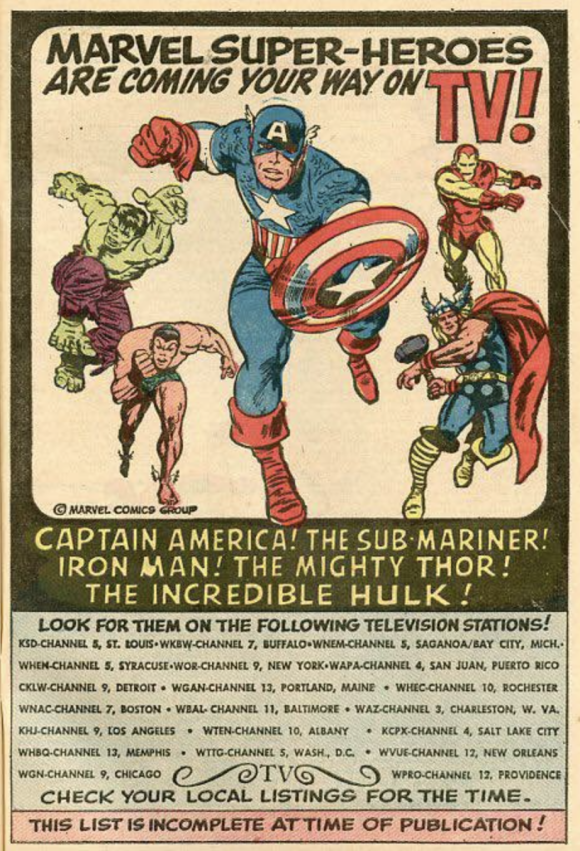
Marvel house ads had alerted fans that the Marvel Super Heroes were on the way, and on September 5, 1966, they arrived on TV screens across the country. The syndicated animated series ran on New York’s Channel 9, WOR-TV, and while they were broadcast in color, I originally saw them on our black-and-white set. It didn’t matter.
Because 1966 was shaping up to be a great year for comic book fans!
The live-action Batman premiered on ABC-TV on January 12, then we got The Marvel Super Heroes and, five days later, Filmation’s animated New Adventures of Superman on CBS Saturday mornings.
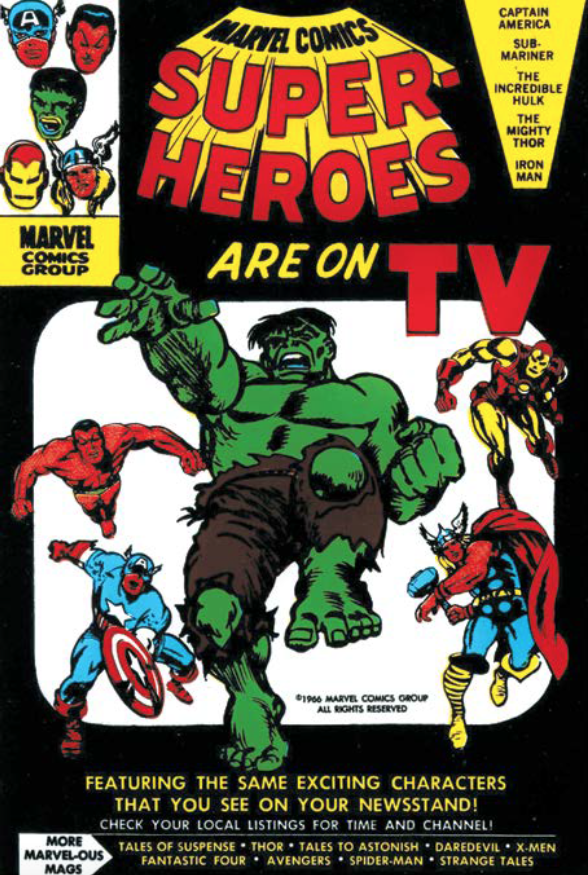
Like most Saturday morning fare, The New Adventures of Superman was produced in limited animation, which is a technique that reduces the amount of new artwork and movement in a scene to speed up production and lower costs. The Marvel Super Heroes — produced by Grantray-Lawrence and featuring segments starring Captain America, the Hulk, Iron Man, Thor, and Sub-Mariner — took the idea of limited animation to the extreme. Instead of fully animating newly drawn characters, Grantray-Lawrence photographed or traced panels and artwork directly from the comics and moved individual elements, i.e. an arm or Captain America’s shield hurtling through the air, over stationary backgrounds.
The animation was stiff and kind of strange, because unlike anything before or since, it utilized the art from published stories — illustrated by Jack Kirby, Steve Ditko, Bill Everett, Don Heck, Gene Colan, and the rest of the Bullpen. The one season produced 13 weeks of daily half hours, 65 episodes in all, each episode consisting of three, seven minute segments starring one of the five heroes: Cap on Mondays, Hulk on Tuesdays, Iron Man on Wednesdays, Thor on Thursdays (naturally), and Sub-Mariner on Fridays.
When Captain America throws his mighty shield,
All those who chose to oppose his shield must yield.
If he’s lead to a fight and a duel is due,
Then the red and the white and the blue’ll come through.
When Captain America throws his mighty shield.
The first episode shown starred Captain America in “The Origin of Captain America” / “Wreckers Among Us” / “Enter Red Skull” (September 5, 1966) and was adapted from Tales of Suspense #63-65 (March-May 1965), while subsequent episodes were taken from various issues through TOS #81 (September 1966) as well as from The Avengers.
The Hulk eps would use material from The Incredible Hulk and Avengers but would draw largely from Tales to Astonish #63-83, while Iron Man used stories from Tales to Astonish #43-83, as well as a couple of stories created for the series. Thor’s adventures were based on Journey Into Mystery #85-128 (by which time the title had changed to Thor), while Sub-Mariner was a mixture of Tales to Astonish #70-89, original material, and Fantastic Four #6 and Fantastic Four Annual #3, but because Grantray-Lawrence didn’t have the rights to the Fantastic Four, the FF were replaced by the original X-Men, who, though retaining their comic book names and costumes were called here the Allies of Peace.
’Cross the Rainbow Bridge of Asgard,
Where the booming heavens roar,
You’ll behold in breathless wonder,
The God of Thunder, Mighty Thor!
The fact that Grantray-Lawrence was mining many relatively recent Marvel Comics for the actual stories and art and bringing them to (limited) life on the screen was magical and insane. I had read a lot of those stories! I could sit in front of my TV and pick out the panels from the printed page that were panning and scanning across the screen.
According to an article about the series in Broadcasting Magazine (August 29, 1966), the secret to this method was “several special Xerox machines, at a cost of about $8,000 each” that reproduced the art onto an animation cel.
Doc Bruce Banner,
Belted by gamma rays,
Turned into the Hulk.
Ain’t he unglamo-rays!
Wreckin’ the town
With the power of a bull,
Ain’t no monster ’round
Who is as lovable.
As ever-lovin’ Hulk! Hulk! Hulk!
In the same article, Marvel Super Heroes executive producer Robert Lawrence was quoted as explaining his rationale for taking this unorthodox creative route. “Why change anything? We already have best-selling readership and established character. We also have the terrific artwork that appears in comics books.
“The people that work for comic books are great art directors, great cameramen,” Lawrence continued. “They have a tremendous feel for continuity, for action. Their work gives the impression of movement… We do not want to fully animate because then the figures on the screen become cartoony, or caricatures… What we do forces people to use their minds to fill in the gaps.”
Tony Stark makes you feel
He’s a cool exec with a heart of steel.
As Iron Man, all jets ablaze,
He’s fighting and smiting with repulsor rays!
Amazing armor! That’s Iron Man!
A blazing power! That’s Iron Man!
The show aimed for the 5:30-to-7 p.m. time period, and the article concluded with the observation that Marvel Super Heroes was expected to “appeal to as many adults as children. The animation firm is also counting heavily on a full range of licensed merchandising items to call attention to the new program… (with) items ranging from Halloween costumes and masks to trading cards and tattoo transfers. Merchandising is projected to total some $35 million a year in sales.”
For that single season, the Marvel Super Heroes lineup had an advantage over its DC Comics-based animated competition: The show’s daily package could be dropped into the existing children’s schedules of local stations across the country. The distributor sold it market by market and didn’t have to wait for one of the big networks — of which there only three in 1966—to give them a Saturday morning timeslot.
Stronger than a whale
He can swim anywhere
He can breathe underwater
And go flying through the air
The noble Sub-Mariner
Prince of the deep
So, beware you deadly demons
Lord Namor of Atlantis,
Is the Prince of the Deep.
And, of course, there were the theme songs! If there’s one facet of the show that just about everybody remembers, it’s that infectious theme, sung to a staccato military beat, and those tight little ditties for the individual characters, all written and composed by Jack Urbont. They were perfect encapsulations of the heroes, capturing the hyperbolic tone of Stan Lee’s prose and of the greater Marvel Universe, becoming earworms for fans of a certain age.
But, more than anything, the show was the first real, sustained exposure of that universe to the wider world outside the newsstand. Everyone knew who Superman and Batman were, but the Incredible Hulk and the Sub-Mariner? Well, face front, True Believers, because as of 60 years ago today, The Marvel Super Heroes had arrived!
Excelsior!
—
MORE
— PAUL KUPPERBERG: How ADAM WEST Made BATMAN Work. Click here.
— PAUL KUPPERBERG: Dig These 13 EXCERPTS From JULIE NEWMAR’s Never-Published Memoir. Click here.
—
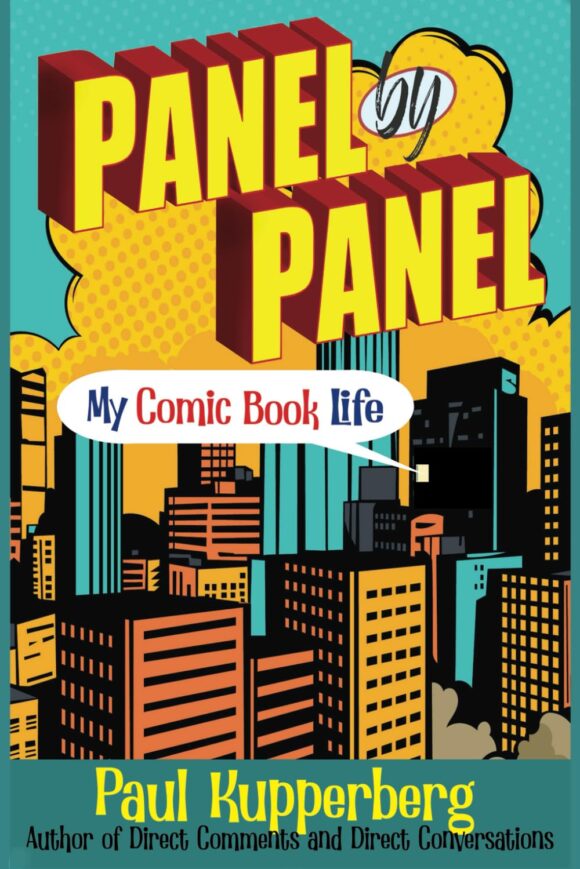
PAUL KUPPERBERG was a Silver Age fan who grew up to become a Bronze Age comic book creator, writer of Superman, the Doom Patrol, and Green Lantern, creator of Arion Lord of Atlantis, Checkmate, and Takion, and slayer of Aquababy, Archie, and Vigilante. He is the Harvey and Eisner Award nominated writer of Archie Comics’ Life with Archie, and his YA novel Kevin was nominated for a GLAAD media award and won a Scribe Award from the IAMTW. Check out his memoir, Panel by Panel: My Comic Book Life.
Website: https://www.paulkupperberg.net/
Shop: https://www.paulkupperberg.net/shop-1

September 5, 2026
Even though the quality is considered substandard by some, I still yearn for an official release on physical media.
September 5, 2026
I’d buy them. I’m sure I never saw all the episodes. For me, they were broadcast on TV20 out of Detroit. I do have 1 VHS tape collection that I’ve since ripped to digital. It’s a shame however the original artists weren’t properly credited.
September 5, 2026
They were released individually by hero on VHS back in the 80’s; I don’t know if these episodes were complete, but that’s the closest it got to a release.
September 5, 2026
I never saw these until the early to mid 80s, when Channel 19 WXIX out of Cincinnati began airing them every afternoon. Which seemed odd that they chose them because there was a glut of NEW syndicated cartoons to choose from at that time! But I ate them up! They showed them in random order, so you never knew if you were going to get a day of Cap, Hulk, etc. And they didn’t use the opening title sequence and theme, which was a bummer, since I later saw/heard it and loved it. This was while Marvel Tales was reprinting the Lee/Ditko Spider-Man run in order, so I felt like I was getting bombarded (like Gamma Rays)with Marvel’s early history. It was a great time!
September 5, 2026
I loved this show as a kid. I believe it aired in New York on WOR-TV Channel 9 in the late afternoons. It was my first introduction to these wonderful Marvel characters and has stuck with me for a lifetime. The limited animation never bothered me because it was like seeing what was years later called a “motion-comic”. for me it was like the comic book came to life. The show left such a lasting impression that it is the character voices of the voice-actors on the show that I hear whenever I later read the comics. Great fun memories. It needs to be officially made available to fans on DVD and Blu-Ray.
September 5, 2026
I’ll take any version that includes all the episodes and theme music. But I doubt source material exists to make a blue-ray viable. At a minimum the 4:3 box ratio would be seen as a drawback I’m guessing. But I’d definitely buy ‘em!
September 30, 2026
WOR-9 ran a half hour each weekday, then reran the week’s worth on Saturday morning. I was competing with 8 other siblings for 1 B&W TV back in the mid-60s, so the Saturday replay was much appreciated, especially when the shows on the 3 networks were reruns I had already seen.
September 5, 2026
Great article. Like Buck I also watched it on channel 20.
Although I wasn’t positive at the time I was pretty sure they were taken straight from the comics, so when I went to my first comic convention in the late 70s in Southfield, MI I was determined to find an episode in comic book form. I found a Tales to Astonish #70 with parts of a Sub-Mariner and Hulk episode that confirmed it.
September 5, 2026
Hey, Doug. There seems to be a few us from that area here on 13D. I was in the Wayne/Westland area. You?
September 7, 2026
Buck, pretty close, I was in Dearborn Heights, the Annapolis side.
September 5, 2026
I watched on WTEN from Albany NY. I was an avid DC reader but had never glanced at a Marvel comic. But I got hooked on those cartoons and soon bought an issue of MCIC (#8) that reprinted an Iron Man story I had seen in the cartoons. Pretty soon I abandoned DC and was buying the whole Marvel line (excluding Sgt. Fury and the Millie books). I own a UK DVD set with the Cap, Thor, Iron Man and Namor cartoons, and a separate German Hulk DVD set
September 5, 2026
All my younger neighborhood friends had color TV’s. I remember seeing part of BATMAN in a shop window in color for the first time. By the time we got a color TV Marvel cartoons were not playing anymore. Did get some silent shortened B&W ones with a clearance Kenner projector set. Sold that several years ago. Yeah, not great quality visually, but was excited to find it at Woolworths.
September 5, 2026
As a 10-year old I was jazzed when I’d catch a promo for this new series. Our local station chose to air episodes once a week. Apologies to the Hulk, but he was No. 5 for me in this group, yet his episodes ran for what seemed like months before Cap took over. Still, weird animation or not, Fridays at 4 p.m. were must-see TV. Also, can’t remember which Iron Man movie riffed on his theme song from this series. But it was played as Tony Stark was attending some social function.
Great article and great memories.
September 5, 2026
As a kid I found The Marvel Superoes to be unwatchable. The extremely limited animation got in the way of any enjoyment I could have from the show. When I rediscovered the series as an adult I instantly thought it was great. It’s fun to see certain poses and actions that I recognize from specific comic stories. Even the talking matched the writing in those early Marvel comics. What’s not to like?
September 5, 2026
When I was a kid, WPGH in Pittsburgh showed them with reruns of other superhero shows in a block from 4:30 p.m. to 5:30 p.m. So on Monday, there was Iron Man and Spider-Man, on Tuesday there was Batman (sometimes the Adam West show and sometimes Fillmation’s first animated series) and the Hulk, on Wednesday there was Ultraman and Aquaman (Filmation’s from the 60s), on Thursday there was Captain America and the Submariner, and on Friday, there was Thor and Superman (the Filmation series from the 60s). To be honest, I had been watching Spider-Man every day on the channel the year before and was sorry to see it reduced to once a week. (The Adam West Batman series had been running after it but it had been on for a couple of years and I had seen all of the episodes multiple times.) But I also was fairly young then and waiting a week to see the next part of the multi-part Marvel shows was a stretch. The themes were cool, though.
September 6, 2026
I couldn’t get the Marvel Superheroes on my TV channels at the time, until after Spider-Man catched on in 1967. We had B&W TV until 1969. Kalamazoo and South Bend and Elkhart ran them at the time around 4 PM, right after I did my homework from school. Though sometimes our antenna won’t pick up the stations and I miss quite a few. I noticed a few mistakes in the article. Saganoa/ Bay City. That should be Saginaw. Iron an appeared in Tales of Suspense, not Tales to Astonish.
September 6, 2026
Re: Saginaw — that’s the original ad!
September 6, 2026
I guess whoever did the ad never heard that song. https://genius.com/Lefty-frizzell-saginaw-michigan-lyrics
September 6, 2026
I like the excuse for the limited animation. Whether a suit making an excuse or not. It makes sense and I loved it. Flaws and all.