
Old-time radio shows and their comics connections…
By PETER BOSCH
Drop your TV remote! It’s me, the Fun Pharaoh of Four Color Radio! I’m ready to take you all again in the Wayback Machine to the days when radio ruled the airwaves. This month, get ready for an adrenaline-charged ride in the Black Beauty with the two greatest racket busters of their time (predating Batman and Robin by three years!) — the Green Hornet and Kato!
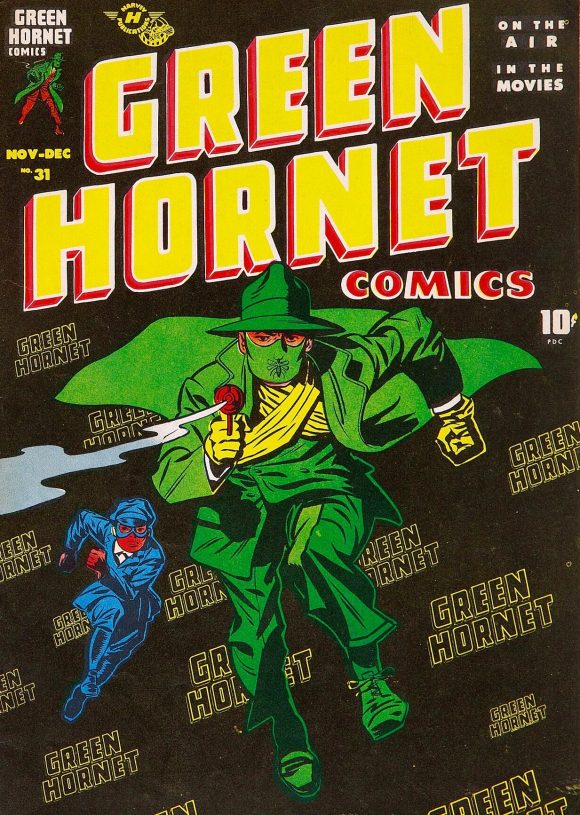
Green Hornet #31 (Nov.-Dec. 1946, Harvey). Cover art by Al Avison.
In 1935, George W. Trendle, the owner of WXYZ radio in Detroit, wanted a follow-up to the station’s great success, The Lone Ranger. Except, this time, he wanted the criminals that the hero would face to be the worst of our modern-day society — dirty politicians, racketeers, and crooked businessmen who preyed upon the public. For this, he turned to the creator of the Lone Ranger, Fran Striker.
As most fans know, there was a great similarity between the two masked heroes. Neither used their weapons to kill anyone. Both had sidekicks (Tonto and Kato), and where the Ranger had Silver, the Hornet had the snazzy Black Beauty. And let’s not forget how the Lone Ranger was so often mistaken for a bad guy because he wore a mask.
On the other hand, the Green Hornet deliberately made people think he was a criminal, as bad as the rest, in order to get within their shady enterprises and expose them to the police. And, oh yes, they were related — but that fact didn’t come out for a number of years.
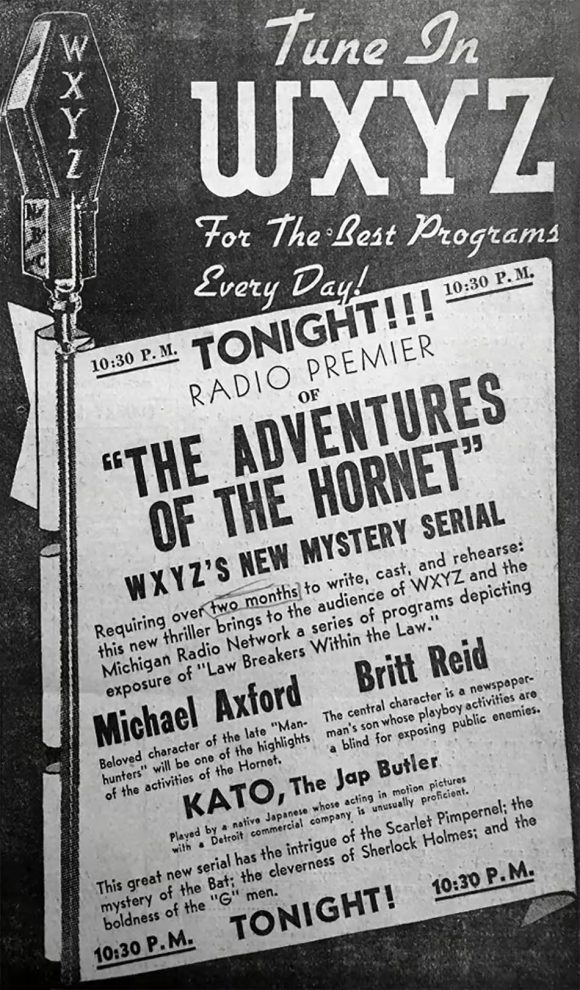
The Green Hornet radio program had its 90th anniversary this year, with it airing originally on January 31, 1936, on WXYZ radio and a few other Michigan stations. In the promotional newspaper ad (above) for the premiere broadcast, you are going to notice three things right away. The first is that the show aired at 10:30 pm. This would quickly change to 7:30 pm, twice a week.
The second item is the title of the show — The Adventures of the Hornet. That also quickly changed because Trendle wanted to copyright it but he discovered “the Hornet” could not be registered; a very rushed conference with station employees came up with “the Green Hornet” — and that worked.
The last item — do you see how Michael Axford got bold billing BEFORE the name of Britt Reid, the hero of the show? The reason for this is Axford, created by Striker, had already been a very popular regular character on two previous radio series from Trendle, Warner Lester, Manhunter, and Manhunters. (The ad also manages to offend modern sensibilities with the designation of Kato.)
In the starring role(s) of the Green Hornet and Britt Reid, the crusading publisher of the Daily Sentinel, was Al Hodge, a 24-year-old actor who also worked on the staff of WXYZ as a writer and a producer for the busy station. (His family was already amazing in their own right, especially his father who had been a trick rider in the 1890s in Buffalo Bill’s Wild West show!)
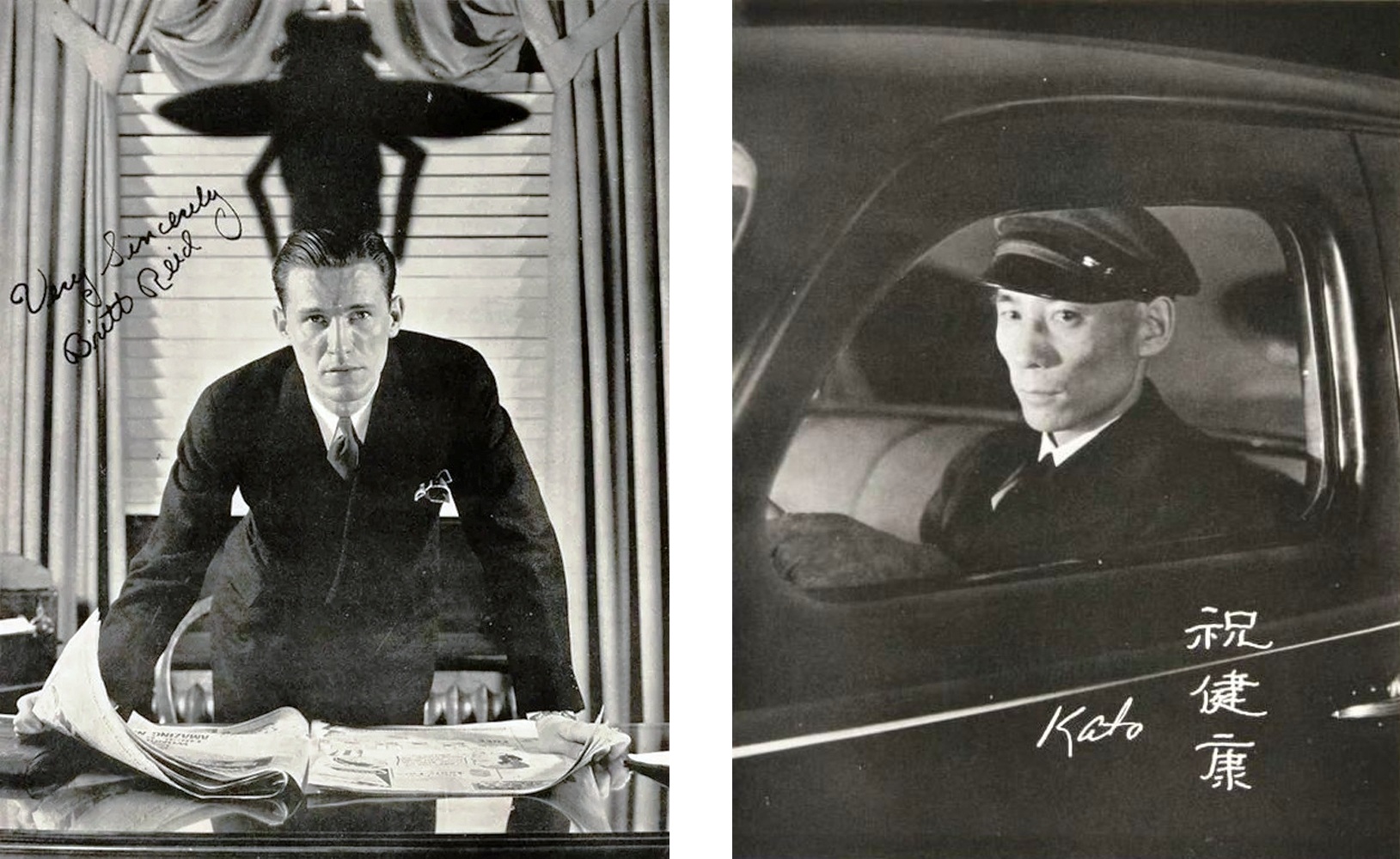
Al Hodge as Britt Reid and Raymond Toyo as Kato. (The letters in the Kato photo mean “celebrate good health.”)
To play Kato, Tokutaro Muramoto (aka Tokutaro Kayashi) was hired. The Asian gentleman was an occasional actor, one who did that for a lark, because his main occupation was owning a very successful Japanese restaurant. WXYZ’s program director, James Jewell, renamed him “Raymond Toyo.”
Also in the cast were Jim Irwin carrying over his role of Michael Axford, Lee Allman as Reid’s secretary, Lenore “Casey” Case, Jack Patruzzi as reporter Ed Lowry, and Rollon Parker as the newsboy who closed each broadcast screaming a headline. (Mike Wallace, later of CBS News, was an announcer of the program for a time.)
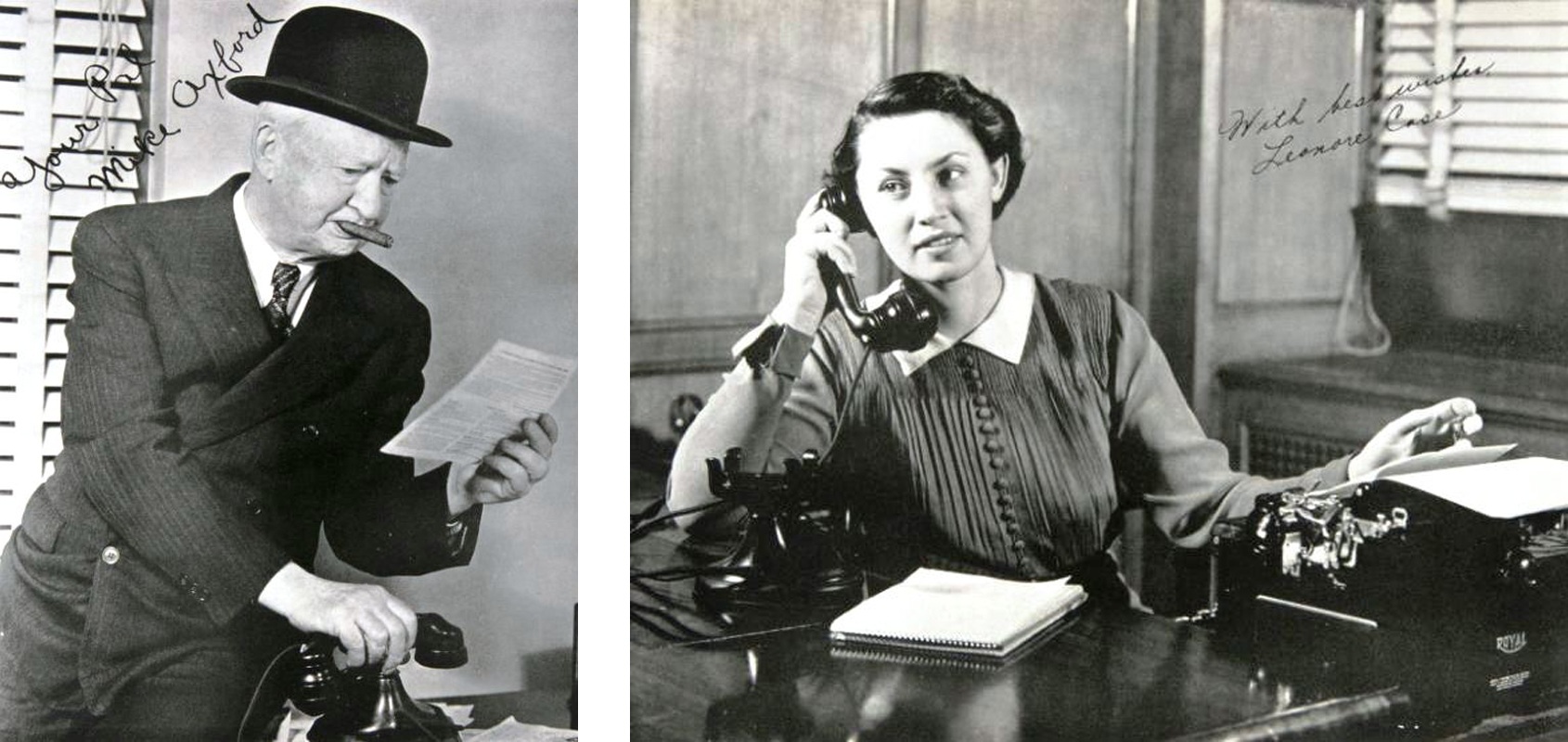
Jim Irwin as Michael Axford and Lee Allman as Lenore Case
As mentioned earlier, The Green Hornet began on WXYZ and a few Michigan radio stations (running from Jan.31, 1936 to April 7, 1938). It was then picked up by the Mutual Broadcasting System, where it aired from April 12, 1938 to November 9, 1939. Following that, The Green Hornet moved over to the Blue Network (which ended up becoming ABC), starting with the program of November 16, 1939, and continuing through to the program’s last broadcast in 1952.
Hodge’s popularity as the Hornet was such that when Universal made the first of two movie serials, The Green Hornet (1940), they had him supply the voice of the Hornet as soon as actor Gordon Jones donned the mask. The second serial did not use Hodge.
Replacements in the radio’s cast began as early as 1938 with the death of Jim Irwin; Gilly Shea stepped into the role of Axford. Hodge left the series in 1943 to serve in the Navy during World War II and was replaced by Donovan Faust. In 1944, Bob Hall took over from Faust and starred as Reid/the Hornet through 1951.
Finally, Jack McCarthy came in and took over the roles for the remainder of the series. (By the time of McCarthy’s arrival, Hodge was already celebrating his new career as a TV star — he was the hero of one of early television’s greatest successes, Captain Video and His Video Rangers).
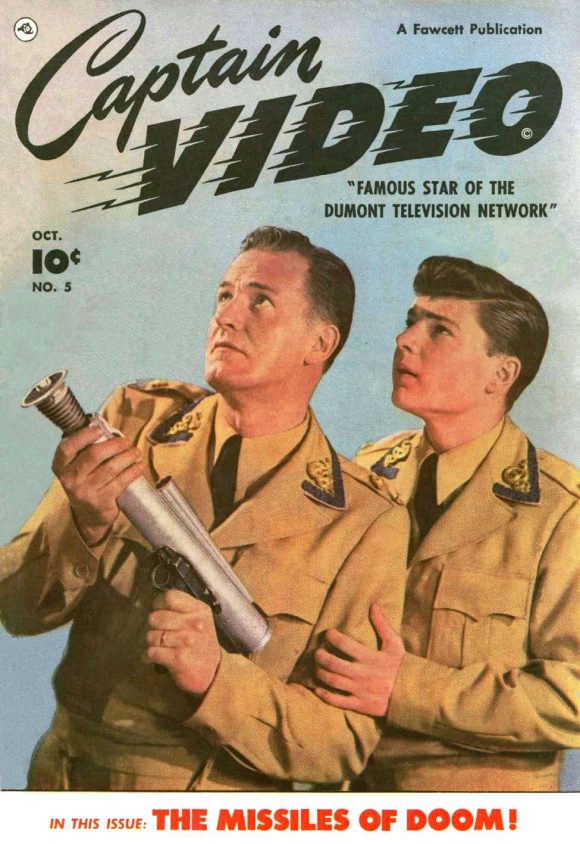
Al Hodge as Captain Video (left) with Don Hastings as Video Ranger. Captain Video #5 (Oct. 1951, Fawcett).
A cast change that was regretfully borne out of necessity was that of Raymond Toyo. In 1942, he suddenly disappeared and no one at the station ever saw him again. Rollon Parker portrayed Kato from that point on, followed by Michael Tolan.
For the many decades since, one theory was that he had been arrested and sent to an internment camp during World War II due to his Japanese nationality. In 2013, another supposition was put forward that Toyo had been drafted as a U.S. soldier and shipped overseas to fight in the European theater. Both versions have him returning to civilian life in 1945 or 1946, but he did not resume his career as an actor.
And there is one other performer who deserves attention: John Todd.
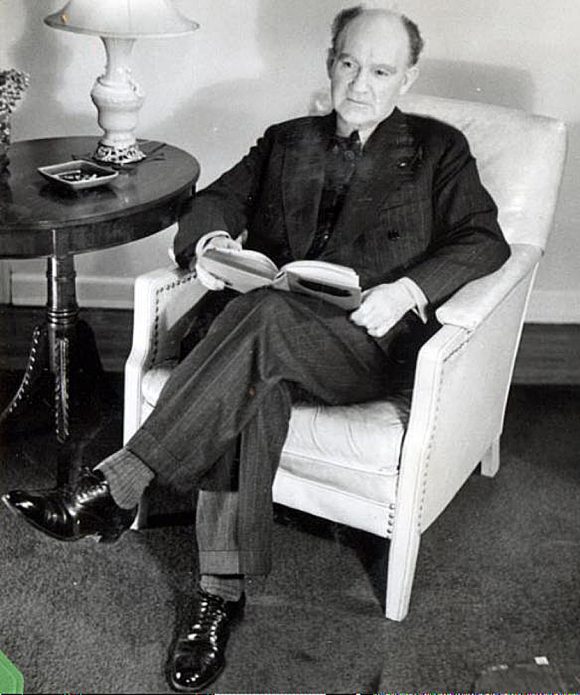
John Todd
On The Lone Ranger, Todd (a former Shakespearean actor) played Tonto for the series’ full 21 years, and on The Green Hornet, he was Dan Reid, Britt’s father and the founder of the Daily Sentinel. The character of Dan Reid was the Lone Ranger’s nephew, played initially on that series by young Ernie Winstanley.
(Fun fact: The elder Dan appeared in 1937 on The Green Hornet — five years before Fran Striker thought of creating a teenage version of him for The Lone Ranger in 1942.)
One of the most important shows featuring Britt and Dan was the Nov. 11, 1947, episode of The Green Hornet called “Too Hot to Handle.” Dan learns that his son is the Green Hornet is very proud. He tells Britt that he, too, fought for justice — in the Old West, with a rider whose picture was on the wall.
While the rider was not mentioned by name, we didn’t need to hear it — for, in the background was the stirring Lone Ranger theme music (Rossini’s classical William Tell Overture). This was a moment when two of fiction’s greatest heroes met spiritually through the presence of one man, Dan Reid.
Merchandising began for The Green Hornet as early as 1939 with a proposed comic strip that never made it past the drawn samples stage, unfortunately. The next opportunity was the 1940 movie serial mentioned earlier, as well as a series of Big Little Books and comic books. Here’s a sampling…
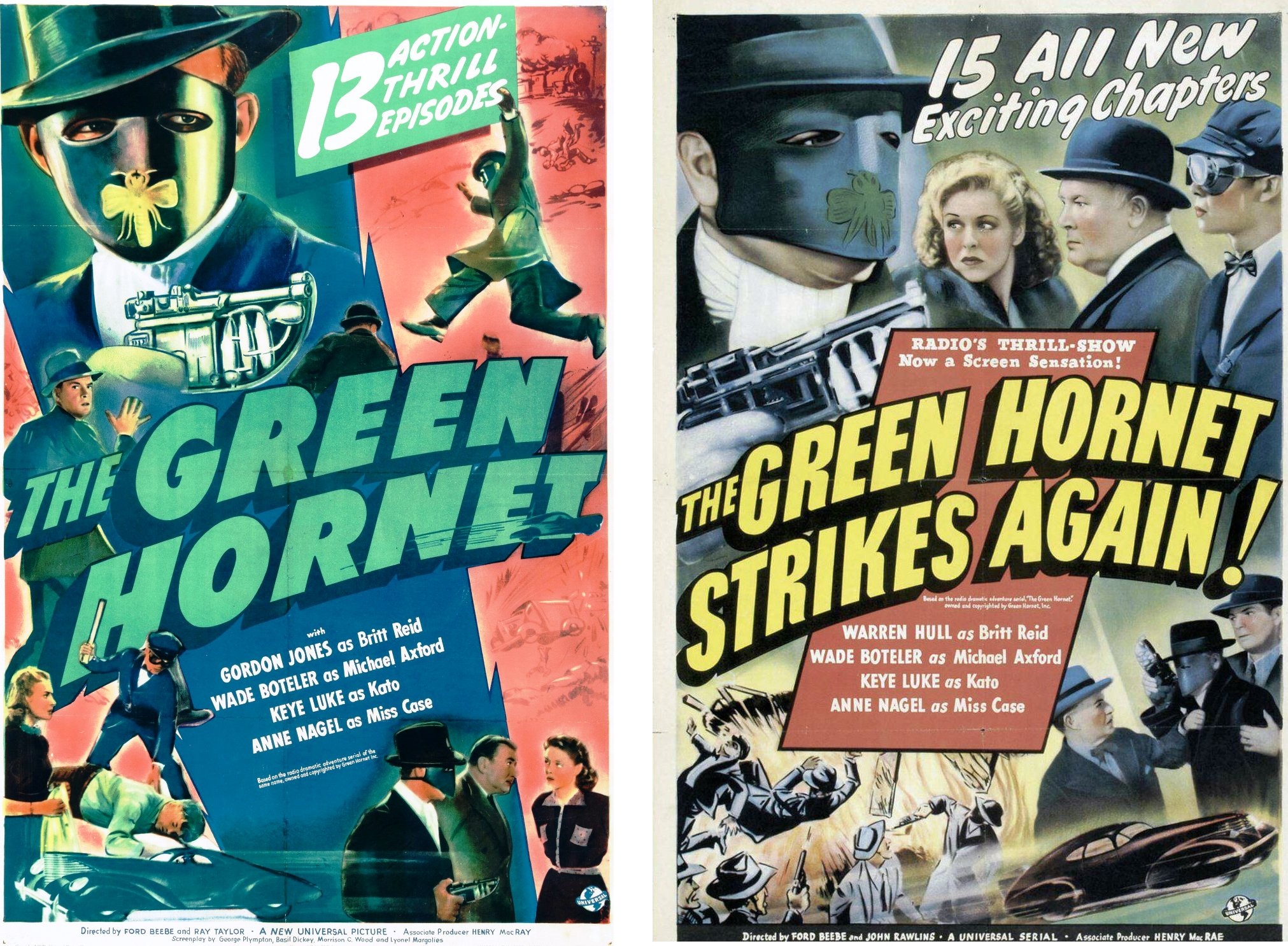
Movie posters and several lobby cards for The Green Hornet (1940) and The Green Hornet Strikes Again (1941) serials.
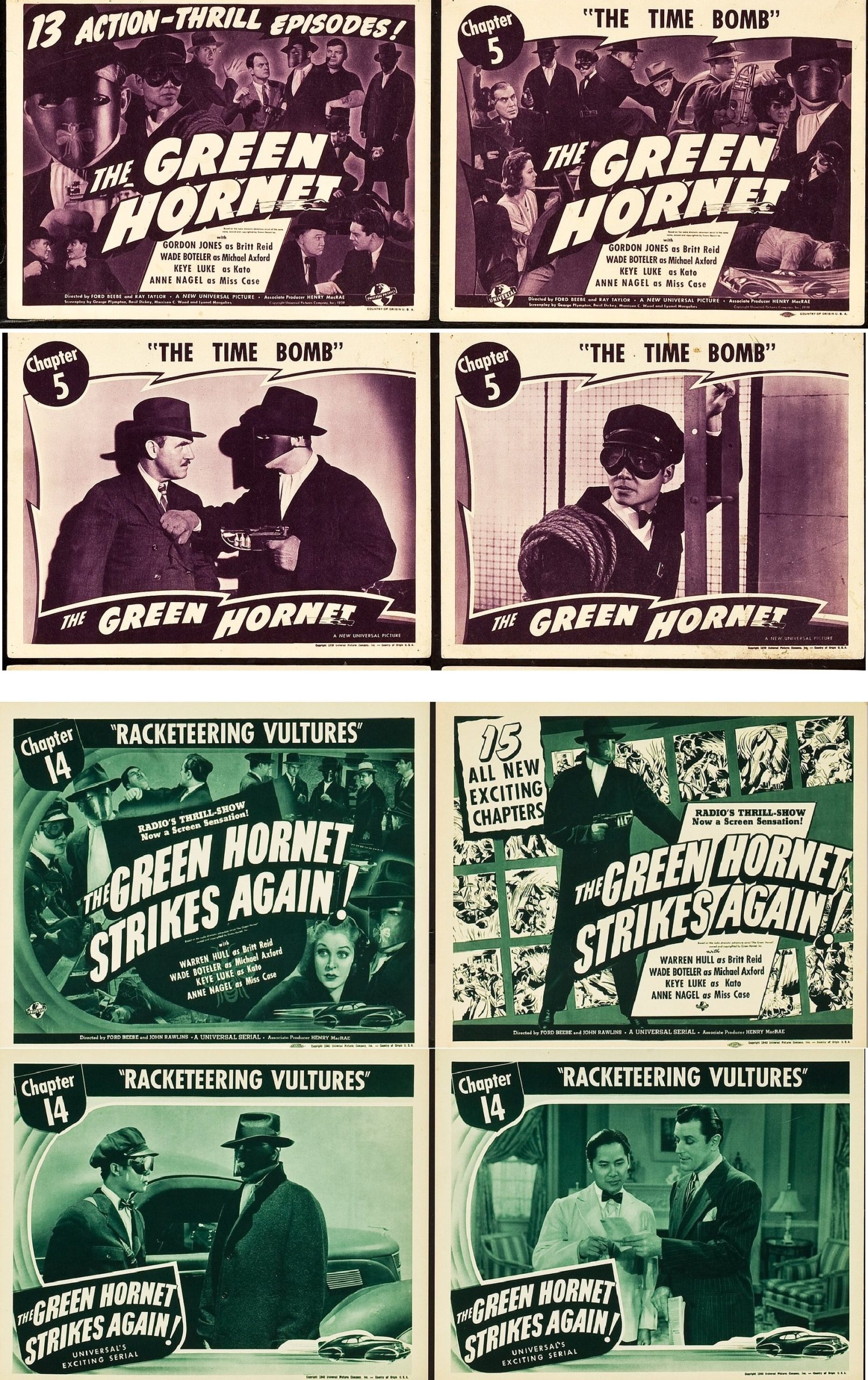
Gordon Jones was Reid/the Green Hornet in the first serial and Warren Hull starred in the second. Keye Luke played Kato in both.
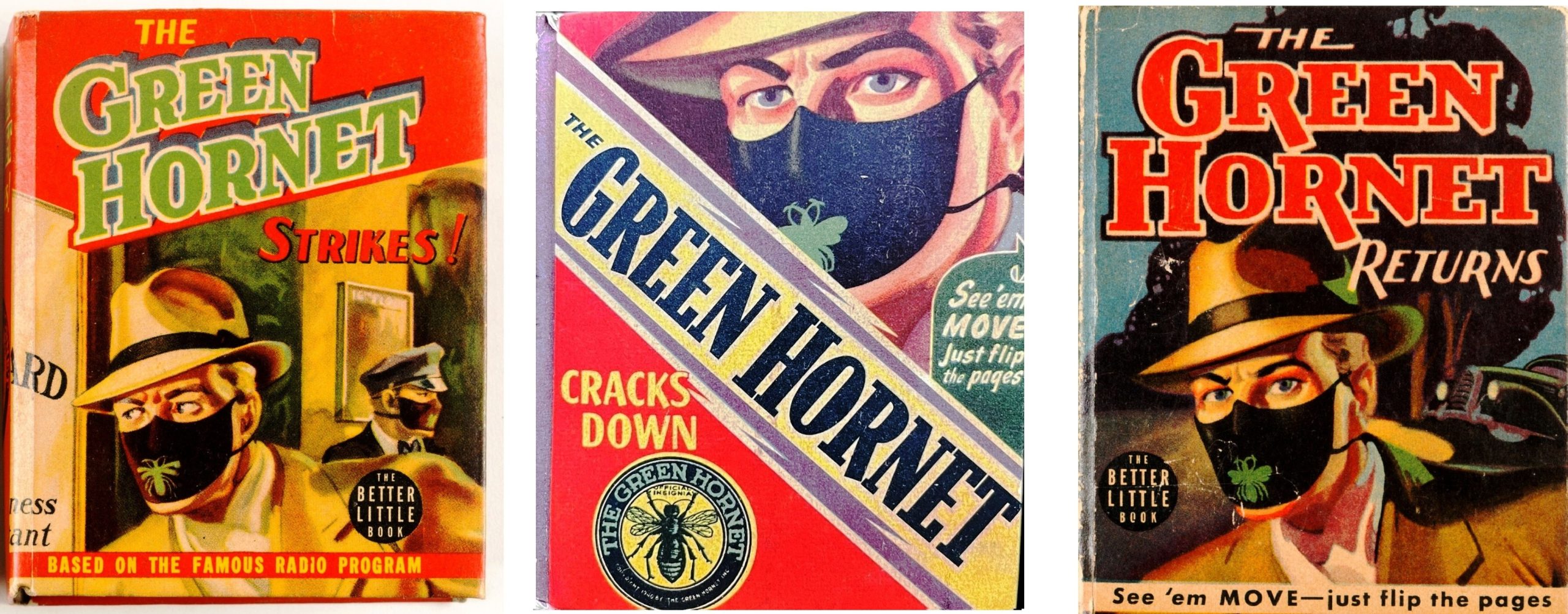
Whitman published these three Big Little Books between 1940-1942
(Unless otherwise indicated, the cover artists for the following comics have not been verified.)
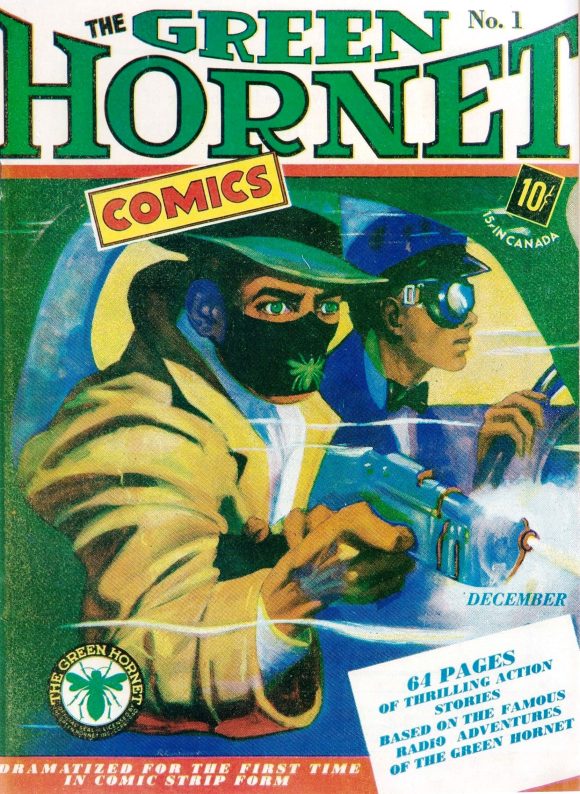
Green Hornet Comics #1 (Dec.1940, Helnit). The publisher released five more issues after this.
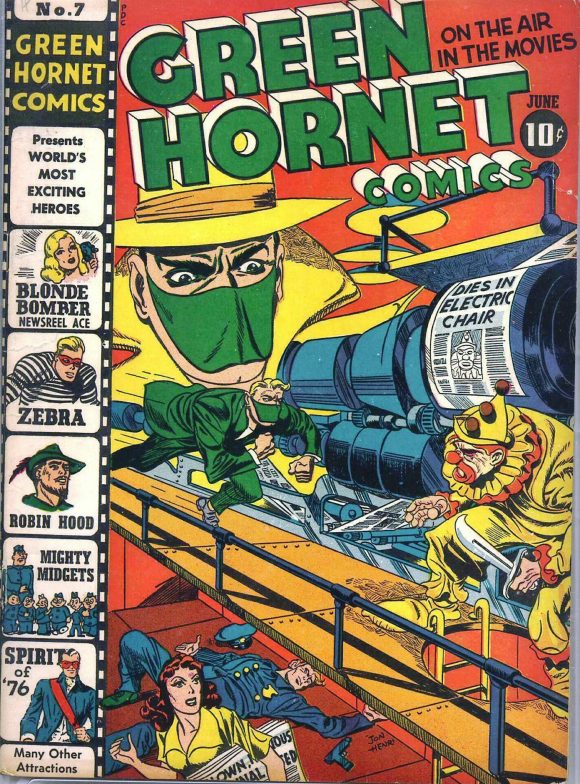
Harvey took up the title with this issue, continuing the numbering from where Helnit left off. Green Hornet Comics #7 (June 1942, Harvey). Cover art by Jack Kirby (pencils) and Joe Simon (inks).
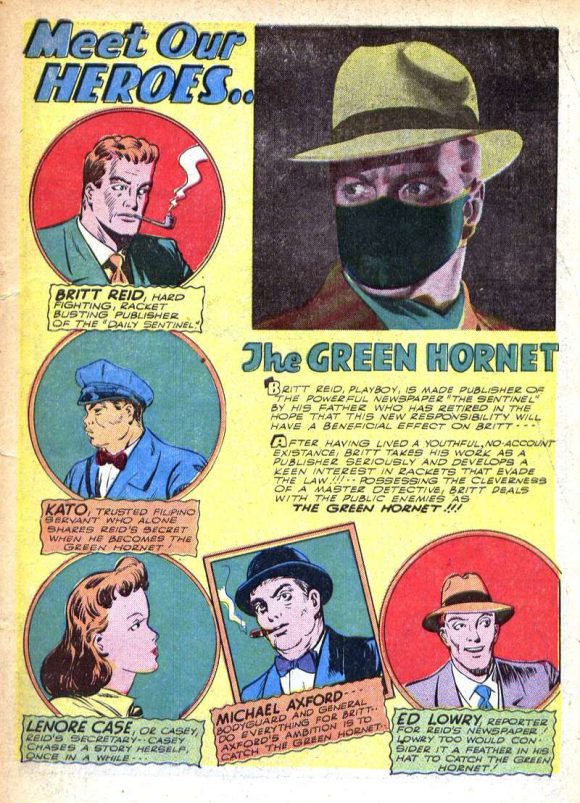
Splash page from the same issue above, introducing the main characters, all part of the radio program
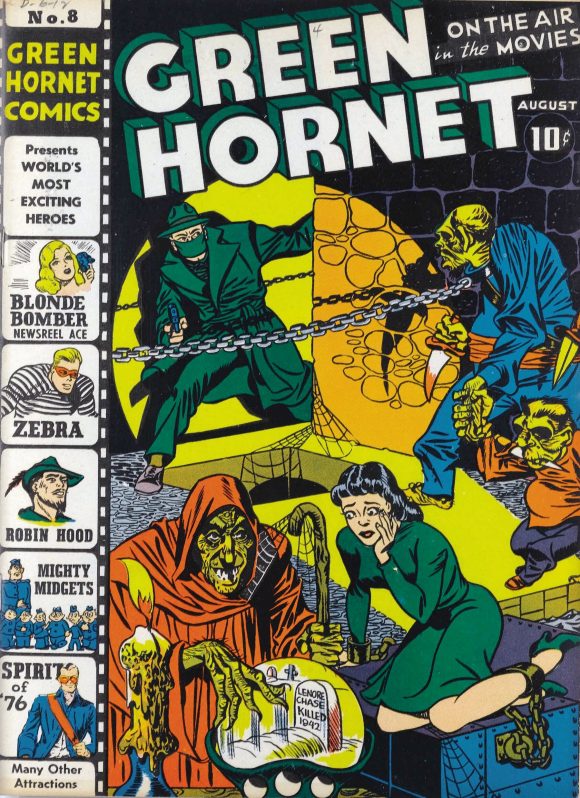
Green Hornet Comics #8 (Aug. 1942)
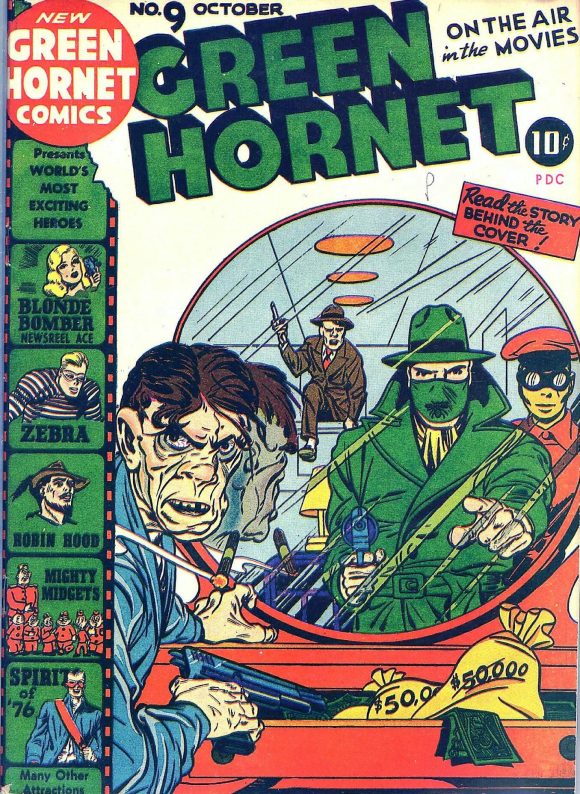
Green Hornet Comics #9 (Oct. 1942). Kirby pencils, possibly Simon inks
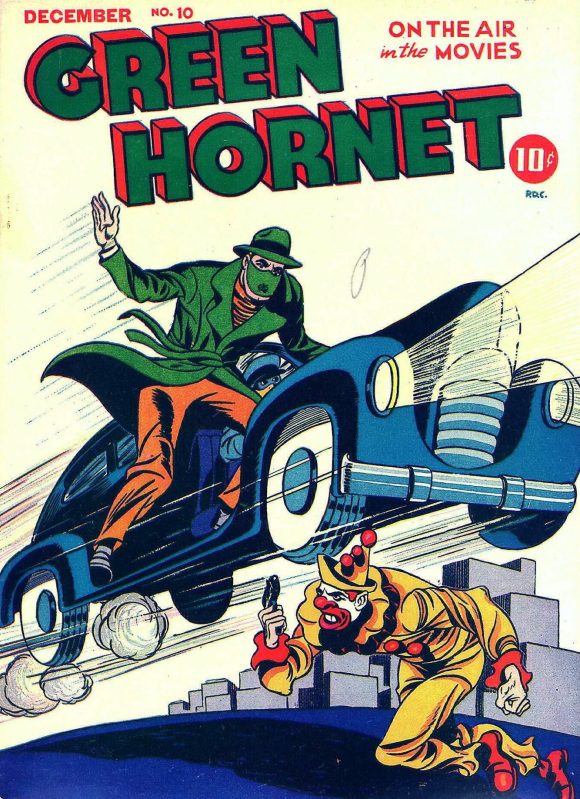
Green Hornet Comics #10 (Dec. 1942).
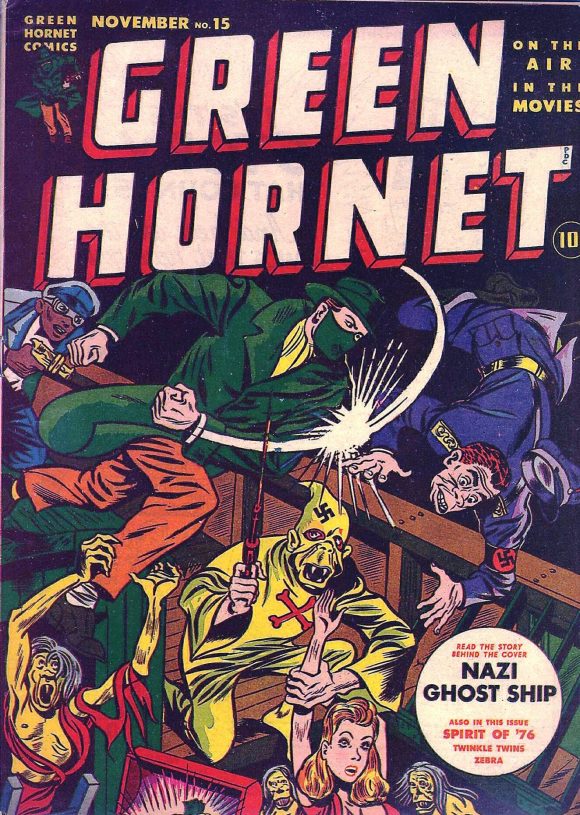
Green Hornet Comics #15 (Nov. 1943). Cover art is possibly by Alex Schomburg.
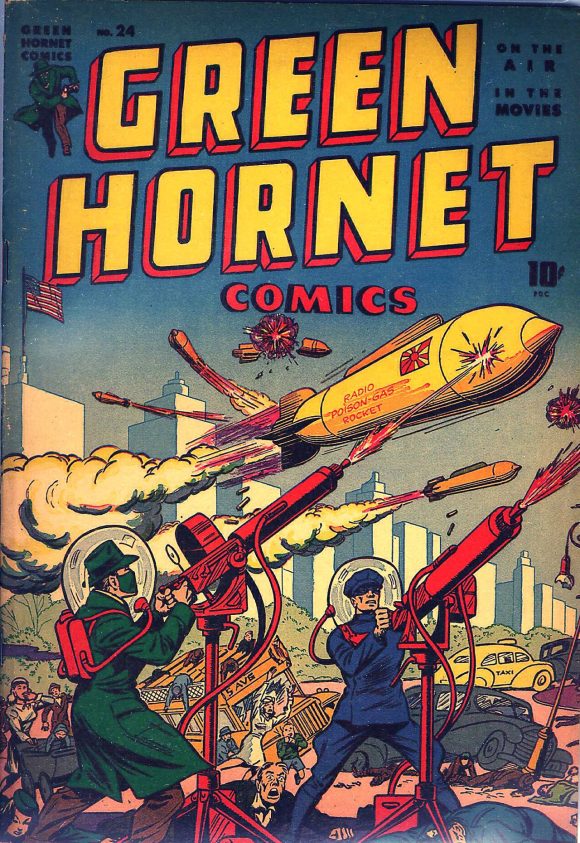
Green Hornet Comics #24 (May 1945).
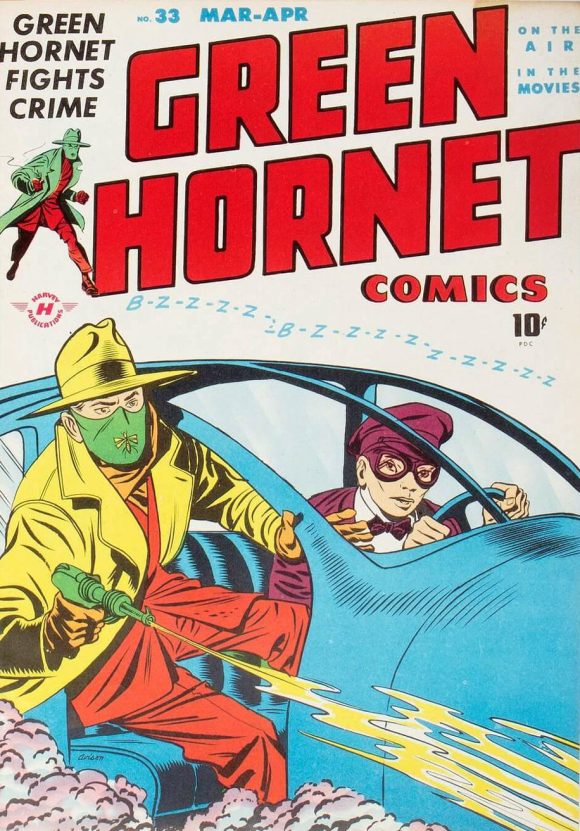
Green Hornet Comics #33 (Mar.-Apr. 1947). Cover by Al Avison.
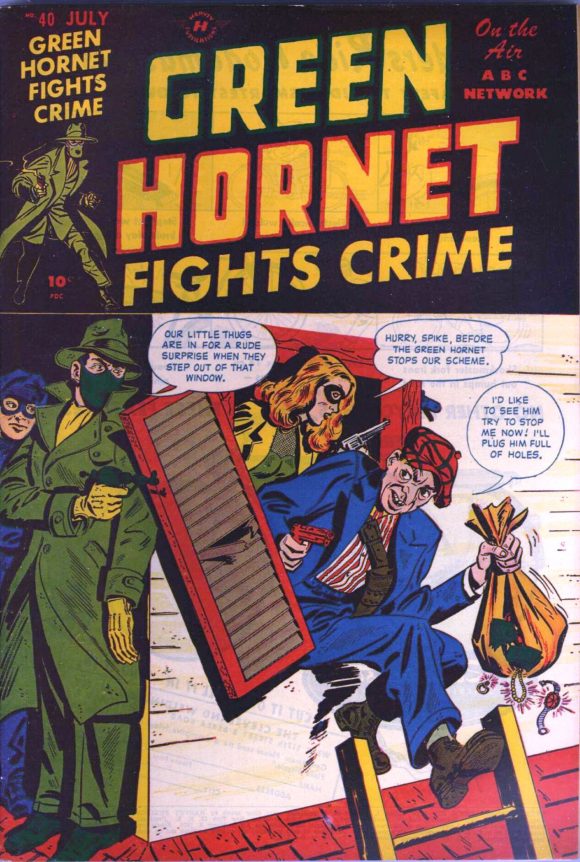
Green Hornet Comics #40 (July 1948).
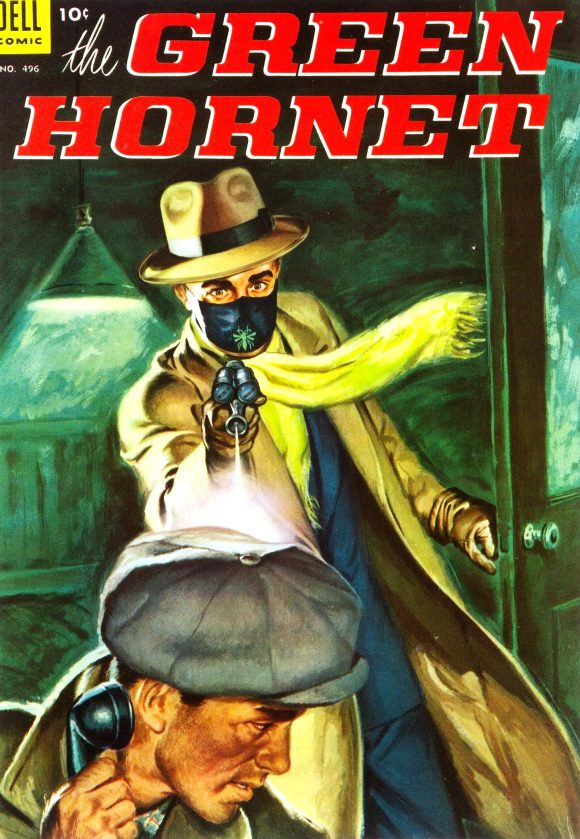
Four Color #496 (Sept. 1953, Dell).
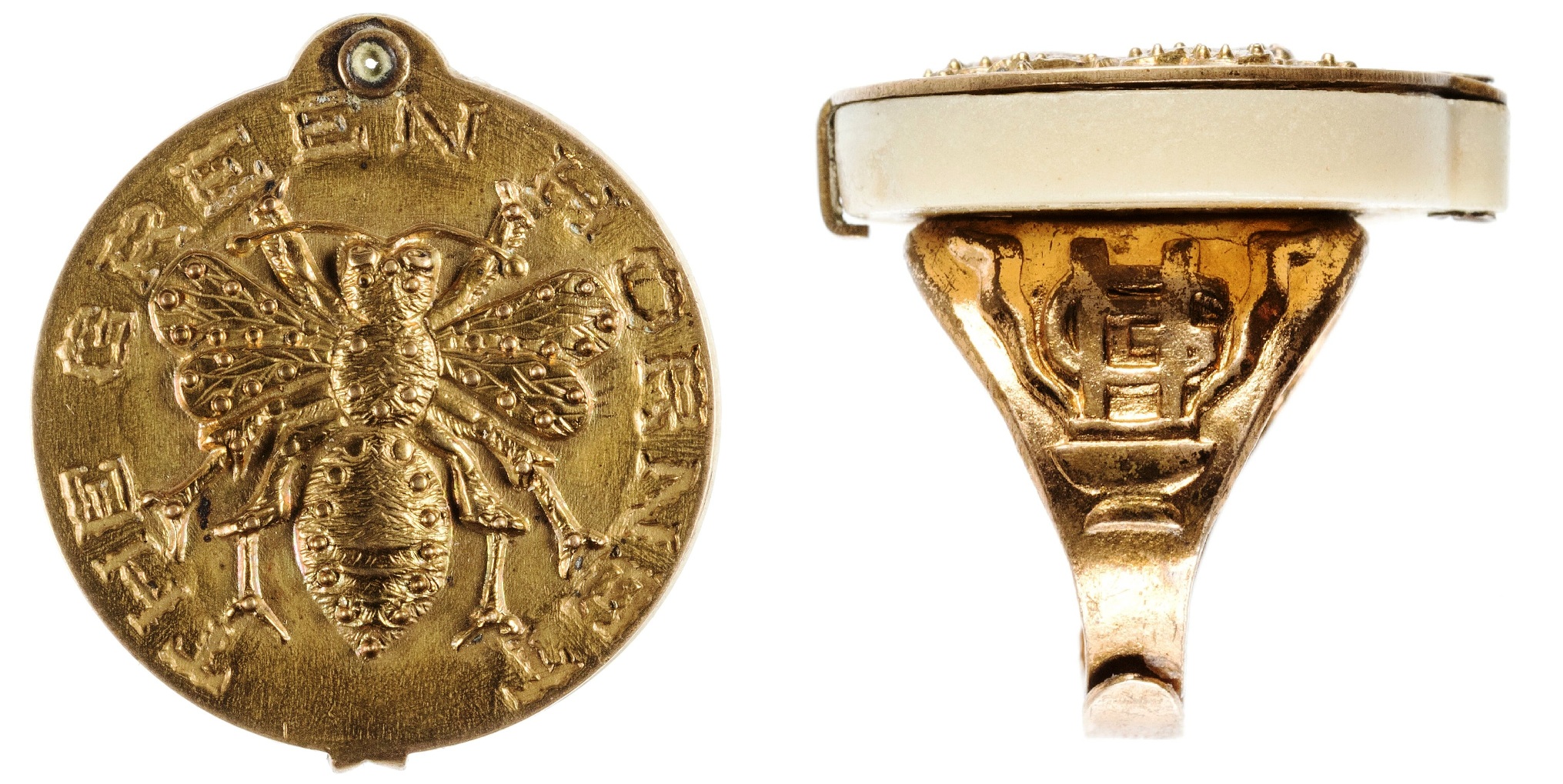
Green Hornet secret compartment, glow-in-the-dark ring. Premium from General Mills in 1947.
The Green Hornet’s original broadcast run ended December 5, 1952. Trendle had done well with TV versions of The Lone Ranger and Challenge of the Yukon (another original WXYZ radio production), but in the early-to-mid Fifties when he tried to get a television deal for The Green Hornet, it just never came together.
However, there was a light at the end of the tunnel. There were transcribed discs containing hundreds of The Green Hornet radio shows from 1939 onward. Shows from the past that would appeal to many nostalgia seekers in the 1960s…
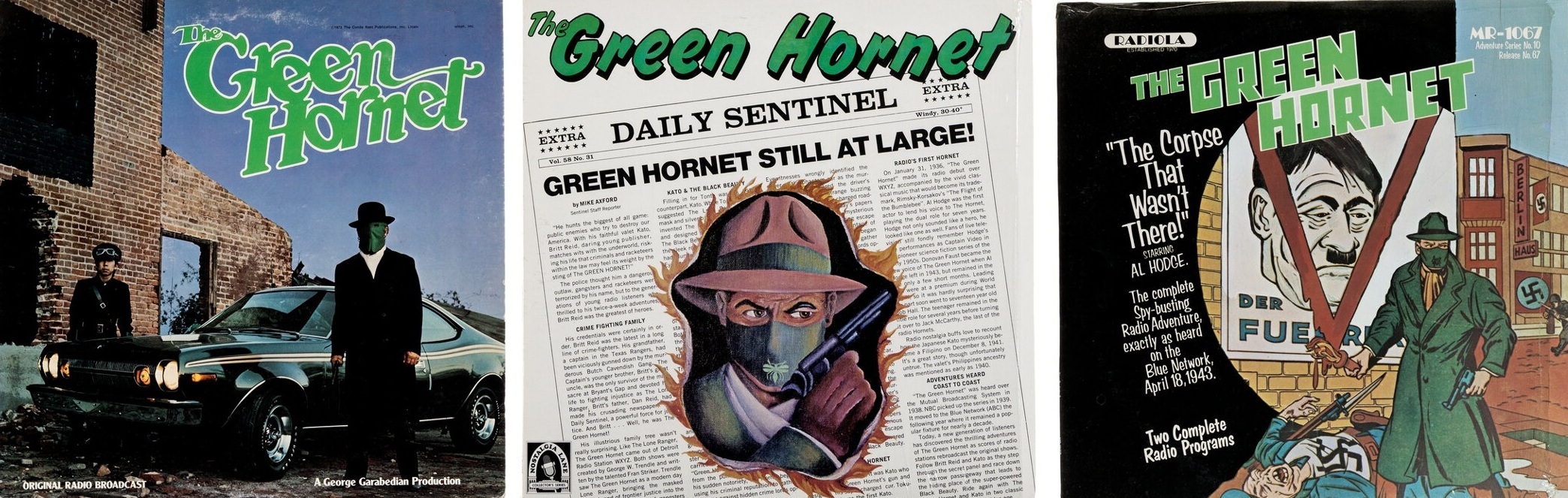
Album collections of classic radio shows were quite common to find in record stores in the ’60s and ’70s.
… and possibly — just possibly — inspire a new version of The Green Hornet.
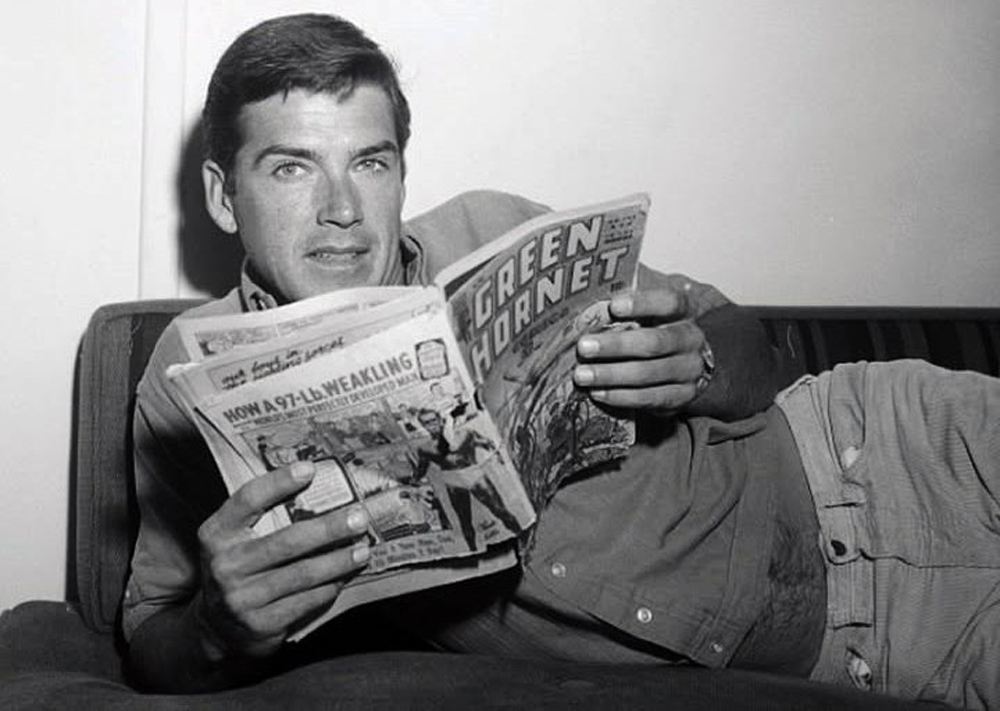
If you are wondering which issue of Green Hornet Comics that Mr. W is reading, look above for the cover of #24.
Now, it’s time for us to get back to 2026. And when we get there, if you have the inclination to listen to a Green Hornet show, there are over 300 that can be heard online.
For much more on The Green Hornet, Martin Grams Jr. and Terry Salomonson’s 800-page book, The Green Hornet: A History of Radio, Motion Pictures, Comics and Television, is essential reading!
OK, we are here. Please gather up all your belongings (records, comics, etc.) and head out on the left side of the Wayback Machine. I will see you back here again next month.
—
MORE
— FOUR COLOR RADIO: The All-Time Classic THE LONE RANGER. Click here.
– FOUR COLOR RADIO: The 1930s’ FLASH GORDON and JUNGLE JIM. Click here.
—
13th Dimension contributor-at-large PETER BOSCH’s first book, American TV Comic Books: 1940s-1980s – From the Small Screen to the Printed Page, was published by TwoMorrows. (You can buy it here.) A sequel, American Movie Comic Books: 1930s-1970s — From the Silver Screen to the Printed Page, is out now. (Buy it here.) Peter has written articles and conducted celebrity interviews for various magazines and newspapers. He lives in Hollywood.

July 18, 2026
I surely would like to hear those four episodes of Captain Marvel written about by PC in the FCA section of Alter Ego awhile back.
July 18, 2026
Kato’s nationality also was changed to Philipino after World War II began. Thanks for the interesting article on the Green Hornet. The Now Comics Green Hornet series might make a good subject for the Buried Treasure feature.
July 18, 2026
I noticed that too in the comic’s splash page above. Was trying to figure out if it was purely a WWII reaction or a one-off mistake missed by the editor. Peter, do you have the full story?
July 18, 2026
Wow! I’ve never seen the Green Hornet Comics covers. Love ’em. I’m particularly fascinated by #8. So much going on–
July 18, 2026
Buck, see above response to Warren.
July 18, 2026
Hi, Warren and Buck. Actually, Kato was called Filipino before December 7, 1941. In June of 1941, he was clearly indicated as such because of rising tensions with Japan.
July 20, 2026
Thanks for the history Peter! My father is a huge fan of both the Lone Ranger and the Green Hornet. He was actually the first who told me about their family connection. He had some Old Time Radio tapes that he let me listen to that I quite enjoyed. Then of course there was the crossover with Batman I’d see in reruns, so when the NOW Comics series began, I jumped right in.