
Old-time radio shows and their comics connections…
By PETER BOSCH
Welcome back to FOUR COLOR RADIO, the magical station where you can be instantly transported to the great old days when radio was what TV is today — the entry into a land of fantastic imagination! I am your host and today we must don our Western garb to visit a time when the masked rider of the plains was our companion in the fight for law and order. So, let’s return to those glorious days when the Lone Ranger and Tonto roamed the Old West.
We actually need to start in 1929, four years before the Lone Ranger came into existence. George W. Trendle and his partner, John H. King, were owners of a string of movie theaters but they decided to dispose of them and turn their attention to what they thought would be a more profitable medium — radio. They purchased a station in Detroit, WXYZ, with the plan to cut ties to the Columbia Broadcasting System (CBS), which had been supplying nighttime programming to the outlet for a fee. Trendle and King believed great profits were to be made by producing their own programs and raking in 100% of the money from local sponsors.
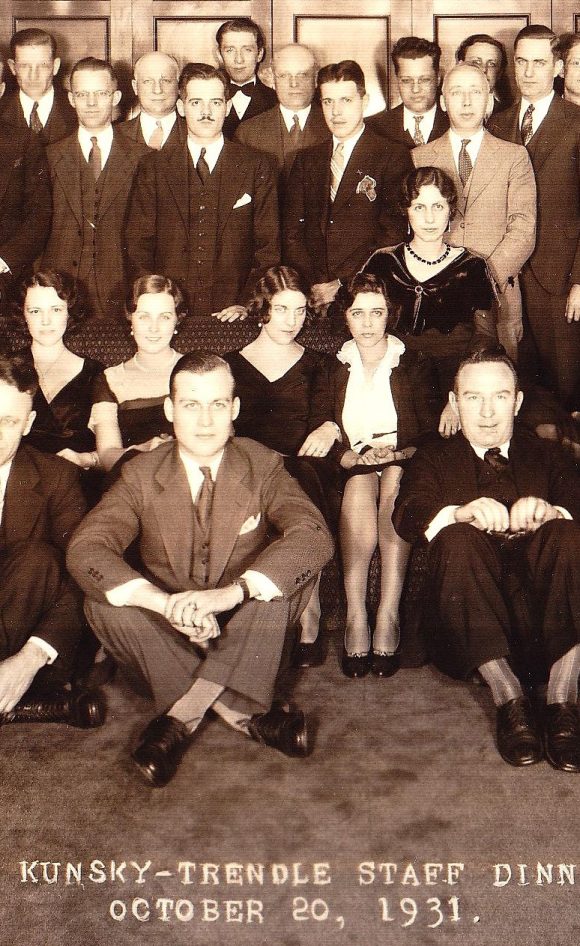
1931 Staff Dinner. Trendle can be seen center at the back (the balding older man).
Toward the end of 1932, however, WXYZ was losing $4,000 a week. What they needed was a hero to come riding to their rescue.
Though several individuals later said the Lone Ranger was their idea, from all accounts it was actually a group effort by Trendle and his team. Trendle decided to make the project a Western that was aimed at kids. He particularly liked the idea of the setting because cowboy character merchandising was easy and had plenty of opportunities for different items.
Trendle was also a fan of Zorro, who had debuted in a 1919 pulp magazine serial, and onscreen in the 1920 silent swashbuckler starring Douglas Fairbanks, The Mark of Zorro. He wanted the new character to also wear a mask and have some of the derring-do and humor of Zorro. The mask stayed but the Ranger was not the right fit for derring-do and humor. The idea for the name of the Western hero was pitched by a team member (“Lone Star Ranger” had been mentioned first but there was already a character called that).
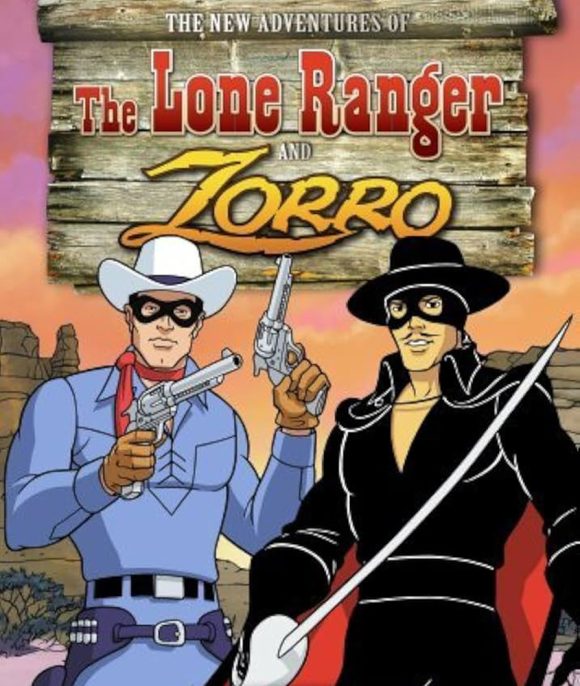
Promotional art for the 1980 Filmation cartoon series, The New Adventures of the Lone Ranger and Zorro.
Trendle called a freelance writer who had sold a number of scripts to WXYZ and got him on board to develop what they had. The writer’s name was Francis Hamilton Striker, better known as Fran Striker.
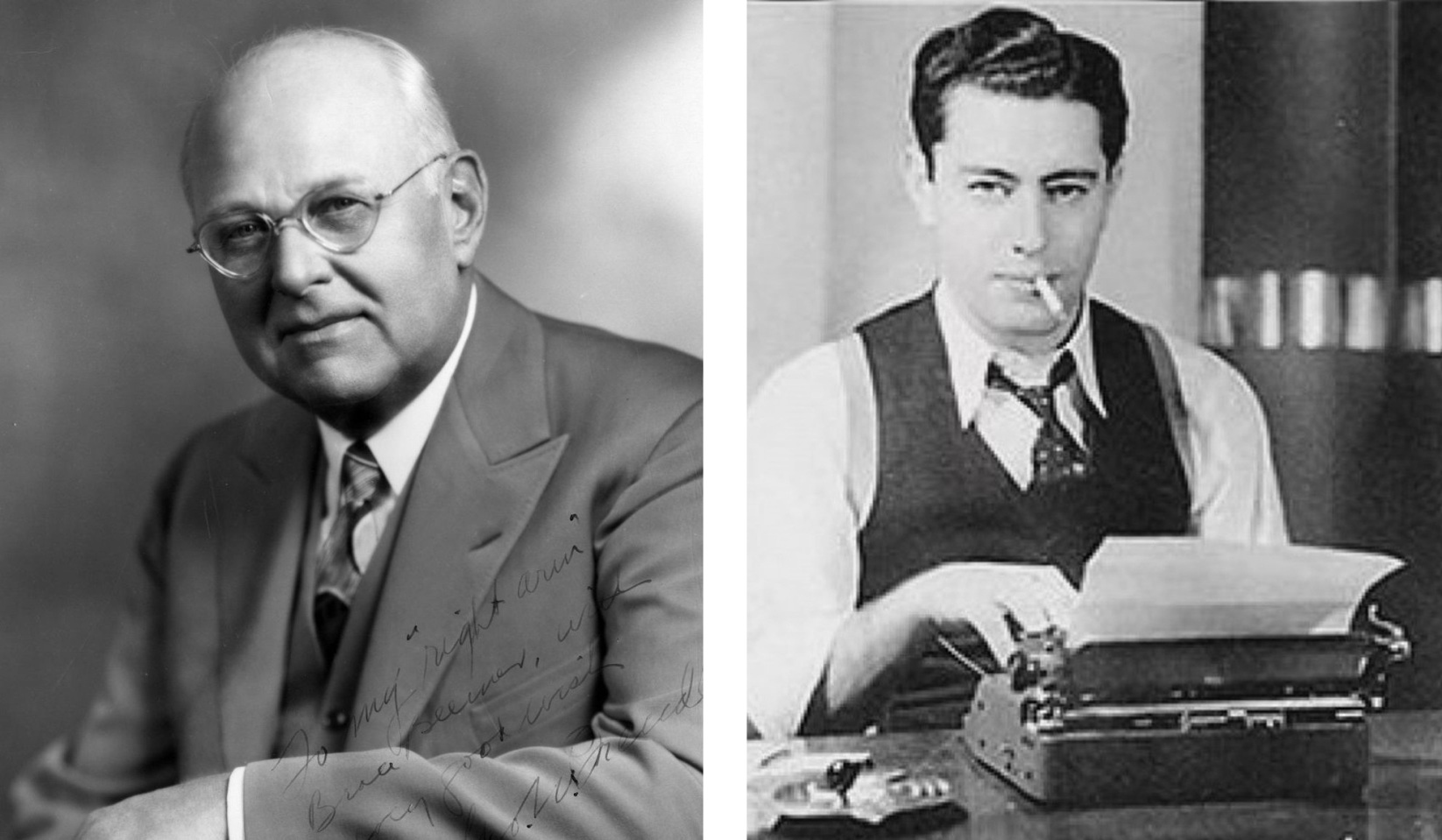
George W. Trendle (left) and Fran Striker (right).
Of everyone before and after The Lone Ranger aired, Fran Striker should be considered the foremost reason that the Ranger is still with us today. It was Striker who co-wrote the Lone Ranger’s famous creed with Trendle:
I believe…
That to have a friend, a man must be one.
That all men are created equal and that everyone has within himself the power to make this a better world.
That God put the firewood there but that every man must gather and light it himself.
In being prepared physically, mentally, and morally to fight when necessary for that which is right.
That a man should make the most of what equipment he has.
That ‘This government, of the people, by the people and for the people’ shall live always.’
That men should live by the rule of what is best for the greatest number.
That sooner or later… somewhere… somehow… we must settle with the world and make payment for what we have taken.
That all things change but truth, and that truth alone, lives on forever.
In my Creator, my country, my fellow man.
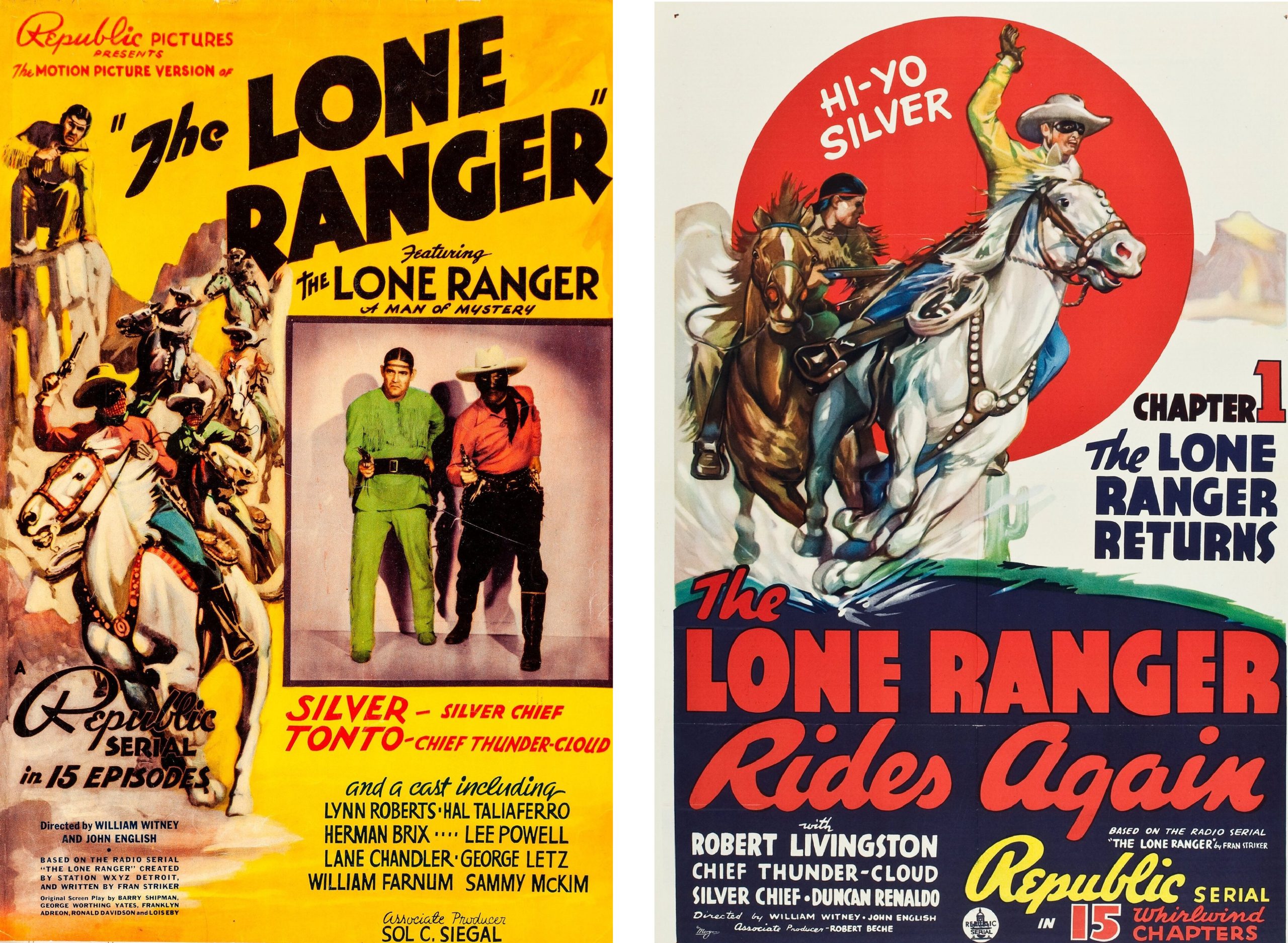
Striker’s input went far beyond the hundreds (perhaps thousands) of scripts for the radio program. He also wrote many of the novels based on the character, the pulp magazine series, and the comic strip. It has also been stated that Striker was involved as sort of a script editor for the two movie serials from Republic Studios, The Lone Ranger (1938) and The Lone Ranger Rides Again (1939).
Oh, and this was in addition to the scripts he was writing for WXYZ’s two other famous radio programs, Challenge of the Yukon (aka Sgt. Preston of the Yukon) and The Green Hornet. (I’m certain I don’t have to mention that Britt Reid/the Green Hornet was the great-nephew of the Lone Ranger.)
The program went on the air for the first time on January 30, 1933. (February 2, 1933 has also been put forth as the debut date, but the January date was on a Monday and more likely because there were two more new broadcasts of The Lone Ranger that week. The Lone Ranger had three new 30-minute episodes every week.
The first actor to portray the masked man was George Stenius. He would remain in the role for the initial three months of the program and then moved to Hollywood as a screenwriter, changing his name to George Seaton. Seaton’s Los Angeles career saw him later directing a number of Hollywood’s most memorable films, including Miracle on 34th Street (1947), The Country Girl (1954), and Airport (1970).
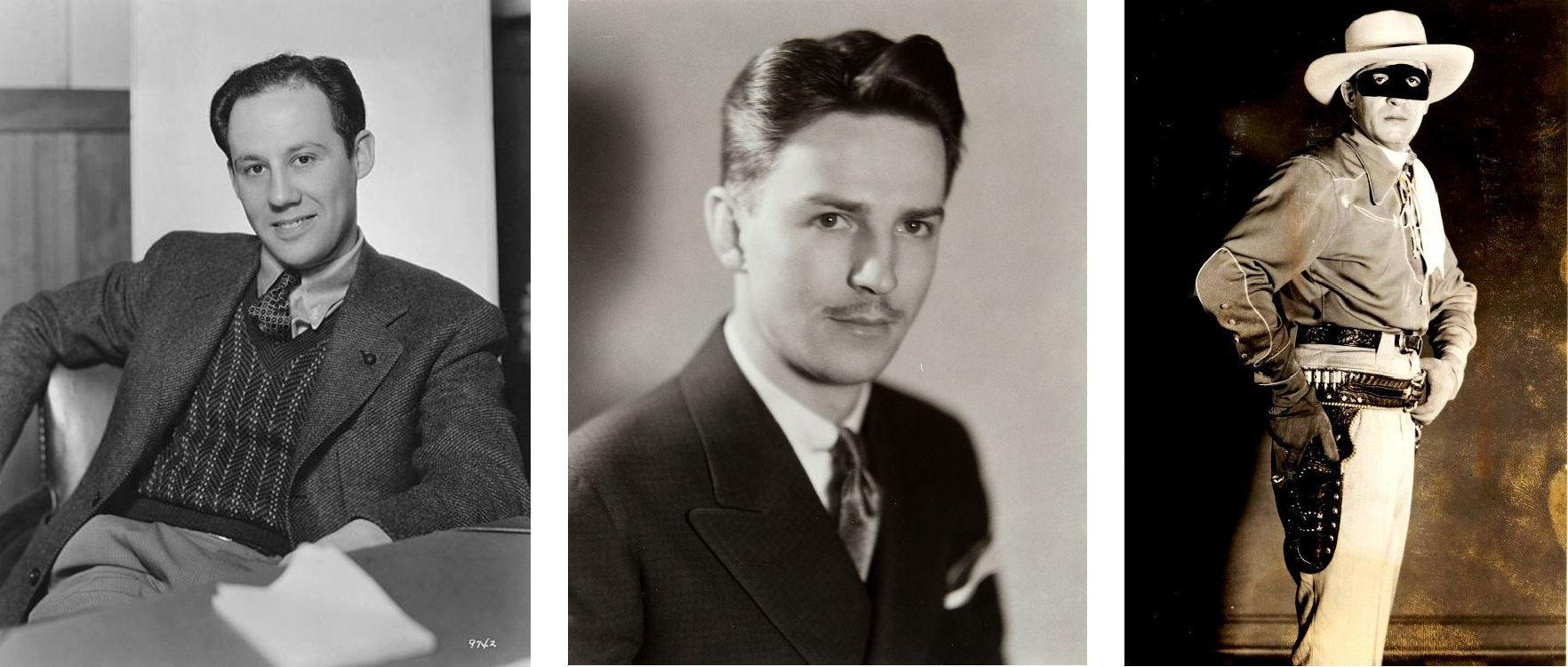
The three voices of radio’s Lone Ranger: (Left to right) George Stenius (Seaton), Earle W. Glaser, and Brace Beemer.
Following Stenius’ departure, Earle W. Graser would take over the role. When Graser died in 1941 in a fatal car accident, Brace Beemer assumed the role and stayed with the radio program through its last new show on September 3, 1954. (Beemer had already been associated with the program as an announcer and voice actor. In addition, because he so resembled what the Ranger should look like, he had previous experience during Graser’s run appearing in mask and Western garb for personal appearances.)
The part of Tonto was played through its entire 20-plus years on the air by just one person, John Todd, an ex-Shakespearean Irish-American actor.
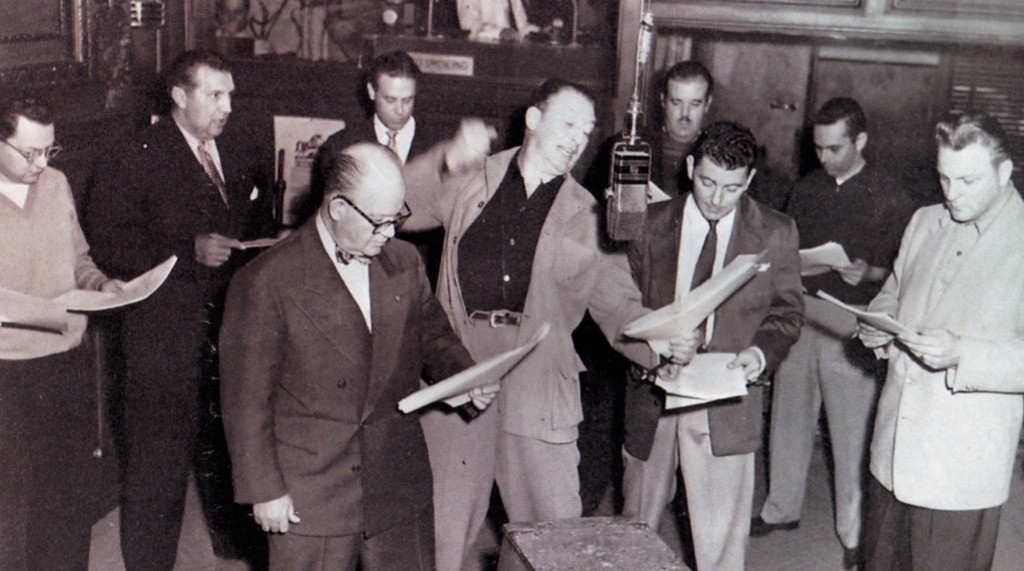
Photo of The Lone Ranger cast, with Brace Beemer (fist raised), John Holt (balding man in glasses), and announcer Fred Foy (far right), ca. 1948.
As pictured above, there were a number of other voice actors connected with the program over the years, playing sheriffs, citizens, and other Western types. But one who was often cast as a bad guy was Danny Thomas (not in photo), years before he became the star of TV’s Make Room for Daddy and The Danny Thomas Show.
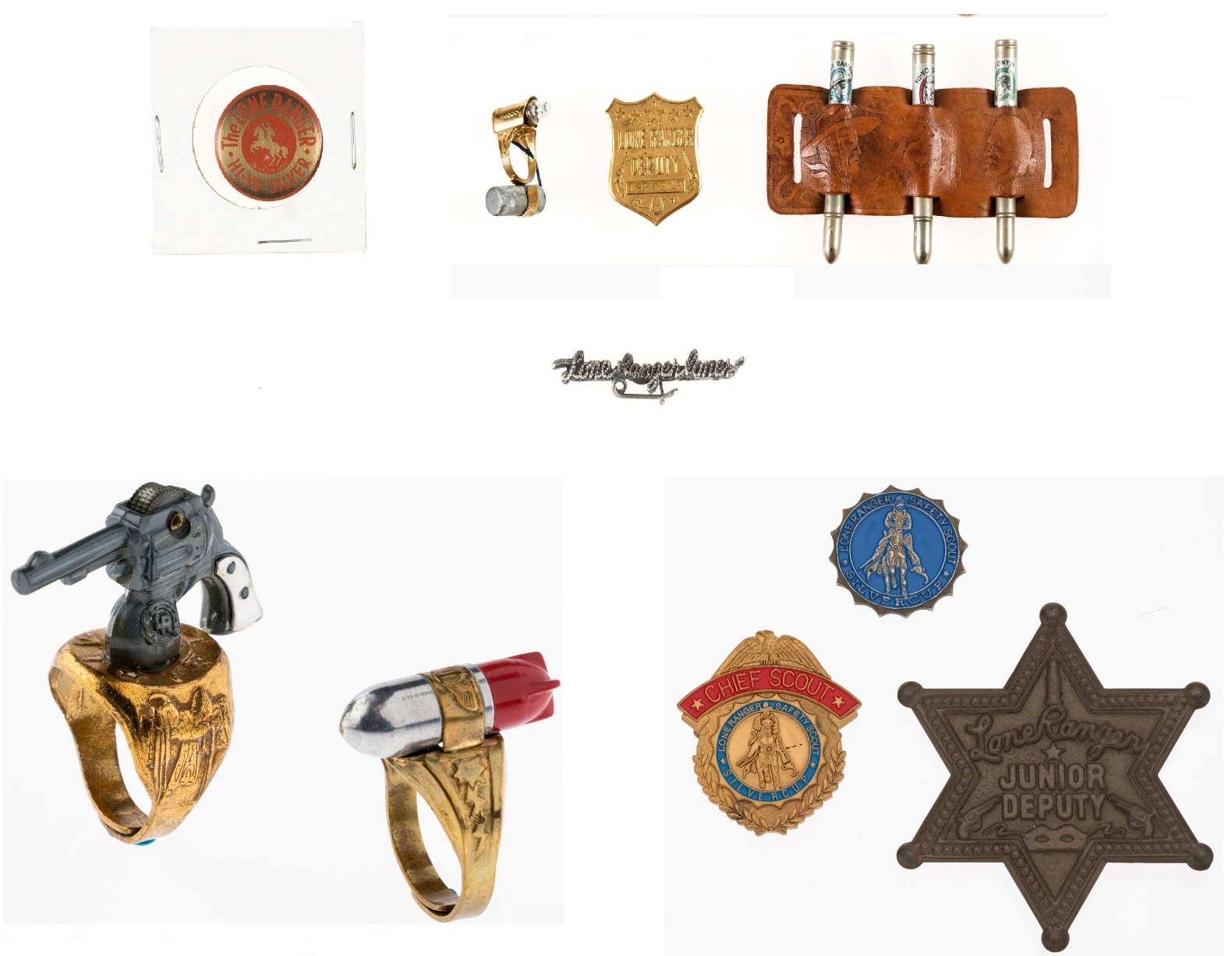
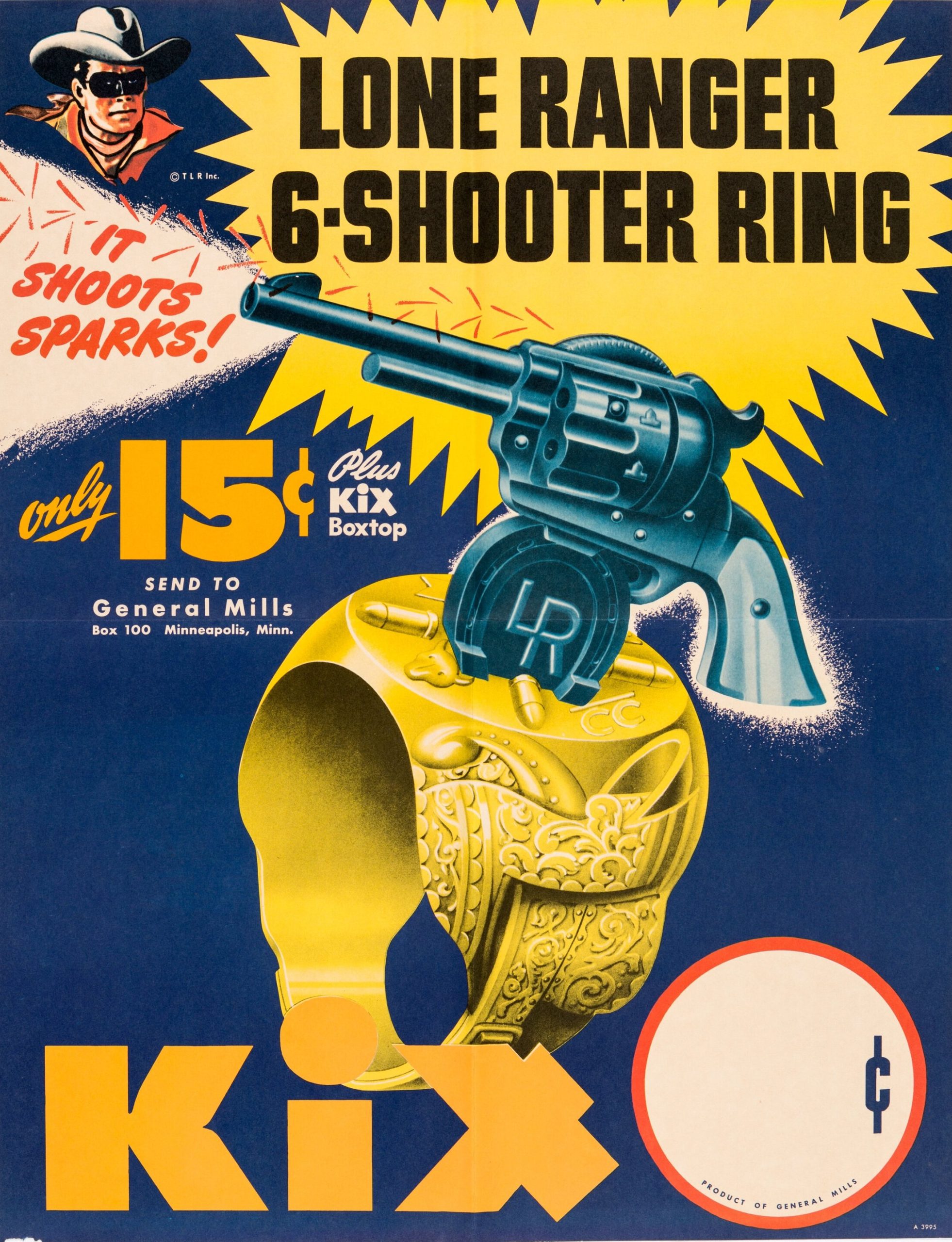
As George Trendle predicted, commercialization of products would be plentiful. Below are just a few of the premiums produced for the radio program, which included comic books and strips, novels and Big Little Books.
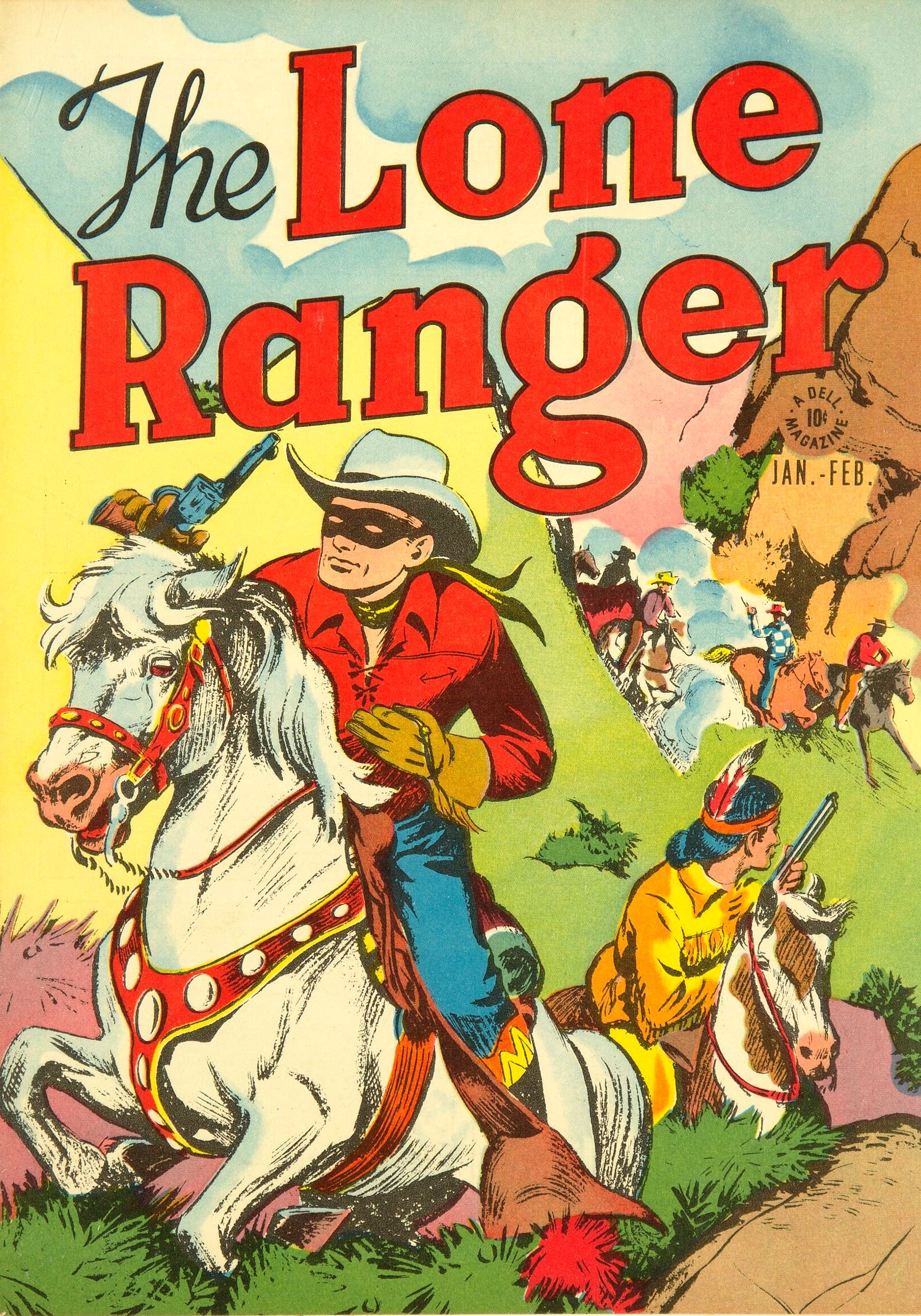
The Lone Ranger #1, from Dell. Jan.-Feb. 1948, cover artist unconfirmed.
For two years after the last new radio show in 1954, transcribed episodes were re-broadcast. (The TV show, which ran from 1949 to 1957, provided thrills for a new generation of fans, with Clayton Moore establishing himself as the definitive Lone Ranger forever.
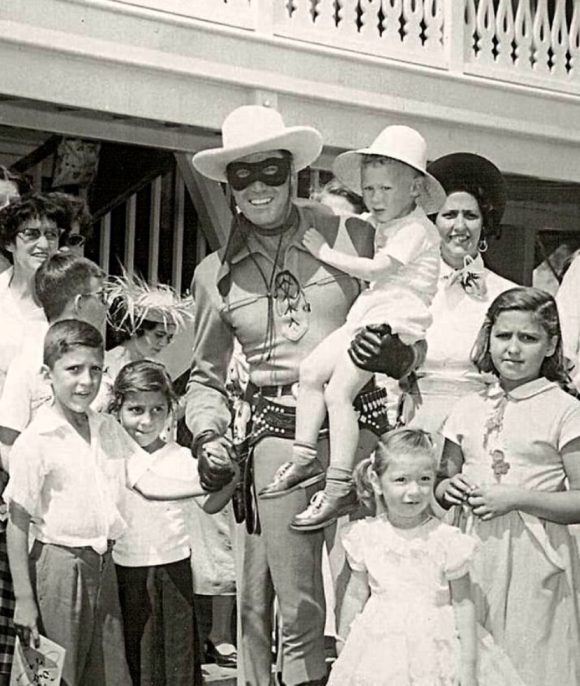
Clayton Moore as the Lone Ranger at Disneyland on opening day, July 17, 1955.
The early years of the radio program have been lost, but when The Lone Ranger gained national success, the show was recorded on transcription discs. The great news is that many of the discs have been preserved over the decades by collectors, and because of that there are more than 2,000 shows available to listen to.
Until next time, my friends… Hi-Yo, Silver — Away!
—
MORE
— FOUR COLOR RADIO: The 1930s’ FLASH GORDON and JUNGLE JIM. Click here.
— FOUR COLOR RADIO Presents: ARCHIE ANDREWS and THE BLACK HOOD. Click here.
—
13th Dimension contributor-at-large PETER BOSCH’s first book, American TV Comic Books: 1940s-1980s – From the Small Screen to the Printed Page, was published by TwoMorrows. (You can buy it here.) A sequel, American Movie Comic Books: 1930s-1970s — From the Silver Screen to the Printed Page, is out now. (Buy it here.) Peter has written articles and conducted celebrity interviews for various magazines and newspapers. He lives in Hollywood.

May 9, 2026
It is said Lone Ranger was modeled after a real black Texas Ranger, who was accompanied by a Native America, whom he rescued. Because a black hero wasn’t acceptable to most Americans, they changed him to white.
May 9, 2026
There was real Lone Ranger, Bass Reeves, in 19th Century. He was black, but the writers saw that won’t be acceptable to most Americans, so they changed him to white.
May 9, 2026
>> I’m certain I don’t have to mention that…
>>
No. No you do not. 😉
So many creative folks in the Detroit area. I grew up on WXYZ News on channel 7.
I still have my ‘70’s Lone Ranger LP. It included 2 radio broadcasts. Still plays. Thanks for reliving some fond memories of my youth. Another great article, Peter.
May 9, 2026
Depending on the age of most 13th Dimension readers, it may not be necessary to explain this, but Trendle and King were investing in “the next big thing” when they bought the radio station. Radio became a forerunner of television as a major source of entertainment in homes everywhere. The “Amos ‘n’ Andy” radio show was so popular at one point that movie theaters would enable theater-goers to listen to it over their speakers, instead of showing films, when it came on.
Thanks for another informative installment of Four-Color Radio.
May 9, 2026
I have a few stills autographed by Clayton Moore
May 9, 2026
As much (to me) as Adam West IS The BATMAN, Clayton is The Lone Ranger. When I saw how they treated the actor with their legal actions back in the late ‘70s, there was no way I was going to see their new (then) movie.
May 9, 2026
I’m guessing that Dell comic book cover explains why the Capt Action Lone Ranger had a red, not blue, shirt, despite the then-ubiquity of the TV series.
May 9, 2026
Yes, SJG, and his outfits in the serials were different from the television version as well. But Clayton Moore also is my Lone Ranger.
May 12, 2026
Along with the authors of this article, I also want to thank “tomboughan” for replying with the info about Bass Reeves. Now, I’m going to watch the series I just discovered about Reeves. Great piece of history!!
July 20, 2026
“Historians generally agree that the fictional Lone Ranger was not directly based on the real-life Black Deputy U.S. Marshal Bass Reeves. While the modern internet frequently circulates this claim due to overlapping tropes — like using disguises, riding a white horse and working with Native American guides — the original character’s creators designed him independently.” The Lone Ranger was entirely fictional, and a direct descendant of Zorro.