
Old-time radio shows and their comics connections…
By PETER BOSCH
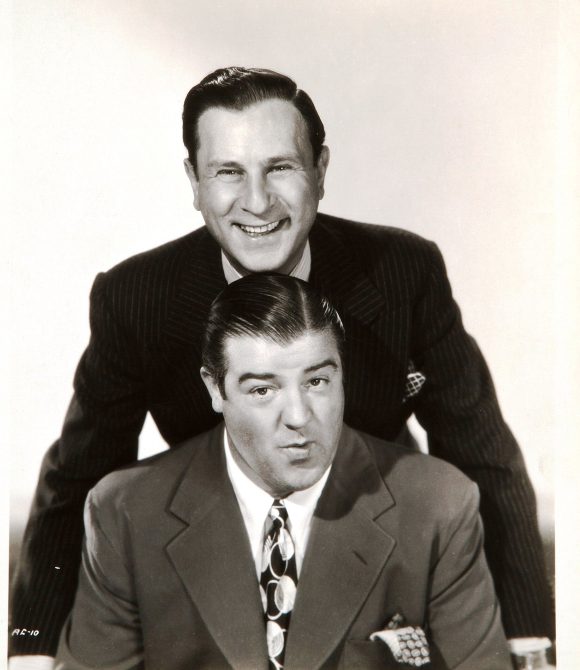
Welcome back to Four Color Radio, where I look at radio programs from the Thirties to the Fifties that had a tie-in to comics of the Golden Age (and sometimes Silver Age). Today, something special: a 90th anniversary salute to the 1936 teaming of Abbott and Costello.
—
THE EARLY YEARS
William Alexander “Bud” Abbott may not have been “born in a trunk,” but he was born in a circus tent, figuratively speaking. Abbott’s father was an advance man for the Barnum & Bailey Circus and his mother had been a bareback rider. Bud grew up in the business, and then became an assistant treasurer of a burlesque theater. He also produced small traveling burlesque shows, including some where he first attempted being the comic in a sketch, but soon realized he was better as a straight man.
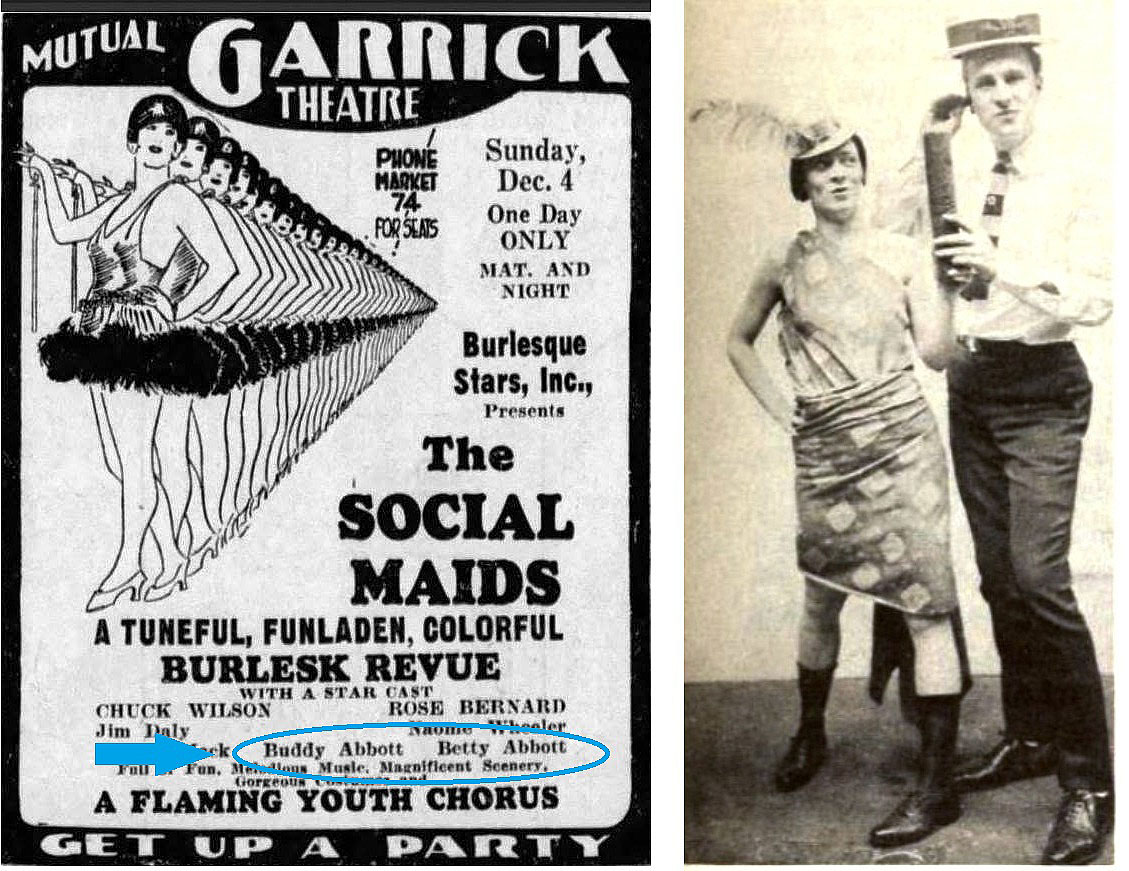
An early teaming of Bud Abbott with his wife Betty.
Louis Francis Cristillo, on the other hand, knew he had a gift for making people laugh. He envisioned being a star in Hollywood and moved there in 1927, getting a job first as a laborer on the MGM lot, then did some film extra work and occasional stunt doubling. (Lou was slimmer then, and athletic. During his mid-teens, he boxed under the name of “Lou King.”)
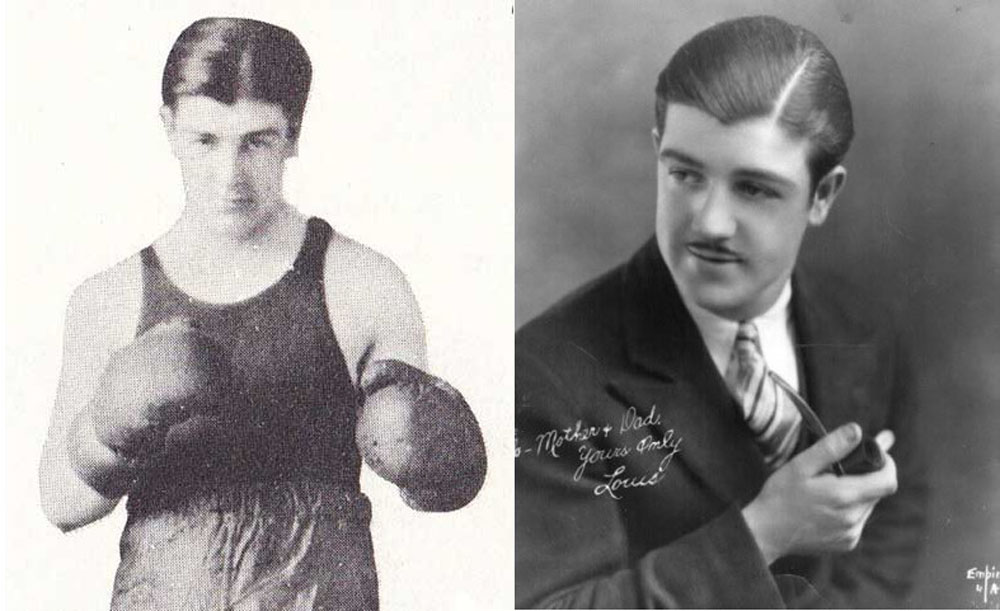
“Lou King” and Costello in his first attempt to make it in Hollywood.
After a year, he decided to return home to New Jersey. However, when he got as far as St. Joseph, Missouri, he was flat broke. Seeing a listing for a job in a burlesque act there, he auditioned for it and got it — and changed his surname to Costello.
Though both Bud and Lou were born in Jersey (Abbott in Asbury Park and Costello in Paterson), they did not work together on stage until 1935 when Bud helped Lou by filling in as his straight man when Costello’s regular partner did not show up. It was just a one-time thing but – fortunately for the world – their wives said they should team up, which Bud and Lou did officially in 1936.
—
THEIR BIG BREAK
Abbott and Costello’s days in burlesque were numbered. New York City Mayor Fiorello LaGuardia started getting such theaters closed in 1937, citing moral decency violations. Bud and Lou moved into vaudeville and they got work at the Steel Pier in Atlantic City, thanks to their new manager, Eddie Sherman. (After achieving fame, they returned to perform for several more summers at the Steel Pier, as thanks for the earlier opportunity.)
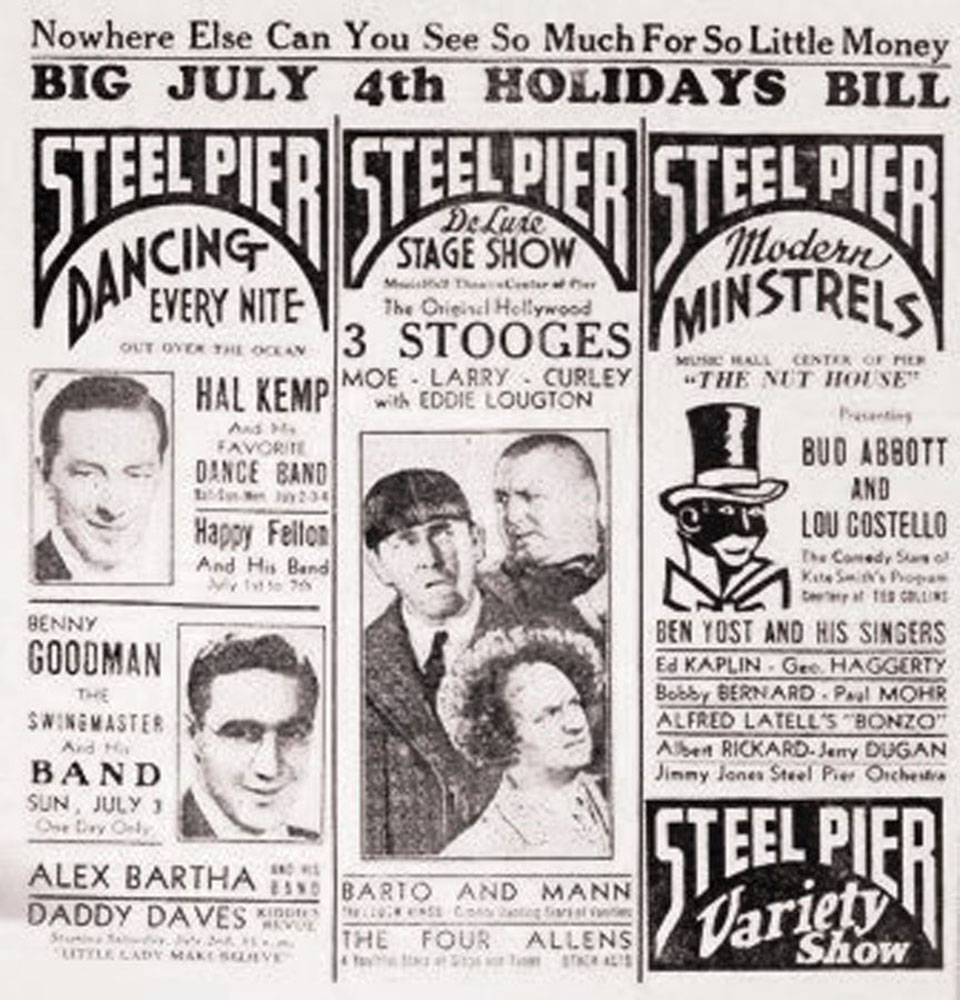
A 1938 Steel Pier handbill. Can you imagine seeing Benny Goodman, the Three Stooges, and Abbott and Costello all live on the same day?!
In early 1938, the team got a guest spot on The Kate Smith Hour, one of radio’s most popular programs of the time. Comedian Henny Youngman was a regular cast member but he was leaving to go to Hollywood and he recommended the show hire Abbott and Costello to take his place.
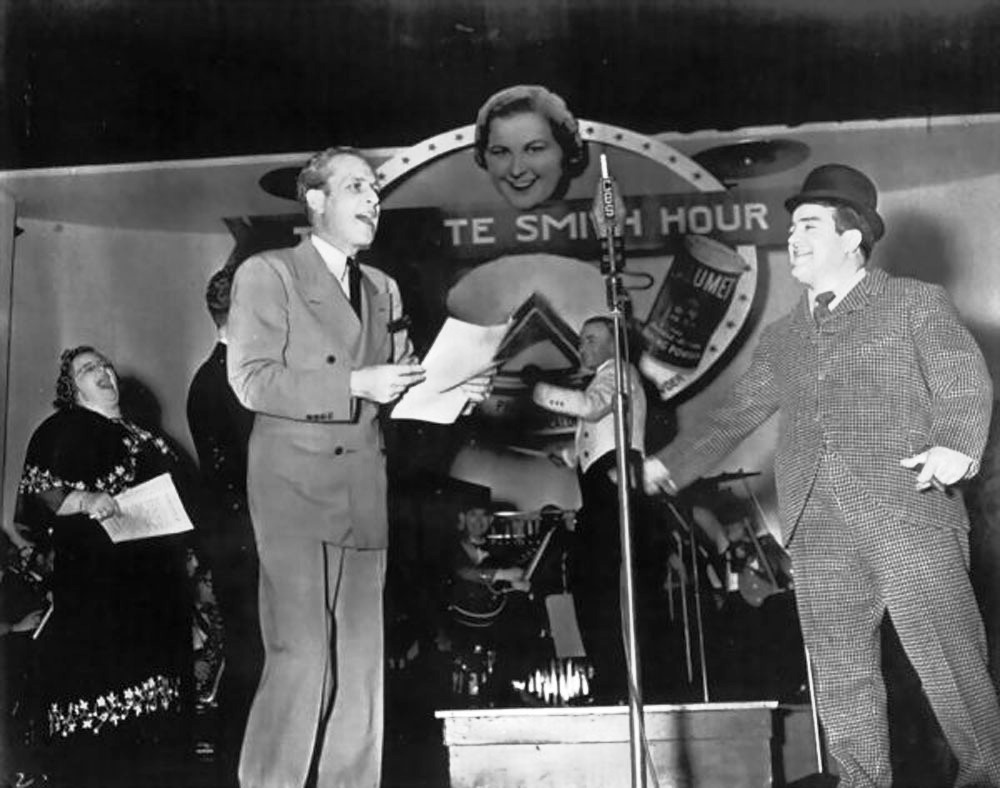
Kate Smith, far left, laughing uproariously at an Abbott and Costello routine.
Kate Smith liked them in their initial appearance and had them return in following weeks – and then, on the night of March 24, 1938, they performed “Who’s on First?” (Note: The original 1938 broadcast no longer exists, but this is a version they did on radio in 1947 or 1948.)
The at-home audience went wild with laughter and lit up the CBS switchboard. Abbott and Costello were made regulars on the program for almost two years.
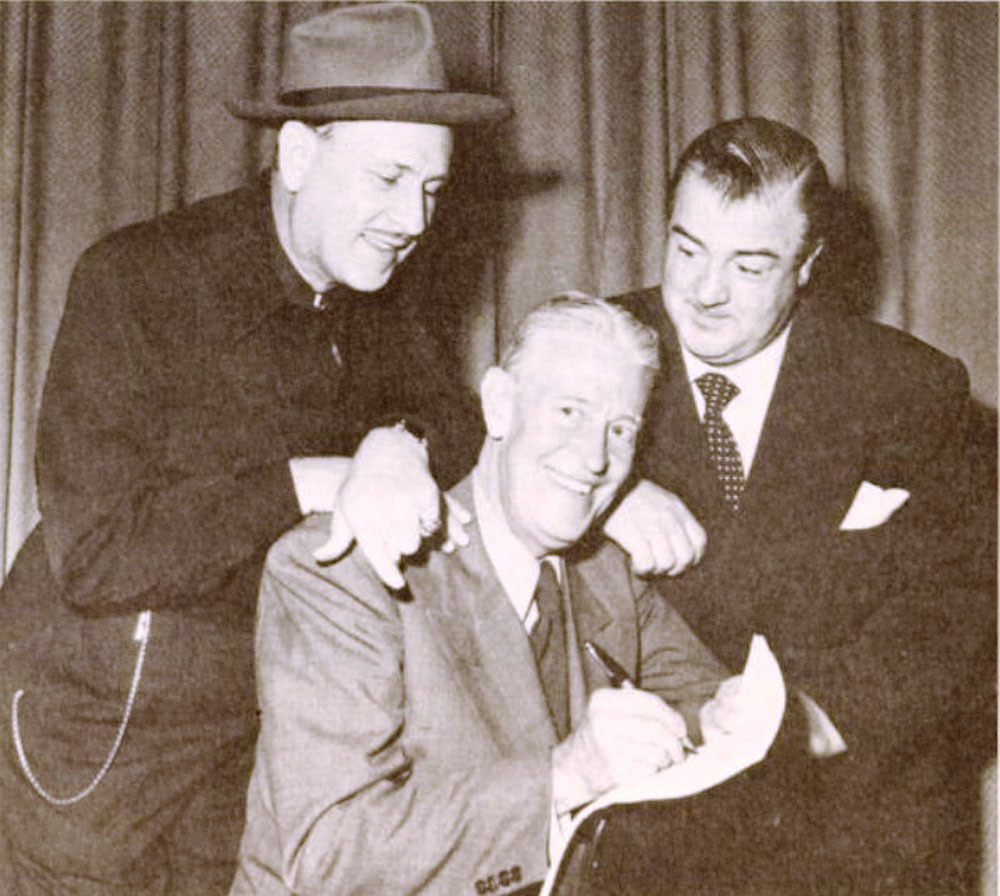
The third member of the Abbott and Costello team: John Grant, frequent writer of their sketches.
Their continued success on The Kate Smith Hour led them to a 1939 Broadway musical comedy revue, The Streets of Paris. (On days when they had both the Broadway show and the weekly Kate Smith radio program, they had to race back and forth across town.)
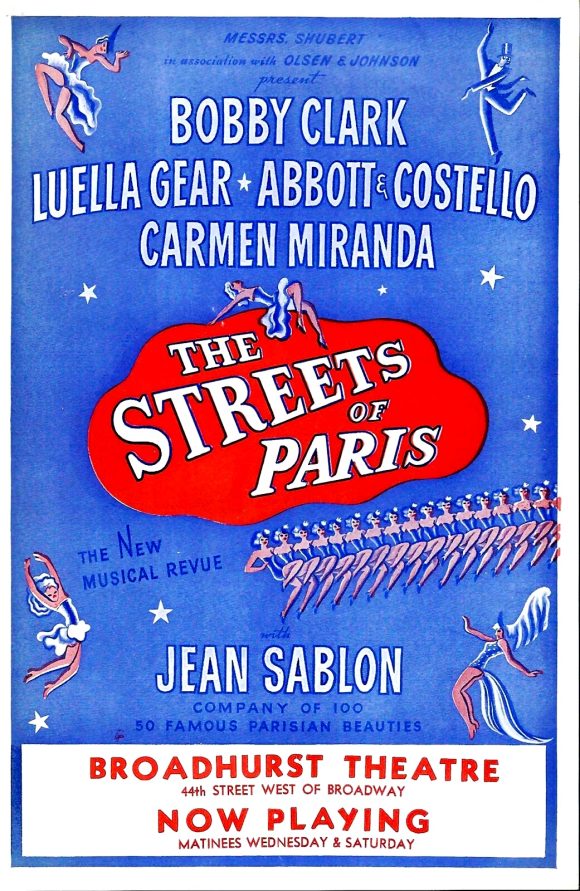
The Streets of Paris closed in February 1940, but Abbott and Costello came back to join the cast when it reopened a few months later at the New York World’s Fair.
—
HOLLYWOOD COMES CALLING
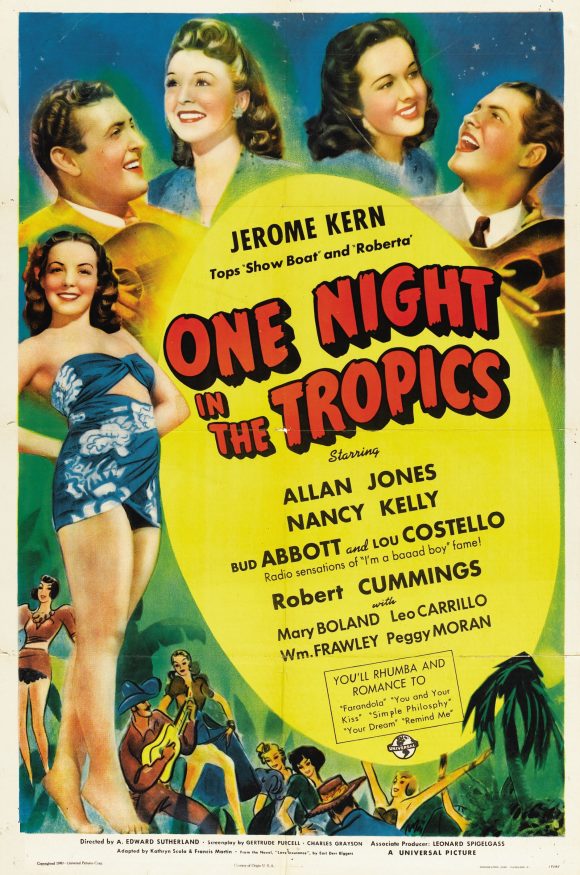
The team’s combined radio and stage popularity grabbed the attention of Universal Pictures, which placed them in their first movie, One Night in the Tropics (1940). They received third billing, but their sections were the best reviewed of the otherwise drab film.
The New York Times film critic wrote, “When Costello is rooked of a year’s salary by a series of logical deductions for holidays and lunch hours, or he and Abbott become involved in cosmic issues over the question of eating a hot dog with or without mustard, ‘One Night in the Tropics’ becomes a riotous excursion. For the rest, it is merely a mild sedative.”
Their next movie, Buck Privates (1941), was their first as lead actors stars and it became Universal’s biggest box-office hit of the year.
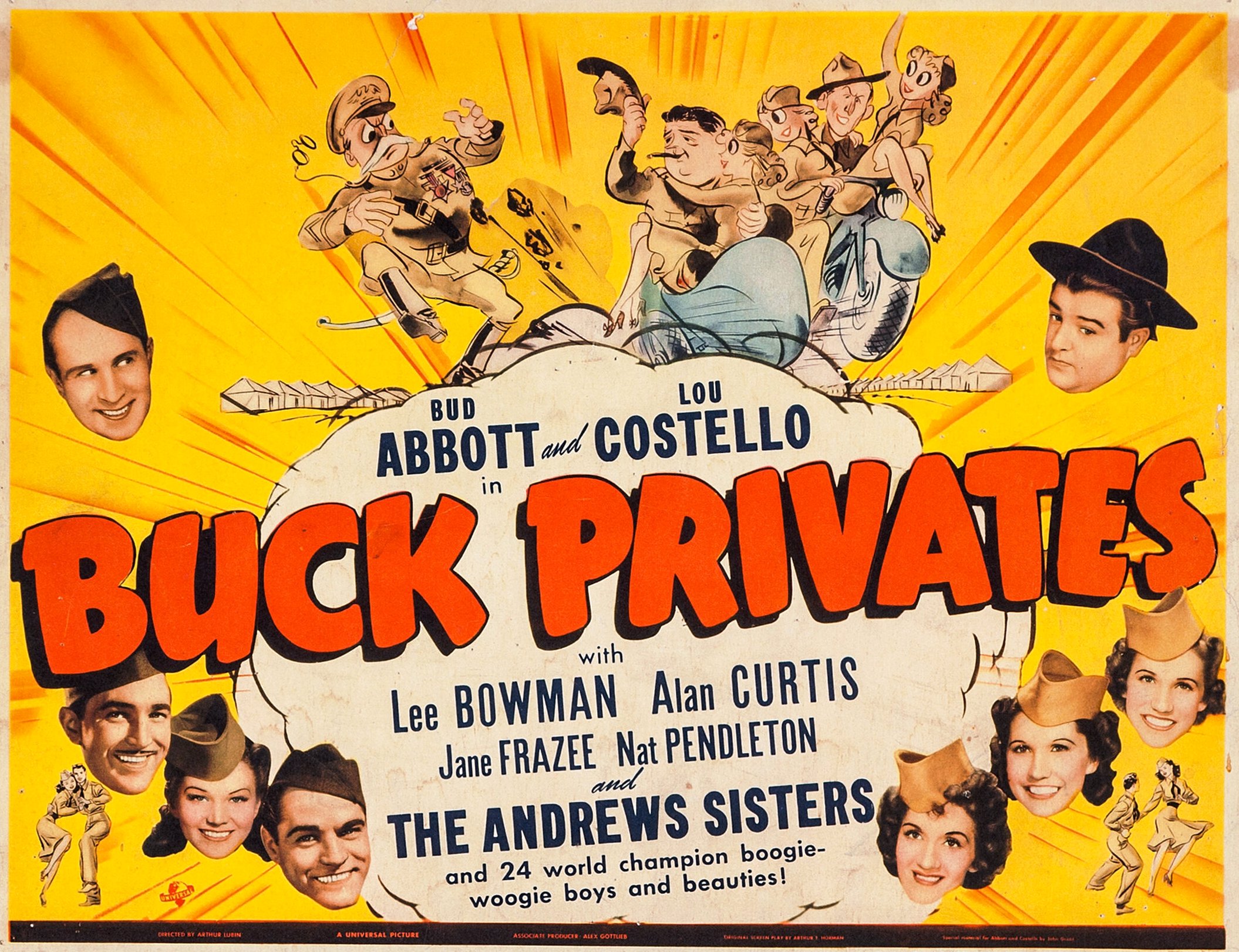
Bud and Lou became the stars of the Universal lot – and with good reason. The studio had been in serious financial difficulties at the start of the 1940s because it had overspent on several productions the decade before. Universal was about to go under until the highly profitable successes of the Abbott and Costello movies saved the studio.
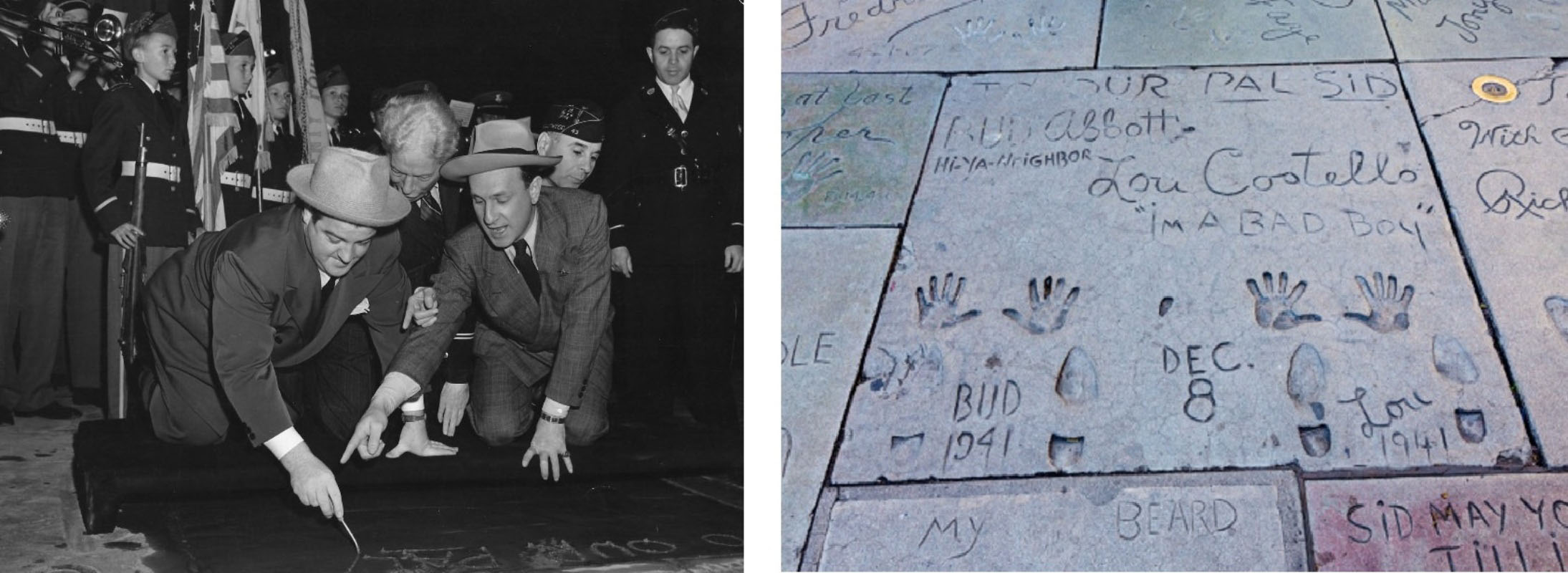
On December 8, 1941 (the day after the Japanese attack on Pearl Harbor), Abbott and Costello had their hand- and footprints ceremony at Grauman’s Chinese Theater in Hollywood.
Abbott and Costello followed One Night in the Tropics and Buck Privates with 26 more films for Universal over the next 14 years.
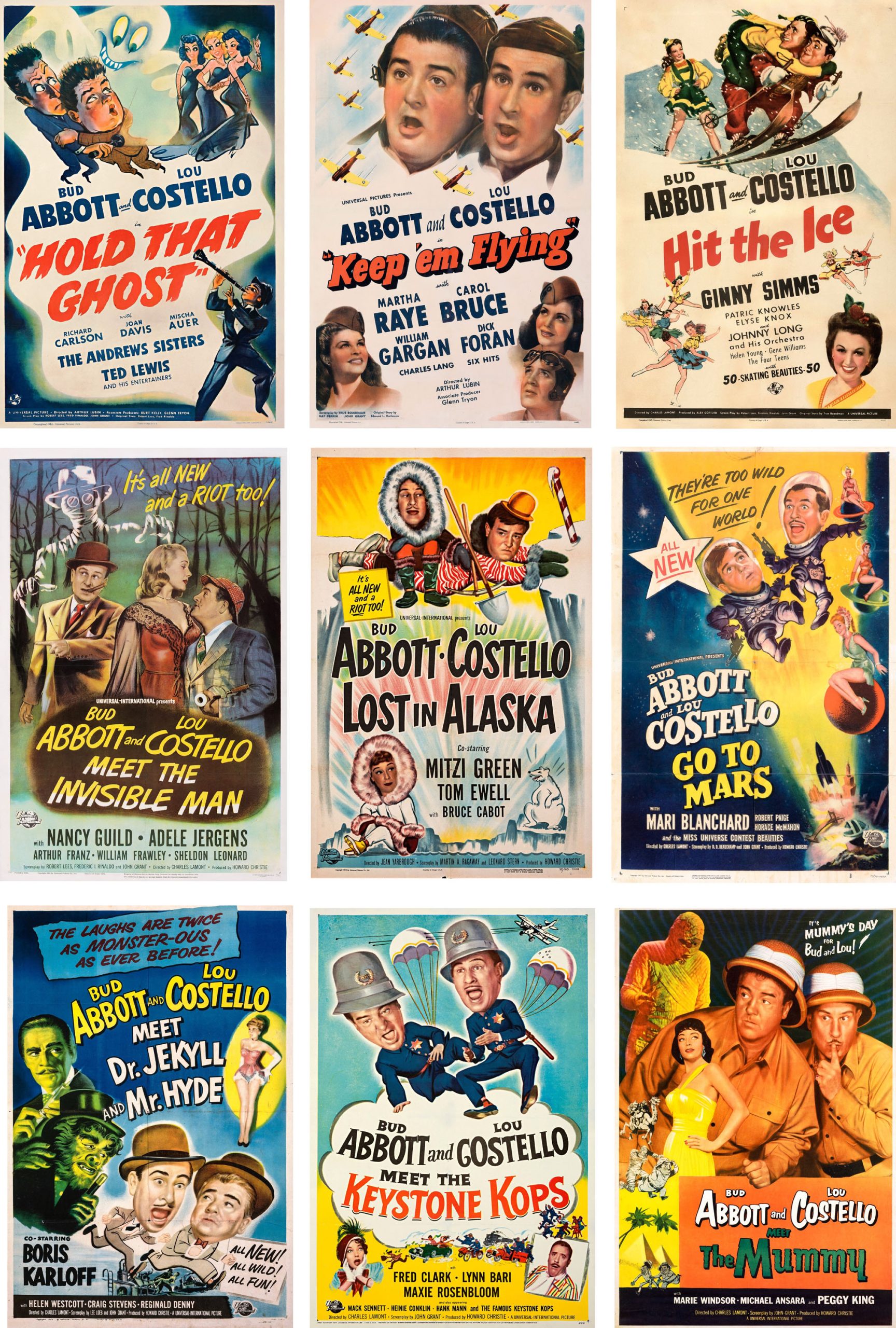
A smattering of their Universal movies
—
RADIO STARS
In 1940, they hosted a summer replacement radio program for The Fred Allen Show when it went on hiatus. The following year, Bud and Lou became featured performers on The Chase and Sanborn Hour.
However, it was in 1942 when their popularity reached amazing heights. They were voted the top box-office stars of the year by film exhibitors, and they went on a 78-cities-in-22-states War Bond drive. (The U.S. Treasury reported they sold $85 million in bonds and defense savings stamps.)
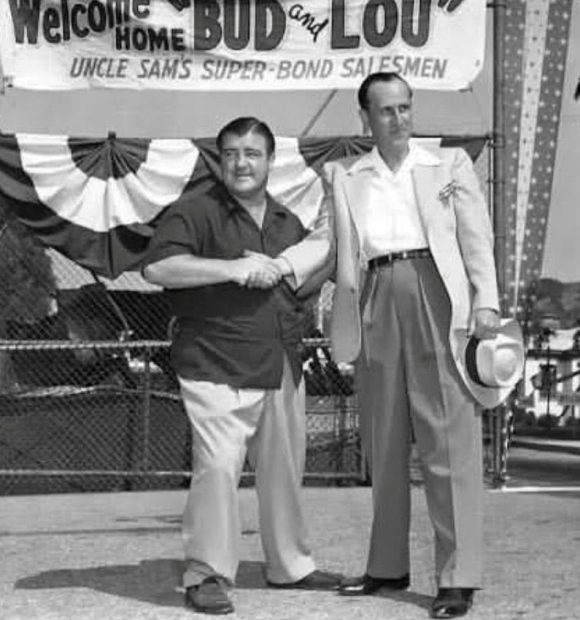
Shortly thereafter, on October 8, 1942, the NBC radio network premiered The Abbott and Costello Show. Over the next five years (through June 27, 1947), millions of listeners tuned in every Thursday night to hear Costello’s opening cry of “Hey, Abbott!!!”
While the program was one of the greatest comedy shows in all of radio’s history, there was one terrible and tragic night: November 4, 1943.
During the afternoon rehearsal for that evening’s program, the pair’s manager Eddie Sherman received a phone call. Costello’s infant son, Lou Jr., had crawled to the family swimming pool, fell in, and drowned. Sherman immediately drove Costello home to find fire department medics trying everything they could to resuscitate the child, but it was no use. The boy had been just two days short of his first birthday.
Though Costello was in unbearable grief, he returned to the radio studio and did the regularly scheduled show in front of an audience. At the end, Lou left the stage immediately, and as can be heard on this recording, Bud then addressed the in-studio and at-home audiences to let them know of the tragedy.
Costello said later he did the program because his son was to have been listening that night.
In 1947, Bud and Lou opened The Lou Costello, Jr. Youth Center in East Los Angeles. This short film with the pair was used to promote it. Near the end, Lou, Jr. is pictured.
Abbott and Costello changed radio networks to ABC beginning with the October 14, 1947, broadcast (and continued there until their final broadcast June 9, 1949). The pair added a second radio series to their schedule — The Abbott and Costello Kids Show. Airing on Saturdays on ABC from December 6, 1947, to March 26, 1949, each week they gave a $1,000 savings bond to an outstanding youth.
—
THE COMICS IN THE COMICS
Bud and Lou continued making movies for Universal and other studios, including their most popular film, Abbott and Costello Meet Frankenstein (1948). (Be sure to read Jim Beard’s incredible tribute to the movie.). Of all their films, though, my favorite is The Wistful Widow of Wagon Gap (1947).
The movie, set in the Old West of Montana, had the boys playing traveling salesmen. They arrive in the small town of Wagon Gap in the middle of wild shooting everywhere, Lou fires a gun into the air and, suddenly, a notorious badman falls from above and lands dead at his feet. Costello is able to escape being hanged for murder because of a state law that says he would have to become the head of the dead man’s family — which consisted of a cantankerous widow and her brood of brats!
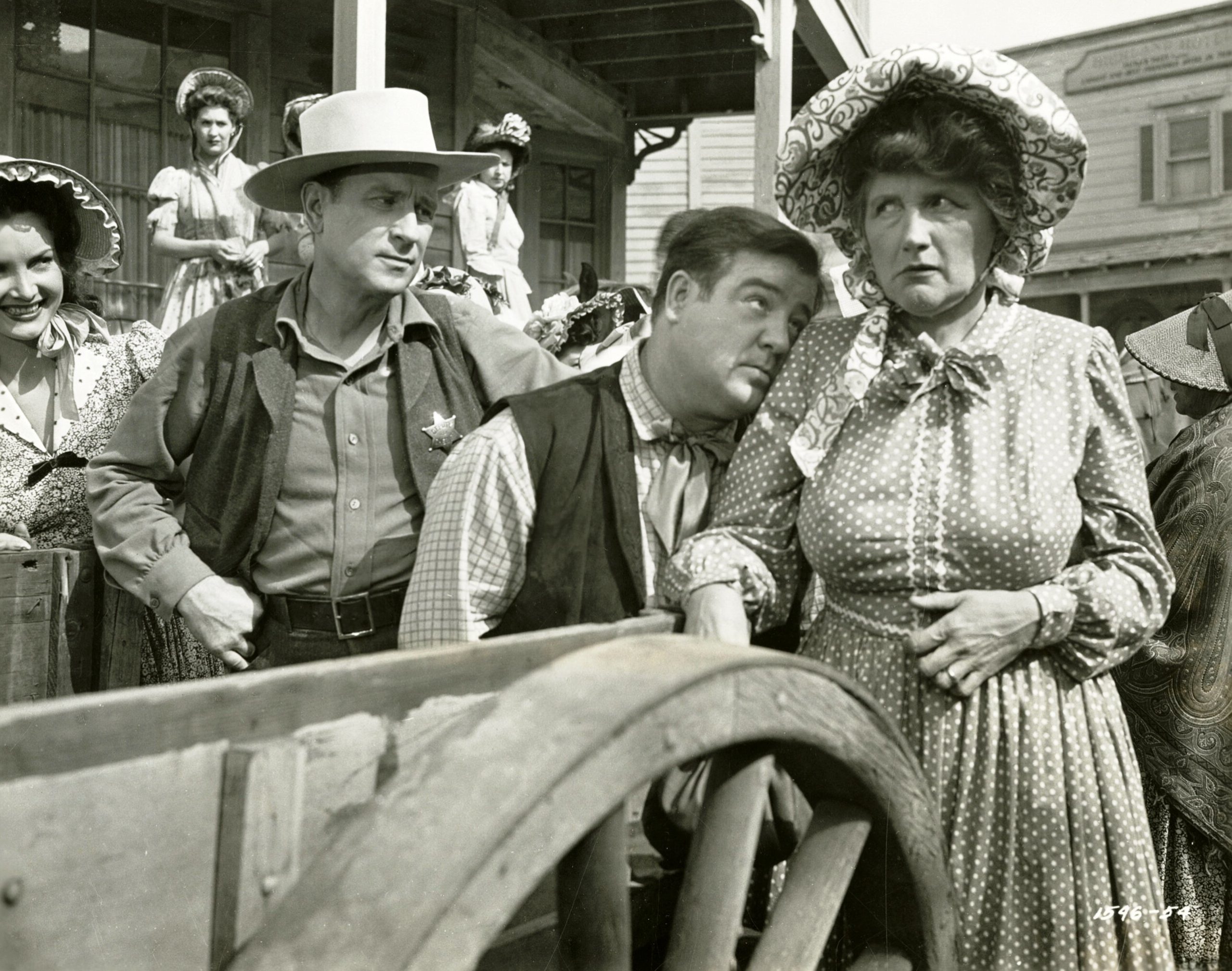
Abbott, Costello, and Marjorie Main
This was top-notch slapstick, thanks to the added comedy chops of the great Marjorie Main (best remembered as Ma Kettle) as the marriage-minded widow who has eyes on Lou.
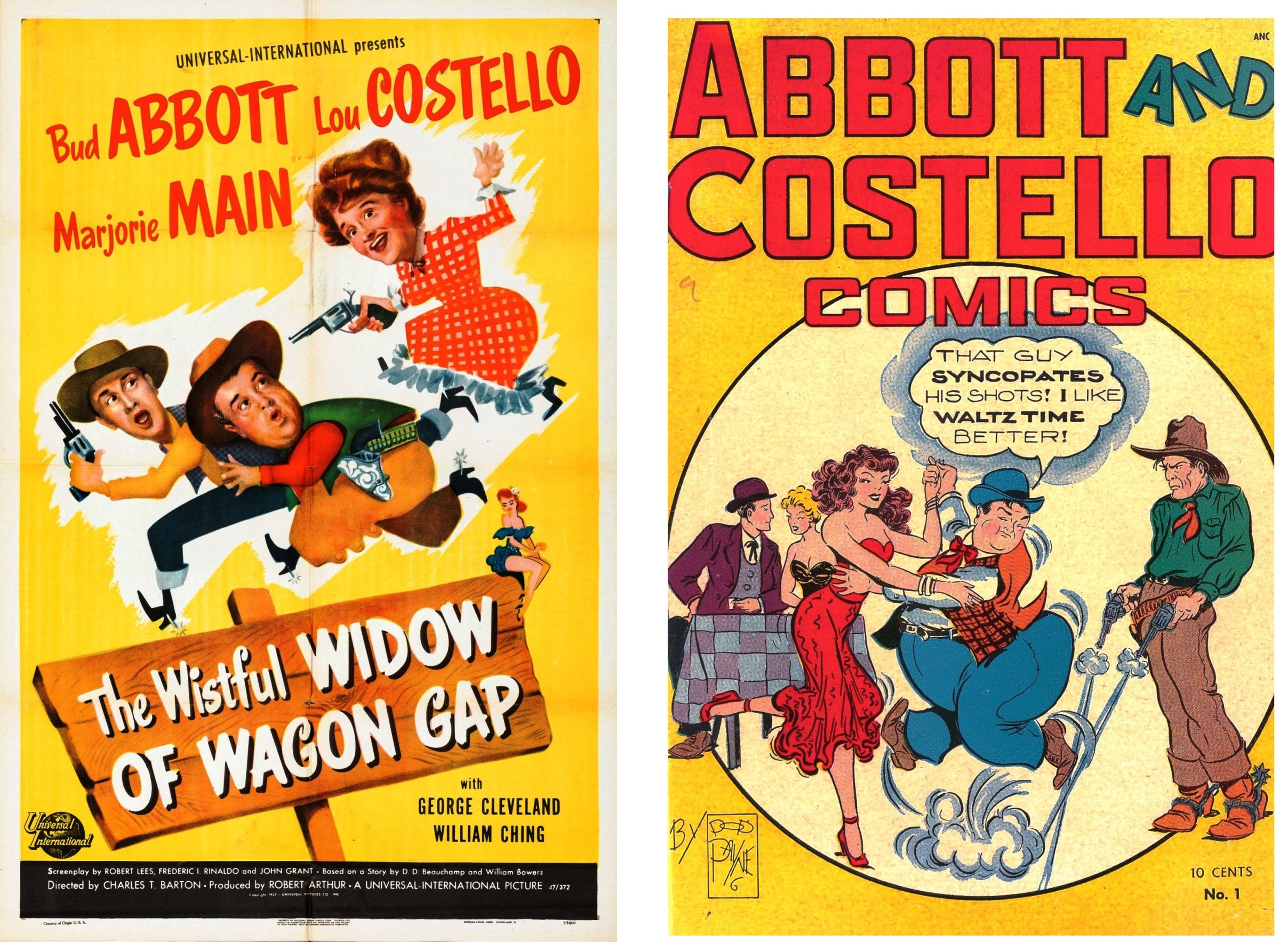
Right: Abbott and Costello Comics #1 (Feb. 1948, St. John). Art by Charles “Pop” Payne.
When it came to comic books, The Wistful Widow of Wagon Gap was their only movie to get an adaptation (in Abbott and Costello Comics #1, February 1948, St. John Publishing).
The St. John series continued for many more excellent issues, coming to an end with #40 (Sept. 1956). A special 3-D comic (Nov. 1953) was also published.
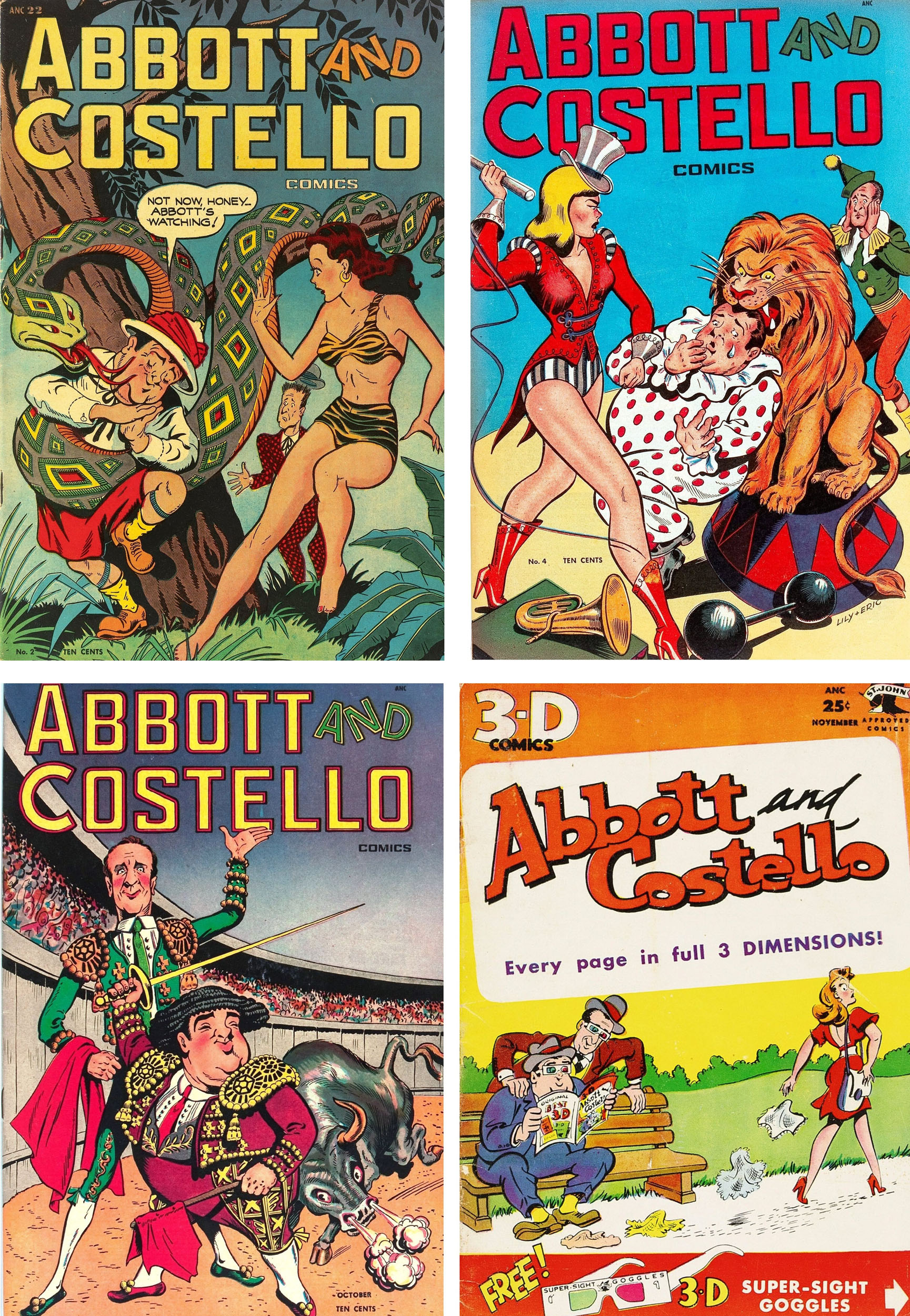
Top left: Issue #2 (Apr. 1948), art likely by Lily Renée and Eric Peters. Top right and bottom left: #4 (Aug. 1948) and #5 (Oct. 1948), both by Renée and Peters. Bottom right: Abbott and Costello Vol. 1 #1 (Nov. 1953), unidentified artist.
The Abbott and Costello series was not the first time Bud and Lou appeared in our four-color comic world. Super-Magician Comics Vol. 1 #8 (Nov. 1942, Street and Smith) contained a one-time six-pager with the partners telling a judge of their lives before and after meeting each other.
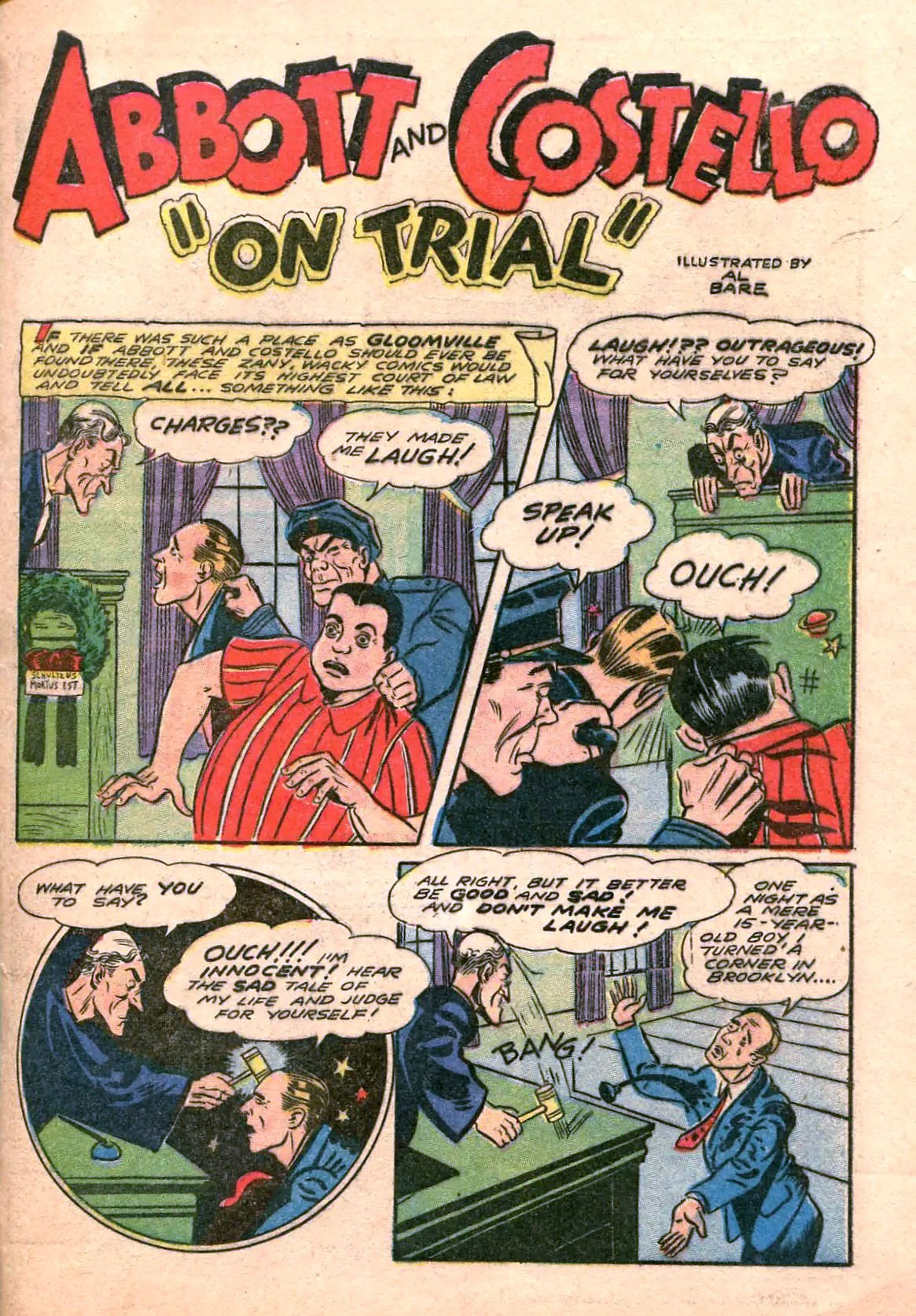
Art by Al Bare. Writer unknown.
About a month later, True Comics #19 (Dec. 1942, Parents’ Magazine Press) included a factual two-page story about a young fan named Jerry Young who hired the comedy team (for 70 cents!) to participate in a Red Cross charity event.
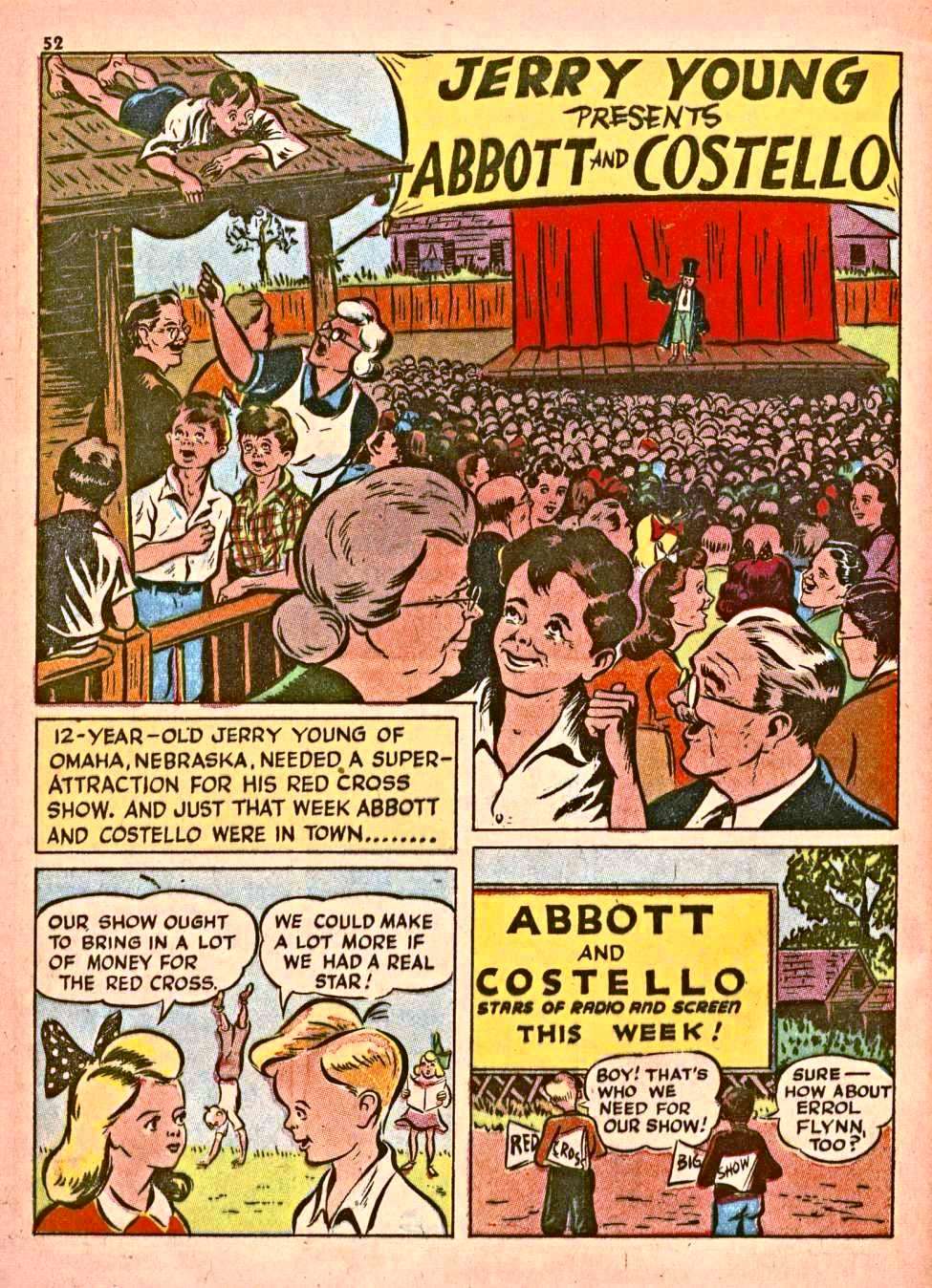
Unidentified writer and artist
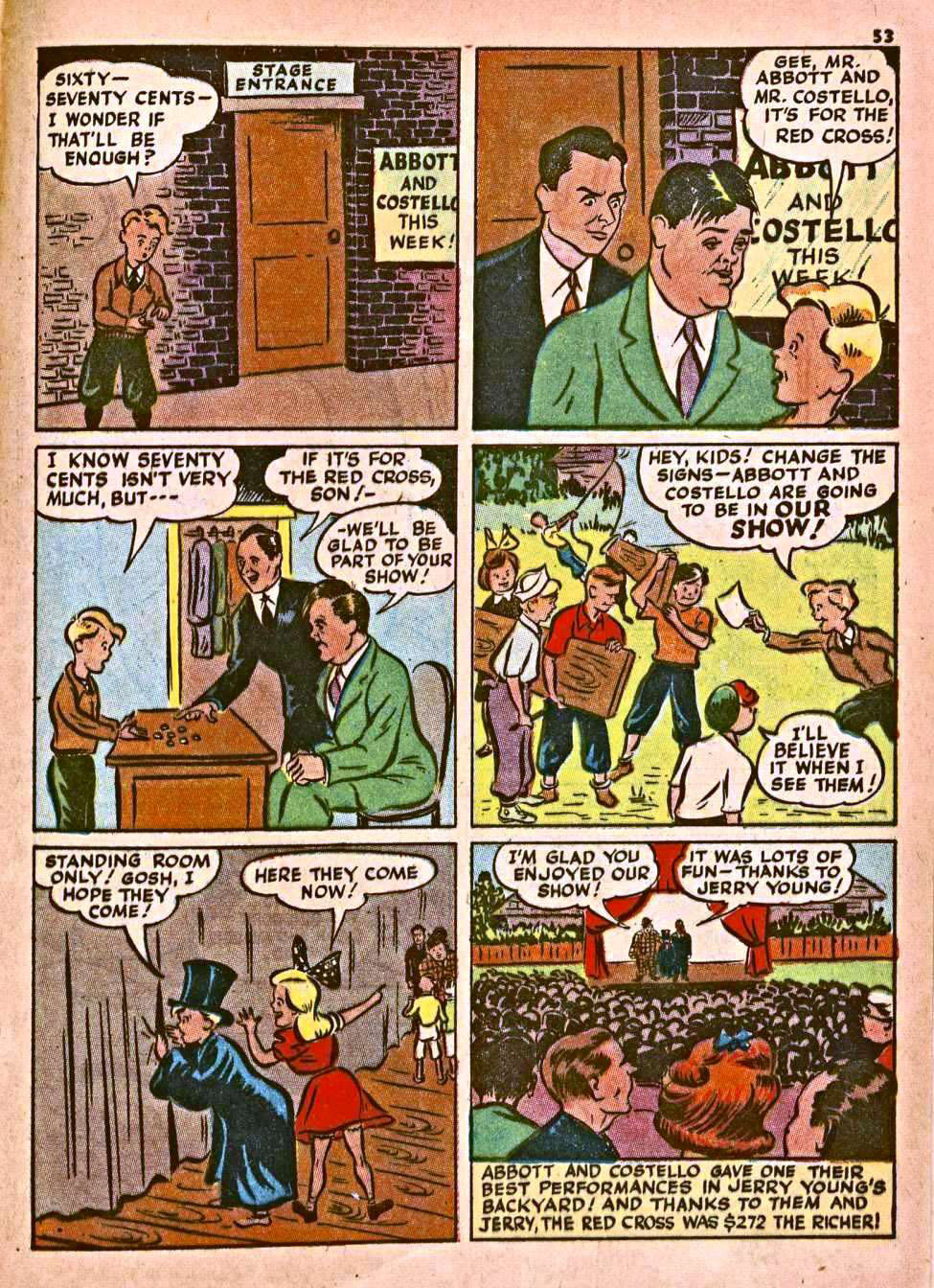
Unidentified writer and artist
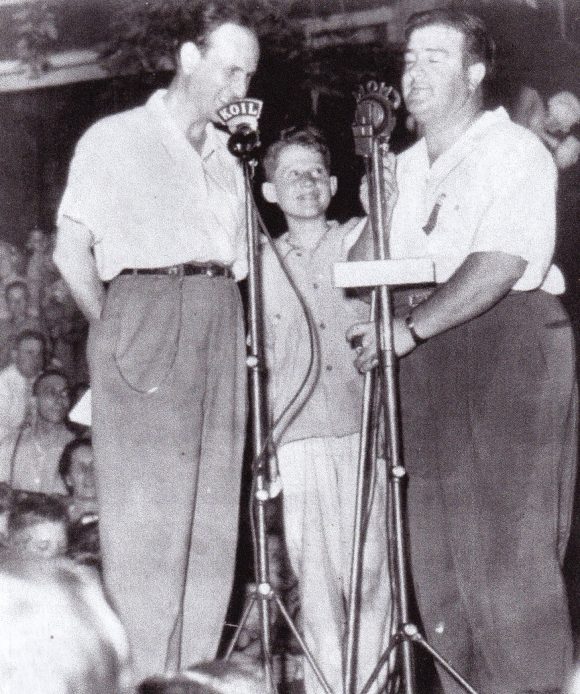
Abbott, Jerry Young, and Costello in August 1942.
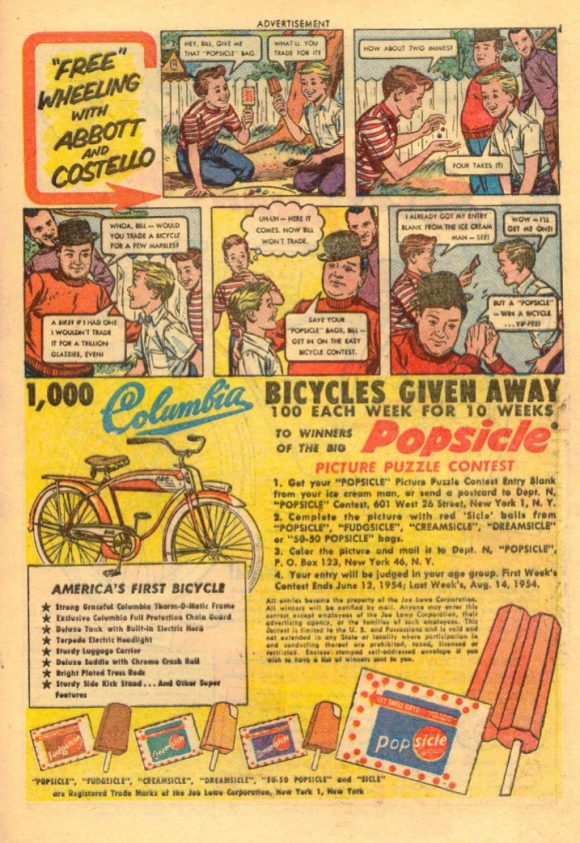
In 1954, Popsicle had a series of ads with Bud and Lou pushing their product.
—
TELEVISION
Wanting to get back in front of a live audience, the team moved into television. They appeared on The Colgate Comedy Hour approximately 20 times between 1951 and 1955. In addition, from 1952-1954, they had their own 52-episode syndicated series, The Abbott and Costello Show. It was the perfect place to perform all their classic routines — and it included the very best version of “Who’s On First?”:
On November 21, 1956, a surprise for Lou came while he and Bud were filming a promotional spot for their 36th film, Dance with Me, Henry. (The quality of this video is not great, but the content is.)
—
THE TEAM COMES TO AN END
They had been a team since 1936, and had been through all the ups and downs that any relationship of two decades would go through, but they were about to get a divorce from each other. And it was something that many people who knew them personally could see coming for some time.
As far back as the mid-1940s, a rift had developed between Bud Abbott and Lou Costello. It may have started when Lou had fired a maid, who then went to work for Abbott. Costello told him to fire her, but Abbott would not do so. For whatever reason, Costello took that personally and didn’t talk to Bud for some time except when they were working.
It may have also been because Lou had been through the loss of his son. His humorous quips with others, especially Bud, had more of a bitter edge to them than before. There was also a change in their partnership status. The 1950s TV series was produced and owned by Lou — and Bud was now his employee.
The tension may have grown more difficult because Bud was drinking more due to the frightening aspects of the epileptic fits he had to endure. His use of alcohol came to a head in 1956 when he and Lou were performing in Las Vegas, and Abbott showed up late, coming onstage intoxicated. Abbott was unable to remember his lines and Costello had to take him off, swearing never to work with him again.
After 21 years, they were done. On July 17, 1957, the dissolving of the partnership was noted on page 2 of Variety in a piece titled “Lou Costello to Stay In Show Biz as Team of A&C Calls It Quits.” The article said (in part):
“One of the major show biz partnerships, Bud Abbott & Lou Costello is now officially over. What had been a few dates as a single for Costello, while his partner was taking it easy, was really the forerunner of a permanent schism. Abbott, now past 60, will take it easy and devote himself to his stable of horses, while Costello, about 10 years his junior, will still be around the entertainment circuits.
“The parting was amicable, there being no arguments of late to precipitate the parting. There was a period, just after the war, when both were feuding even as the pair were doing a tour of arenas and vaude houses for benefit of the Lou Costello Jr. Foundation, founded in memory of his late son. The pair held press conferences at which time Costello was managed by Eddie Sherman, while Abbott’s affairs were handled by Sam Steifel. When they resumed partnership, Sherman took over.
“The pair came up from burlesque and, at one time, while working for Universal Pictures, were the hottest boxoffice property extant. It was at the height of their career when their major quarrel came and Universal stepped in to protect its valuable b.o. asset.”
Lou made one picture by himself in 1958, The 30 Foot Bride of Candy Rock, but it was not released until five months after his death on March 3, 1959, from a heart attack. Bud Abbott was a pallbearer at his ex-partner’s funeral.
—
BUD TRIES TO CARRY ON
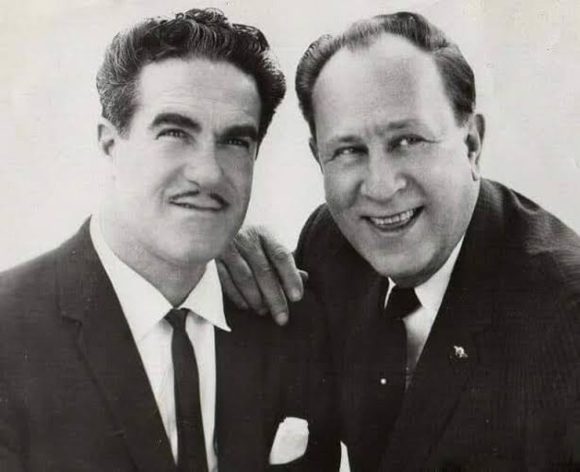
Candy Candido and Abbott
A year later, due to pressure from the IRS for back taxes, Bud began working with a new partner, Candy Candido, but Abbott felt it wasn’t the same without Costello and he dissolved the team.
There was a gap of several years before Bud was involved with the Abbott and Costello team again — at least a version of it. Between 1967 and 1969, Bud contributed his voice to his own character in the new Hanna-Barbera TV series, The Abbott & Costello Cartoon Show. Stan Irwin supplied the voice of the Lou Costello character.
Charlton Comics launched a 22-issue Abbott & Costello series (cover-dated February 1968 through August 1971) to tie in to the animated series.
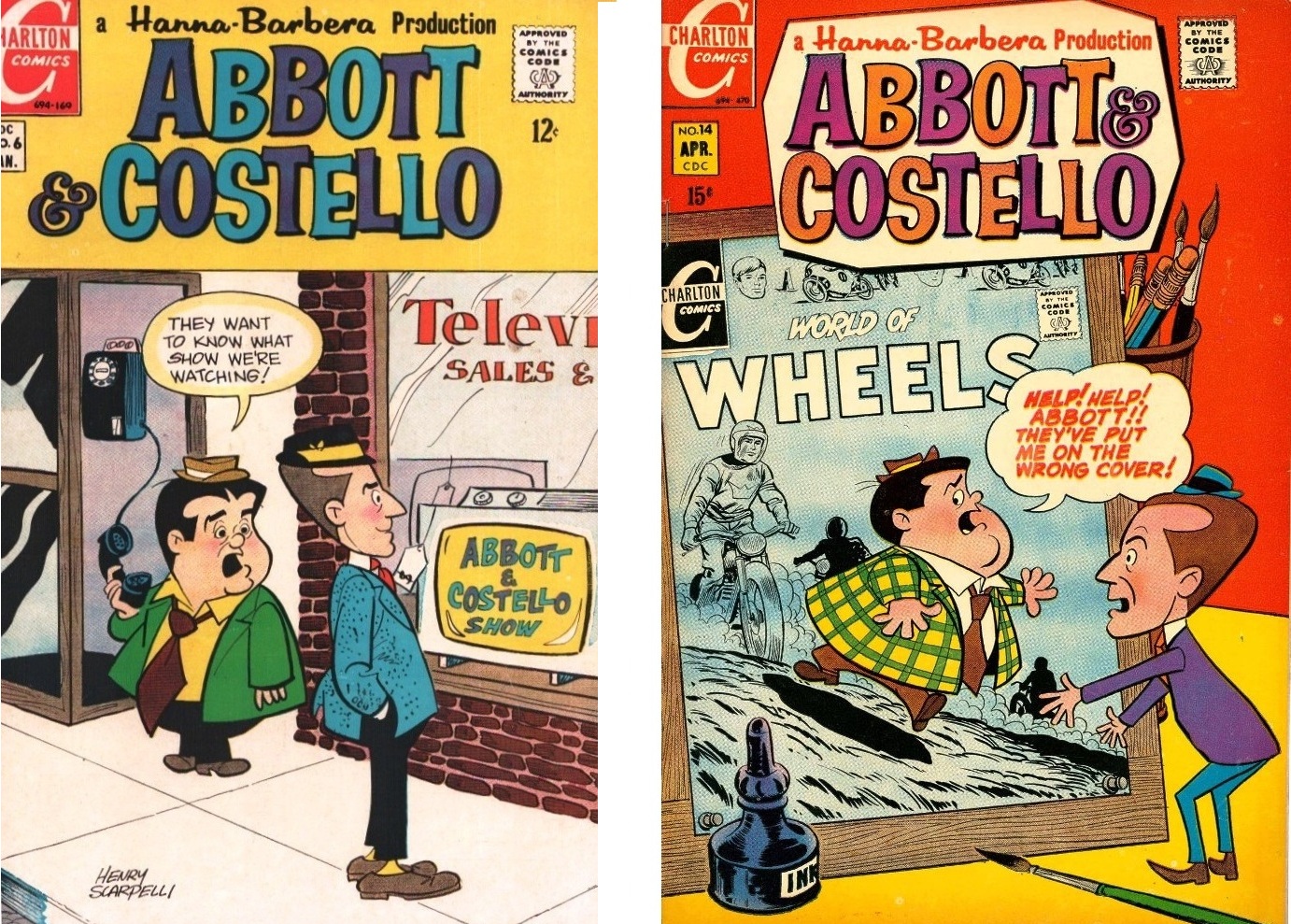
Issues #6 (Jan. 1969, art by Henry Scarpelli) and #14 (Apr. 1970, art by Bill Fraccio, pencils, and Tony Tallarico, inks)
Bud’s senior years were not good. He was in ill health from the many years of epileptic seizures. Finally, he succumbed to cancer on April 24, 1974.
—
WHAT THEY LEFT BEHIND SURVIVES
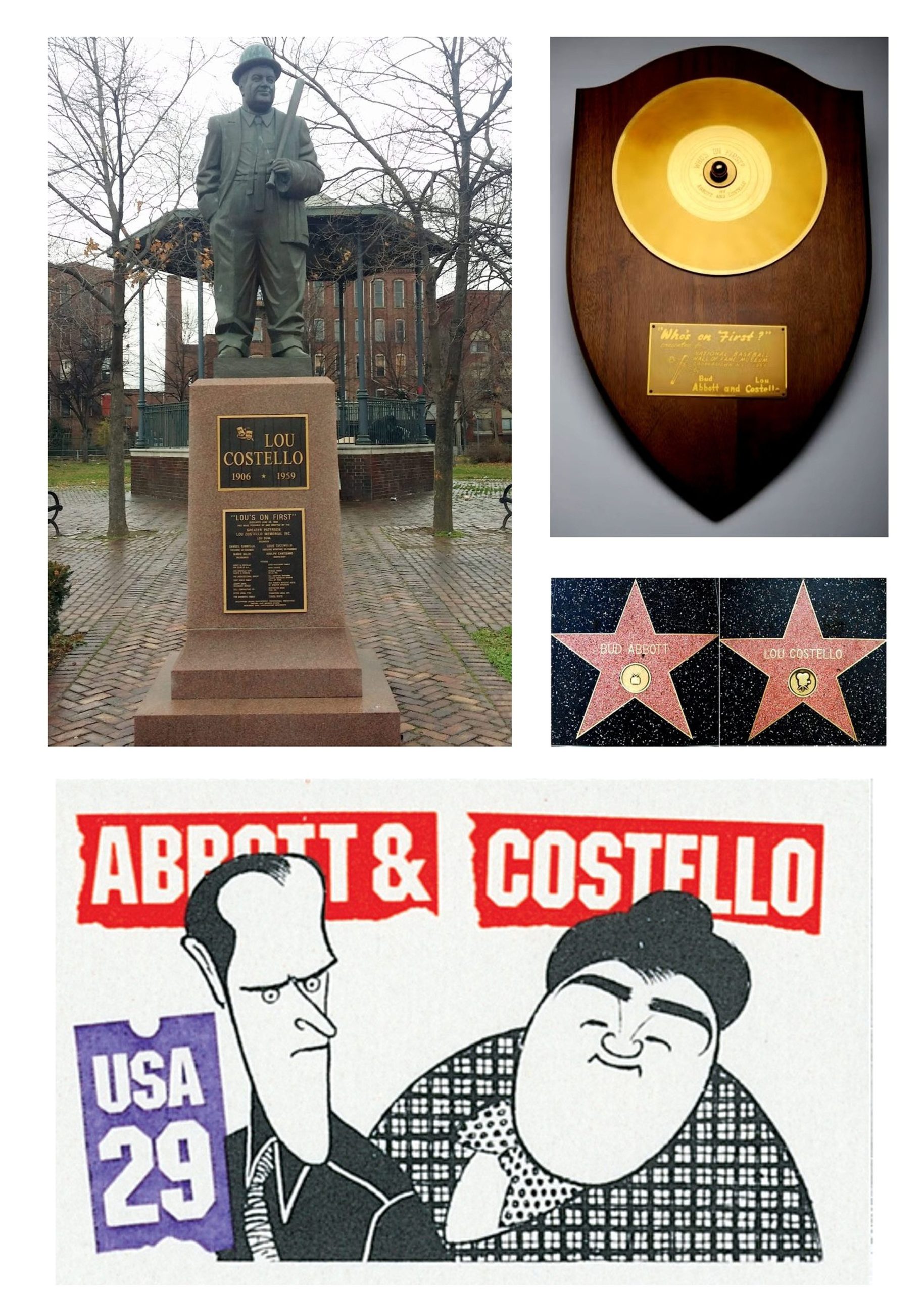
(Clockwise from top left) “Lou’s On First” statue in Lou Costello Memorial Park, Paterson, N.J.; gold record of “Who’s On First?” routine in the National Baseball Hall of Fame in Cooperstown, N.Y.; stars on the Hollywood Walk of Fame (Bud and Lou have three each: for radio, movies, and TV); and the 1991 U.S. Post Office stamp drawn by Al Hirschfeld.
The Lou Costello, Jr. Youth Center in East Los Angeles continues to operate today. It was purchased by the City of Los Angeles in 1951 and renamed the The Lou Costello, Jr. Recreation Center. Since that time, the Lou Costello Senior Citizen Center has been added to the complex.
All of their 36 movies are available on home video, as are the 52 episodes of their TV program.
Of their approximately 460 radio broadcasts between 1938 and 1949, over 150 of them are available to listen to online, including several episodes of The Abbott and Costello Kids Show.
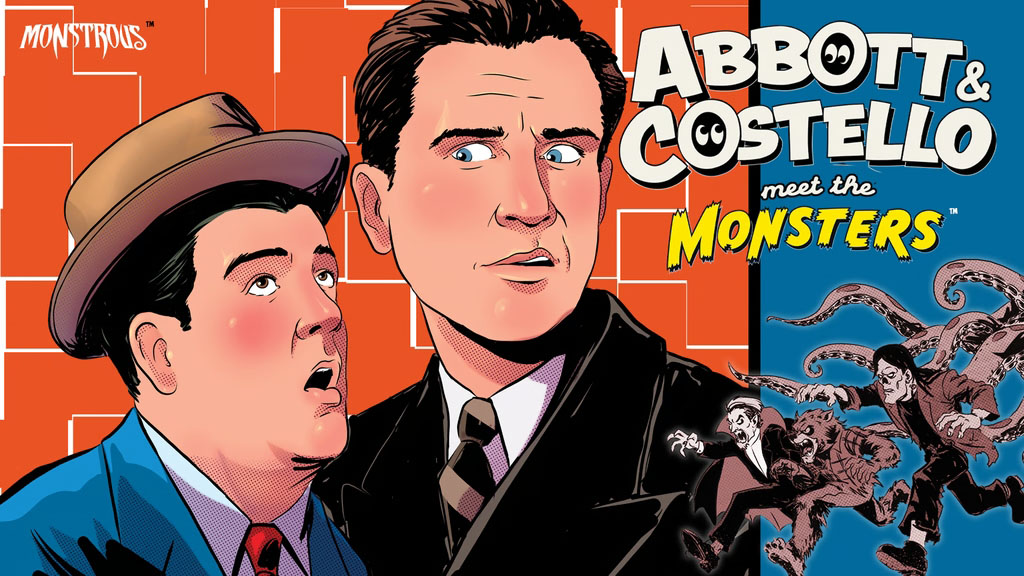
And, for the first time in 55 years, a new comic book series about Bud and Lou, Abbott & Costello Meet the Monsters, is coming.
Most important of all, they left behind families that loved them — and the families of Abbott and Costello are very good friends.
What richer legacy could Bud Abbott and Lou Costello leave than love, friendship, and laughter?
—
MORE
— FOUR COLOR RADIO: The Great DICK TRACY. Click here.
— FOUR COLOR RADIO: The All-Time Classic CAPTAIN MIDNIGHT. Click here.
—
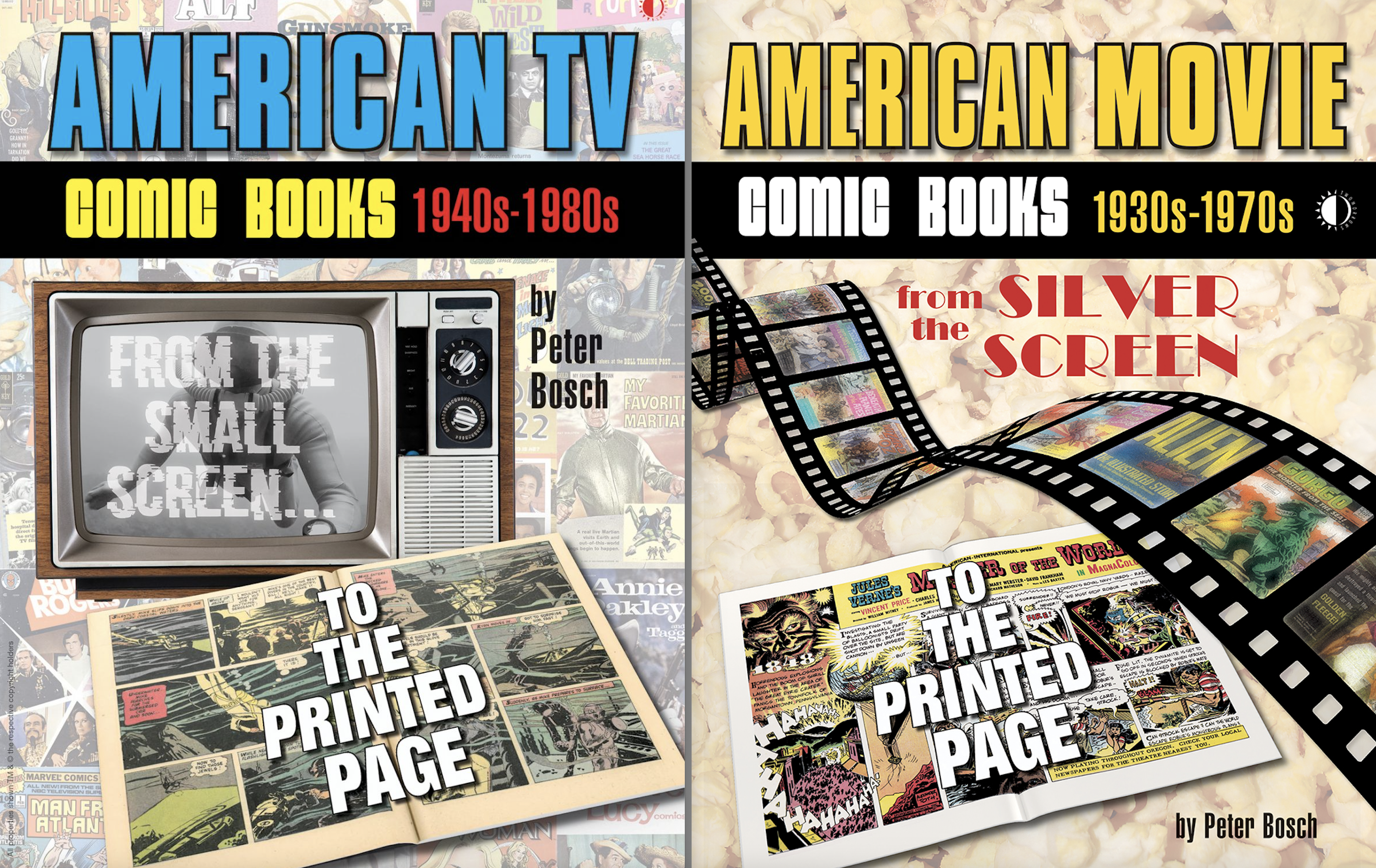
13th Dimension contributor-at-large PETER BOSCH’s first book, American TV Comic Books: 1940s-1980s – From the Small Screen to the Printed Page, was published by TwoMorrows. (You can buy it here.) A sequel, American Movie Comic Books: 1930s-1970s — From the Silver Screen to the Printed Page, is out now. (Buy it here.) Peter has written articles and conducted celebrity interviews for various magazines and newspapers. He lives in Hollywood.

November 14, 2026
It was recently announced that Warner Brothers Archive will soon be releasing Hanna-Barbera’s Abbott & Costello’s Cartoon Show on Blu-Ray.
November 14, 2026
>>The original 1938 broadcast no longer exists
>>
Let’s hope they are just misplaced on a shelf next to the lost BBC Dr Who episodes. Someday I hope they all turn up. Great Saturday morning coffee read! Thanks, Peter.
November 14, 2026
Thanks for the thorough history of two of my favorite comedians. I will check out the links you included. Those who enjoy humor involving plays on words should check them out.