
1966 WEEK Meets REEL RETRO CINEMA: New looks at old flicks, and their comics connections…
—
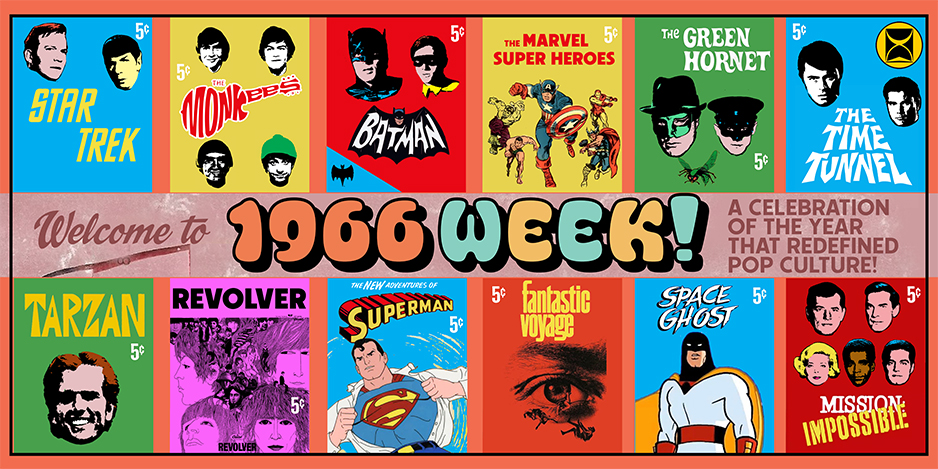
Welcome to 1966 WEEK — a 60th anniversary celebration of an extraordinary, landmark year in popular culture. For seven days, we’re bringing you a whole host of features on everything from Star Trek, to Batman, to the Beatles, to the Monkees, and much, much more. (Just check out Walt Grogan’s latest fab banner, above!) Click here for more of the far out fun! — Dan
—

By ROB KELLY
While network TV offered multiple sources of entertainment for fans of science fiction/fantasy/horror — Lost in Space, Batman, the soon-to-debut Star Trek — the pickings were relatively slim in movie theaters. Unlike their TV counterparts, movie studios were slow to realize there was a burgeoning market for material aimed at younger viewers that had aged out of Disney movies. For the most part, film executives relegated genre movies to lower budgets and diminished expectations.

One exception was Fantastic Voyage, which debuted 60 years ago, on August 24, 1966. 20th Century Fox put enormous resources behind it, hiring 20,000 Leagues Under the Sea’s Richard Fleischer to direct and assigning a top-notch production crew to give the film a hip, modern look and feel. From the eye-catching (no pun intended) minimalist poster by the legendary Saul Bass to the kinetic opening credits, to the eye-popping (dammit, I did it again) color palate, Fantastic Voyage takes an old school Men (and Women) of Action derring-do story and applies a “mod” filter to it.

The film stars Stephen Boyd, Raquel Welch, Arthur Kennedy, William Redfield, and Donald Pleasance as a team of government agents and scientists who, aboard their ship Proteus, get miniaturized and injected into the bloodstream of a scientist working behind the Iron Curtain who was almost assassinated. The victim has an inoperable brain clot, so Boyd’s Grant leads the mission to fix it and get out in less than 60 minutes, the time limit of the miniaturization process. This is such a simple, genius idea for a sci-fi movie I was shocked to learn it wasn’t based on a book or is an adaptation of any kind — it was an original story by writers Otto Klement and Jerome Bixby (who would go on to write for the aforementioned Star Trek).

Pleasance, Kennedy, Boyd, Welch
The crew of the Proteus are met with one threat after another, as the body’s natural defenses kick in to eliminate the foreign object in its midst. When reticular fibers cause the team to divert their original path to the clot by way of the inner ear, there’s a, well, fantastic sequence where someone on the surgical team outside the body drops a pair of metal scissors onto the floor, and sound waves cause an earthquake-like series of convulsions that the ship has to weather.
If that wasn’t bad enough, our heroes learn there is a saboteur on board (have a look at the cast list and take a wild guess who it is). While two of the scientists are using a laser to fix the clot, the rest of the crew have to stop the Proteus from being hijacked and leaving everyone behind. I won’t reveal what it is here, but the saboteur plot line ends in a wonderfully satisfying, delightfully icky way.

All of this is rendered practically, with a combo of rear projection, matte paintings, and physical sets that required the actors at times to be dangled high in the air to replicate swimming through the bloodstream. The human body is shown to be a combo of Hieronymous Bosch paintings, prog rock album cover art, and lava lamps that can kill you. It’s a delightful mix of wonder, mystery, and horror.
I would argue the only real weakness Fantastic Voyage has is its relatively cardboard characters. It’s filled with great old character actors playing familiar types (the gruff general, the stoic pilot, etc.) but we don’t really get to know any of them on a personal level. When the mission is over, the film pretty much ends then and there, as if there’d be no purpose to examining how these people might feel after such a harrowing experience. Fantastic Voyage was Raquel Welch’s first film for 20th Century Fox; she was less than one year away from icon status thanks to her starring role in One Million Years B.C. She’s perfectly fine here, but like the rest, her character is on the bland side so we don’t get to see any of the superstar sizzle she would add to many films later in the decade.

Fantastic Voyage’s concept was so novel that it got into the pop culture bloodstream (OK, that pun I meant) fairly quickly. There was a 1968 Saturday morning series by Filmation that featured voice work by the first animated Aquaman himself, Marvin Miller. There was also a Mad magazine spoof (a sign you’ve truly made it), and during its 1979-80 season Saturday Night Live did a parody of it called “The Micro Dentists” where medical professionals get shrunk down to fix the teeth of Egyptian president Anwar Sadat. I watched SNL during those years and I remember that sketch and understanding what it was, even though I had probably not seen the original movie at that point. Coincidentally, the sketch features Bill Murray, who would then star in 2001’s Osmosis Jones, a comedy takeoff on the whole Fantastic Voyage concept.

With a premise this visually rich, there no way comic books weren’t going to get involved. Unfortunately, it was Gold Key that got the gig. Despite tapping the legendary Dan Adkins and Wally Wood to do the art, Fantastic Voyage the comic is a curiously bloodless affair. It’s all just… fine, but it just doesn’t have any of the visual imagination from the film, and the colors are unfathomably dull. This was a perfect opportunity to go with 100% saturated reds, blues, and yellows; instead we get a lot of light green and grey. There isn’t even any of Wood’s trademark ornate sci-fi machinery decorating the backgrounds.

I understand that part of Dell/Gold Key’s remit was their comics were so clean that they didn’t need to be reviewed by the Comics Code Authority, but surely simply being exciting wasn’t considered unsafe for kids? It’s a real missed opportunity and I’m imagining what the late, great Neal Adams — in the middle of his Deadman crazy layouts and panel construction phase — could have done with this. Ironically, the film’s most adult moment — when our saboteur gooily gets it — is shown via a still from the movie on the inside back cover!


Actually, we don’t have to imagine what Adams would have done with Fantastic Voyage, since there was a direct homage to it in The Avengers #93 (on sale August 1971), when Ant-Man shrinks himself down and enters the “bloodstream” of a passed out Vision. Writer Roy Thomas titled this chapter “A Journey to the Center of the Android!”, but the death-defying voyage Ant-Man goes on is more of a fantastic one. Come to think of it, Stephen Boyd might have made a good Hank Pym if an Avengers movie had been possible in the 1970s.

DC got into the act a few years later, in The Brave and the Bold #115 (on sale July 1974) when the Atom has to take a similar trip, this time into the brain of an unconscious Batman. (Artist Jim Aparo crushes the assignment.) We got a double homage to both movie and comic in the 2009 Batman: The Brave and the Bold episode “Journey to the Center of the Bat!” where the Atom and Aquaman have to rescue Batman from an attack by Chemo. And it all comes full circle with the title of the episode referencing the Avengers story, which is in itself referencing the Jules Verne classic. Whew!

One of the other unique things about Fantastic Voyage is that is has never been remade. Heavy Hollywood hitters like James Cameron and Guillermo Del Toro have talked about it, but nothing has ever come to pass. Joe Dante got closest when he did a comedic take on the idea in 1987’s Innerspace, but considering how desperate the IP mining is in movies right now, it’s genuinely surprising the Proteus has remained in dry dock all these decades.
But you know what? That’s OK! I rewatched Fantastic Voyage just a few days before writing this and was delighted to find it still works like gangbusters. The effects — despite the occasionally noticeable matte line here and there — still hold a sense of strangeness and wonder, partly because we know the actors are actually navigating them. And, like our team of heroes, it knows to get in and get out — Fantastic Voyage runs a brisk 100 minutes; if it ever is remade, it’ll be 40 minutes longer for no good reason.
Fantastic Voyage is aptly named.
—
MORE
— The Complete 1966 WEEK INDEX of Features. Click here.
— CLASH OF THE TITANS AT 45: A Fitting Finale for RAY HARRYHAUSEN That Stands the Test of Time. Click here.
—
ROB KELLY is a podcaster, writer, illustrator, and film commentator. You can find his work at robkellycreative.com.

September 11, 2026
Asimov said he couldn’t resist the truckload of cash he was offered for novelizing this film, but he was never satisfied with it otherwise. His “sequel” (or more aptly, “his redemption”) is much better, and much more scientifically sound, and no less fantastic.
September 12, 2026
Gene, thank you for bringing up Isaac Asimov’s novelization. I have to disagree with you about your ranking, however. I read the novelization long before I saw the movie, loved it then, and recently reread it and loved it now. He made the characters much more interesting than in the film, and was smart not to name the two sides, just calling them “Us” and “Them”. I also reread his original follow-up (“Fantastic Voyage II: Destination Brain”); he’d made the sides explicit, and the story just wasn’t as interesting to me. Both are worth reading, however.
September 11, 2026
Journey to the Center of…That’s Jules Verne, not H.G. Wells.
September 11, 2026
Fixed!
September 11, 2026
The Proteus is bad ass to this day