
An ANNIVERSARY SPECIAL: Batman’s junior partner turns 86…
By JIM BEARD
Batman’s always been my most favorite fictional character of all time, but I’m not sorry to say Robin has given him a run for his millions more than once along the way.
Many things influenced that opinion while I was a kid. Burt Ward is chief among them; you don’t get a more comics-accurate Boy Wonder than the 1966 Batman show. After that is the fact that the very first Mego World’s Greatest Super-Heroes action figure I ever owned was Robin, even before Batman. It just happened that way. Go figure. Then, and I don’t diminish it by listing it third, was a battered, well-loved copy of Batman #185 that was lying around the house. That 80-Page Giant was “A Prize Collection Starring Robin the Boy Wonder,” and its stories have stuck with me for nearly 60 years now.
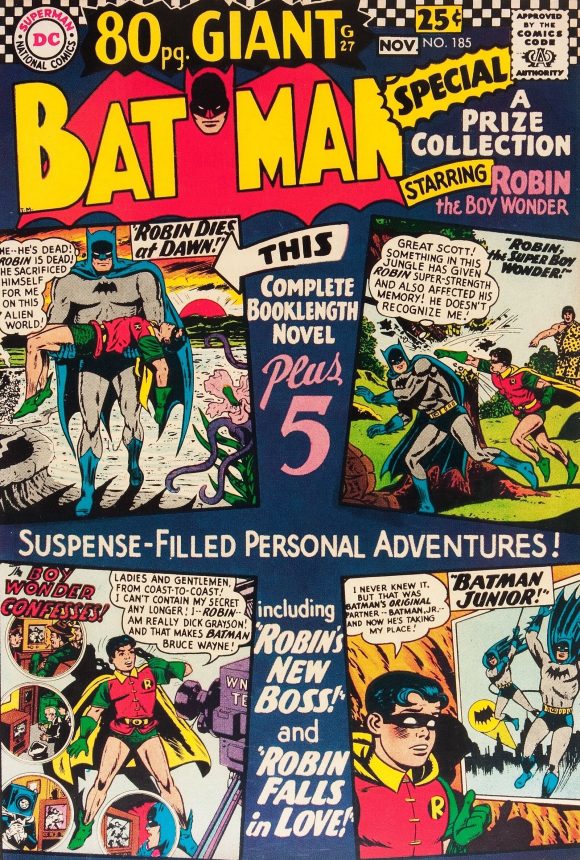
One of them, probably the most memorable of them, is “Robin Dies at Dawn!”
As the kids say, if you know, you know. If you don’t, here’s why I’m celebrating the story here on the anniversary of Robin’s debut in March 6, 1940’s Detective Comics #38: It’s a one-two punch knockout.
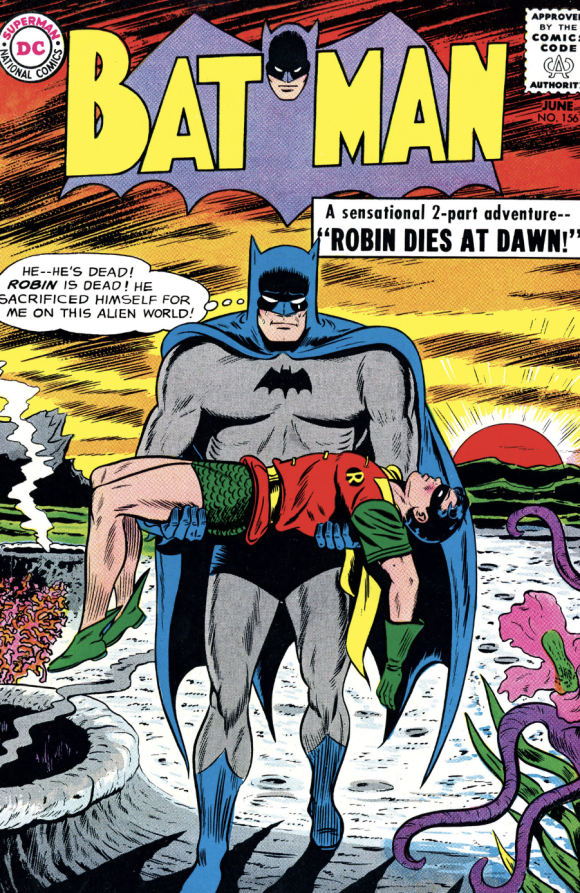
Back in 1963 when Jack Schiff was the ringleader of the Batman line of titles, they were goofy. I’m not ashamed to admit that, just as I’m equally not ashamed to admit I loved them and still do. The “science fiction” era was what it was, an attempt to sell comics based on what was in the air at the time, and what the editor believed kids wanted to read. That said, in the middle of all the aliens and mutations and other-dimensional imps came a story that, to put it mildly, stood way, way out from the pack. That was “Robin Dies at Dawn!” in Batman #156, written by Bill Finger and illustrated by Sheldon Moldoff and Charles Paris.
It’s funny, but it had the usual team of creators behind it, but some kind of magic happened between them and the story went down in Bat-history as a dark, moody exercise in psychology in place of the usual punch-’em-up fare. I just re-read it for the purpose of writing this article with fresh thoughts on it, and here’s what I came away with.
It’s Robin-centric. Oh, I know the title implies that, but it really is about Robin and the place he holds in Batman’s heart and soul. Without the Boy Wonder and his devotion to the Caped Crusader, there just isn’t any story. Batman’s either worrying about him or mourning his seeming death, or Robin himself is acting with urgent agency to find his partner or even go behind his back to try to figure out what’s wrong with him. In the end, there is only sunlight when the Dynamic Duo is whole again and faces the world together.
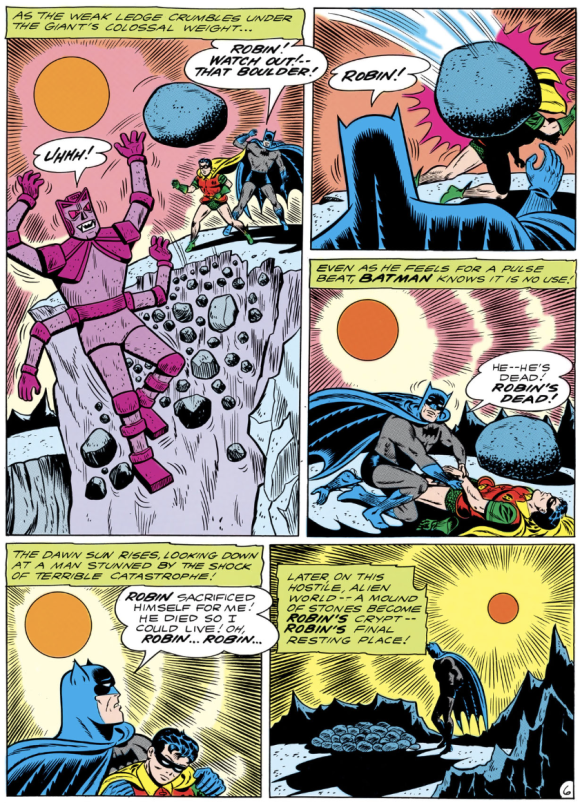
Moody? Oh, yeah. Moldoff and Paris soak the tale in shadows, throwing one grim panel after another at you. Sure, there’s all the alien planets and whatnot in the first half, but for some strange reason it hits differently than the SF-filled Batman stories that came right before and right after it. There are some shots here that are actually chilling, and leave you with no questions about why writer Grant Morrison glommed onto this one decades later — and turned the weird, unnamed doctor in the story into one of the most heinous Bat-Villains of all, Doctor Hurt.
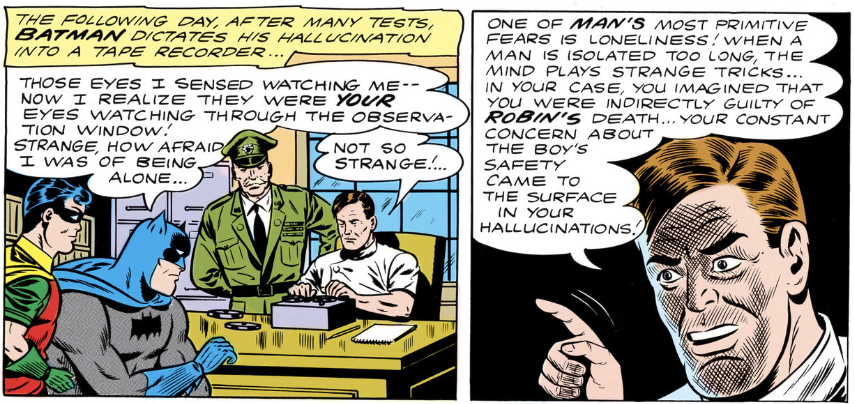
Bruce’s post-experiment breakdown feels real. That’s a lot when you consider how many Batman stories of that time offer nearly nothing more than ruses and schemes and distractions in order for the hero to catch crooks. There is no true antagonist in “Robin Dies at Dawn!,” not really, unless you count Bruce’s own suffering mind. Can you say that about any other Batman story up to that point? How many other musings on the psychology of sleep-deprivation and isolation were there in superhero comics by 1963?
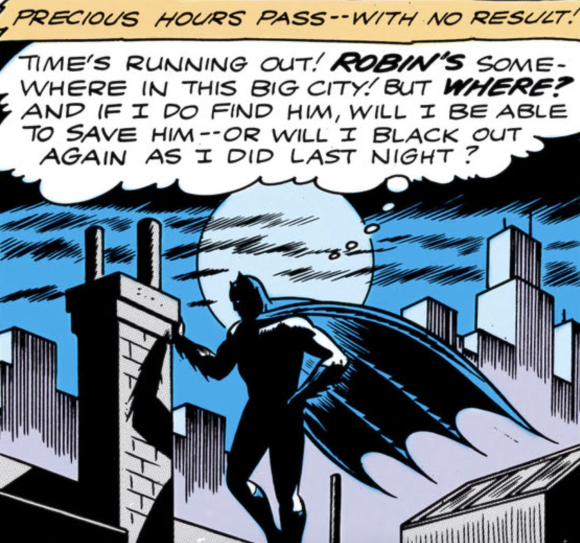
The stakes are real in “Robin Dies at Dawn!” Bruce hangs up his cowl not to fool Dick or Alfred or Gordon or even Ace the Bat-Hound. He does it because he hallucinated that Robin was killed on an alien planet by a boulder and he can no longer trust himself out in the field as Batman. As a kid, I felt that decision. I cried alongside Dick when he heard the news. I anguished over Batman’s shock and grief when he checked the ersatz-Robin’s pulse and found it just wasn’t there. I had never read a story before it that made me feel quite like that. Haven’t really since, if I’m to be honest.
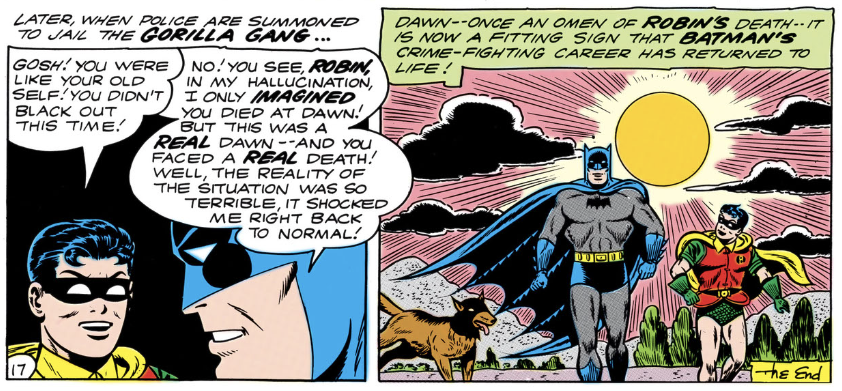
To me, it’s no wonder it’s often chosen as one of the best Boy Wonder stories of all. In my opinion it still is and will always be.
If you’ve never read it before, go and find it. If you have, give it a re-read and see if it doesn’t hit you like a boulder all over again.
—
MORE
— ROBIN DIES AT DAWN: Dig This Homage With an EARTH-TWO Twist! Click here.
— ROBIN DATES AT DAWN: The Boy Wonder’s ‘Romance’ With the Other BAT-GIRL. Click here.
—
JIM BEARD has pounded out adventure fiction since he sold a story to DC Comics in 2002. He’s gone on to write official Star Wars and Ghostbusters comics stories and contributed articles and essays to several volumes of comic book history. His prose work includes his own creations, but also licensed properties such as Planet of the Apes, X-Files, Spider-Man, Kolchak the Night Stalker and Captain Action. In addition, Jim provided regular content for Marvel.com, the official Marvel Comics website, for 17 years.
Check out his latest releases: a Green Hornet novella How Sweet the Sting, his first epic fantasy novel The Nine Nations Book One: The Sliding World, Running Home to Shadows about Dark Shadows, and the most recent Batman ’66 books of essays he’s edited: Zlonk! Zok! Zowie! The Subterranean Blue Grotto Essays on Batman ’66 – Season One, Biff! Bam! Ee-Yow! The Subterranean Blue Grotto Essays on Batman ’66 – Season Two and Oooff! Boff! Splatt! The Subterranean Blue Grotto Guide to Batman ’66 – Season Three.

March 6, 2026
Let us not forget the prologue story that opened up “Robin Dies at Dawn.” Robin is concerned because Bruce is out – somewhere – as Batman, some secret mission. Robin doesn’t know, and it’s worrying him to distraction. At the same time, a new crime fighter presents himself in combat with some standard Gotham City crooks, in which Robin participates. A teeny-tiny man who calls himself “Ant-Man.” Knowing that he doesn’t live in the Marvel Universe, Robin suspects Ant-Man really Bat-Man – only little. Very little!
Robin realizes Ant-Man is another Gotham bad guy and ends the story, worrying whatever is happening to Batman.
March 7, 2026
Good call. Thanks for the rundown.
March 6, 2026
(“I must put away my Batman costume and retire from crimefighting” Wonder who hid that command in your head, Bruce. Come on, don’t look so confused.)
I absolutely love how Grant Morrison was able to retcon this no named doctor, and and combine him with several other obscure Batman characters of the past (Mad Thomas Wayne, Barbatos) and create Doctor Simon Hurt.
March 6, 2026
Entretenida historia
March 6, 2026
Thank you! I have always been a fan of the Jack Schiff era of Batman! As a kid I preferred the reprinted 80 page giant stories over the “New Look” Batman!
March 6, 2026
This book so needs to be a facsimile.
March 6, 2026
Acquired that 80-page giant in a childhood trade and still have it. A fantastic main story, and the panels showing Robin being felled by the boulder, and Batman’s reaction were chilling to me as a kid. Funny how the images from a single story from decades ago imprint themselves in our heads.
Great work, Jim.
March 7, 2026
Appreciated, Jeff.
March 6, 2026
In addition to being a classic story this is one of the most swiped covers of all time.
March 6, 2026
Homaged, you mean
March 6, 2026
Excellent coverage, Jim! This was one of the greatest comics of my youth.
March 7, 2026
Peter, sincere thanks.
March 9, 2026
Picked up a well-loved copy of this issue for a fiver last year and you reminded me to dig it out and give it a read!