
A Halloween Week salute to the Peter Cushing/Christopher Lee classic…
By CHRIS FRANKLIN
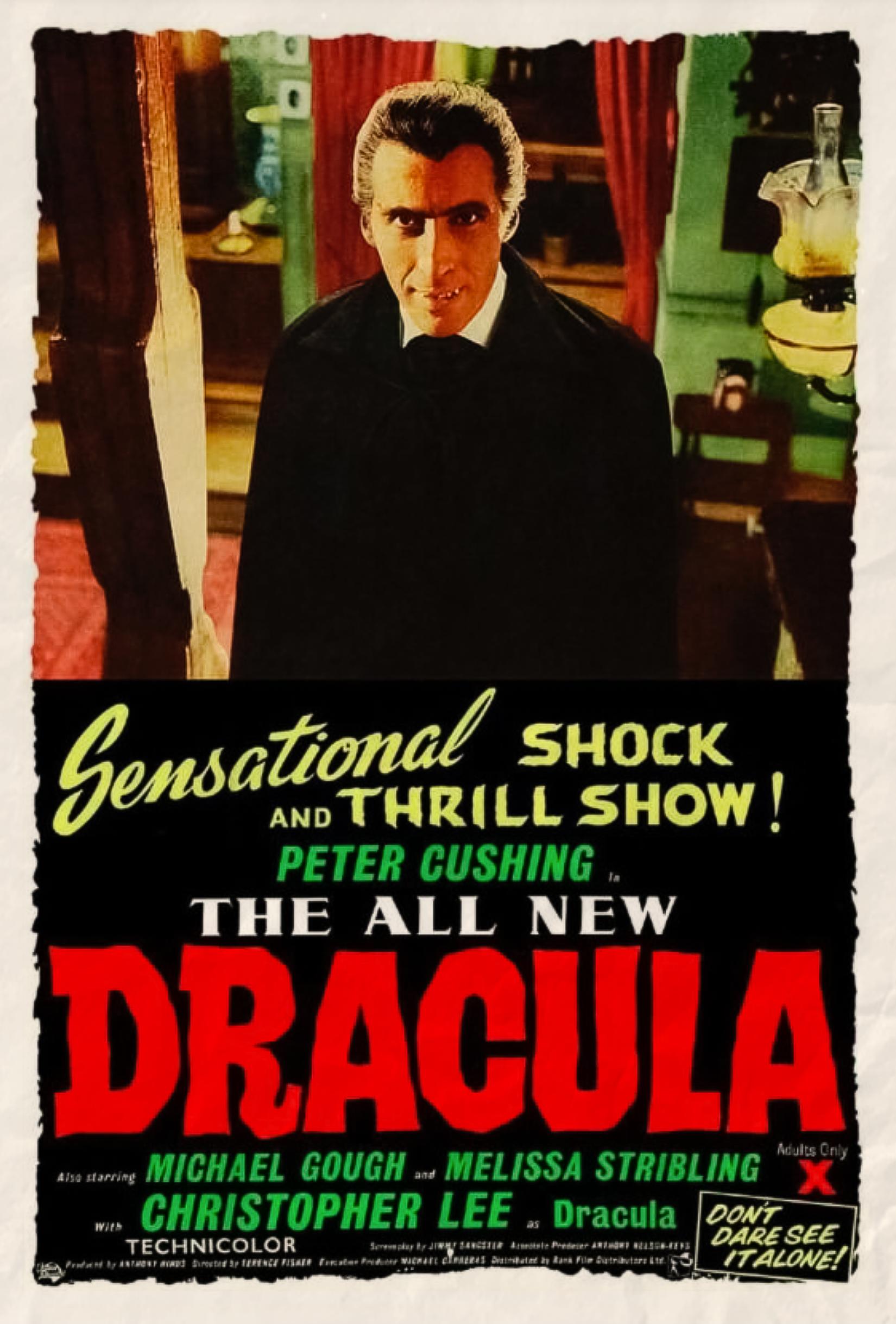
In 1958, British studio Hammer Films followed up the previous year’s smash success The Curse of Frankenstein with the next logical gothic horror adaptation, Dracula. Reassembling most of the Frankenstein team, including director Terence Fisher, writer Jimmy Sangster and stars Peter Cushing and Christopher Lee, Hammer set out to adapt the story of Bram Stoker’s vampiric count in a way never seen before. They succeeded.
Dracula, or The Horror of Dracula as it was known in the US, was a bombastic, savage attack on the senses to audiences of the time. Filmgoers had never seen full-color blood, fangs, and on-screen stakings in previous vampire cinema. Censors were nervous, audiences were enthralled, critics were appalled, and Hammer now had a winning blueprint from which to build an empire.
The vampire film, and the horror genre in general, would never be the same.
This fall, the current incarnation of Hammer is issuing a new 4K/Blu-ray box set of Dracula in the UK, partnering with Warner Archive to do the same for The Horror of Dracula in the US. Hammer is touting this release as the definitive version, featuring for the first time an extended “director’s cut” that includes all the footage Fisher was forced to cut for British and US censors.
The handsome package includes a full-color, 200-page book, a 60-page comic reprinting the adaptation from the 1970s House of Hammer magazine, special features galore, other cuts of the film, and much more.
To celebrate this release — it’s due in the US on November 24 (too late for Halloween but in time for the holiday season) — let’s take a look at what made this landmark film such a monumental achievement for the small, homebound studio. And why its legacy endures decades after the count was first laid to rest at film’s end.
—
James Bernard’s Score. From the opening seconds, the heavy, bombastic beats of James Bernard’s score set the mood: dark, foreboding, and menacing. This is no “Swan Lake,” which opened the 1931 Universal Dracula by Tod Browning. Then there’s the three notes that spell out “DRAC-U-LA”. That trick (which John Williams will also use in Superman: The Movie two decades later) mirrors the tone of the entire film. How the Count, even with fairly limited screen time, will dominate all the action and conversation.
The entire score is a wonderful complement to the film, such as the swirling strings as Lucy anticipates the arrival of her forbidden vampiric lover, leaves blowing about her terrace as she awaits his entry.
Bernard is one of the key factors in why the heart-thumping finale succeeds. The continuous audible build-up as Van Helsing chases Dracula into and through his castle, until the two physically crash into one another, just as the symbols in the orchestra do. A masterpiece of film scoring.
—
Production Design, Makeup and Special Effects. Castle Dracula is not the moldering remnants of another time we might expect. Bernard Robinson goes against the grain, and Universal’s previous example, by giving the Count a home that looks ornate, regal, and still livable. That somehow makes it even more eerie, as only the dead live there.
The staircase that Lee descends in his introduction allows him to approach us unencumbered, with nothing to stop him. The room where Dracula and Van Helsing have their final battle is opulent with its giant table, perfect for Cushing to run across, and a giant window, destined to call curtains on the vampire.
As he did with all of his Hammer projects, Robinson takes a meager budget, Hammer’s home of Bray Studios, an old manor house in the English countryside, and outdoes Hollywood’s biggest epics.
Equally impressive is the makeup of Phil Leaky, who wasn’t a particular fan of Hammer’s descent into horror, although he enjoyed creating the impressive makeup for Hammer’s break-out sci-fi film The Quatermass Xperiment a few years prior.
Leaky and his assistants (including later Hammer makeup supervisor Roy Ashton) established the look of the modern vampire, including giving them fangs for the first time in an English-language production. The bloodshot eyes were done with innovative contact lenses, which were carried forward in further Hammer Dracula films, much to Lee’s chagrin, as they were painful to wear.
Leaky and his crew worked in tandem with Special Effects Supervisor Sid Pearson to create Dracula’s elaborate demise as he disintegrated into a pile of dust. Several excised shots from this sequence are being restored to the new director’s cut as well.
—
Terrence Fisher’s Direction. Terrence Fisher had directed many films for Hammer and their parent company Exclusive before helming The Curse of Frankenstein, but that film seemed to be the perfect vehicle for the filmmaker. Fisher often preferred to call his horrors “dark fairy tales” and if one considers the original version of the Brothers Grimm’s stories, it’s an apt description.
Fisher wasn’t afraid to show the gore that became Hammer’s trademark, but he realized that shock only got you so far. It’s the characters, their interactions and their reactions to the horror that stick with you, and none were better than Fisher at making those memorable. Fisher had worked early in his career as a film editor, and that eye for the final cut served him well, although editor James Needs was also a master of his craft.
Fisher’s action sequences, lensed with precision by cinematographer Jack Asher, were thrilling and far ahead of their time. The climax of Dracula (more on that later) being a highlight of the genre.
But Fisher’s films were not without nuance and subtext, and his horrors often championed for Christianity to triumph over evil. Dracula isn’t a monster just because he drinks blood and kills, but because he perverts the sacred vows of matrimony, and undermines the sanctity of family.
Under his direction, Lee and Cushing gave legendary performances, becoming international stars, and cementing their association with the Count and Van Helsing for all time. Fisher took stellar ingredients and made a film that is as thrilling and engaging today as it was nearly 70 years ago.
—
Jimmy Sangster’s Script. Having worked as a studio assistant and then assistant director for Hammer for over a decade, Jimmy Sangster stepped behind the typewriter to create Hammer’s sci-fi thriller X the Unknown in 1956. This success led to him loosely adapting Mary Shelley for the studio’s The Curse of Frankenstein the following year.
But with Dracula, Sangster took on a whole new challenge. Stoker’s novel is winding, written from the perspectives of many characters through their personal journals, and the locales range from Transylvania to Whitby, England. In a move that would get him crucified online now, Sangster dared to reshape Stoker’s story to properly fit the running time, and Hammer’s limited budget.
By setting the action near Castle Dracula in the fantasy Euro-neverland of Karlstadt, Sangster eschews the globetrotting by making Dracula’s conquests personal. Harker stole his bride, and he would take his. He also smartly has Van Helsing record his theories and knowledge on vampirism, as Cushing nearly speaks directly to the camera, sparing us more exposition, and an unneeded larger cast.
The result is a lean, fast-paced thriller that never lets up. The story is still quintessentially Dracula, and a version much easier to digest. Sangster would go on to write many of Hammer’s best horrors and psychological thrillers.
—
Jonathan Harker: Secret Agent. Sangster wisely chose to keep Stoker’s journal component in the beginning, with Jonathan Harker (John Van Essyen) narrating the action as he arrives at Castle Dracula. Rather than make him a solicitor, Harker is instead a librarian, hired to put Dracula’s collection in order. But we quickly learn that it is all a facade. Harker is a vampire hunter, there to destroy the undead Count.
Nowadays such a change would be called blasphemous, but the move immediately tells us what kind of threat Dracula is, with a conspiracy already against him, and we haven’t even met him yet!
Unfortunately, Harker isn’t the right man for the job, allowing the vampire woman (Valerie Gaunt) to get too close and bite him, before he finds himself in the middle of an animalistic show-off between her and Dracula, fighting for him.
He further bungles his mission when he finds the vampires’ resting place, and chooses to destroy the woman first, leaving Dracula to rise with the coming of dusk. These mistakes doom him to become the very thing he set out to destroy.
—
Dracula’s Introduction. Having first encountered the castle empty, and a meal left for him, Harker is seemingly puzzled by the appearance of Gaunt, as a mysterious woman who is begging for his help in escaping Dracula. But she soon runs off, and Harker learns why. He feels the presence of someone else in the room and turns with a shock as he sees a tall silhouette on the stairs above him.
Dracula glides down the stairs quickly, with no sounds of footsteps. He approaches the camera in one uninterrupted take and invades Harker’s and the audience’s personal space as he talks directly to the camera: “I am Dracula, and I welcome you to my house.” Fisher and cinematographer Jack Asher make this introduction not only powerful, but somewhat uncomfortable.
Although not yet projecting evil, Lee’s Dracula is intimidating from the beginning, with an air of mystery about him, despite his low-level charm. Lee speaks his only dialogue in this sequence as he shows Harker to his room, and comments on the photo of Lucy, Harker’s fiancée: “Charming.”
When next we see Dracula, it is after Harker has again encountered the mysterious woman, who then proceeds to bare her fangs, and bites him. Jump cut to a hissing Dracula, filling the screen, eyes bloodshot, fangs bared, with Hammer’s patented “Kinsington gore” dripping from his gaping maw.
The shock audiences must have felt in this moment cannot be underestimated. And Lee gives unlife to the visual standard by which all cinematic vampires would be judged moving forward.
—
Van Helsing Arrives. Top-billed Peter Cushing doesn’t appear for 23 minutes into the run time, but he commands the film from there on out.
In Stoker’s original novel and previous adaptations, Van Helsing is called in when Lucy’s blood loss can’t be explained. He has previous knowledge of vampires, but we’re never really told how much experience he has with them. Cushing’s Van Helsing is a vampire hunter first, doctor second, and has an active campaign to destroy Dracula and his kind.
We meet him as he checks in at the inn near Castle Dracula, and is stymied by the locals, who refuse to cooperate with him, despite him knowing they are in desperate need of his help. When the maid brings him Harker’s journal that he’d hidden for his friend to find, Van Helsing fears the worst.
At the castle, he finds the body of the staked vampire woman, then that of Harker, asleep in a coffin, fangs protruding from his lips. The look of regret on Cushing’s face says it all: He should have never sent Harker here. Now he has the task of dispatching his friend and freeing him from this curse.
Van Helsing’s compassion for his fallen comrade continues when he visits the home of Arthur Holmwood (Michael Gough, known to later generations as Batman’s Alfred), his wife Mina (Melissa Stribling) and Holmwood’s sister Lucy (Carol Marsh). But Arthur has questions that Van Helsing isn’t quite willing to answer, not wanting to drag the family into the world he is unaware they are already mired in.
Recording his notes onto a phonograph in his study, Van Helsing compares the vampire’s victims’ inability to resist their master as being akin to drug addiction. It’s another way to ground the fantastical somewhat but is also a shocking wrinkle for a film of the time.
—
Lucy’s Wedding Night. Turning him into a vampire wasn’t good enough for Jonathan Harker. No, Dracula has to seduce Harker’s fiancée Lucy and make her one of his own. Lucy had already been visited by the Count off-screen, but the preparations we see her make seem like an anxious virgin bride anticipating the arrival of her “husband” to de-flower her. The removal of her cross (and therefore her Christian beliefs), her opening of the window, the straightening of her gown, and the nervous look on her face says it all.
Stoker’s Dracula was pretty loathsome, but Hamilton Deane’s play, and John L. Balderston’s US adaptation of it, had brought a touch of romance to the character, carried into the 1931 Universal film adaptation. Sangster, Fisher and Lee take it to the next level, with Dracula cast as an undead lothario. The vampire bite is now a direct analogue for a sexual act, no subtext needed. Censors clutched their pearls.
—
The Staking of Lucy. The scene of the undead Lucy luring young Tania (Janina Faye) to her crypt is one of the eeriest in all of Hammer’s horror catalogue. The betrayal of friendship and trust between an adult and child, bastardized by the vampire curse, is unsettling. Thankfully both Arthur Holmwood and Van Helsing are there to stop Lucy before things get far worse.
After he runs Lucy back to her crypt by burning her with his crucifix, Van Helsing takes the time to comfort Tania and give her his coat.
This Van Helsing is a compassionate man who knows the trauma of the vampire curse goes beyond those directly afflicted. But then he gets down to business. And the scene where Cushing’s vampire hunter drives a stake through Lucy’s chest must have been just as harrowing for audiences as it was for poor Arthur, forced to see his sister’s body mutilated. But the look of serenity calms both character and viewers, cementing Fisher’s belief that faith and goodness will ultimately triumph over all evil.
—
Satisfied Mina. As if his encounters with Lucy left any doubt, Dracula’s seduction of Arthur’s wife Mina tells us the Count has a way with women. We don’t see Mina’s first rendezvous with Dracula, but the next morning Stribbling has a VERY satisfied grin on her face. This is largely due to Terence Fisher directing her to “act as if you had the best sex of your life.”
Later, Dracula’s slow, powerful march up the stairs and into her room, and Mina’s semi-willing acceptance of his advances raised eyebrows in 1958, certainly among the censors.
Producer Anthony Hinds had to argue with the British Board of Film Censors that they had already approved such scenes during a rough black-and-white cut. Still, edits were made, which are now being restored in the new “director’s cut.” Lee’s animalistic nuzzling of her, pre-bite, seems to show he’s not just in it for the snack. And since Arthur Holmwood comes across as a real stiff, well, the implications of an unsatisfying marriage are certainly very obvious.
—
The Finale. Horror’s greatest final act begins when Van Helsing realizes Dracula’s coffin is in the very house they are staying at. He finds it in the basement, and the two rivals meet briefly before Dracula locks him in. While he’s pounding on the door, the Count grabs Mina to be his bride. Van Helsing and Holmwood give chase, and when they catch up to him at Castle Dracula, the vampire is burying Mina in the earth outside.
With dawn approaching, Dracula flees into the castle, and James Bernard’s pulse-pounding score really kicks in. Dracula silently glides up the stairs, two steps at a time as Van Helsing follows, and then confronts the vampire hunter when he’s cornered trying to access a trap door.
The fight is intimate and violent, with Van Helsing feigning unconsciousness as a smiling Dracula leans in for the bite. Van Helsing pushes him away and rises, but the Count still has him right where he wants him. That is, until the hunter glances at the large windows.
Leaping on a long table, Van Helsing runs across it, jumps on the curtains and pulls them down, bathing the Prince of Darkness in deadly sunlight.
Dracula drops to the floor and screams, but Van Helsing isn’t going to let him crawl away. In a move conceived by Cushing to alleviate the number of crucifixes Van Helsing pulls from his pockets, he grabs two candelabras and makes a makeshift cross, pushing the vampire back into dawn’s rays.
Dracula writhes and moans as his foot disintegrates, then his hand, and finally his body, as he claws at his own face in agony. All that’s left are his clothes and his ring, as the ashes that were once his body blow away. Cue the credits.
This conclusion is nothing less than perfectly satisfying, a confrontation between these forces of good and evil you’ve waited to see throughout the whole film. By comparison, in the original 1931 film, Dracula is staked off screen by Van Helsing, with only Lugosi’s moans and the sound of a hammer to let us know what has happened. Sangster and Fisher do not cheat the audience. The battle is all on screen in all its glory, and Lee and Cushing are at their very best delivering it.
—
Peter Cushing as Van Helsing. If Peter Cushing tells you vampires are real, you believe it. Cushing had a nearly unequaled ability to make the fantastical seem reasonable, just by the utterance of his refined but comforting voice. His preparation for his roles is well documented, often writing back stories for his characters, and having every detail of their person down pat before he stepped on set, down to what they were carrying in their pockets. Just look at how he performs an early blood transfusion in this film. Just as believable as the “surgery” he performed as Baron Frankenstein the year before.
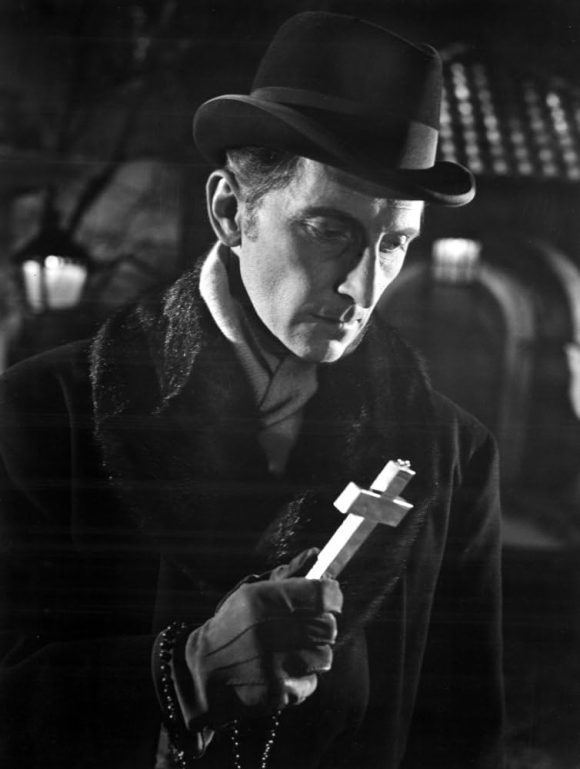
His Van Helsing is not an elderly, eccentric man of science. He’s an agile man of action who isn’t afraid to go toe-to-toe with the undead. This is a few years prior to the birth of the action movie with James Bond’s big-screen debut in Dr. No, but Van Helsing in many ways is a precursor to that archetype. Van Helsing’s virtue, faith and compassion are his greatest strengths, however. There’s no need to question his motives. He knows the threat of vampirism must be stamped out, and he’s willing to take the lead in doing so.
Cushing would reprise the role without Lee (or Dracula) in the equally excellent Brides of Dracula two years later, proving that he could carry the series even without Lee’s commanding presence. It’s a shame Hammer didn’t give us more solo Van Helsing adventures. Of course, he was kept busy playing the sociopathic genius Baron Frankenstein, who couldn’t be further from Van Helsing. Thankfully in the early 1970s, they brought Cushing back to the role, playing Van Helsing’s descendant, once again matching wits with Lee, his immortal screen nemesis, but close personal friend.
—
Christopher Lee as Count Dracula. A fan of Stoker’s novel, Lee took a different approach to the role than Lugosi and everyone who came before him. His Dracula was a creature controlled by an unquenchable thirst, and even in the restrained opening scenes with Harker, you can tell the beast is baying at the door. Lee wasn’t afraid to go full savage, revealing the hungry animal Dracula’s curse had reduced him to.
It’s easy to say Lee’s Dracula is perhaps one of the most evil portrayals, but the actor felt he simply was what nature had consigned him to be. The carnage he created was part and parcel with what he had to do to survive. There’s still an air of nobility about him, a regal posture that befits his stature. This despite the blood and fangs and red eyes.
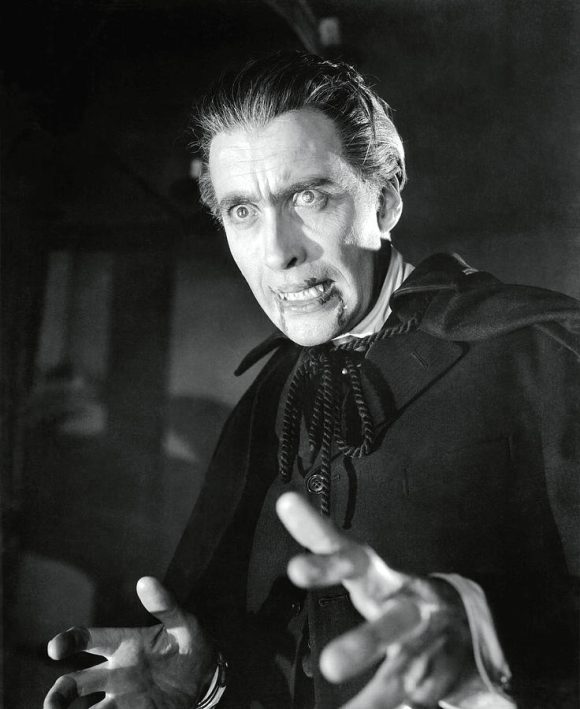
In direct opposition to the grotesque and pitiful creature he played in The Curse of Frankenstein, Lee amped up Dracula’s sensuality, coming across as a forbidden lover who answers the carnal prayers of chaste women, consequences be damned.
Lee’s relationship with the role became complicated, despite it making him a star. He didn’t reprise it for eight years, and then nearly yearly afterward. He often felt emotionally blackmailed into continuing the part, since his popularity guaranteed good box office, keeping Hammer in the black, and his colleagues working.
But aside from Lugosi himself, Lee stands as the definitive Dracula, and one modern audiences can identify as a vampire they recognize, greatly due to the influence he had on those who followed.
—
MORE
— 13 Great CHRISTOPHER LEE Horror Roles That Aren’t DRACULA — RANKED. Click here.
— Dig These 13 Great PETER CUSHING Performances — RANKED. Click here.
—
13th Dimension contributor CHRIS FRANKLIN is a graphic designer, illustrator, writer, and podcaster, who co-hosts and produces several shows on the Fire and Water Podcast Network, including Super Mates, with his wife Cindy, featuring their annual Halloween horror film series, House of Franklin-Stein. They’ve covered many Hammer, Lee and Cushing films in their terrifying 13 seasons.
