
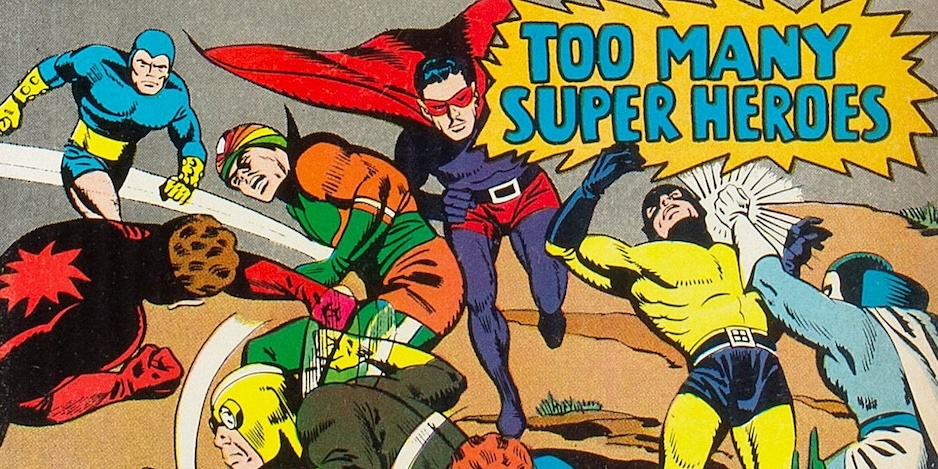
An ANNIVERSARY SPECIAL: You can never have TOO MANY SUPERHEROES!
By PETER BOSCH
It isn’t often I will devote an article such as this to a comic book that was a total mess… but this mess is one of my favorite comics of the Sixties. And since this is the 60th anniversary of that comic appearing on the newsstand on February 1, 1966, let’s look at this landmark issue. Yes, I said “landmark” because it introduced 13 (or 14, based on how you view Steel Sterling) of MLJ’s greatest Golden Age heroes to the Silver Age!
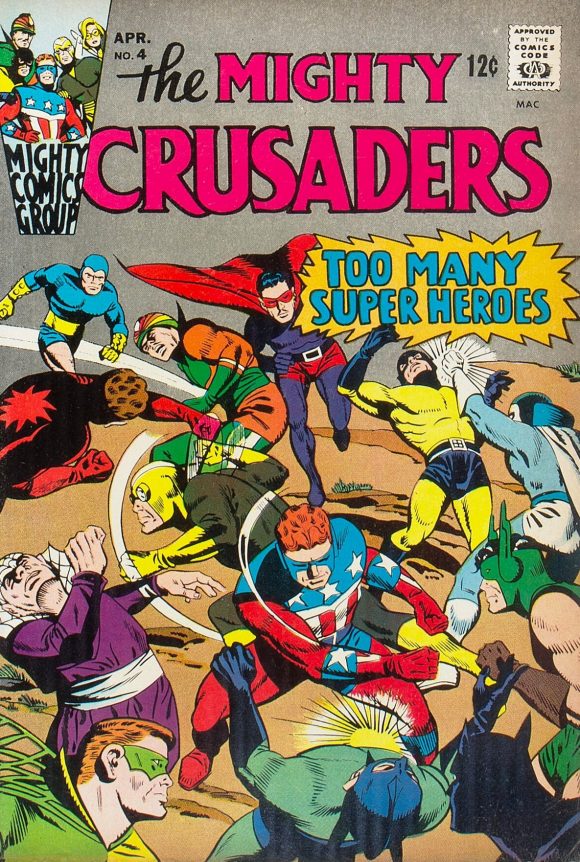
The Mighty Crusaders #4 (Apr. 1966). Art by Paul Reinman.
The comic in question is The Mighty Crusaders #4 (Apr 1966) and the story written for this particular issue was by Jerry Siegel (yes, Superman’s co-creator). For a few years, Archie Comics had been slowly re-introducing a few characters (the Black Hood, the Comet, and the Shield) from the 1940s MLJ comic book line into issues of The Fly and The Jaguar.
(However, it later turned out that the Shield of the 1960s was actually the original Shield’s son. There had also been an attempt by Archie in 1959 to resurrect the Shield in The Double Life of Private Strong, a series by Joe Simon and Jack Kirby that lasted two issues.)
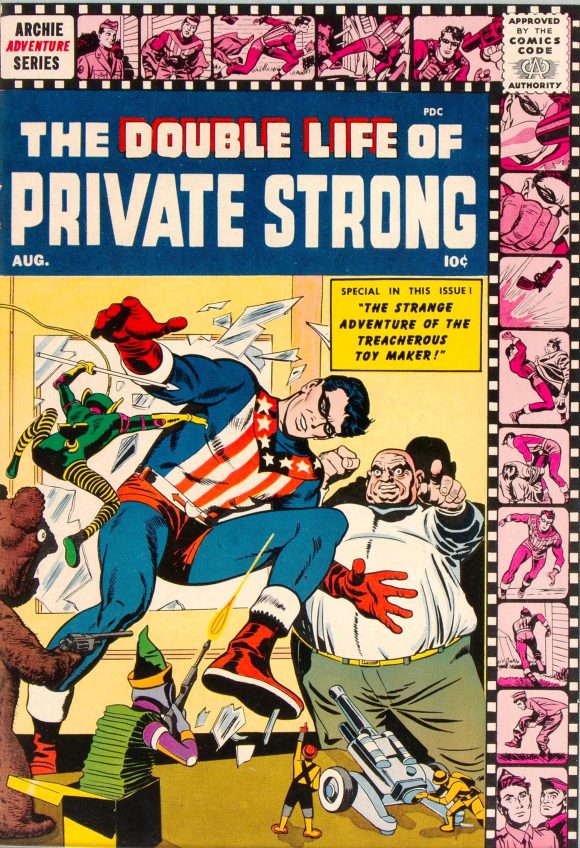
The Double Life of Private Strong #2 (Aug. 1959). Art by Joe Simon and Jack Kirby.
Archie Comics also reintroduced two of MLJ’s best heroes — the Hangman and the Wizard — in Fly Man #33 (Sept. 1965). The pair applied to join the Mighty Crusaders — but when the team recovered various loots from criminals and placed the riches in one location, the sight of it brought the newcomers’ overwhelming avarice to the forefront, turning them evil. Both were defeated but would show up again in The Mighty Crusaders #4.
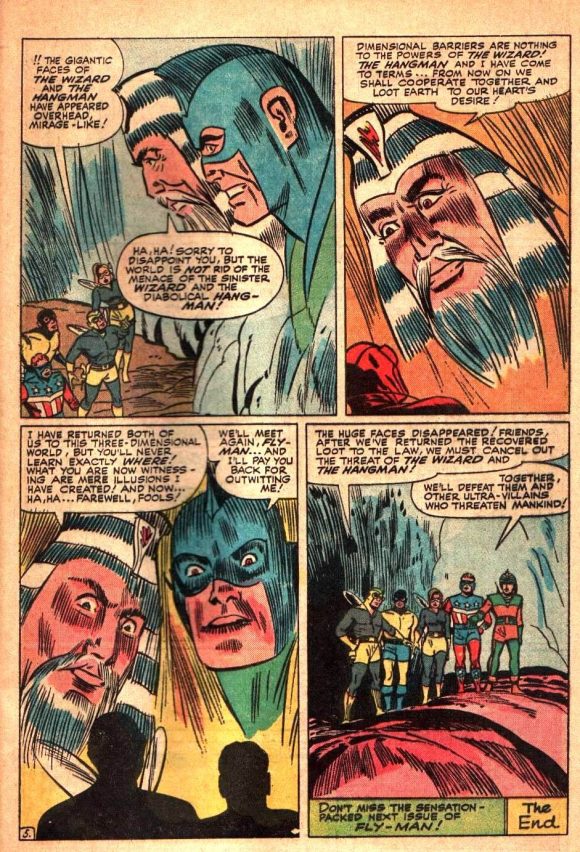
Fly Man #33 (Sept. 1965). Script by Jerry Siegel. Art by Reinman.
Another MLJ hero brought back prior to The Mighty Crusaders #4 was the Web, in Fly Man #36 (Mar. 1966), a character who was perhaps the weakest and most uninteresting of the bunch in his updated version. He had married and was forbidden by his wife, Rosie, to take up the Web identity. He had become a henpecked husband. Whether Archie Comics saw this as a humorous situation or not, the Web of the 1960s failed badly.
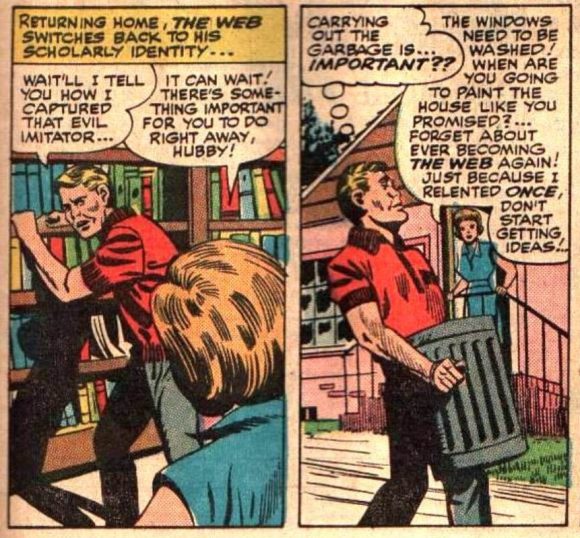
Fly Man #36 (Mar. 1966). Script by Siegel. Art by Reinman.
One last MLJ good guy that did appear before The Mighty Crusaders #4 — and yet he did not appear — was Steel Sterling. Fly Man #34 (Nov. 1965), published nearly four months before TMC #4, contained an ad that announced Sterling would be getting his own title.
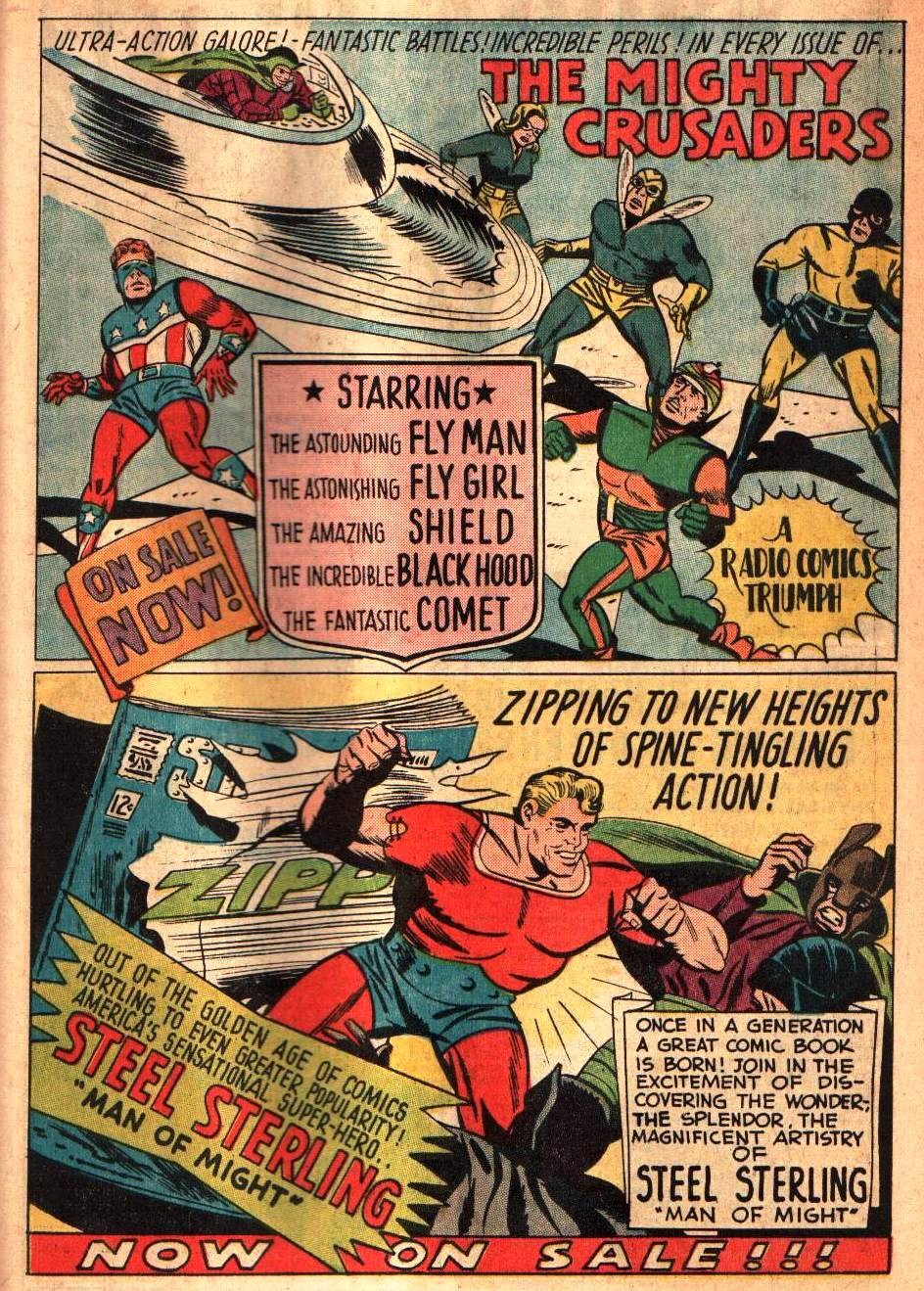
House ad from Fly Man #34 (Nov. 1965), picturing Steel Sterling’s first Silver Age appearance, one month before the release of The Mighty Crusaders #4. Art credit unconfirmed.
However, Steel Sterling #1 never came to be. So, this ad really was his first Silver Age appearance. (There are several online comics histories that incorrectly list Fly Man #39, cover dated September 1966, as Sterling’s Silver Age debut, but that issue was released five months after he appeared in TMC #4. (There was also a paperback collection of reprint strips, High Camp Super-Heroes from Belmont Books, that was published in April 1966 — a few months after TMC #4.)
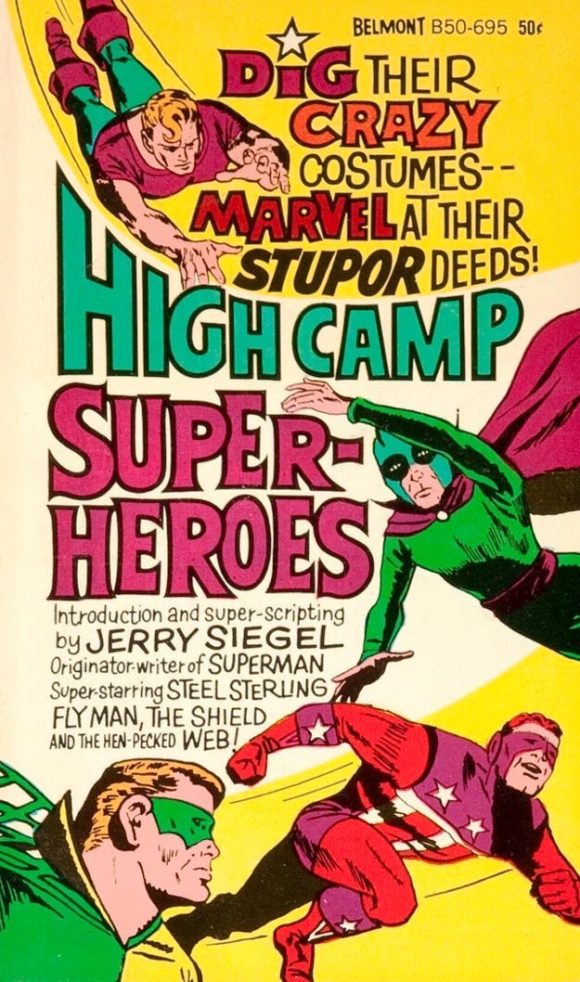
Seeing that both DC and Marvel were bringing back many Golden Age heroes, Archie Comics decided to go all in.
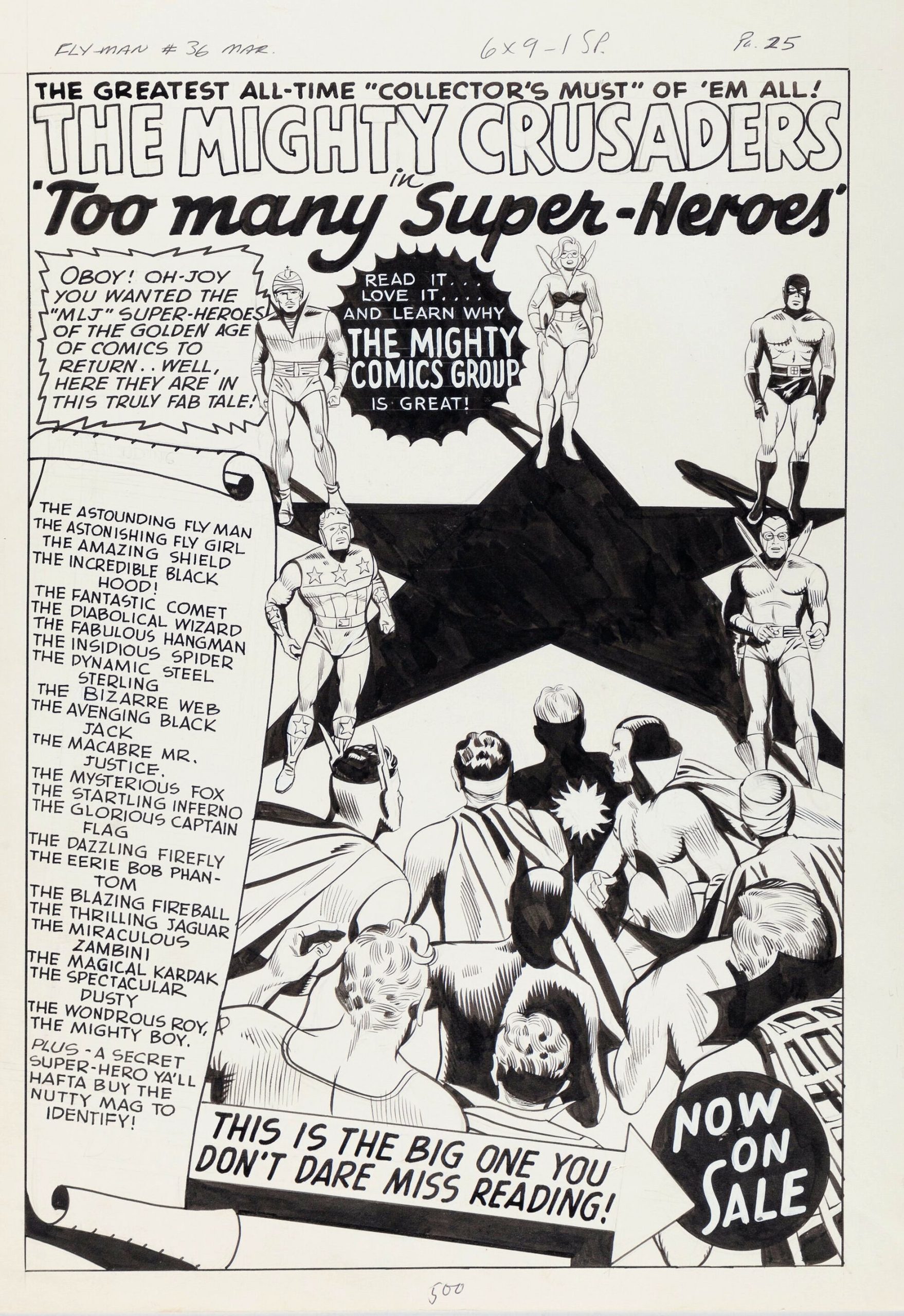
Original art for Fly Man #36 interior ad promoting The Mighty Crusaders #4. Art attributed to Paul Reinman.
They also tried to imitate Marvel’s wit and fighting between their heroes. However, they didn’t have Stan Lee, Jack Kirby, Steve Ditko, and the various other great writers and creators that were over at the House of Ideas. What resulted? The mess called The Mighty Crusaders #4.
On the splash page, in the credits, “Rick Gee” was Richard H. Goldwater; “Jerry Ess” was Jerry Siegel; “Paul Are” was Paul Reinman; and “Vic Torr” was Victor Gorelick. An attempt at hip that was hapless.
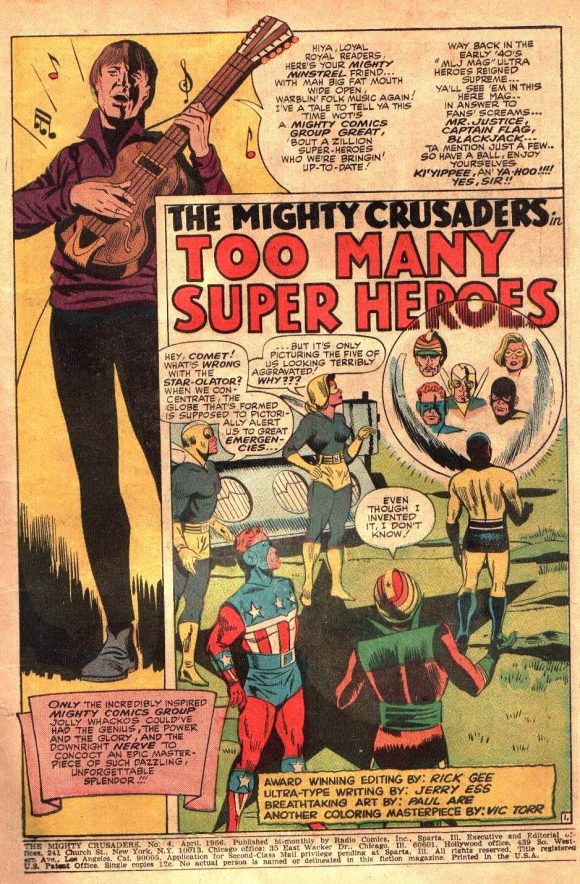
Out to prove themselves, Fireball, Inferno, and Firefly encounter a criminal called the Dragon, only for the villain to remove his mask to reveal he was actually the Hangman, who thinks to himself merely, “It amused me to assume another identity!” When he is attacked by Firefly, the Hangman replies: “Hee hee! Flaming youth, eh? Razz-ma-tazz and poop-poop-a-doop! 23 skidoo!” Jerry Siegel penned some of the best Superman stories of the 1960s, so it is hard to figure out why the writing was so bad here. Every time the writing tried to sound flip… it flopped.
One thing Siegel did do – and quite deliberately, it seems – was show in the story how many of the MLJ characters were practically clones of each other, including those with either fire or bright light as their gimmick (Fireball, Inferno, and Firefly), magicians (Zambini and Kardak), and flag-draped heroes (the Shield and Captain Flag). But to the young comic book fan I was in the 1960s, I loved seeing all the costumed good guys from the past.
And here they are, the 13 MLJ heroes making their first Silver Age appearance in The Mighty Crusaders #4!
(NOTE: Unless otherwise stated, all pages below are from The Mighty Crusaders #4.)
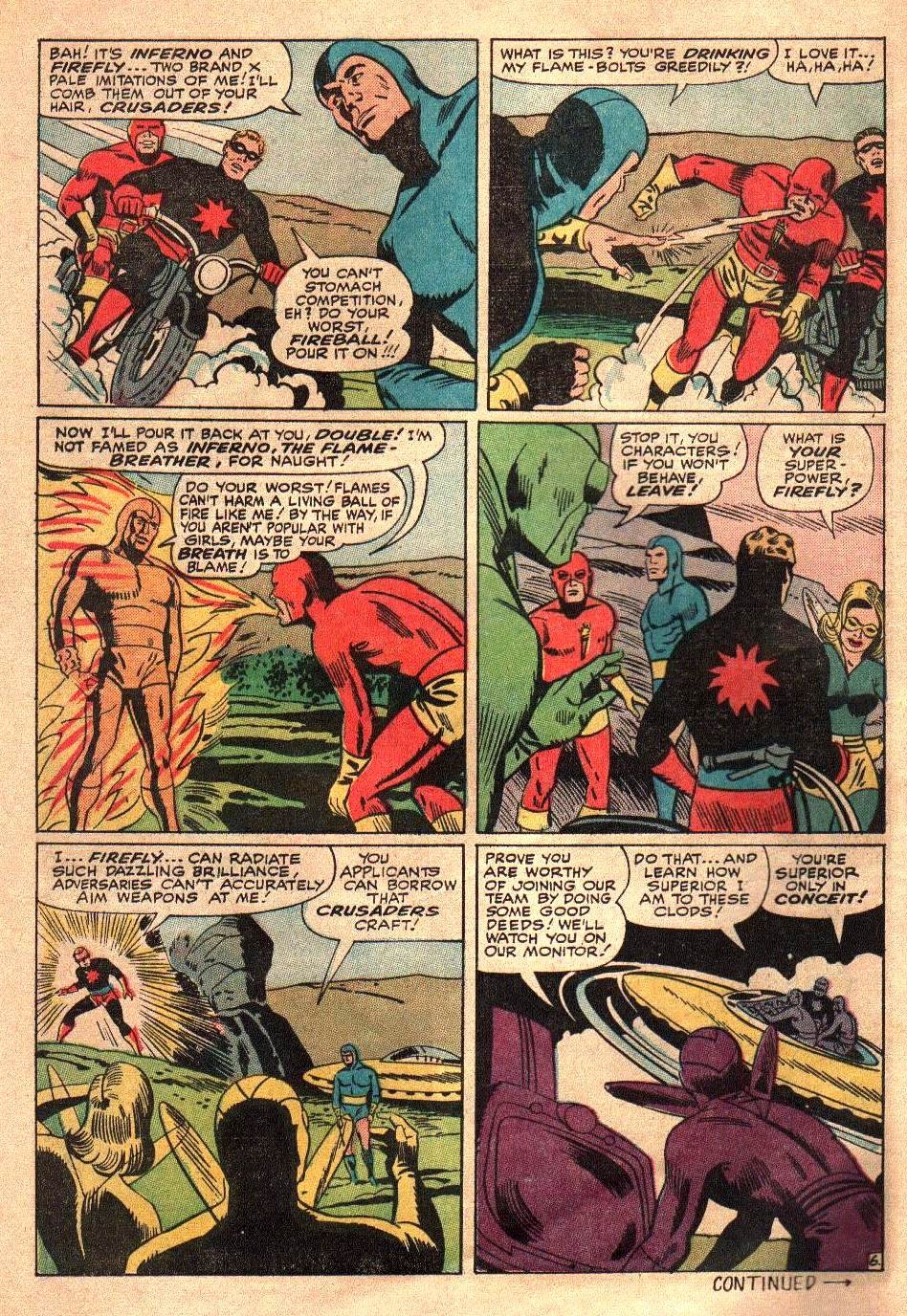
Firefly, Inferno, and Fireball all apply for membership.
—
1. The Firefly. Co-created by Harry Shorten and Bob Wood, chemistry major Harley Hudson decided at an early age to change his life, studying how insects use their strength to handle heavy objects or jump. Discovering how to train his muscles in the same way, he could uproot a tree, leap great distances, smash stone walls with his bare hands, and stay underwater for a long time. In a fanatical cry, he yelled, “Now I am ready!” with his chest bursting a chain.
The final step was he needed a heroic name, something to terrify the underworld and – suddenly – a group of fireflies appeared. “That’s what I will be… a firefly! Lighting up the darkness that shrouds the underworld!” It wasn’t exactly as dramatic as being influenced by a bat. He appeared in Top-Notch Comics #8 (Sept. 1940) through #27 (May 1942).
2. Inferno. Not to be confused with the outer space villain Inferno in The Mighty Crusaders #2 (Jan. 1966), Inferno – the good guy – made his first appearance in a Steel Sterling story inside Zip Comics #10 (Jan. 1941), as well as in the next three Sterling issues.
He was an ex-convict working for a circus as a flame-breathing performer. However, he had violated his parole and was blackmailed into joining a criminal gang — but when Sterling saved his life, he decided to go straight. He popped up next in Blue Ribbon Comics #13 (June 1941) with his own feature, at the end of which he had designed a costume for himself in order to fight crime as “Inferno, the Fire Breather.”
The tales continued through Blue Ribbon Comics #19 (Dec. 1941). Joe Blair and Paul Reinman were the co-creators.
3. Fireball. Ted Tyler was a firefighter who had been left to die in a chemical-factory blaze by a mad arsonist named the Bug, but he was coated by spilled chemicals and lived. After that, he discovered he could emit fire from his fingers, as well as absorb flames.
He put on a costume that came to resemble that of Fox’s Blue Beetle, sans leggings, and called himself the Fireball. At the end of his initial outing in Pep Comics #12 (Feb. 1941), he deliberately engulfed the Bug in flames, killing him. The strip, created by Paul Reinman, was dropped after Pep Comics #20 (Oct. 1941).
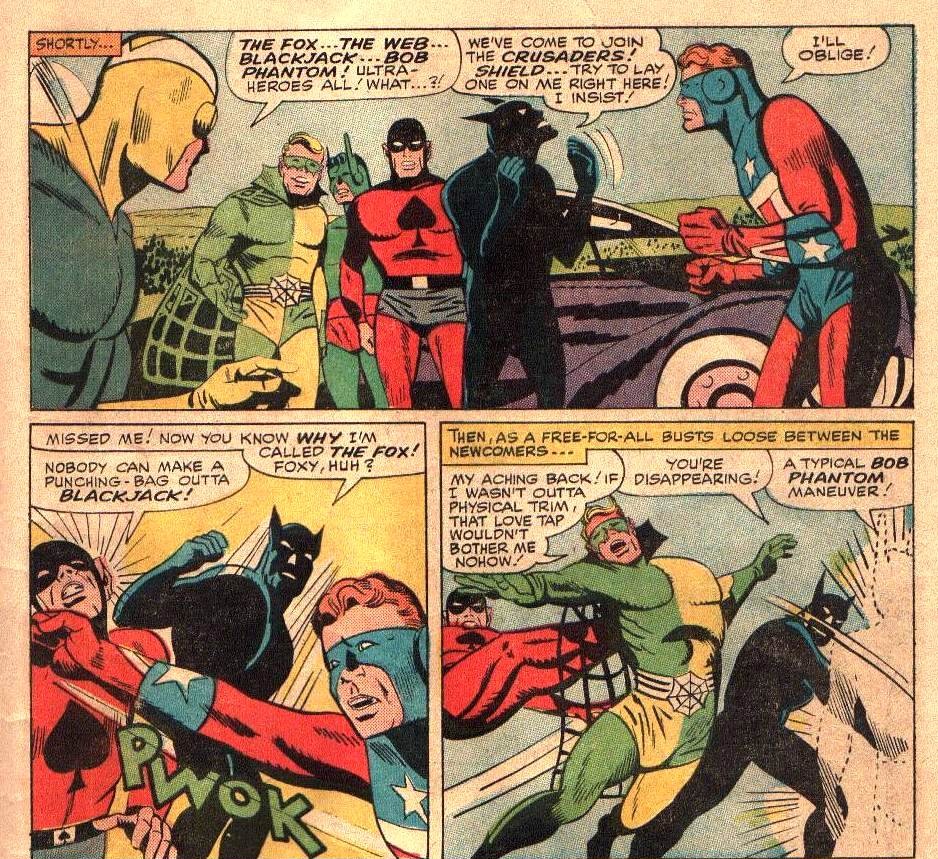
Bob Phantom, The Fox, and Black Jack (renamed “Blackjack”) making their Silver Age debuts.
4. Bob Phantom. Walt Whitney was a Broadway gossip columnist who took up the identity of Bob Phantom, a very strong, seemingly invulnerable, masked good guy who could transport himself from place to place in seconds. (No origin was provided for him.) Co-created by Harry Shorten and Irv Novick, “the Scourge of the Underworld” could be found in Blue Ribbon Comics #2 and #3 (Dec. 1939 and Jan. 1940, respectively) before moving over to Top-Notch Comics #3 (Feb. 1940) through #25 (Mar. 1942).
5. The Fox. Paul Patton was, at first, dressed in a floppy hood and black costume before adopting a more consistent look that resembled Batman. He had been an athlete and became a newspaper photographer. (Decades prior to Spider-Man carrying around a secret miniature camera, the Fox had one hidden in the emblem of his costume, allowing him to get great crime photos.) The hero, co-created by Joe Blair and Irwin Hasen, appeared in Blue Ribbon Comics #4 (June 1940) to #22 (Mar. 1942).
6. Black Jack. Police Detective Jack Jones is betrayed by a crooked fellow cop and left to die behind a plastered-up wall by a criminal gang. The bad cop tosses in a Jack of Spades playing card as a farewell joke because Jones always called himself “Black Jack” because of his solid black hair.
However, Jones uses that card to help dig a slit in the wall in order to get air and tosses the card through it. As luck would have it, the owner of the house arrives, not knowing that crooks had used it, finds the card and frees Jones. He suggests that since the gang and the bad cop think him dead, he take advantage of that.
Jack Jones agrees, dons a costume and becomes Black Jack to fight criminals. The character, created by Al Camy, appeared in Zip Comics #20 (Nov. 1941) through #35 (Nov. 1943).
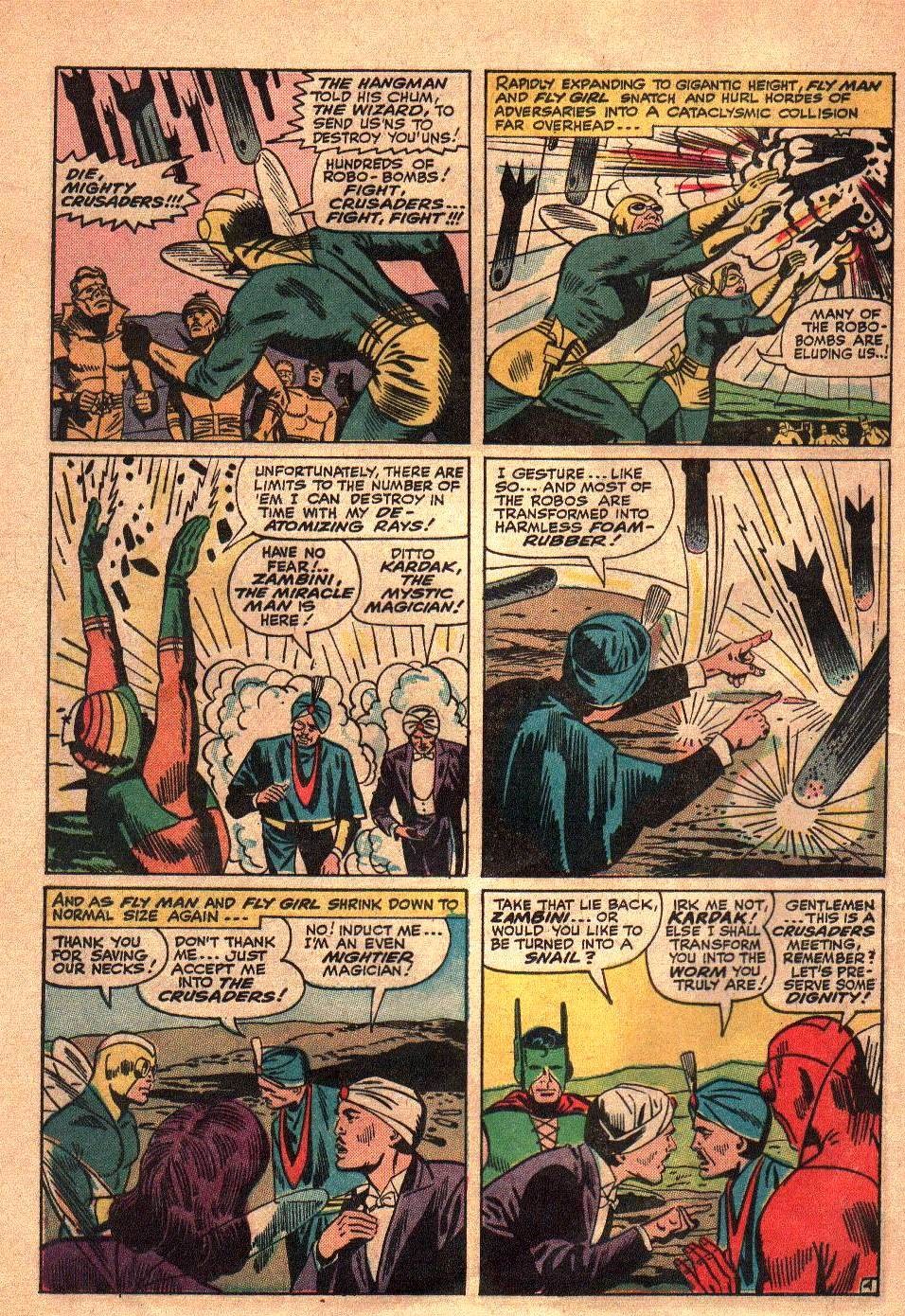
Magic men Kardak and Zambini arrive in time to defuse the falling bombs but make the explosive situation worse by their temperaments.
7. Kardak, the Mystic Magician. Kardak employed the use of stage hypnosis and illusions to fight crime. However, it wasn’t long before the tales turned to the fantastic, including undersea kingdoms, Eastern mysticism, the Axis menace, and more. Kardak first appeared in Top-Notch Comics #1 (Dec. 1939), with the feature originally just called “The Mystic.” Kardak was a part of Top-Notch Comics through #27 (May 1942), missing only the third issue. Kardak could also be found in issues #28 (July 1942) and #29 (Sept. 1942), when the title had been changed to Top Notch Laugh Comics. The co-creators for the series were Harry Shorten and Chuck Winter.
8. Zambini, the Miracle Man. Zambini, co-created by Joe Blair and Ed Wexler, started out in Zip Comics #1 (Feb. 1940) and was a regular feature there through #35 (Mar. 1943). His strip, first entitled “The Miracle Man” in huge letters (with “Zambini the Magician” in much smaller text underneath it) came across not as a “Mandrake the Magician” clone, but a genuine master of magic who was so greatly feared by agents of a foreign power that they tried several times to kill him.
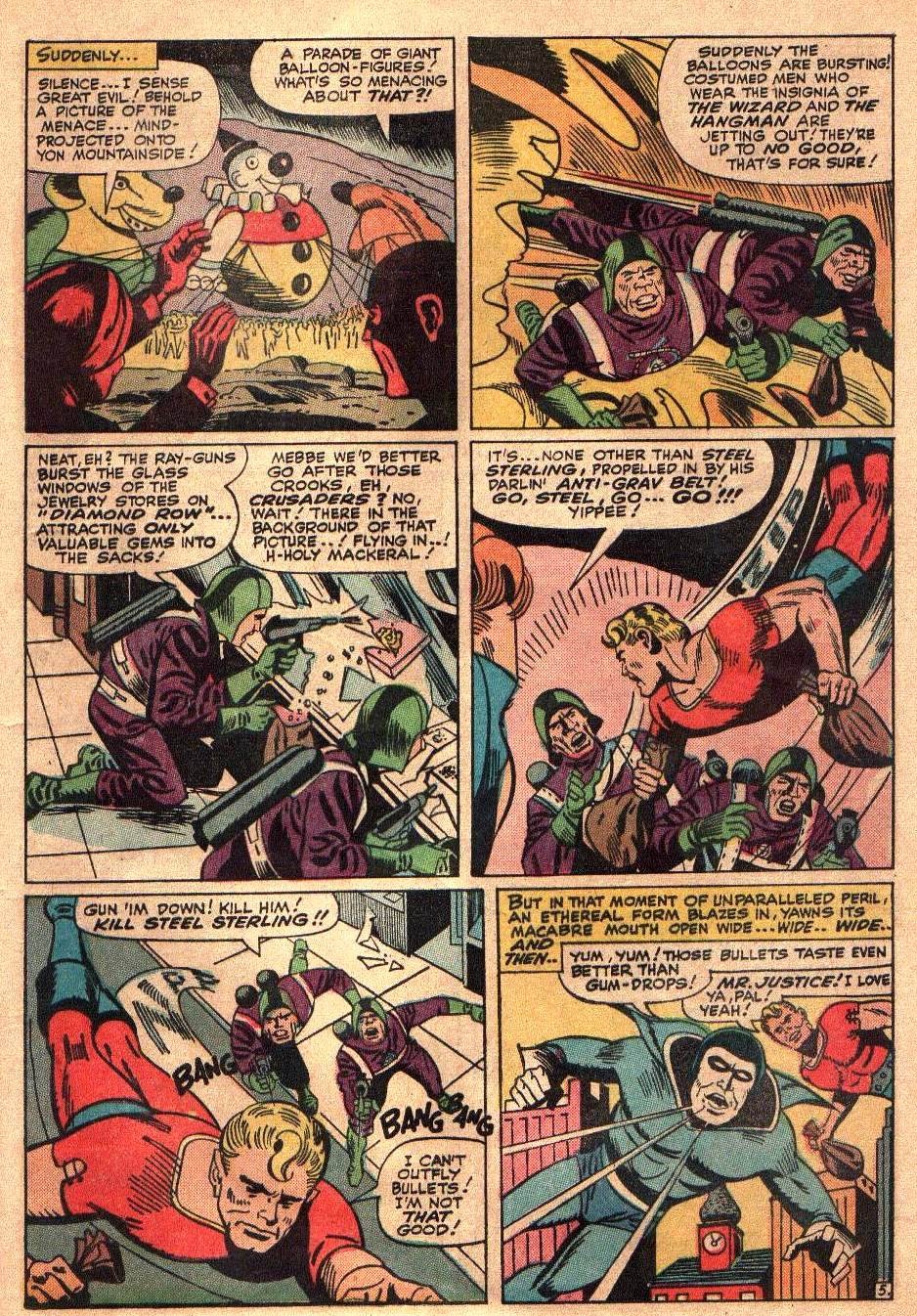
Mr. Justice arriving just in time. However, why Sterling says he can’t outrace bullets is puzzling since bullets had never been able to pierce his tough skin.
9. Mr. Justice. MLJ’s version of the Spectre, Mr. Justice was actually a many-centuries-long-dead English prince, James, whose spirit was locked within the walls of a castle after he was murdered by an enemy. Switch to then-present day 1940 and the English government is afraid Germany will blow up the castle. They dismantle it and ship it to the United States for protection.
However, on the trip across the Atlantic, the ship carrying it was sunk by a German submarine — and the prince’s spirit was freed. (Please don’t ask how; one would have thought the dismantling of the castle walls would have done the trick.)
The spirit arrived in New York Harbor and transformed itself into what appeared to be a living mortal — but when he encountered evil men, he was able to leave the human body and strike terror into them as Mr. Justice.
The feature was created by Joe Blair and Sam Cooper and first appeared in Blue Ribbon Comics #9 (Feb. 1941) and continued there through #22 (Mar. 1942), as well as in Jackpot Comics #1 (Spring 1941) to #9 (Spring 1943).
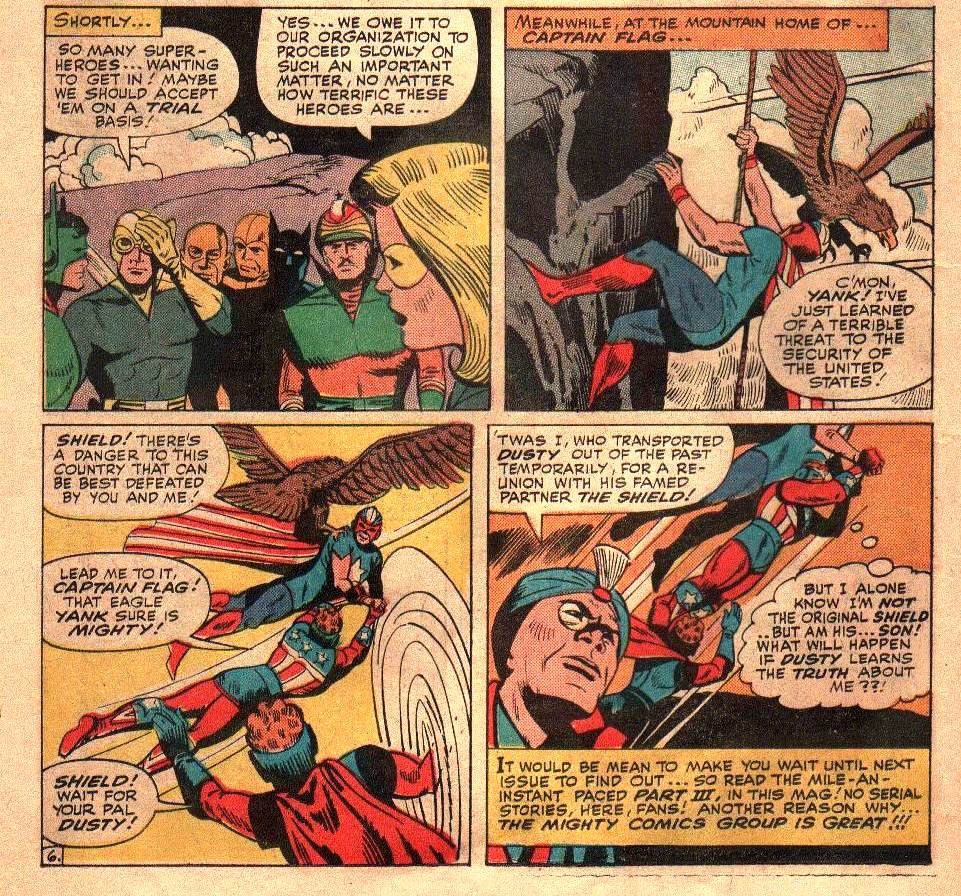
Captain Flag with Yank, along with the sudden appearance of Dusty, the original Shield’s sidekick!
10. Captain Flag (and Yank). Blue Ribbon Comics #16 (Sept. 1941) contains a grisly tale of a disease-spreading criminal called the Black Hand. The villain captures inventor John Townsend — and, in turn his worthless playboy son, Tommy — in order to torture them to get the secret of a new Army bombsight. Unsuccessful at getting the man to talk, the Black Hand kills him and is about to do the same to the young man, when, suddenly, a gigantic eagle flies in and grabs the rope-bound Tommy. The eagle carries him away to a mountaintop.
Over time, the eagle brings him fish and other healthy food, and Tommy trains himself into becoming a world-class athlete. Then, one day, the bird brings him an American flag. Tommy fashions it into a costume and he and the eagle, whom Tommy names “Yank,” return to civilization to defeat Black Hand (which took almost all of the Captain’s run in Blue Ribbon Comics, through #22, March 1942, to accomplish). The feature was co-created by Joe Blair and Lin Streeter.
11. Dusty, the Boy Detective. Sidekick to the Shield, Dusty first appeared in Pep Comics #11 (Jan. 1941) when his father was killed by saboteurs. The Shield was there and took the boy under his care. Co-created by Harry Shorten and Irv Novick, he appeared through Pep Comics #65 (Jan. 1948), Shield Wizard Comics #2 (Winter 1940) to #13 (Spring 1944), Special Comics #1 (Winter 1942), Hangman Comics #2 (Spring 1942) to #8 (Fall 1943), and The Black Hood Comics #10 (Spring 1944).
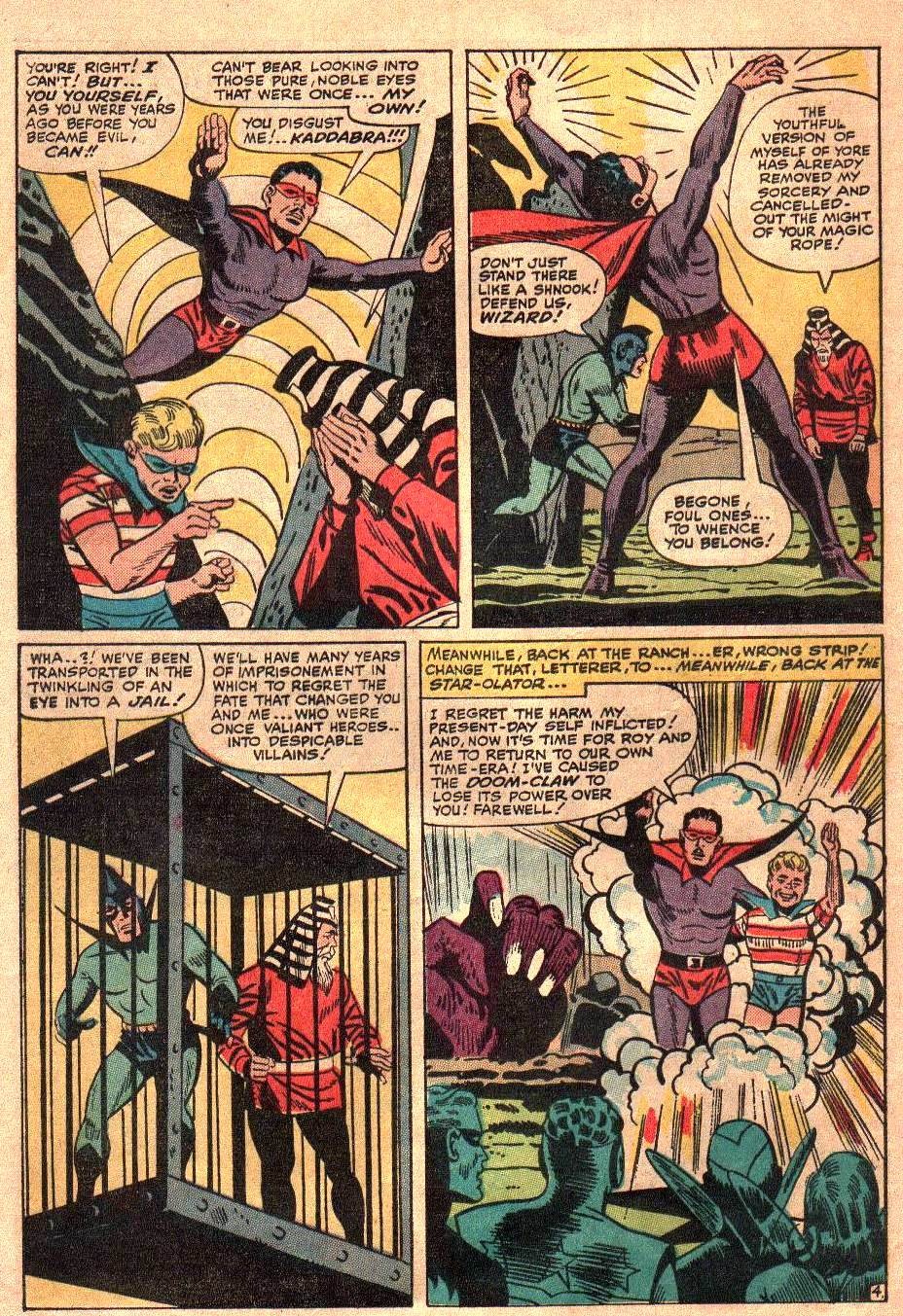
Roy the Super-Boy and the Golden Age Wizard arrive to defeat the villains!
12. Roy the Super-Boy. (The nickname was changed in the Sixties to “the Mighty Boy.”) Roy Carter is a 12-year-old shoeshine boy who is targeted by bad guys when he witnesses them committing a murder. The Wizard happens on the scene and is impressed by how the boy fought off grownup criminals. He took him under his wing and trained him to have the power of 10 men. (The character appeared in many of the same comics as Dusty above and teamed with him on occasion.)
His debut was in Top-Notch Comics #8 (Sept. 1940) and he continued on through #27 (May 1942), as well as showed up in Shield Wizard Comics #s 2-13 (Winter 1940 to Spring 1944, respectively), Special Comics #1 (Winter 1942), Hangman Comics #2-8 (Spring 1942 through Fall 1943), and The Black Hood Comics #s 9 (Winter 1943) and 11 (Summer 1944). Co-created by Harry Shorten and Edd Ashe, Jr.
13. The Wizard. During the early 1940s, the Wizard, nicknamed “The Man with the Super Brain,” was one of MLJ’s most popular characters, with appearances in Top-Notch Comics #1 (Dec. 1939) to #27 (May 1942), Hangman Comics #2 (Spring 1942), Shield Wizard Comics #1 (incorrectly listed as #5 in the indicia, Summer 1940) to #13 (Spring 1944), Pep Comics #4 (May 1940) and #5 (June 1940), Special Comics #1 (Winter 1942) and Miss Liberty #1 (1945, which consisted of reprints from Shield Wizard Comics #13).
For his origin, the co-creators (Will Harr and Edd Ashe, Jr.) threw in everything under the sun. Blane Whitney (no relation, apparently, to Walt Whitney alias Bob Phantom) is a super athlete and in possession of an intellect through which he invents many items, including a long, powerful car for his own use as the Wizard, as well as an airplane. However, people think that Blane is a wastrel society playboy, a guise that he puts forward to mask his true exploits. (Basically, he was Superman and Batman rolled into one.)
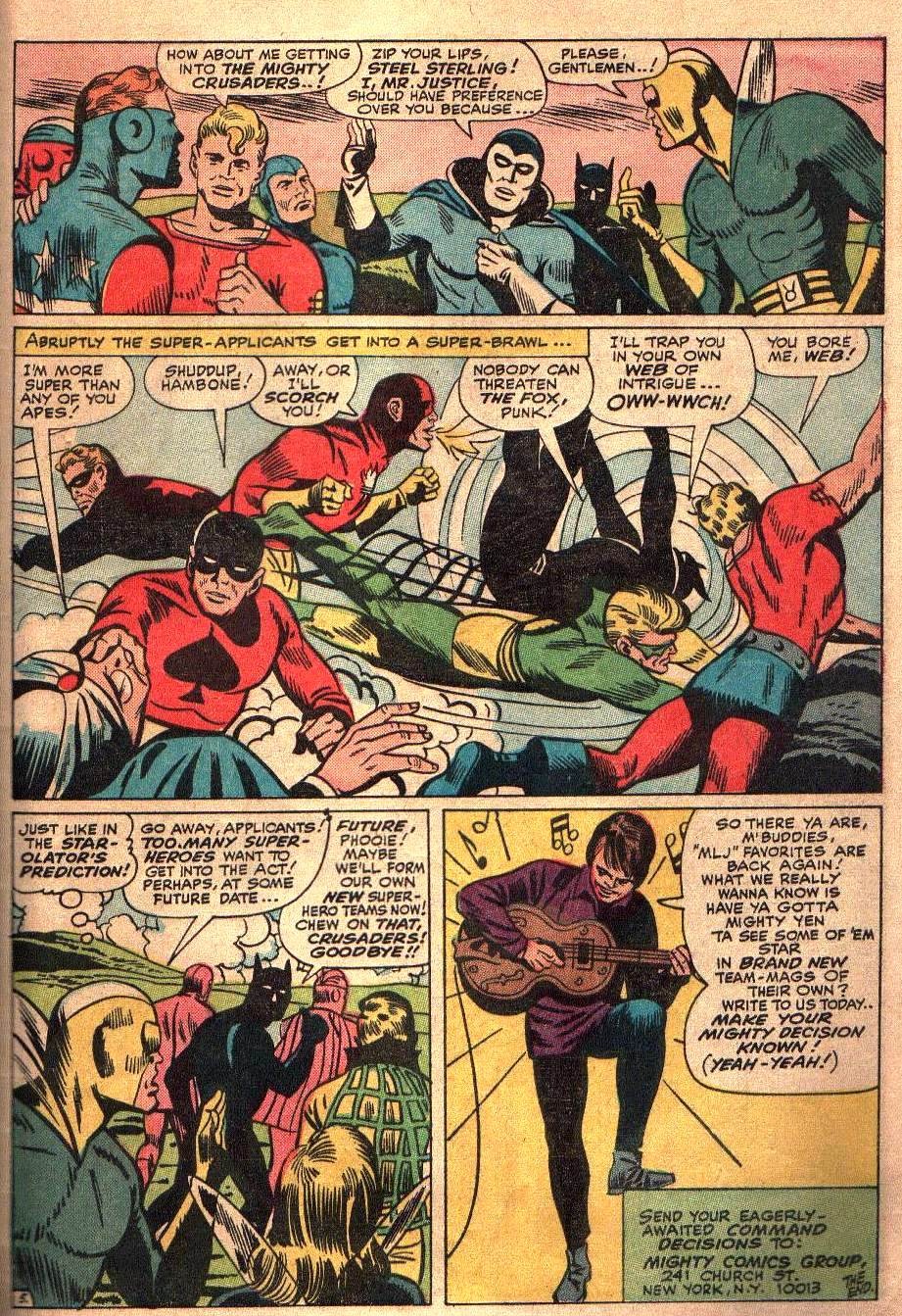
At the end of The Mighty Crusaders #4, none of the heroes are accepted and several go off to form their own groups.
Is there anything that could have made The Mighty Crusaders #4 more of a mess?
Yes. We should be thankful that Archie Comics’ version of the Shadow did not apply.
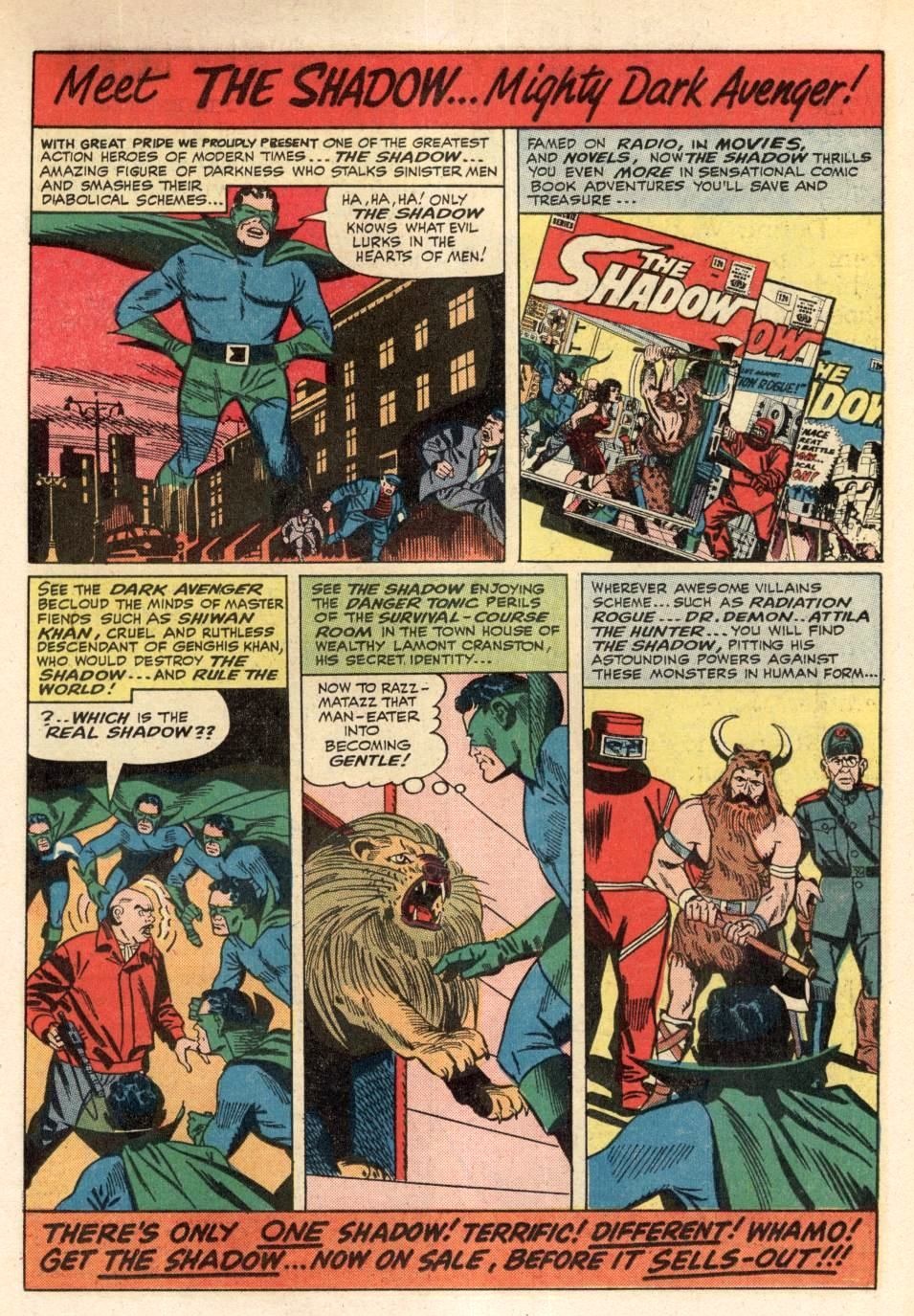
Ad from Fly Man #31 (May 1965). Art by Reinman.
—
MORE
— FOUR COLOR RADIO Presents: ARCHIE ANDREWS and THE BLACK HOOD. Click here.
— 13 ARCHIE/MLJ SUPERHERO COMICS Facsimile Editions We’d Like to See. Click here.
—
13th Dimension contributor-at-large PETER BOSCH’s first book, American TV Comic Books: 1940s-1980s – From the Small Screen to the Printed Page, was published by TwoMorrows. (You can buy it here.) A sequel, American Movie Comic Books: 1930s-1970s — From the Silver Screen to the Printed Page, is out now. (Buy it here.) Peter has written articles and conducted celebrity interviews for various magazines and newspapers. He lives in Hollywood.

February 1, 2026
>> that lasted two issues.
>
There’s no way they got sales numbers back by then for the first issue. Is there? I know in the late 50s some publishers were throwing everything up at the wall but I would have figured more thought would be involved by ‘66. It had to have been cancelled immediately otherwise I’d think there’d be unused artwork for issue #3 out there.
Another fun article.
February 1, 2026
Buck, it was Archie publisher John Goldman who cancelled The Double Life of Private Strong. He had received a cease and desist letter from DC layers who said he was derivative of Superman and chose not to go through the hassle.
February 1, 2026
Hi, Buck. It was the publisher of Archie Comics, John, who cancelled the comic after being contacted by DC’s lawyers as being too derivative of Superman.
February 1, 2026
John Goldwater, that is.
February 1, 2026
Interesting. But I’ve learned my lesson from earlier post on this site and I won’t comment further on that. 😉
I also see my post got posted twice. Sorry about that. WordPress….whatcha gonna do?!
February 1, 2026
Despite what the internet would have us believe, ads are not true appearances.
February 2, 2026
It’s interesting that nearly all of those pages feature (uncredited) lettering from Sam Rosen, who was heavily identified with Marvel in the 60s and early 70s. I know Rosen lettered most of Simon and Kirby’s “Fighting American”, but that was in the 50s. I guess he didn’t have an exclusive contract with Marvel, but until people like Gaspar Saladino and John Costanza started working for both companies, Marvel and DC tended not to share letterers. Work from Ben Oda, on the other hand, appeared for many different publishers in addition to his steady work for DC.
February 2, 2026
Too. Many. “Heroes.”
February 2, 2026
I bought this from the Pacific Comics mail-order catalogue when I was, like, 11 or so. I was just dazzled to find there was a whole other universe of superheroes. Even though the story was super-corny.
February 3, 2026
I have loved the Mighty Crusaders since the moment I saw it on the newsstands.
The idea of so many heroes, so many colorful costumes was a delight to my young mind.
While many would disagree, I consider this book one of my top five comics of the Silver Age.
My love of the Crusaders extended throughout the decades and when I stated collecting original art, I commissioned several artists to do their version of Crusaders 4, Mike Machlan’s work ended up as an Alter Ego cover.
Late last year I am proud to say I was able to purchase the original art to the Mighty Crusaders 4’s cover.
February 4, 2026
Cool!