
PLUS: A 60th ANNIVERSARY INSIDE LOOK at its sister book — BATMAN VS. 3 VILLAINS OF DOOM…
—
The Adam West Batman theatrical movie was released 60 years ago, on July 30, 1966! For this 60th anniversary, we’re doing something slightly different: a review of the novelization, as well as its sister paperback — both the first books of their kind! Jim Beard’s got it all below, but we also have a few faves from the vault to offer too. The links are at the bottom of the post. Dig it! — Dan
—
By JIM BEARD
Leave it to the 1966 Batman theatrical film (and the TV series) to make pop culture history, but then to have said history obscured and even buried over the decades.
That year saw the release of two paperback tie-in books, both of which were the first of their kind, but forgotten today in the heady deluge of Bat-product. That’s sad because Batman vs. 3 Villains of Doom and Batman vs. The Fearsome Foursome stand as publications that led the charge toward bigger and better things for the Caped Crusader.
Both books were written by Winston Lyon and released in April and August of 1966, respectively. Ostensibly, 3 Villains of Doom seemed to support both the newly minted TV series as well as the then-upcoming summer movie release, and The Fearsome Foursome was absolutely connected to the film, being a novelization of Lorenzo Semple’s screenplay. The two today are odd side-hustles of the greater Batman ’66 saga, but also significant in more ways than one.
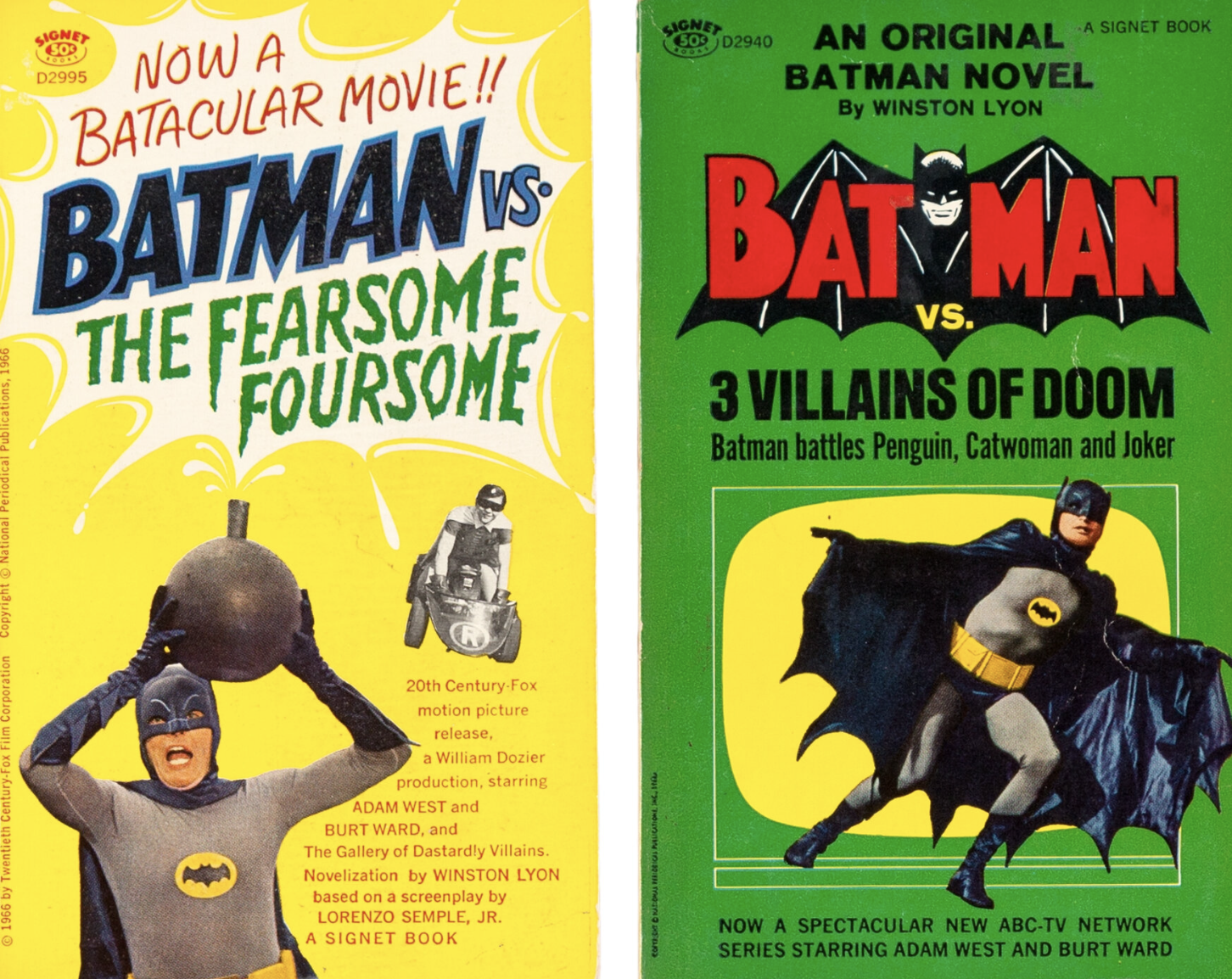
I want to correct or perhaps clarify something I said about Batman vs. 3 Villains of Doom in a past 13th Dimension article. There I noted that the novel “aligns itself far more with the comic book characters than the television versions of same.” Upon my re-read of the book for this article, I realized it is a far more balanced proposition between those two foundations.
Published, as I said, in April of ’66, the book is arguably the very first original Batman prose novel — if World Distributors of England hadn’t already published the first installment of their Batman World Adventure Library before then. I’m afraid I just don’t know, due to little exact release info on the British offerings, so let’s just say for certain that 3 Villains of Doom is the very first American prose novel of the Darknight Detective.
And what a little landmark of a paperback it is.
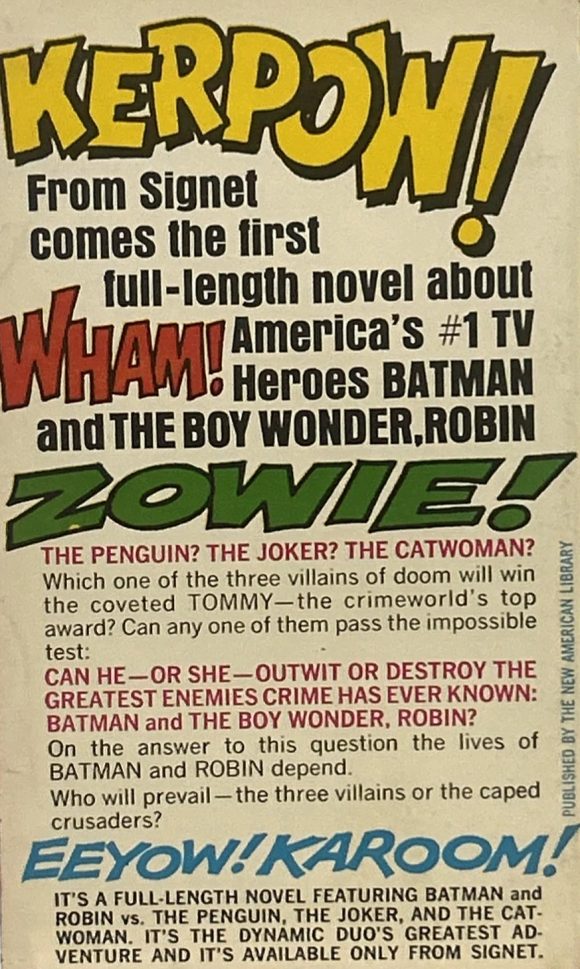
The back cover of 3 Villains of Doom
The story is an episodic one, covering the titular three criminals—Penguin, Joker, Catwoman—and their campaigns to win an underworld trophy called the “Tommy” (as in Tommy gun). This involves beating the Dynamic Duo in bouts of badness, with many dastardly diversions along the way, as Batman and Robin find themselves pushed to their limits at times to ensure none of the trio win the prize, and preserve their own lives while doing so.
The narrative is equal parts campy and strangely murderous. There’s a clear desire to emulate some of the ’66 TV series’ feeling, but it’s also obvious the Penguin, the Joker, and the Catwoman as presented in the novel owe much to their comic-book counterparts of the 1940s and ’50s. They’re more prone to wielding real-world guns than kooky contraptions inspired by the TV show, and they often espouse a desire to blow the Dynamic Duo’s heads off with a bullet than to tie them to giant appliances and the like.
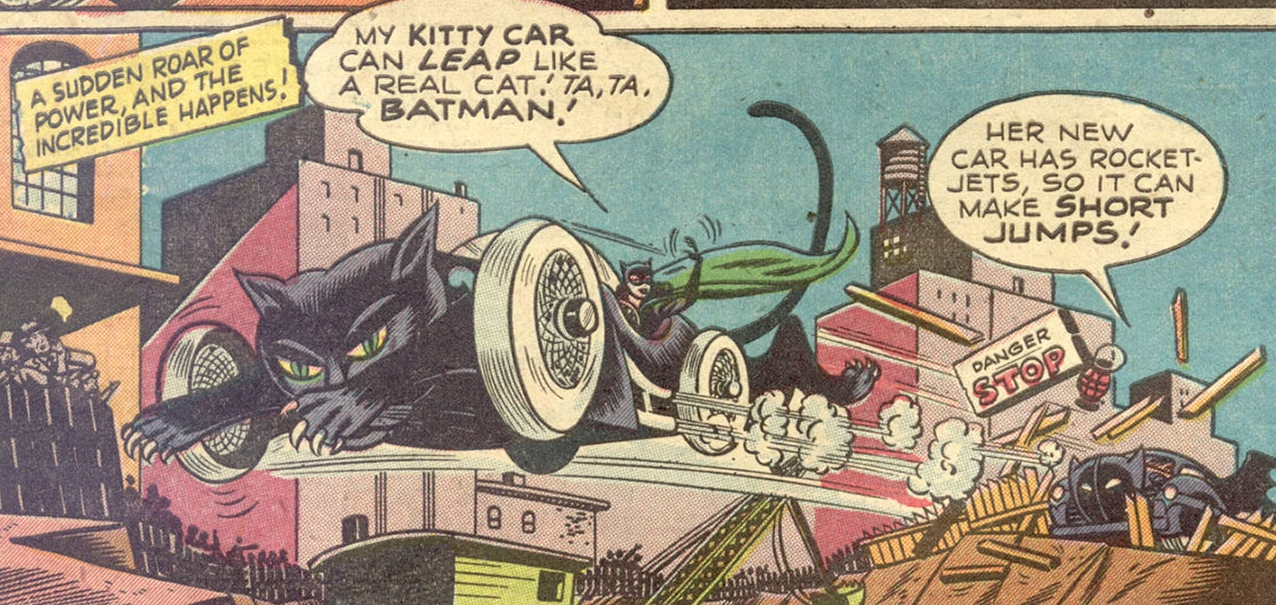
In addition, their henchmen are nearly always cookie-cutter and nameless, no themed monikers as in the show, and not a single moxie moll in sight. Penguin operates his comic-book umbrella-copter, the Joker is much more cunning and deadly, and the Catwoman sports her Kitty Car from 1947’s Detective Comics #122, complete with rocket jets to propel it through the air. The villainess even wears her comic-book green cape and full cat-eared cowl. Julie Newmar she ain’t, not really.
Why is this? Why is a novel with Adam West plastered across its cover so rooted in the four-color source material? Why does the story not follow the TV series’ patented narrative set-up? Why does Batman wear black leather gloves and fly a Batplane, and Robin kick the Joker in the groin? Why does New York City exist in the story when the Gotham of the show was always its boob-tube stand-in?
The answer likely rests in the man who wrote the novel, Winston Lyon, aka William “Bill” Woolfolk, prolific comic book scribe of the Golden Age and early Silver Age.
Woolfolk, despite not being a comics fan’s household name, wrote for all the big houses back in the 1940s and into the 50s, including Timely, Fawcett, Quality, MLJ/Archie, and yes, National (DC). While his work for National wasn’t as weighty as with others, especially Fawcett (he coined the phrase “Holy Moley!”), he did write a clutch of Batman stories in the 1950s, an era that directly influenced the camp tales of the ’66 Batman show. Those stories involved, among more mundane antagonists, the Joker, the Penguin, and the Catwoman… which probably explains their presence in 3 Villains of Doom, and the lack of the feature film’s fourth baddie, the Riddler (as well as the fact that the Prince of Puzzlers just wasn’t all that in the ’50s and early ’60s).
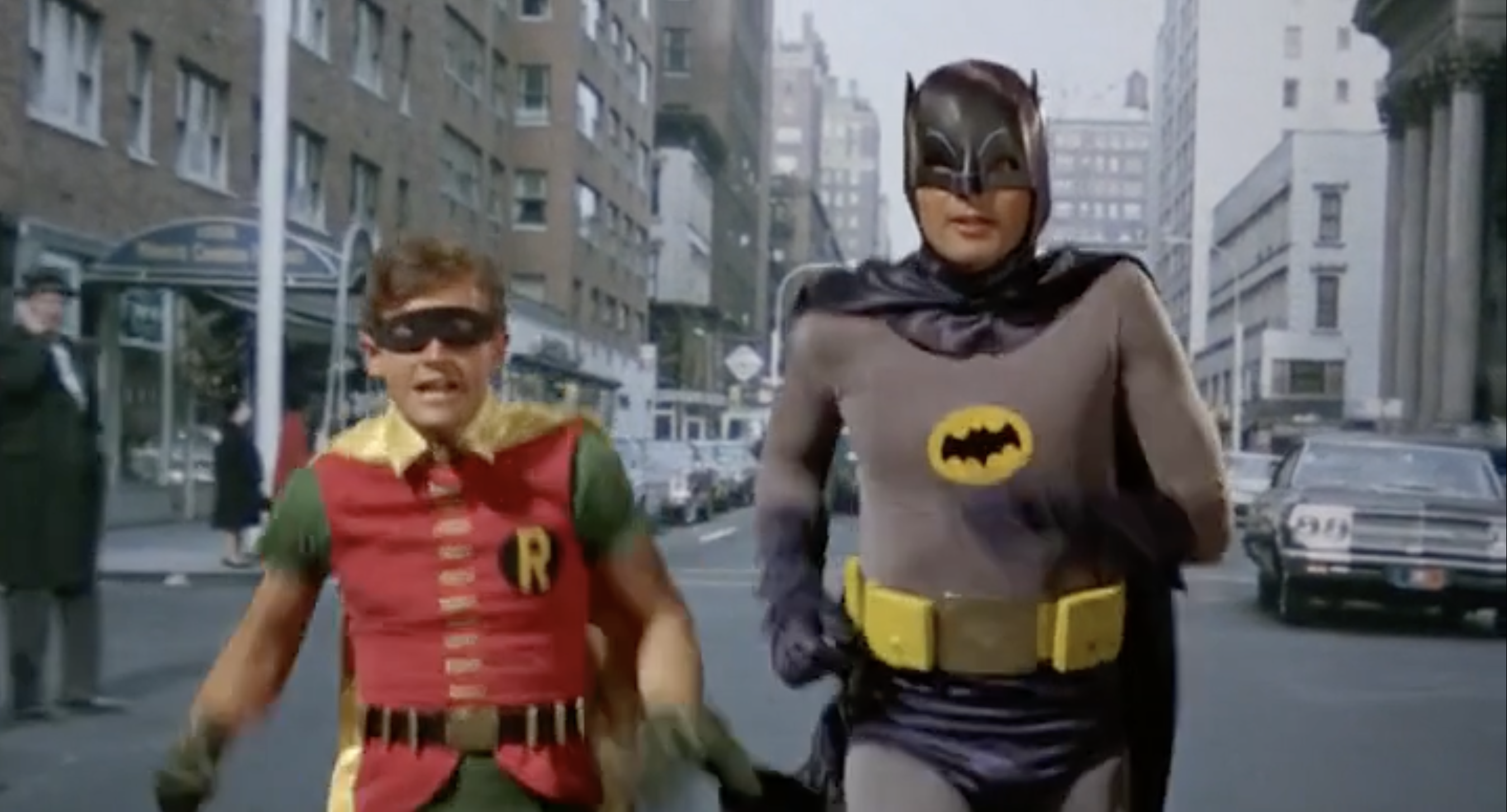
It’s likely Woolfolk was given early scripts from Batman to learn from, and of course the feature film script as well. The actual writing of the novel had to have been either before the show’s premiere in January of 1966, or right around the same time, so as to have it ready for the April publication. This may explain why the narrative is a mix of comic book sensibilities and a dusting of TV series details. Woolfolk’s Aunt Harriet feels like Madge Blake, his Alfred channels Alan Napier, but his Commissioner Gordon is more generic, and while his “Inspector” O’Hara mutters only one “begorrah,” there’s no hint of Stafford Repp otherwise. As stated before, his villains are torn right from the comic pages — it’s even been said that the writer borrowed plot points from his own 1950s Batman stories to create the novel’s narrative.
In all, Batman vs. 3 Villains of Doom is fun and sprightly, and while it’s not 100 percent faithful to the TV show (I can’t see how it really could be given the time when it was crafted) it will still appeal to its fans, not to mention admirers of the classic Jack Schiff era of the Caped Crusaders comics.
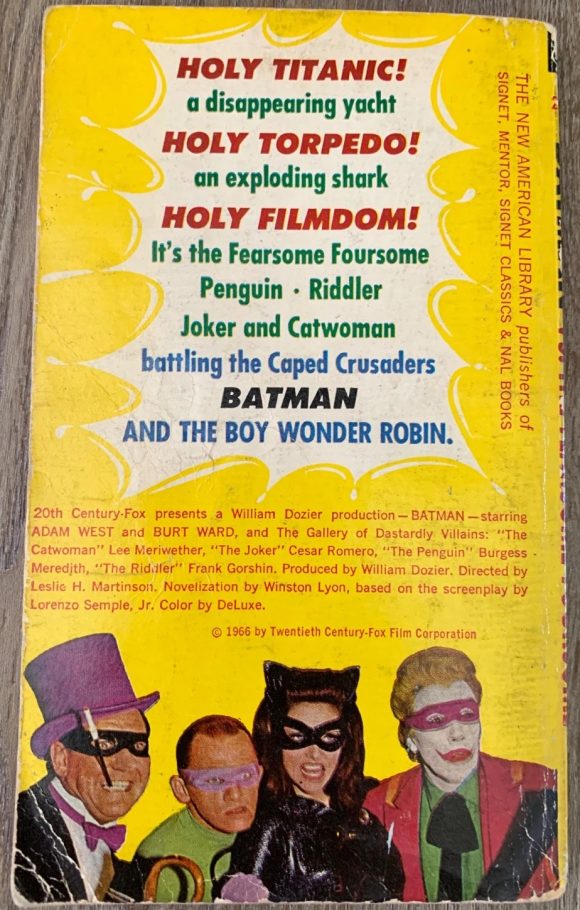
Back cover of Fearsome Foursome
Four months after the novel’s release, Lyon/Woolfolk and Signet Books dropped the other Bat-boot with Batman vs. The Fearsome Foursome, a novelization of the feature film (not of the same name).
For those among us who enjoy such tie-ins, it’s pretty much what you’d expect: a prose version of the movie with the requisite few pages of photos from said movie in the middle. For those same tie-in fans, what it also offers is a few scenes that aren’t in the movie.
Woolfolk, as with most other novelizers (novelizationers?), worked from the script, likely an early draft, even, and while I can’t swear that some of the book’s extra bits are in that script (cut later during the movie’s production), they do help bridge some narrative gaps and make for interesting reading.
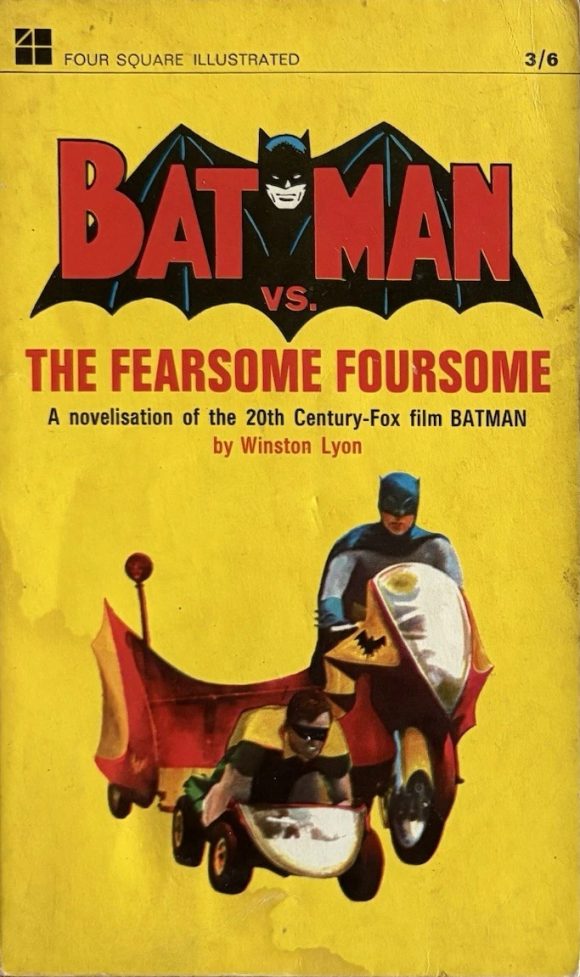
British edition
Those unique moments include Batman and Robin actually receiving the news of “Commander Redhead” (changed to Commodore Schmidlapp in the film) and his approaching yacht, Commissioner Gordon rushing to Wayne Manor when Bruce has been kidnapped, Aunt Harriet ordering the Wayne treasurer Mr. Percy to draw out 10 million dollars for the ransom, and more commentary from the Caped Crusaders at story’s end concerning the situation with the world leaders who had been dehydrated and then rehydrated.
The focus of the two novels is primarily on the 1966 movie, not necessarily the TV series. That’s not much of a surprise when you consider the feature film was always meant to be released first, but it was used a bit later to Zok, Zwapp, and Zowie the new Batfans into complete submission.
Today, conversely, the two tie-in books have nearly been forgotten, but remain important historical features in Batman’s trophy room.
—
MORE
— The World Premiere of the 1966 BATMAN MOVIE Was a Colorful, Groovy Affair. Click here.
— The 13 GREATEST MOMENTS of the 1966 BATMAN MOVIE. Click here.
— Dig the Greatest BATMAN ’66 MOVIE Poster That Never Was. Click here.

July 30, 2026
Over the years I’ve seen so many people debate Who was the best Batman on film? Which Batman movie was the best?
There’s only one Batman movie that has stood the test of time, and it’s because it’s honestly the only one that has been the most comic book accurate, even after all these decades. Batman 1966 despite what any detractors say, IS THE most comic accurate!
And not just that, but it’s also extremely entertaining to watch.
July 30, 2026
I have to wonder why that first novel chose to leave out the Riddler?
July 30, 2026
I think Jim explained that pretty well.
July 30, 2026
Jim certainly suggested a legit reason. But, he also indicated the writer had copies of the tv/movie scripts so maybe there is more to his reasoning to leave the Riddler out. Lost to time I suspect. But certainly fun to discuss over with my morning coffee.
July 30, 2026
>>… they do help bridge some narrative gaps…
>>
Jim, are you saying there’s a director’s cut somewhere out there?!
July 31, 2026
That would take a better investigative reporter than me, old chum.
July 30, 2026
I bought both of these books when they came out in the 1960s, and still have them. “3 Villains of Doom” got deeper into Batman’s psyche in one sequence where he thinks Robin has been killed and loses his will to fight. And “Fearsome Foursome” has a narrative flub where one of the riddles given to Miss Kitka doesn’t match with Robin’s conclusion about what the riddles mean (substituting one about an elephant in a refrigerator to the one about people always in a hurry). These books are fascinating curios of that bygone era.
July 30, 2026
Read the novelization, and loved it! (I was nine years old.)
July 31, 2026
I always figured the fact the movie was originally intended to be released (and therefore took place before) the series went a long way towards explaining the Batman/Catwoman dynamic in both. At the time of the movie he’d never seen her unmasked and by the time of the series she’d broken his heart (accounting for the more hostile dynamic between them in the earlier episodes).
August 19, 2026
Best Batman film was Batman Forever. Mask of the phantom was as good.