
An ANNIVERSARY SPECIAL…
By CHRIS FRANKLIN
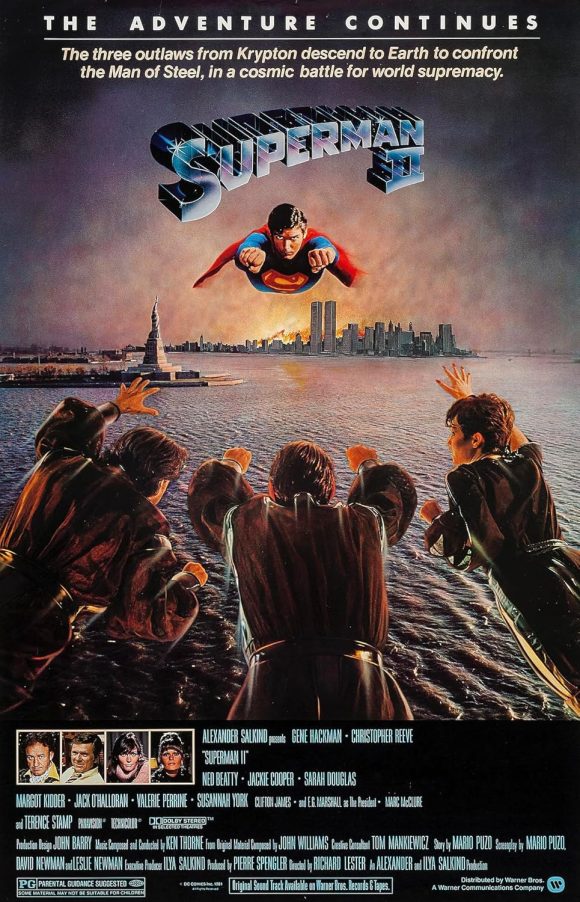
Superman II is considered one of the best movie sequels ever made. There are even those who prefer it to its predecessor, Superman: The Movie (I’m not one of those). Unlike that first film, however, it hits the ground running, with Lois Lane in danger, the Man of Steel in action, and three super-powered villains loosed on Earth. A certain cab driver says later in the film what most audiences realized right from the start; “This is going to be good.”
But it shouldn’t work.
The theatrical cut of Superman II — released in the United States 45 years ago, on June 19, 1981 (after having debuted across the pond the year before) — is the child of two parents. Director Richard Donner (The Omen) filmed the bulk of the sequel while in production for Superman: The Movie. His relationship with the producers, Ilya and Alexander Salkind and Pierre Spengler, deteriorated over the course of filming. So, the Salkinds brought in their friend, director Richard Lester (A Hard Day’s Night), who had directed their successful Three Musketeers and Four Musketeers films (also filmed concurrently, but that’s another story) to act as a go-between. With a Christmas 1978 release date looming, Donner was forced to halt production on sequel footage and focus on the first film. Superman: The Movie was a smash hit, but Donner was extremely vocal about his troubles, particularly with Spengler. He was quoted as saying if Spengler was involved in the follow-up, he was out. And the Salkinds took him at his word.
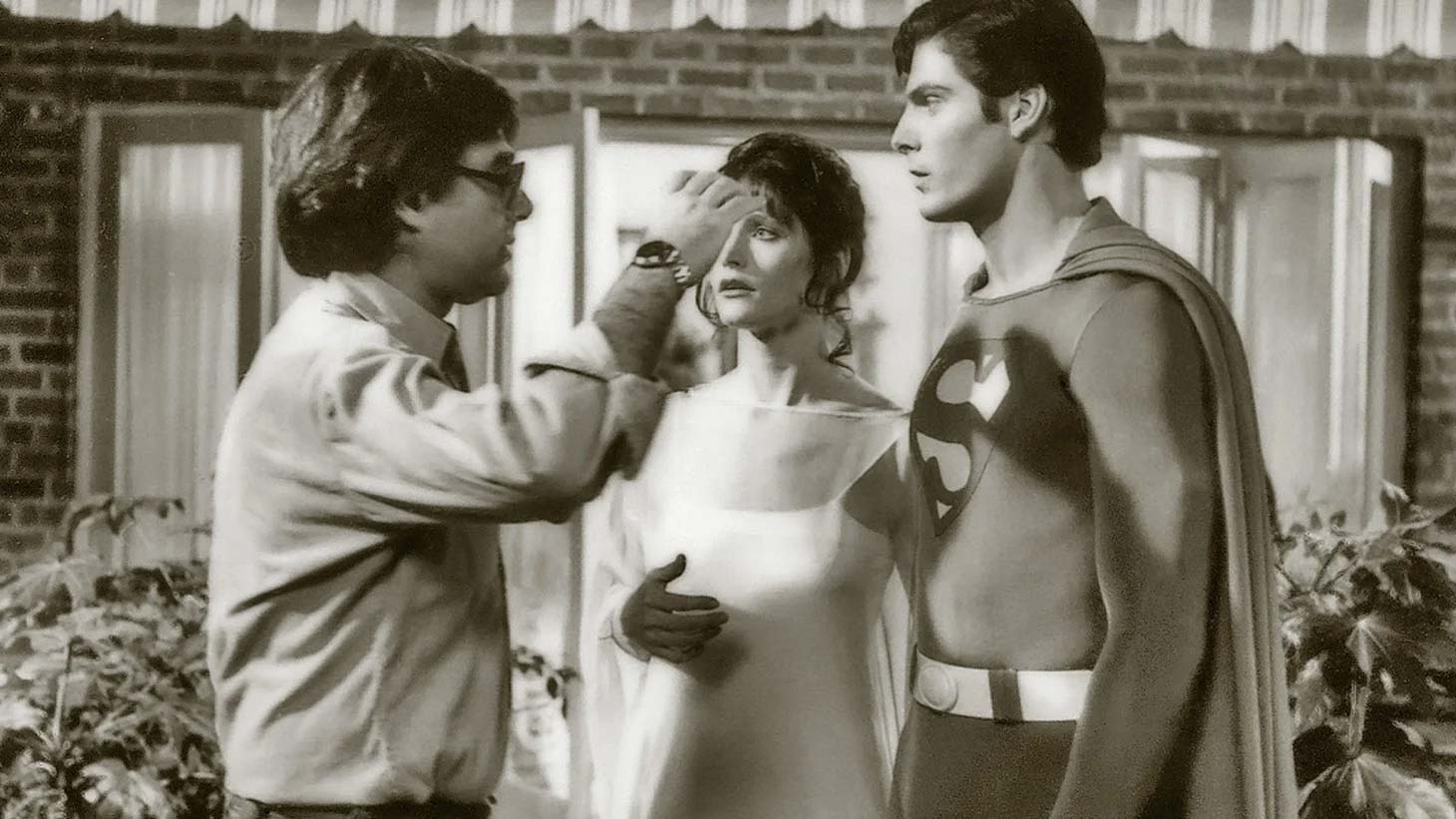
Richard Donner directs Margot Kidder and Christopher Reeve during production of Superman: The Movie
Richard Lester took the helm when Superman II resumed filming and reshot many of the scenes Donner had already completed, primarily to be able to receive a solo directing credit. A new opening was conceived, abandoning Lois Lane’s near suicidal attempt to prove Clark is Superman by jumping out of the high-rise window of the Daily Planet building. But much of Donner’s footage was still used, and the directors’ approaches to the material were diametrically opposed in many ways. Donner championed verisimilitude, and came at the production with a sincere reverence, taking the task of preserving an American myth seriously. His cinematographer Geoffery Unsworth (who died before the first film was released) complied with a sweeping, epic style, and lighting that befitted the noble heroes and vile villains. Lester took the material at face value, and he and new Director of Photography Robert Paynter strove to replicate the flat look of a comic book, along with quick pacing, as if leaping from panel to panel. Lester and Paynter would resume their roles for the next film, Superman III.
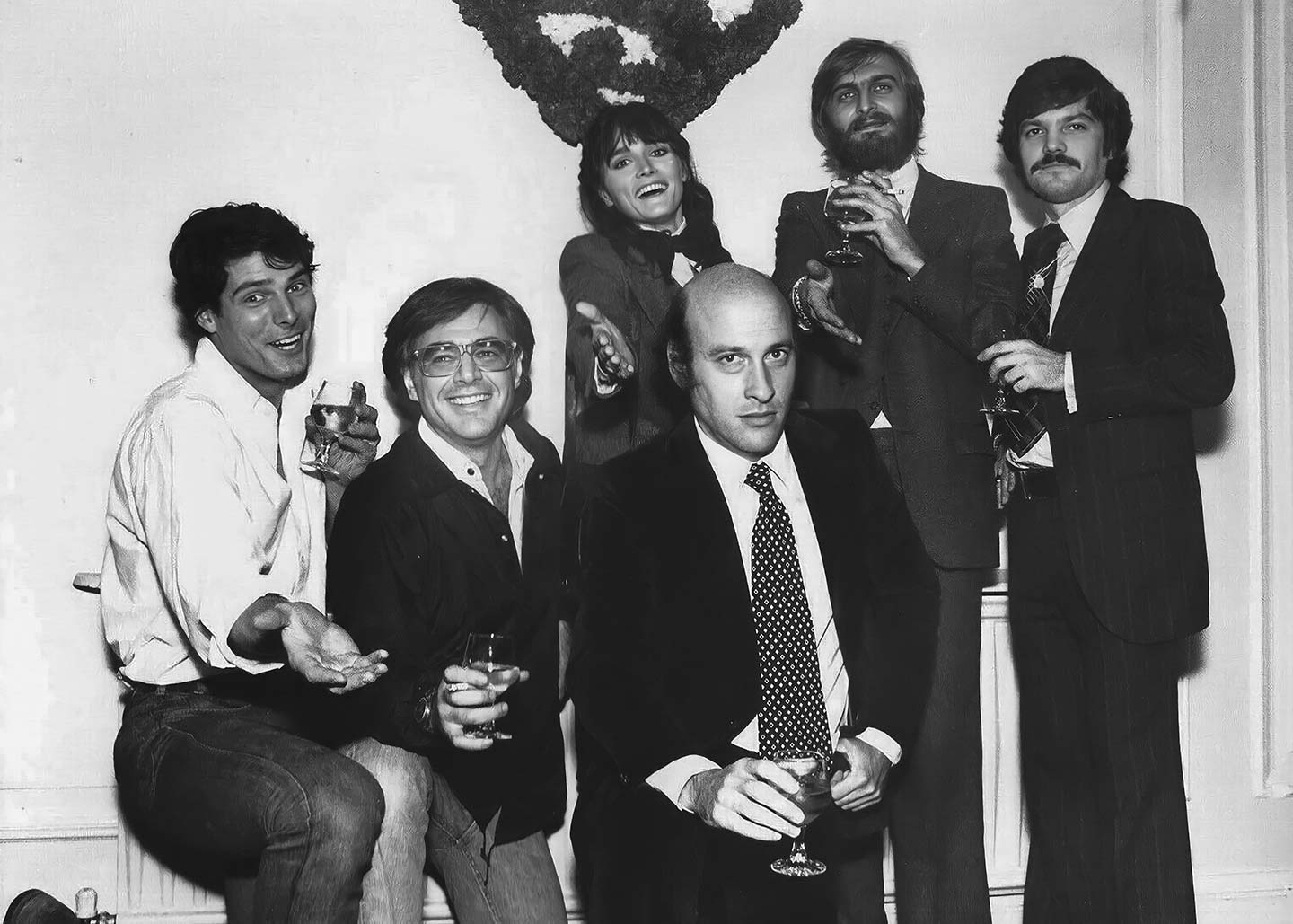
Christopher Reeve, Richard Donner, Richard Lester, Margot Kidder, Pierre Spengler and Ilya Salkind
The story — credited to Mario Puzo, David and Leslie Newman, and “Story Consultant” Tom Mankiewicz (who wrote much of the filmed screenplay for the first two films) — received added bits of humor at every turn at Lester’s insistence, challenging the earnestness of Donner’s completed work. Marlon Brando (Jor-El) and Gene Hackman (Lex Luthor) chose to not return for reshoots. The former due to a salary dispute, the latter out of loyalty to Donner. Jor-El was jettisoned in favor of new scenes with a returning Susannah York as his wife Lara, and a body double and voice impersonator were used when new footage of Luthor was needed. Margot Kidder (Lois Lane) was also very vocal about missing Donner and bemoaned the treatment he received. Christopher Reeve, feeling the responsibility of the production, tried to play peacemaker and stayed the course. Fans in the know can easily spot the differences in footage that is shot by Donner as opposed to Lester’s later material. By the time Lester had taken over, Reeve had put on more muscle, Kidder had lost a significant amount of weight, and Terence Stamp’s hair was longer and curled up at his shoulders, for instance.
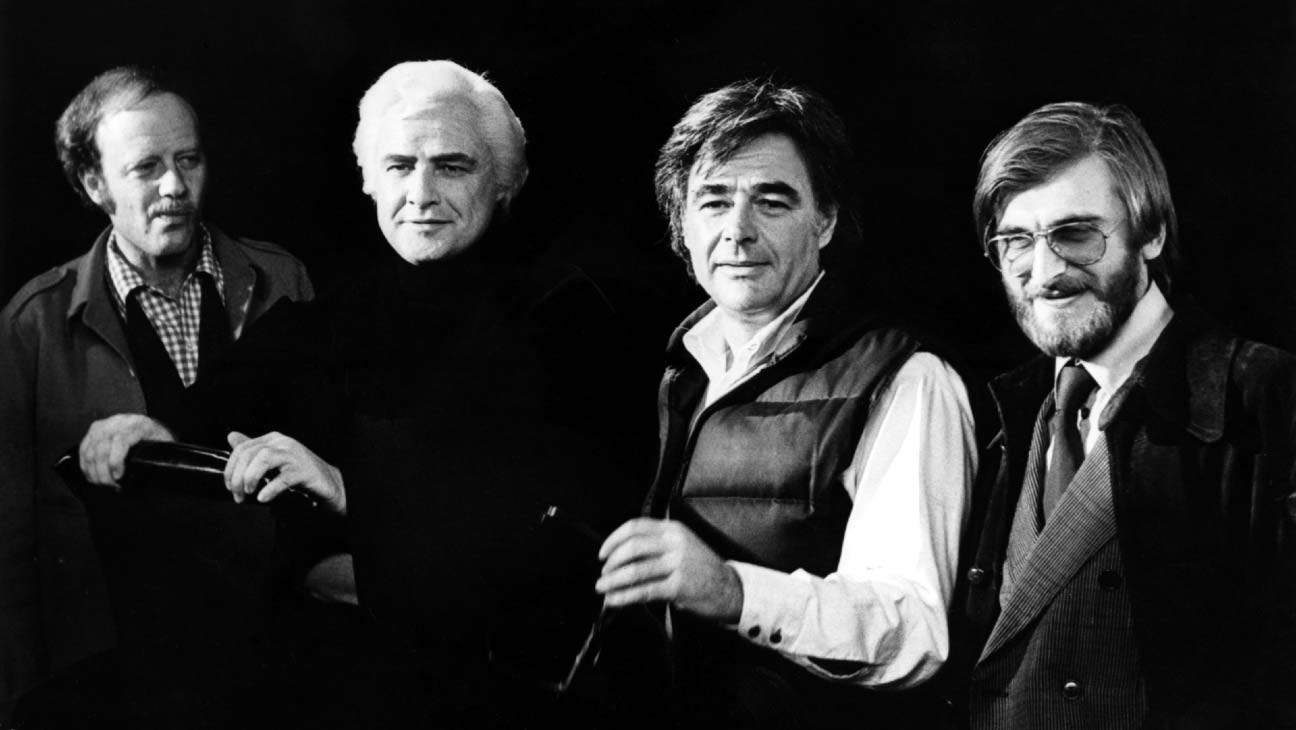
Story consultant Tom Mankiewicz, Marlon Brando, Donner and Spengler on the set of Superman The Movie.
Any of these factors could have spelled disaster for the completed film. For a more recent example in the same genre, look at the theatrical release of Justice League, directed by Zack Snyder AND Joss Whedon. But despite all the chaos, Superman II emerges as a satisfying sequel to the original, and a rollicking adventure film in its own right. Kudos must go particularly to credited editor John Victor Smith, who somehow assembled an entertaining and memorable film out of the bifurcated production.
Below are 13 reasons — ranked! — this beloved film not only succeeds, but endures, despite its shaky origins. (And we will be discussing moments from the theatrical cut of Superman II, credited to Richard Lester, NOT Superman II: The Donner Cut).
—
13. The Recap. After we get a new version of Zod and crew being sentenced to the Phantom Zone (excising any footage or audio of Brando) we cut to a montage of scenes from the first film while Ken Thorne’s re-orchestrated John Williams theme stirs our memories. In a time before readily available physical media or streaming, most people hadn’t seen the first film since it left cinemas. Watching Superman’s greatest hits brought us back to this wonderful world, and I for one was glad to there. Since a cousin took me to see the first film, this was a chance for my mom, who took me to this one, to catch up.
—
12. The Alley Change. After learning Paris is threatened by terrorists with a hydrogen bomb, and that Lois Lane is right in the thick of it, Clark Kent dashes out of Perry White’s office and to the street below. He ducks into an alley and gives us cinema’s greatest full transformation from Clark Kent to the Man of Steel. As the Superman theme swells, Christopher Reeve runs down the alley, opens his shirt, and blurs from mild-mannered reporter to Metropolis Marvel. The effect looks like a Curt Swan-drawn panel come to life, and when Reeve takes flight, we know the film is off to an action-packed start!
—
11. A Great Metropolitan Newspaper. The scenes in the Daily Planet office aren’t as frequent as in the first film, but there are some memorable moments there. When Clark Kent walks in to learn that fanatics have taken control of the Eiffel Tower (which Marc McClure’s Jimmy Olsen informs him is in Paris), Kent utters how terrible that is. Jackie Cooper’s Perry White delivers a perfect deadpan comeback: “That’s why they call them terrorists, Kent.” Later when Zod and crew attack the building, looking for Lois under Luthor’s direction, Perry and Lois do their best to subdue Non and Ursa. Even though it’s futile, you must admire their bravery, with Jimmy continuing to snap pictures as these angry gods descend upon them.
—
10. Rocky’s Comeuppance. At the film’s end, Clark returns to the diner where he and Lois were accosted by the local bully, truck driver Rocky. Defending Lois, the then-powerless Clark was sucker-punched, beaten and knocked into a glass partition, bloodying his face and hands. Now Clark returns and with his powers restored, antagonizes Rocky into striking him again. Rocky breaks his hand on the abs of steel, and Clark spins him around on the diner stool, sending him sliding down the counter, into a waiting pinball machine. I have heard this moment criticized by some fans as out of character for Superman, but I disagree. Go read Action Comics #1, where Superman brutalizes a man who has assaulted his wife. This is the early “defender of the oppressed” version of Superman at play. Yes, he’s getting personal revenge, but he’s also teaching Rocky a lesson, and ensuring he won’t play the bully anymore. Plus, the diner staff and patrons’ reactions to all of this are perfect, as is Reeve’s delivered explanation: “Oh… I’ve been… um… working out,” as he mimics lifting barbells. It became a catchphrase in our home, as this is my father’s favorite scene in ANY superhero film.
—
9. The Romance. By today’s standards, there are some problematic elements in the love story in Superman II. The worst offender being the “super kiss” which robs Lois of all memories of her knowledge of Clark’s secret identity… and the consummation of their relationship. This is made even worse if you consider Superman Returns and their super-offspring to be canon. But you must give the creators points for at least toying with Lois learning the secret, and the two FINALLY becoming an actual couple. With 30 years of Clark and Lois as a married couple now behind us, we take for granted that at this time, outside of imaginary stories and the Earth-Two continuity, this had never happened in the regular comics or any media adaptations. Reeve and Kidder’s performances and commitment to the roles and the relationship paper over a lot of dubious elements, such as Superman’s flippant decision to relinquish his powers for his own happiness. Under lesser hands, the whole thing would have fallen apart, but with these two behind it, audiences are really hoping these kids can finally make it work. And we’re crushed when circumstances tear them apart. Yes, the resolution is troubling, and ultimately a copout, but the creators obviously felt like they had to reset the board.
—
8. Jack O’Halloran as Non. Before Lester infused more humor into the film, Non was always meant to bring some comic relief to the villainous ensemble. Somewhat like a Kryptonian version of Lenny from Of Mice and Men, Non has a child-like mind, and the body of a killer. He is also mute, which makes Jack O’Halloran’s performance even more exceptional, just conveying Non’s simple thoughts through pantomime. His frustration with being unable to use his heat vision like the others, and his desire to please Zod by ripping the siren light from the police car, are genuinely funny moments. And when Zod rejects his gesture, you feel bad for the big guy! This despite the fact that he’s a superhuman wrecking machine that constantly leaves death and destruction in his wake.
—
7. Sarah Douglas as Ursa. In the first film, when Ursa was sentenced to the Phantom Zone, Jor-El specifically mentioned she had terrorized “even the children of the planet Krypton.” Clearly, Ursa is a very disturbed individual, and Sarah Douglas portrays this aspect wonderfully. While Zod seeks power and control to subjugate anyone he sees beneath him (which is everyone), Ursa just delights in causing pain and agony, particularly to any man other than her beloved General. Blink and you’ll miss how she keeps adding patches and badges from the astronauts and police she’s defeated onto her uniform. I joked with Rob Kelly on our Superman Movie Minute podcast that perhaps Ursa was kicked out of Krypton’s equivalent of the Girl Scouts and is still hunting merit badges. Evidently, Annie Ross, who would go on to play Vera Webster in Superman III dubbed at least some of Douglas’ dialogue in the finished film. Whichever one of them cooingly uttered, “Suuuuppppermannnn” and called the Man of Steel’s attention right before hurling a manhole cover at his midsection deserves an extra pat on the back for a timeless delivery.
—
6. Gene Hackman as Lex Luthor. It may seem like Luthor is taking a backseat to Zod and his crew in the villainy department, but ultimately, he ends up pulling their strings and pointing them toward their confrontations with Superman. Gene Hackman once again brings a sadistic streak of humor to the sociopathic genius, and he’s just a delight to watch on screen. One of my favorite exchanges is when he’s slyly intimating the close relationship between Superman and Lois to Zod: “He gives her every exclusive.” His weaselly double-cross against Superman in the finale is another highlight, as he and Reeve continue the chemistry that made their face-offs in the first film so memorable. It’s a shame that Valerie Perrine’s Miss Teschmacher and Ned Beatty’s Otis disappear from the film so early, because it would have been a blast to see them interact with Ursa and Non, respectively.
—
5. “General…would you care to step outside?” The villains have won. The Phantom Zoners have conquered the world, and now Lex Luthor has taken them to the Daily Planet, to use Lois Lane to flush out the hated son of Jor-El. But Lois and, by proxy, the audience, know Clark has lost his powers and is but a normal human now. After the super-criminals rampage through the Planet offices, outside a familiar theme begins slowly, as a newsstand’s content is disturbed by something moving fast above. Superman floats outside Perry White’s window, arms folded, and with the sternest look possible on his face asks, “General… would you care to step outside?” A nice callback to Clark asking the bully Rocky the same thing earlier in the film. Lois and even Lex Luthor are relieved that Earth’s Greatest Hero has returned in its darkest hour, and Reeve and all involved sell this fist-pumping moment perfectly. Rob Kelly says upon seeing this for the first time in a theater in 1981, every kid cheered at this moment. As well they should!
—
4. The Battle of Metropolis. Movie audiences had never seen such a spectacle before. Comic fans knew what a battle between multiple super-powered beings looked like, but even they had never seen it achieved in live action. It took a crew of some of the best filmmakers on two continents to conceive such a battle and boy did they deliver. From Zod’s heat vision assault on random cars to Superman throwing him into the lighted Coke billboard, every moment was more exciting than the one before it. And for the most part, the practical effects really hold up and look great today. When the denizens of Metropolis fear Superman has been murdered by the Phantom Zoners, they rally to take up his fight, in a rousing scene. Unfortunately, Lester injected WAY too much humor and slapstick gags into the carnage. The KFC employee, the roller skater, and the oblivious man in the phone booth being blown away by the super-breath attack, for instance. But Reeve grounds it back to heightened reality when Superman emerges from the previously loaded bus Ursa and Non hurled at him, assesses the damage that continuing the fight there would have on his city, swallows his pride, and flies off.
—
3. Terence Stamp as General Zod. Taking the role in the first film for a chance to work with Marlon Brando, Stamp made only a brief appearance in the opening scene on Krypton, where he and his cohorts are banished to the Phantom Zone. But he makes up for lost time in the sequel, dominating every scene and relishing his role as the commanding but constantly annoyed General Zod. Stamp really puts across Zod’s superior attitude toward the human race, and his own loyal followers. His hatred for the son of Jor-El glows red like Krypton’s sun. Stamp said on many occasions he found it refreshing to play such a two-dimensional character. But he still brought nuance to the role, going from calm and cool to enraged in an instant, whenever someone dared to defy him. His frequent command of “Kneel before Zod!” is a catchphrase that is still remembered today, and he stands as one of the screen’s most memorable and hissable villains of all time.
—
2. Margot Kidder as Lois Lane. Kidder may have been unhappy with the change in directors, but that doesn’t affect her performance. As in the first film, she puts across the dual nature of Lois: a cynical but fearless, intrepid reporter, and, alternately, a doe-eyed little girl, completely in love with Superman. Lois climbing onto the bottom of the Eiffel Tower’s elevator, attempting to get the story on the terrorists, reminds you of the dangerous lengths she would go to for a story in the classic Fleischer cartoons. But Kidder conveys that Lois knows she is still in terrible danger the entire time. Her desire to find out if Clark is Superman dissipates when the proof is laid before her, and Kidder changes gears from dogged journalist to lover easily. When Clark gives up his powers to be with her, there is the tiniest hint of regret that he’s not the man she fell in love with, even before he’s beaten and humiliated by Rocky. Her tearful confession to Clark at film’s end vocalizing that their romance must end is heartbreaking for both, and it largely works thanks to Kidder.
—
1. Christopher Reeve as Superman. But the best thing about ANY of the films in this series is the star himself, Christopher Reeve, playing the definitive screen Man of Steel AND Clark Kent. This time around we get to spend more time with Superman when he’s not busy saving the day, just having dinner and conversation with Lois. And Reeve’s ease in the costume makes this look completely relatable, despite the strange uniform. This is Superman with his guard down, opening himself up to someone for the first time, and he seems relieved.
Contrast this to the terror on Clark’s battered face when he learns Zod has conquered Earth while he was out romancing Lois — giving up the powers needed to stop his Kryptonian kinsman. Reeve isn’t afraid to show the mighty Man of Steel at his absolute lowest. His incredulous cry of “No… don’t do it… the people!” as Non and Ursa plan to throw a busload of humans at him demonstrates how he just can’t fathom the depravity of his foes.
As Clark Kent, Reeve gets plenty of opportunities to show his penchant for light comedy. A standout is the scene where Lois throws herself into the Niagara River, and Clark nervously runs after her, trying to use his powers in the least obvious way possible. But perhaps most revealing is when Superman admits that he enjoys being Clark, even if he sometimes makes a fool of himself. This, and his clumsy trip into the open fire that reveals his secret to Lois makes you continue to question just how much of an act Clark really is. The fact that fans are still examining these elements of his portrayal is a testament to the work Reeve put into each facet of the character.
—
MORE
— The TOP 13 SUPERMAN II Collectibles — RANKED. Click here.
— 1981’s SUPERMAN II: A Euphoric, Enduring Classic. Click here.
—
13th Dimension contributor CHRIS FRANKLIN is a graphic designer, illustrator, writer, and podcaster, who co-hosts and produces several shows on the Fire and Water Podcast Network, including Superman Movie Minute, where he and co-host/producer (and fellow 13th Dimension contributor) Rob Kelly discussed Superman II five minutes at a time.

June 19, 2026
Superman and Superman II are both magnificent movies!
Of course I definitely enjoyed the Donner re-cut version of 2 as well. But the theatrical version will always have a special place in my heart.
June 19, 2026
To this day, no other superhero movie has ever come close to capturing the same magic as the original Superman movie.
A few have come close. Spider-Man 1 and 2, the first Teenage Mutant Ninja Turtles movie, but none seem to feel comfortable to stay close enough to the original source material. All these movie studios and directors are overcome by the obsessive compulsion to make the film in their own image. While the end result may be entertaining, it still sullies the film.
June 19, 2026
“Lester, raised in England…”
A small correction: Richard Lester was born in Philadelphia. He didn’t move to the UK until he was in his twenties.
June 20, 2026
Thanks for the correction. I should have fact-checked those dates beforehand. Lesson learned!
June 19, 2026
Chris mentioned Richard Lester’s The Three and The Four Musketeers films (1974 and 1975 respectively) in passing, but for those who haven’t seen them, they’re really, really good and worth seeking out. Because the films were independently produced by the Salkinds and not owned by a studio, they seem to have fallen into relative obscurity over the years despite having an all-star cast, but the Criterion Collection just released restored versions of the films on Blu-ray last year, and I think they’re probably Lester’s best work. The lesser known (and lesser regarded) third film in the trilogy, The Return of the Musketeers (1989), is also quite good despite not being as good as the first two films (it’s also available on Blu-ray from Kino Lorber).
June 19, 2026
I was 8 when this came out & loved every minute of it!
June 19, 2026
You can tell the Lester filmed parts of the movie vs Donner’s. The schtick humor vs an attempt to build a myth. Superman II is a great movie, but my favorite is the first Superman.
Don’t get me started on how bad Superman III and IV were.
June 20, 2026
1978’s Superman and both the theatrical and Donner Cut versions of Superman II are arguably the best Superman movies of all time