
Scott and Dan hit up the comics racks from 48 years ago…
This week for RETRO HOT PICKS, Scott and I are selecting comics that came out the week of March 4, 1978.
Last time for RETRO HOT PICKS, it was the week of Feb. 25, 1958. Click here to check it out.
(Keep in mind that comics came out on multiple days, so these are the comics that went on sale between March 1 and March 7.)
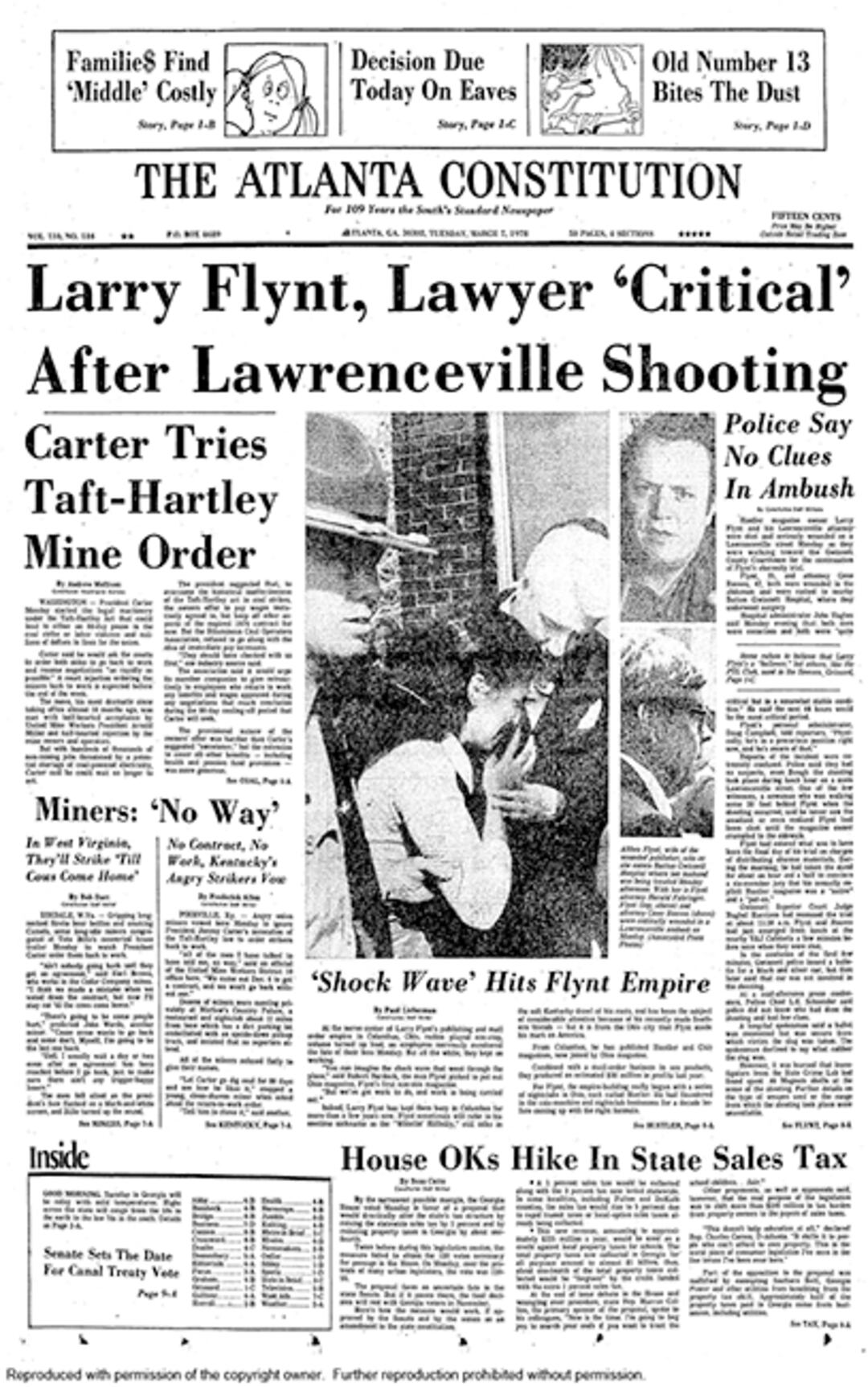
So, let’s set the scene: If there was a character made for the 1970s, it was smut peddler and unlikely free-speech advocate Larry Flynt, who delighted in upending any notion of what was considered socially acceptable about sex. He had none of Hugh Hefner’s pretensions of sophistication and his Hustler magazine was a far raunchier spectacle than Playboy ever dared to be.
On March 6, Flynt was shot by a sniper outside a courthouse in Lawrenceville, Georgia, where he was facing obscenity charges, just one of many legal battles he was embroiled in throughout his career. Flynt was left paralyzed from the waist down and it later turned out that he was shot by Joseph Paul Franklin, a white supremacist, domestic terrorist and serial killer who was outraged by a Hustler spread depicting interracial sex.
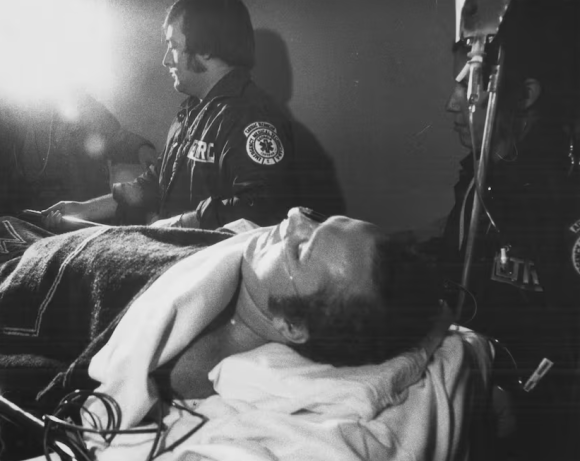
Flynt on March 9, being transferred to a different hospital
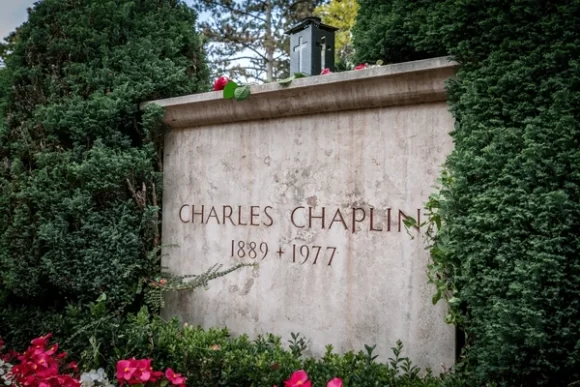
Days earlier, on March 1, a bizarre scenario was playing out in Europe. On March 1, Charlie Chaplin’s remains were stolen from his grave in Corsier-sur-Vevey, Switzerland. Chaplin had died the previous Christmas at the age of 88, and his coffin was dug up by two men, Roman Wardas and Gantcho Ganev, who demanded a ransom from the film titan’s widow, Oona Chaplin. (The grave robbers would be busted in May and Chaplin would be reinterred in a reinforced concrete vault.
The Disco Era hit its peak. Released at the end of 1977, Saturday Night Fever, starring John Travolta, was now the No. 1 movie in the United States, providing a pop-cultural flashpoint that forever defined the late 1970s. It was the top-grosser for only five weeks but was a massive hit both before and after its run at the top.
Also defining the zeitgeist was Close Encounters of the Third Kind, Steven Spielberg’s follow-up to Jaws, underscoring his standing as one of Hollywood’s biggest directors. Other notable movies included The Betsy, Coming Home, Fingers, and An Unmarried Woman.
Sadly, acclaimed character actor John Cazale, best known for his role as pathetically tragic Fredo Corleone, was in the final days of his battle with lung cancer, which had spread to his bones. Cazale, who had a lengthy stage career, was only in five films, but he left an indelible mark on each, and they were all nominated for Best Picture: The Godfather, The Godfather Part II, The Conversation, Dog Day Afternoon, and The Deer Hunter, the last of which was posthumously released later in 1978. (Director Michael Cimino rearranged the filming so that Cazale could film his scenes first and he was able to complete his performance before he died at the age of 42 on March 13.)
Cazale was beloved by his fellow actors, including his frequent collaborator Al Pacino, and his romantic partner, 28-year-old, little-known actress Meryl Streep, who cared for him during his illness. ”I’ve hardly ever seen a person so devoted to someone who is falling away like John was,” Pacino told Entertainment Weekly decades later. ”To see her in that act of love for this man was overwhelming.”
If Laverne & Shirley wasn’t the No. 1 show, it was probably Happy Days instead. (This week, it was Laverne & Shirley.) Three’s Company (in its first season), MASH, Little House on the Prairie, One Day at a Time, Charlie’s Angels, and Barney Miller also drew big ratings.
Meanwhile, cable network Showtime, which had launched in Southern California in July 1976, on March 7 became available across the country.
The disco hits that dominated the charts: the ballad (Love Is) Thicker Than Water by Andy Gibb; Stayin’ Alive, Night Fever, How Deep Is Your Love, all by the Bee Gees; Dance, Dance, Dance by Chic. Eric Clapton’s Lay Down Sally, Billy Joel’s Just the Way You Are, and Queen’s We Will Rock You/We Are the Champions were also getting heavy radio play.
The Saturday Night Fever soundtrack was an absolute monster LP and Fleetwood Mac’s Rumours was also a powerful seller. Other popular selections included City to City by Gerry Rafferty, Macho Man by the Village People, and Excitable Boy by Warren Zevon. Van Halen’s self-titled first album was out for less than a month and is widely considered one of the greatest debuts in rock history.
Wendy and I went to Lee Ho Fook on our honeymoon. I don’t remember whether my hair was perfect.
—
Dan Greenfield, editor, 13th Dimension
Batman #300, DC. Probably the strangest of all Batman anniversary issues. Rather than featuring an all-star cast of villains or a monumental event, the story by David V. Reed is a futuristic, sci-fi-heavy story that presents “The Last Batman Story — ?”
The concept of the Caped Crusader’s final case is a sound one (as we’ve seen elsewhere), but there’s very little of the story that’s inherent to Batman’s world. The villains are a cultish organization called Spectrum, whose operatives wear specific colors head to toe, including their skin. The Walt Simonson-Dick Giordano artwork is terrific, however, suitably enhanced by colorist Jerry Serpe. (Moody Giordano cover, too.)
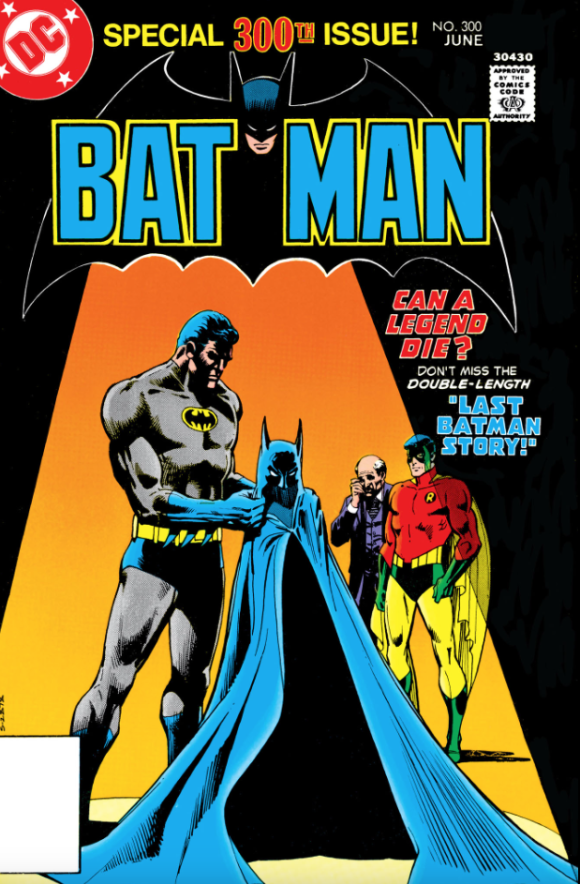
Scott adds: Great landmark cover here by Dick Giordano. I especially like the inclusion of the Earth-2 Robin costume.
Dan adds: And yes, that. This, in fact, may be the only straight-up Batman-and-Robin-team-up-as-adults story of the Bronze Age, and that aspect is pretty cool. (Correct me if I’m wrong.)
—
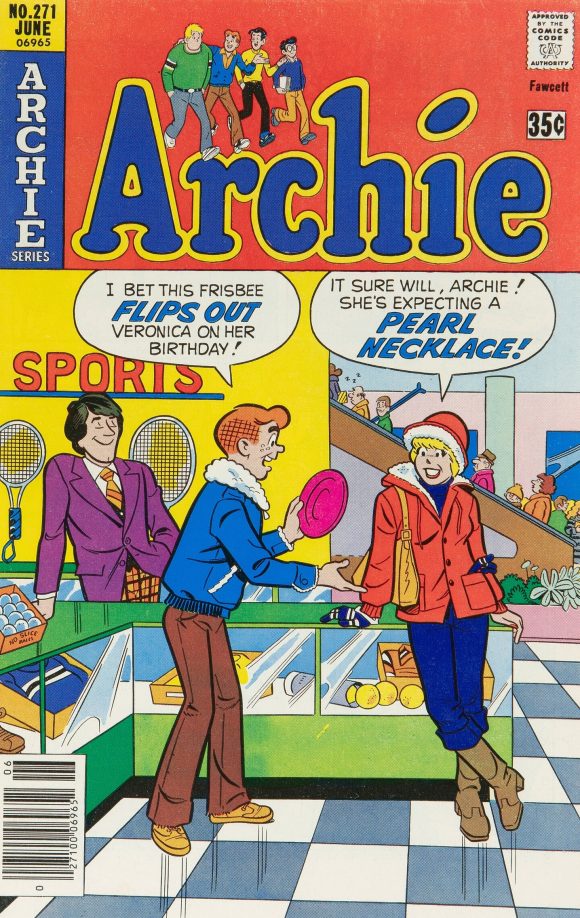
Archie #271, Archie. One of the all-time dirtiest double-entendre Archie covers ever. A close second behind 1968’s Betty and Me #16.
—
The Six Million Dollar Man #9 and The Bionic Woman #5, Charlton. The Bionic Era was on its last cybernetic legs. On March 6, the final episode of the Lee Majors series aired, wrapping up its fifth season. Lindsay Wagner’s program still had a couple months left until its May finish. Both Charlton comics ended with these issues.
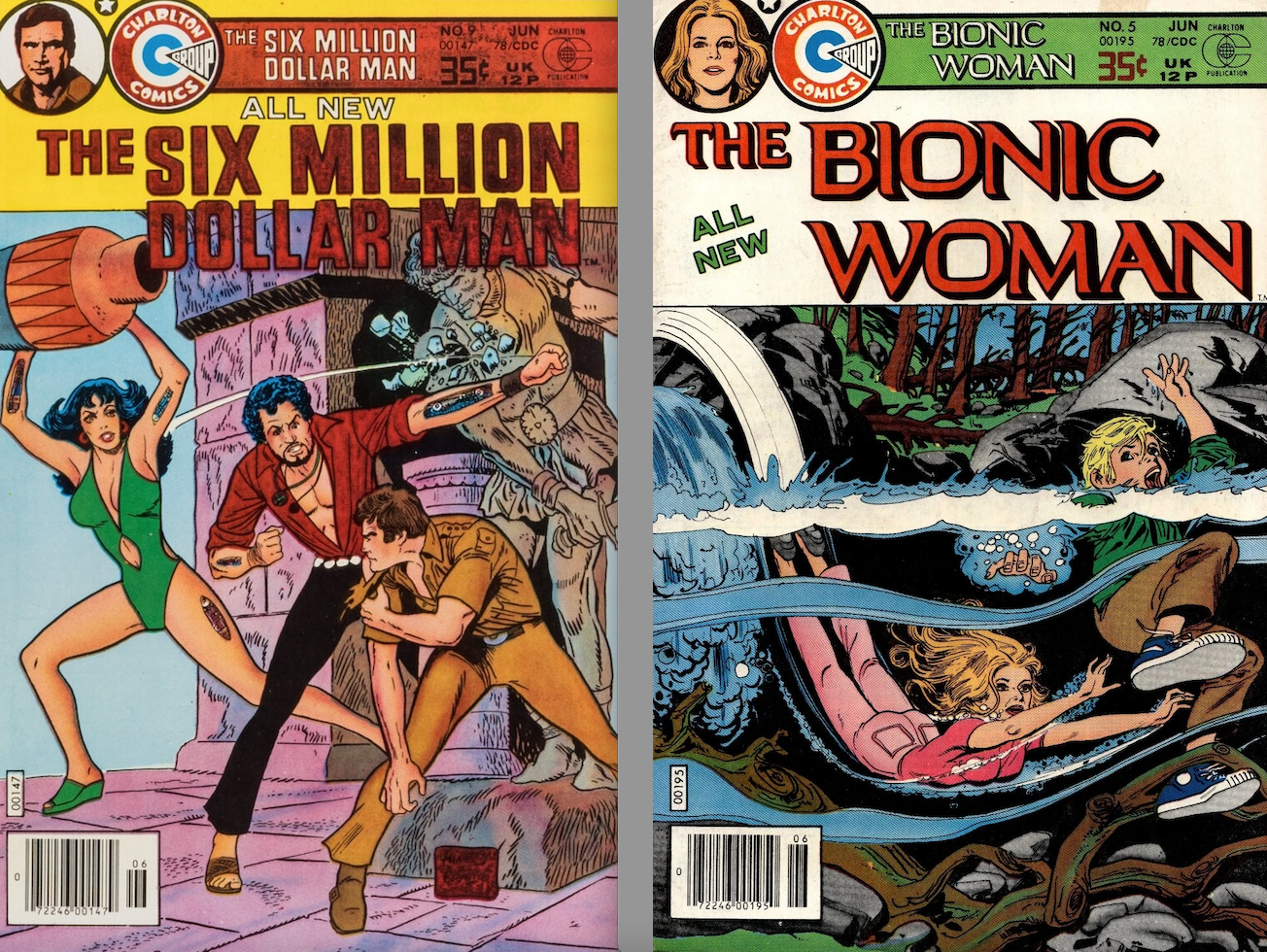
I wasn’t a fan of the show — for some reason, I had a hard time with a superhero who didn’t wear a cape or have a secret identity — but I did want that action figure. Never got it, though.
—
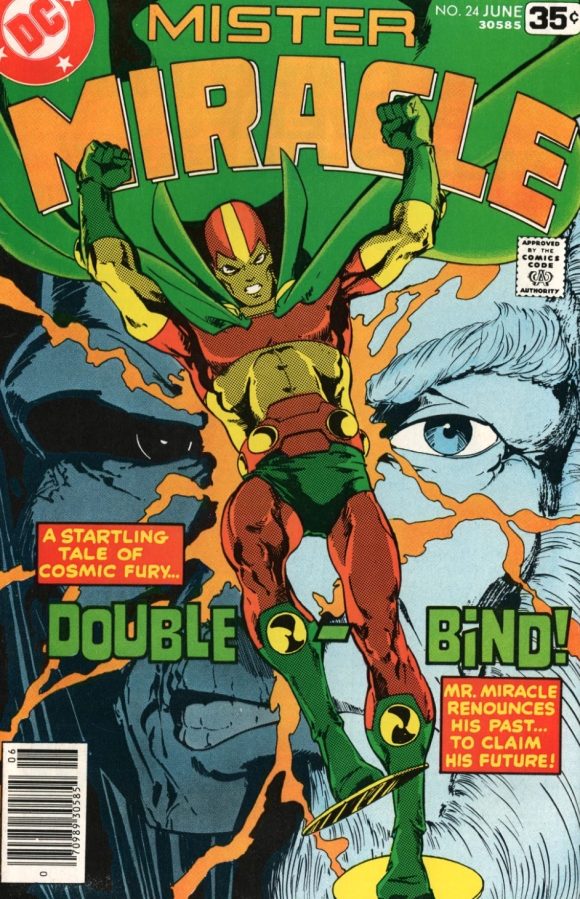
Mister Miracle #24, DC. A lot of talent went into this 35-cent comic: Written by Steve Gerber, pencilled by Michael Golden, inked by Russ Heath, colored by Cory Adams, lettered by John Workman, edited by Larry Hama, with Joe Orlando managing editor and a dazzling cover by Marshall Rogers.
—
Scott Tipton, contributor-at-large, 13th Dimension
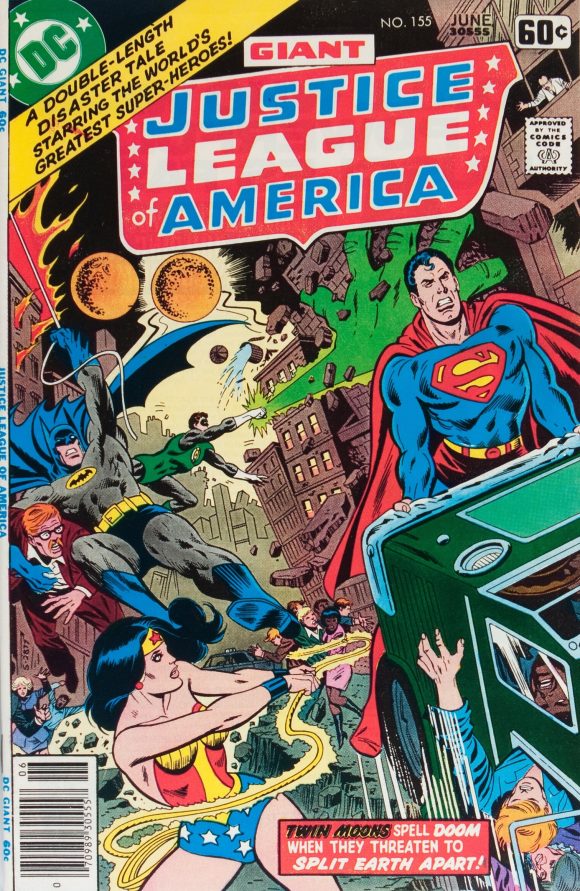
Justice League of America #155, DC. DC was big on disasters for a while in the ’70s, perhaps following the disaster-movie trend in Hollywood.
—
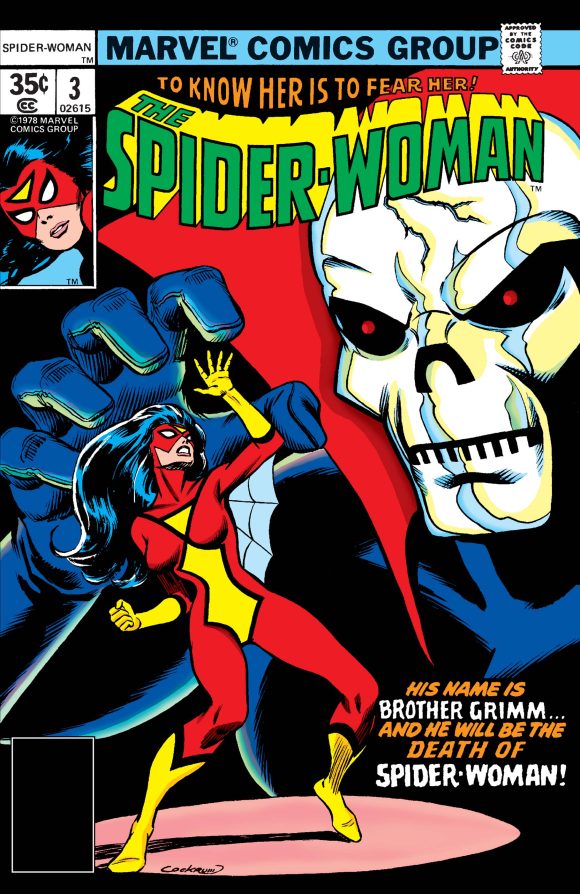
Spider-Woman #3, Marvel. The classic Spider-Woman costume (designed by Marie Severin) doesn’t get anywhere near enough credit for how cool it is. Massively underrated.
—
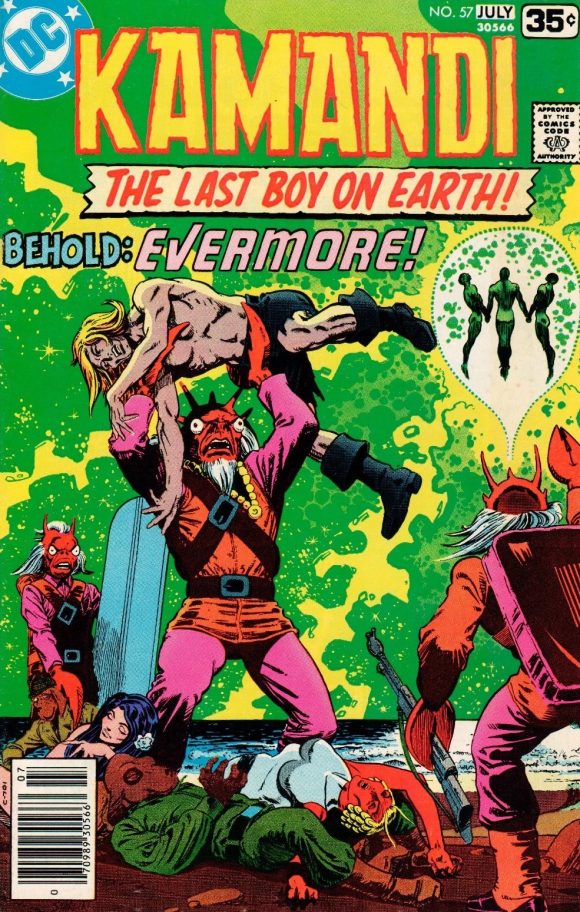
Kamandi, the Last Boy on Earth #57, DC. Are those crab men? You don’t see enough crab men in comics.
—
MORE
— RETRO HOT PICKS! On Sale The Week of February 25 — in 1958! Click here.
— RETRO HOT PICKS! On Sale The Week of February 18 — in 1962! Click here.
—
Comics sources: Mike’s Amazing World of Comics and the Grand Comics Database.

March 4, 2026
RE: Batman # 300: “but there’s very little of the story that’s inherent to Batman’s world.”
Well, yes. It’s a David V. Reed story.
This was a noted feature of Reed’s run on Batman from 1975 to 1978 where he very strongly, if not absolutely, downplayed Batman’s traditional rogues gallery esp. in favor of making him more an international detective and secret agent engaged in mystery oriented adventures themselves that had an internationalist type of intrigue. As much as I like Bat’s rogues gallery (one of the best and most iconic in all of superherodom), my early to mid-adolescent self really took to these kind of stories, as I still do now, like the “Underworld Olympics of 76” (issues 272 to 275) or his battling of of the international group Omega (issues 281 – 283). It put Batman on a kind of James Bond level, if better, as the stories showcased some real sleuthing and detective work rather than just being a jet-setting operations man stressing more sabotage and the like than intelligence gathering.
You have something similar with Batman # 300 as he and a fully grown up, adult Robin, shown to great effect in the Neal Adams’ “Earth 2” costume battle another organization, Spectrum, who’s name not only refers to colors of light, but as a metonym for the wide-ranging diversity of crimes it commits (the full spectrum)–including trying to destroy the Wayne Foundation, all within a futuristic setting of regular space shuttle flights, space stations with zero-gravity medicine and a 4-day work week. I loved how Batman, this non-superpowered yet singularly capable hero, the world’s greatest detective, is able to foil international organizations of intrigue like this just as much as he can best the Joker or Ras al Ghul.
Batman # 300 is a classic and has always been one of my very favorite Batman tales back when I first got it in 1978 (my only time to have a subscription to several DC comics–Batman, B&B and Green Lantern as I remember). I would love see more internationalist detective stories in Batman again in that spirit of the wonderful David V. Reed. It very much suits him.
Apologies for length. But I wanted to advocate for the late Mr. Reed and Batman # 300.
March 4, 2026
Kamandi #57, one of my fave stories of the run of #50-59, the Jack C Harris/Dick Ayers period that really needs to be reprinted into a TPBK…I collect the original art from this last bunch of issues (anyone got any pages from 55-60 I’m missing?). Note the Jim Starlin cover on #57 too! Very underappreciated part-1 of a 3-part crossover-story that leads into Karate Kid #15 and then back into #58…(Bob Rozakis/Juan Ortiz). So fun!
March 4, 2026
Dan adds: And yes, that. This, in fact, may be the only straight-up Batman-and-Robin-team-up-as-adults story of the Bronze Age, and that aspect is pretty cool. (Correct me if I’m wrong.)
If we’re defining “adult” as an individual over the age of 18, then I think ‘Tec 473 (the Englehart-Rogers Penguin story) counts. If not, there’s the Brave and the Bold 182 (Earth 1 Batman and Earth 2 Robin).
As an aside, re: Batman 300, I wasn’t a fan of that one, so much so that when I read DC was doing another “Last Batman Story” about 8 years later, I wasn’t expecting much at all and almost skipped it. That later “last Batman story”? The Dark Knight Returns!
March 4, 2026
I once owned the full run of the Original Spider Woman comics, and issue 3 was missed somehow on the racks. Not necessarily a great story, but I DO love Jessica’s costume.
March 4, 2026
Unless I’m mistaken, I think that “The Bionic Woman” got one more season (1978-79) but it was switched to NBC.
March 4, 2026
The Bionic Woman did get a third and final season on NBC (from ABC originally) but it was during the 1977 to 1978 TV season.
The show was a mid-season replacement for its first season running from January to May 1976. Then season two was from 1976 to 1977. It and the Six Million Dollar Man (still on ABC) were both cancelled in 1978.
March 4, 2026
I wanted Batman #300 for years after seeing the ad in JLA #155 (my first issue of that title), mostly because I recognized the Earth-Two Robin costume from All-Star #74. But when I got the anniversary issue sometime in the 80s, I was disappointed by the non-Batman-ness of it as well. Sorry, William Roark. Nice art though!
March 4, 2026
That Miracle Man vol. 2 run remains a highlight for art (Golden, Rogers) and story. Damn implosion
March 4, 2026
I wanted to get into The Six Million Dollar Man but I couldn’t. For most of its run it aired on Sunday nights, and my family went to church on Sunday nights – there was no getting around it. And no one was really using video recorders at the time so I couldn’t record it. The only times I was able to watch the show was if I was sick and couldn’t go to church. I also missed The Wonderful World of Disney each week and the annual showing of The Wizard of OZ, which was usually shown on a Sunday (I was in high school before I saw the movie for the first time). I did, however, have a Steve Austin action figure and the Mission Control Center.
March 4, 2026
The prose the show was based on is worth a read too!
March 5, 2026
I’ve never been to Lee Ho Fook’s, but on first arriving in Los Angeles I happened to drive past Trader Vic’s. Didn’t go in to see who might be drinking a Pina colada, though.