
Adam Strange! Hawkman! SPACE CABBY!
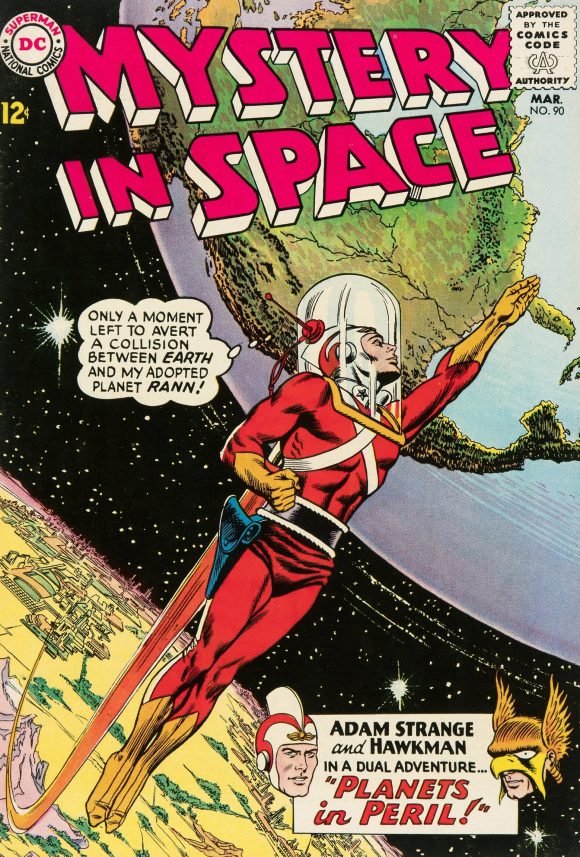
Mystery in Space #90 (Mar. 1964, DC). Possibly the most iconic cover in the history of the title. Carmine Infantino (pencils, with inset drawings of Adam Strange and Hawkman by Murphy Anderson) and Anderson (inks).
By PETER BOSCH
It was a time when science-fiction was everywhere. Films such as Destination Moon, The Day the Earth Stood Still, When Worlds Collide, Rocketship X-M, and The Man from Planet X were playing in first-rate movie houses. Television, too, had plenty of outer-space adventure shows, including Space Patrol, Tom Corbett Space Cadet, and Captain Video and His Video Rangers. There were just so many tales set in the future and on other planets to tell, with a good helping of warnings about invaders trying to take over our planet.
A year before DC Comics released Mystery in Space #1 (Apr.-May 1951) on February 19, 1951 (75 years ago!), it introduced Strange Adventures #1 (Aug.-Sept. 1950), the publisher’s first sci-fi title. However, many of the tales in SA were set on Earth. Mystery in Space took them to the Final Frontier, outer space!
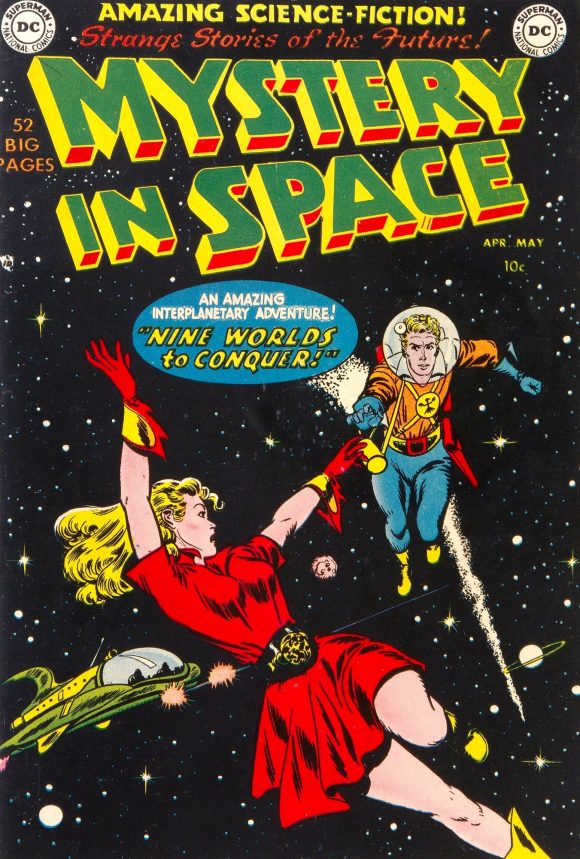
Mystery in Space #1 (Apr.-May 1951, DC). Infantino, pencils. Frank Giacoia, inks.
Starting with the first issue of Mystery in Space, writers’ names were mentioned on splash pages (thanks to editor Julius Schwartz, who had been a literary agent). The artists were not likewise acknowledged, but they were an exceptional group in that first issue — Carmine Infantino, Alex Toth, Virgil Finlay, and Frank Frazetta!
Just as the early issues of Strange Adventures had ongoing features of “Darwin Jones” and “Captain Comet,” Mystery in Space #1 introduced the “Knights of the Galaxy.” They were a 30th-century group of space commandos from Earth, based on a man-made asteroid port, Gala, and ready to help defend the free people of the solar systems from various menaces. The focus of the series was Lyle, a handsome, quick-witted young recruit, whose assignments included foiling kidnappers, space pirates, a deadly intergalactic game player, and other menaces.
The Knights series had good art by Carmine Infantino, but the stories by Robert Kanigher (using the pseudonym of “Dion Anthony”) were rather tedious. An example of this is Mystery in Space #8 (June-July 1952), with the Knights’ minds and personalities suddenly being supplanted by King Arthur and his knights from the Medieval Ages. (It turned out that Merlin cast an evil spell, swapping the brains of the past and present knights.) The story marked the last tale of the Knights.
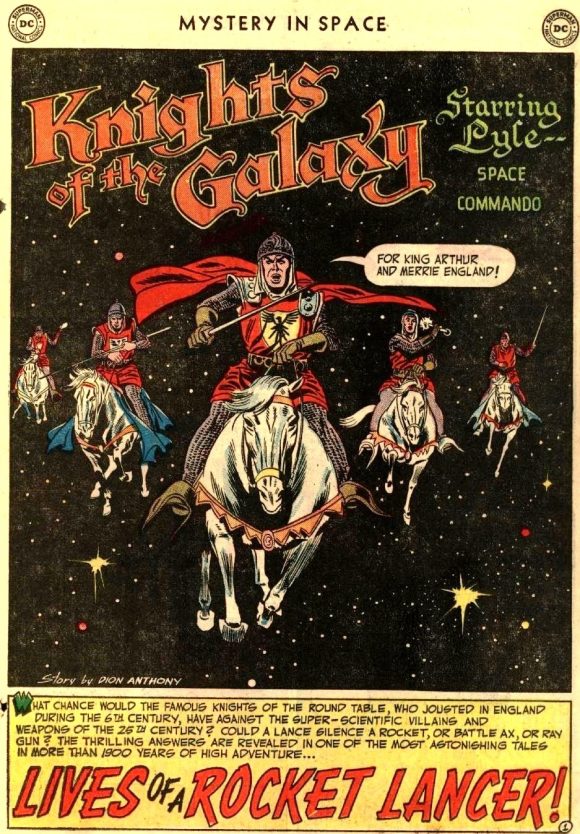
The last Knights of the Galaxy story (and this splash page certainly shows why it came to an end). Mystery in Space #8 (June-July 1952). Script by Robert Kanigher (using the pseudonym “Dion Anthony”). Art by Infantino (pencils) and Sy Barry (inks).
The next regular series introduced within the title was a strange choice. “Interplanetary Insurance, Inc.,” which ran from Mystery in Space #16 (Oct. 1953) to #25 (Apr. 1955), co-created by Sid Gerson and Infantino, featured one of the most difficult main characters to like — Bert Brandon, a space-travelling insurance salesman whose job was to look for alien races that were immortal and sign them up for coverage. His main job was to make sure the company never paid a cent in claims. Sigh, didn’t we have enough of that in real life?
The first continuing fun character in Mystery in Space was a co-creation by Otto Binder and Howard Sherman, “Space Cabbie” (aka “Space Cabby”), which first appeared in Issue #21 (Sept. 1954) in a story titled “Space-Taxi.”
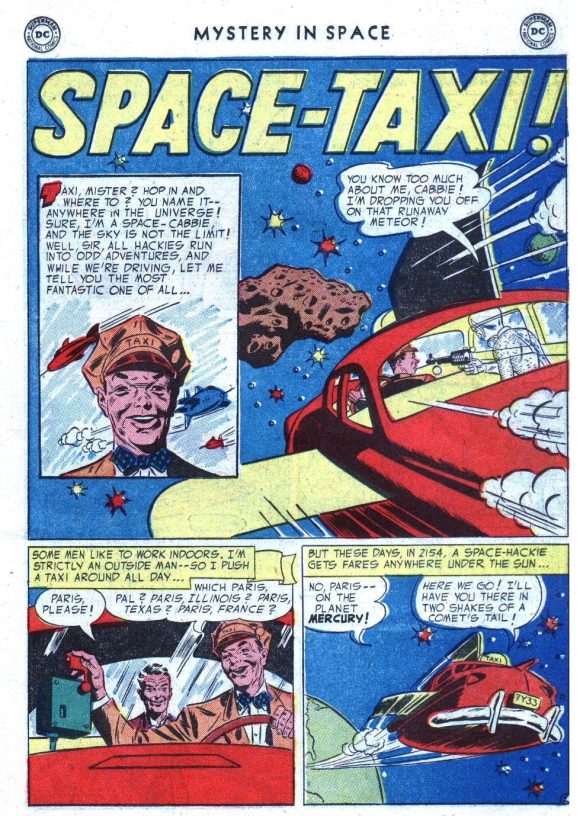
First appearance of Space Cabbie. Mystery in Space #21 (Sept. 1954). Script: Otto Binder. Art: Howard Sherman.
The cabbie’s real name was not revealed during his run through #47 (Oct. 1958, missing only #22, 23, and 25), but he was just a nice guy trying to make a living traveling between the stars. He and #7443, his taxi, traversed outer space as he picked up different alien fares along the way, with stops from one end of the galaxy to the other. However, the tales he recounted to the reader were more than just that of a hack; he was the main character in doing everything from capturing an invisible thief (who made the mistake of stiffing him his fare) to stopping invasions of our planet. Sherman was followed on the art by Gil Kane and then Bernard Sachs.
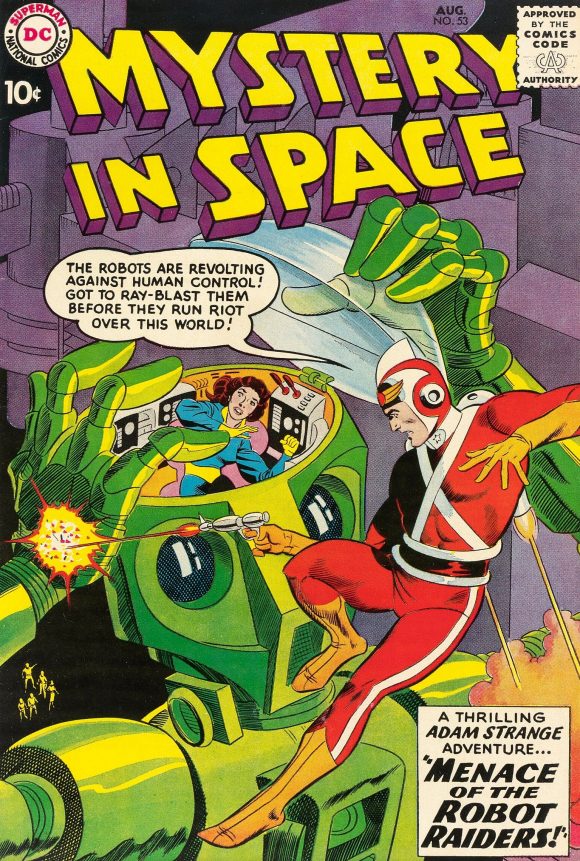
With Mystery in Space #53 (Aug. 1959), Adam Strange took over the title with his first appearance following his debut run in Showcase #17 to 19. Cover art by Gil Kane (pencils) and Bernard Sachs (inks).
It took Adam Strange just a few months from his first appearances in Showcase #17 (Nov.-Dec. 1958) (and its subsequent issues, #18 and #19) before he was assigned the lead spot in Mystery in Space #53 (Aug. 1959)… and the title became one of the brightest spots in the DC Universe with Schwartz as editor, Gardner Fox writing, Infantino on pencils, and Anderson usually on hand to give covers and stories an incredible polish with his inks!
(NOTE: All covers in this group below pencilled by Infantino and inked by Anderson unless otherwise noted.)
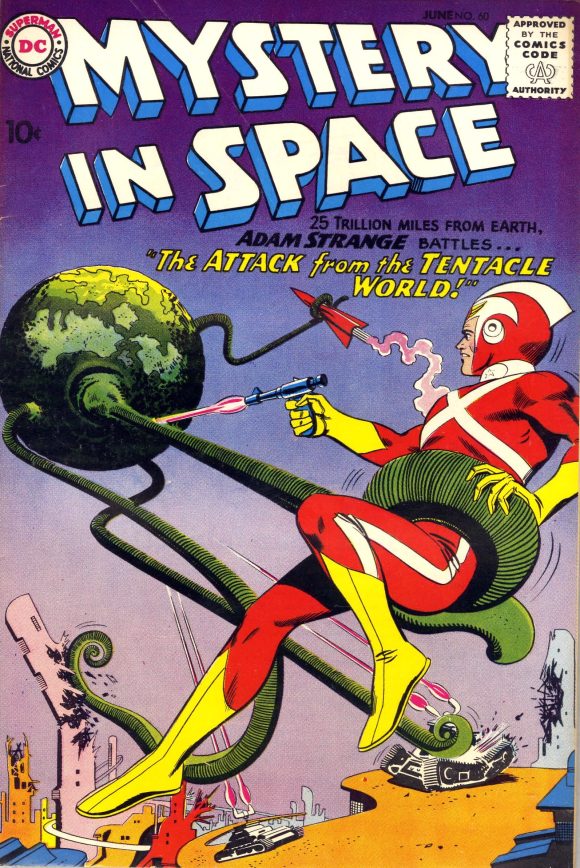
Mystery in Space #60 (June 1960). Cover inked by Joe Giella.
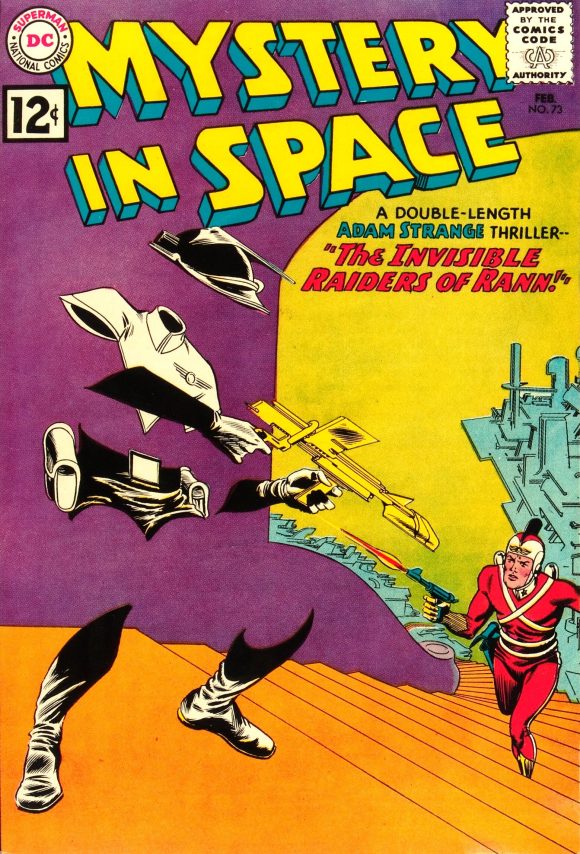
Mystery in Space #73 (Feb. 1962).
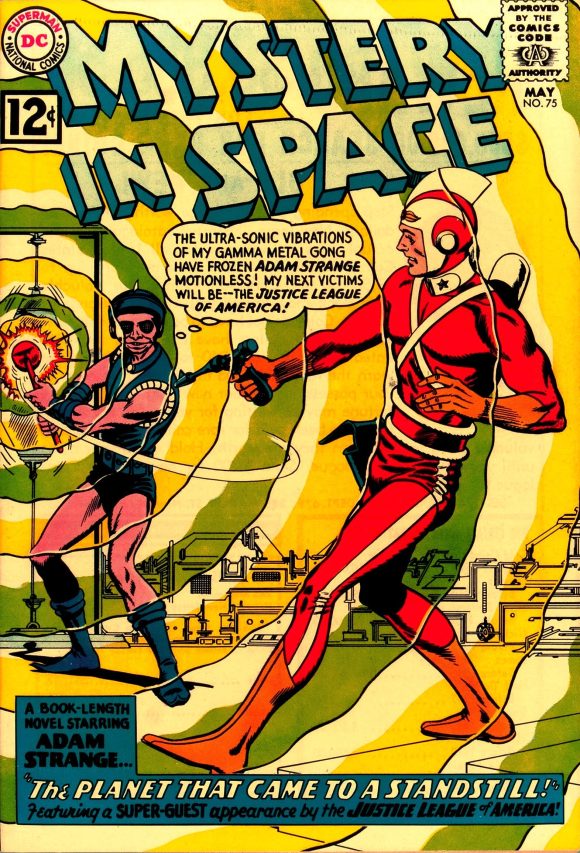
Mystery in Space #75, a classic story within that included the Justice League of America.
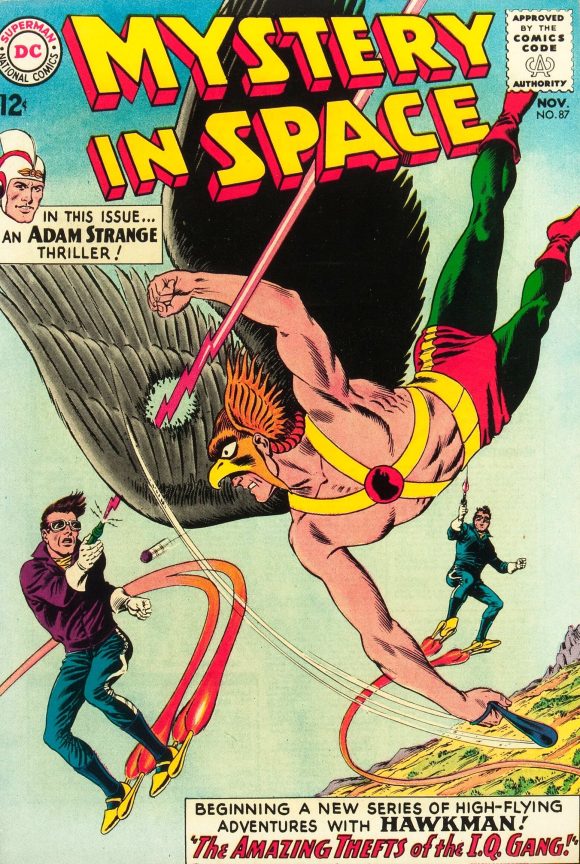
Hawkman began sharing the comic with Adam Strange, starting with Mystery in Space #87 (Nov. 1963). Cover pencilled and inked by Anderson.
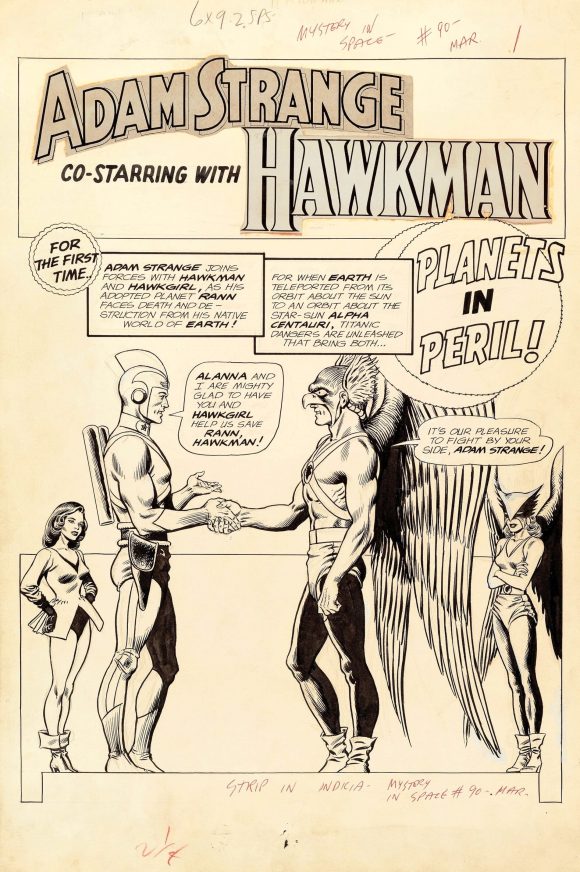
Splash pages seldom equal this. Original art for Mystery in Space #90 (Mar. 1964).
(Before continuing, there was one other new backup feature that started within Mystery in Space #66, March 1961. “The Star Rovers” – co-created by Gardner Fox and Sid Greene – consisted of three well-to-do adventurers who competed with each other in getting to a prize item first. The feature appeared on a semi-regular basis, alternating every three issues on average with regular science-fiction backup stories. The series left MiS after #86, September 1963, and moved over to Strange Adventures for a couple of appearances there.)
However, even with exceptional issues like #90, the title was about to hear its death knell.
It began when DC turned to Julius Schwartz to save the Batman and Detective Comics titles from their low sales. Under editor Jack Schiff, Batman had encountered just too many alien civilizations. Schwartz got the Batman titles and Gardner Fox, Carmine Infantino and Murphy Anderson followed him over there. In return, Schiff was given the Mystery in Space and Strange Adventures books to edit.
With Mystery in Space #92 (June 1964), Schiff brought in Lee Elias to draw Adam Strange. While Elias was a terrific artist who had made The Black Cat comic from Harvey Publications a winner, he was absolutely wrong for Adam Strange. Schiff also added Dave Wood to handle the writing and brought over Space Ranger, which he had co-created with Bob Brown back in Showcase.
Mystery in Space went from this, Julius Schwartz’s final issue (#91, May 1964)…
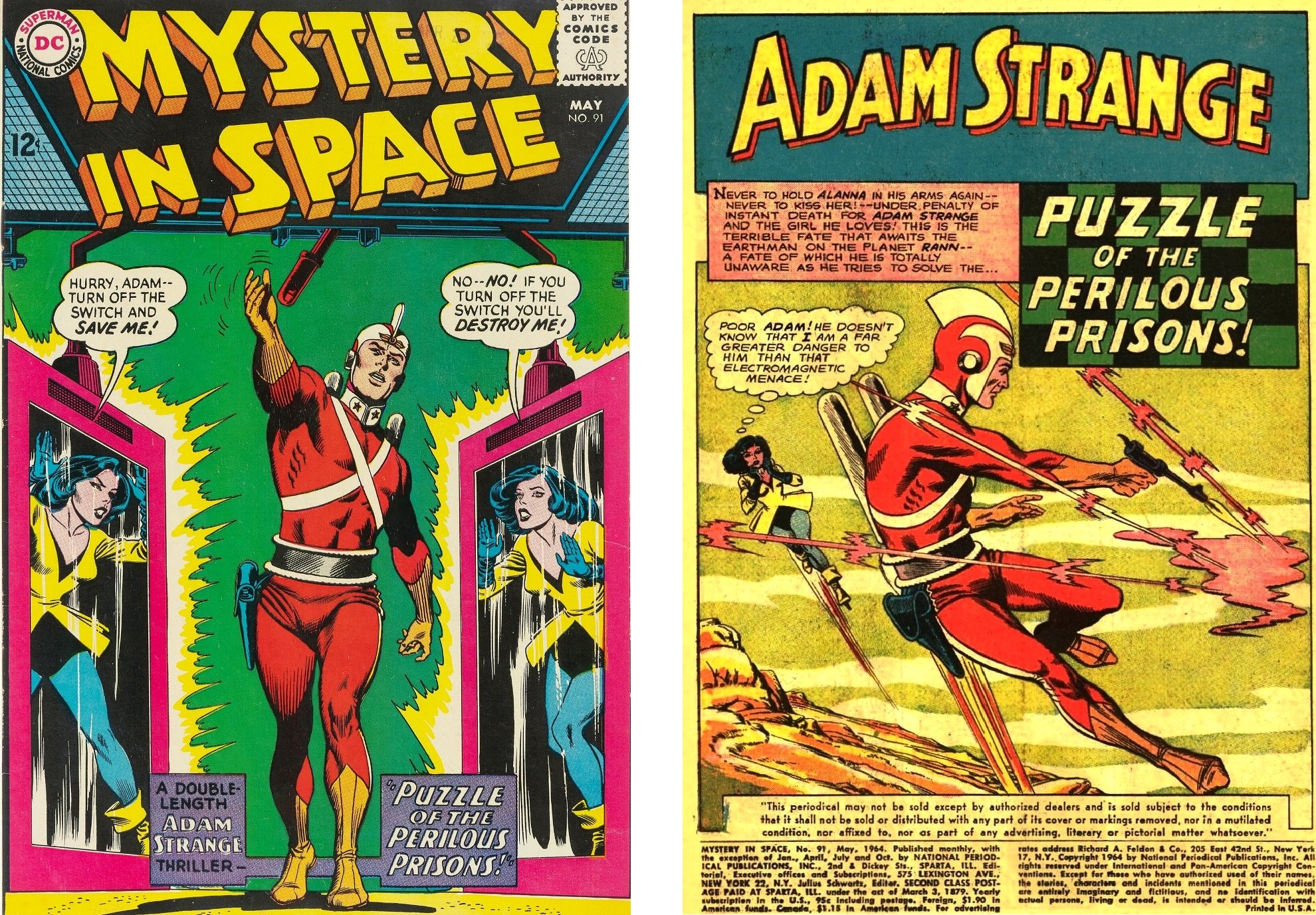
Mystery in Space #91 (May 1964). Cover art by Infantino (pencils) and Anderson (inks). Story page written by Gardner Fox, pencils by Infantino and inks by Anderson.
…to this within a few issues…
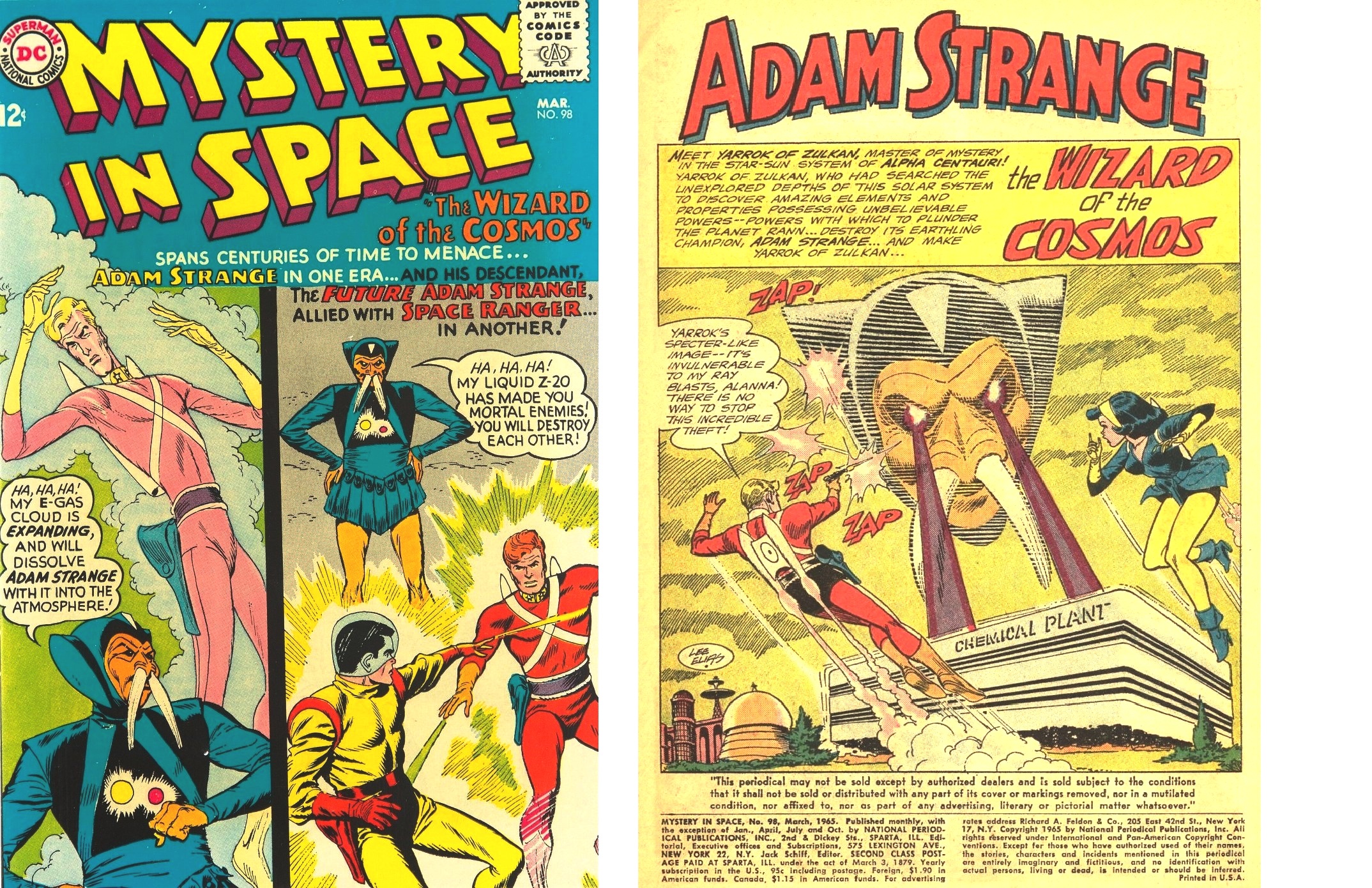
Issue #98 (Mar. 1965). Cover art by Lee Elias. Story page written by Dave Wood, art by Elias.
Dave Wood and Lee Elias co-created a new hero, Ultra – the Multi-Alien, who was introduced in Mystery in Space #103 (Nov. 1965) but the title, under Schiff, still ended with Issue #110 (Sept. 1966).
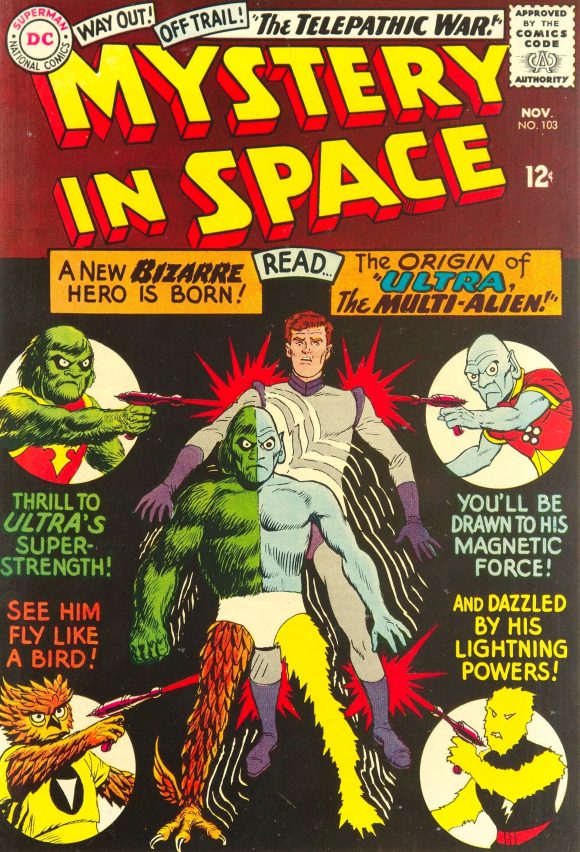
The first appearance of Ultra the Multi-Alien, in Mystery in Space #103 (Nov. 1965). Art by Elias.
It would take 14 years before Issue #111 (Sept. 1980) would appear on the comics racks, this time with Joe Orlando as managing editor and Len Wein as editor. Though the title’s resurrection only lasted through #117, those seven issues featured the artistic talents of Joe Kubert, Marshall Rogers, Dan Spiegle, Jim Aparo, Steve Ditko, Tom Sutton, Terry Austin, Trevor Von Eeden, Jerry Bingham, Michael Golden, Jerry Grandenetti, John Celardo, Johnny Craig, Tom Yeates, George Tuska, Brian Bolland, Jim Starlin, Jose Delbo, Dave Cockrum, Infantino (inked by Jerry Ordway), Don Newton, Rick Veitch — and more!
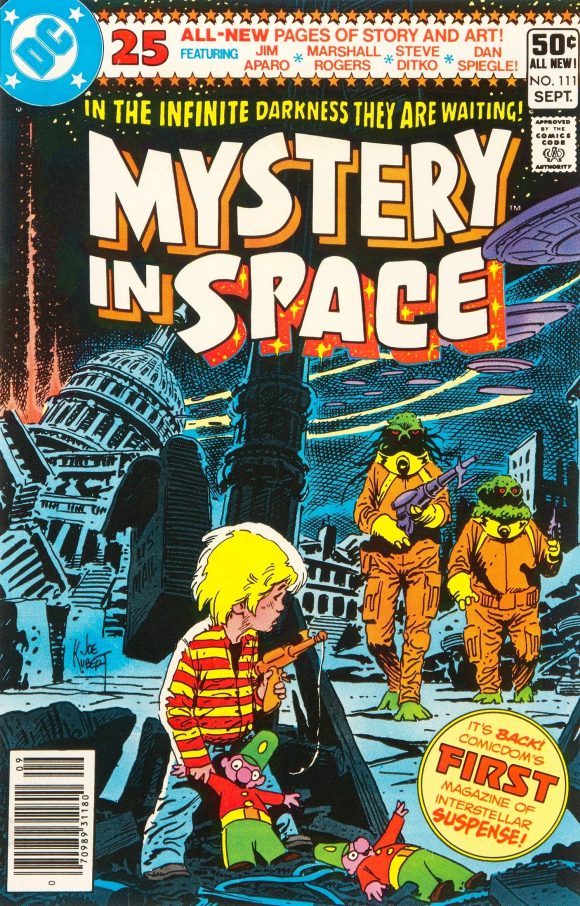
Mystery in Space #111 (Sept. 1980). Cover art by Joe Kubert.
The title Mystery in Space has been used by DC a few times since then for one-shots and an eight-issue limited series. In addition, there was Mysteries of Love in Space. But there is no mystery which Mystery in Space to love… the original.
—
MORE
— 1941’s ALL-STAR COMICS #4: A Celebration of the JUSTICE SOCIETY’s First Real Adventure. Click here.
— THE MIGHTY CRUSADERS #4 at 60: 13 Golden Age Superheroes Who Were Brought Back in the 1966 Cult Classic. Click here.
—
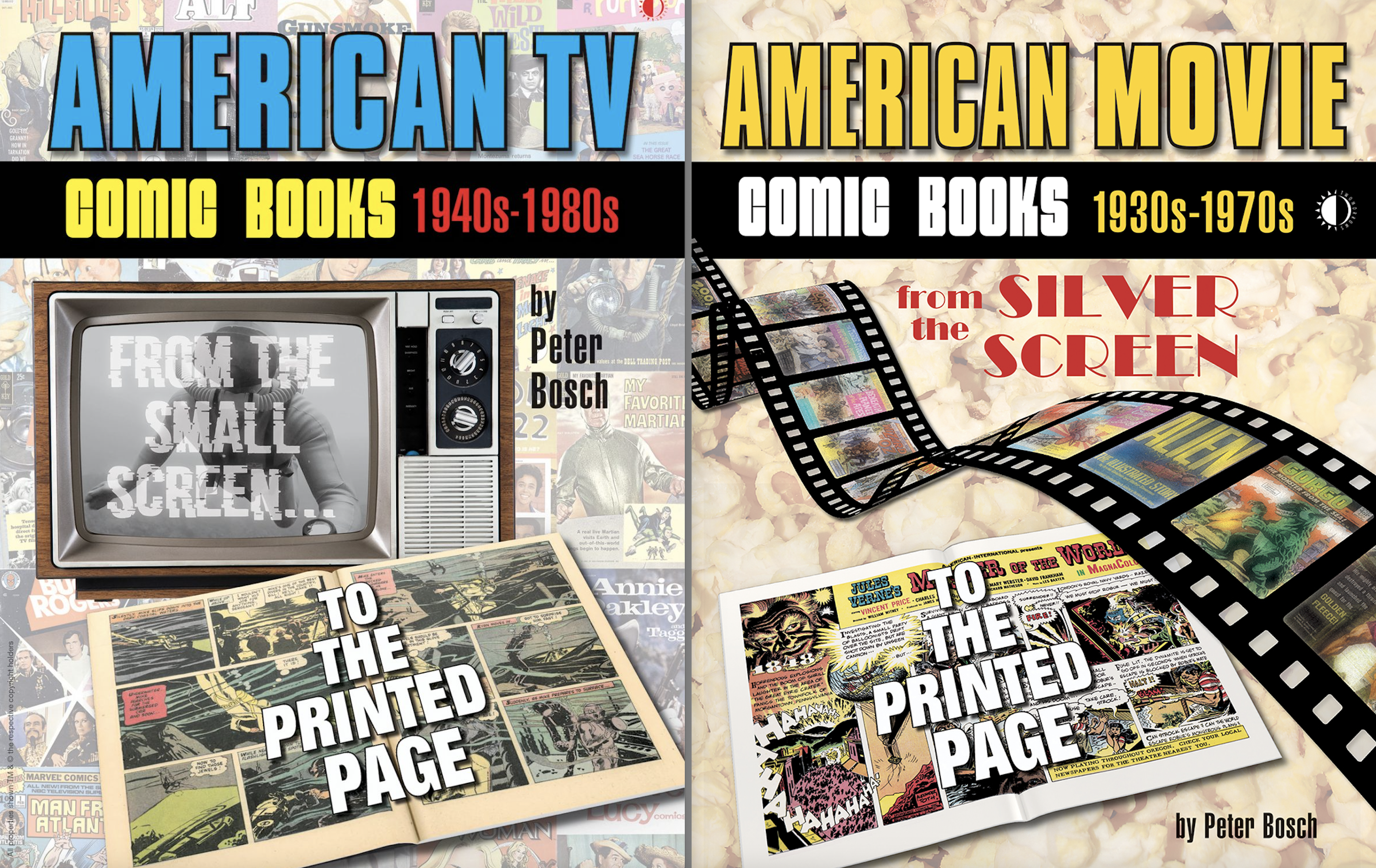
13th Dimension contributor-at-large PETER BOSCH’s first book, American TV Comic Books: 1940s-1980s – From the Small Screen to the Printed Page, was published by TwoMorrows. (You can buy it here.) A sequel, American Movie Comic Books: 1930s-1970s — From the Silver Screen to the Printed Page, is out now. (Buy it here.) Peter has written articles and conducted celebrity interviews for various magazines and newspapers. He lives in Hollywood.

February 21, 2026
This was interesting. Except for Adam Strange, my only exposure to most of these characters was from Howard Chaykin and Jose Luis Garcia-Lopez’s great (and criminally underrated) Twilight mini-series from 1991 that was a darker, modern, post-Crisis hard reboot of all of these characters. It was fun reading this article and learning where they all came from originally.
February 21, 2026
Mystery in Space #90 so need to be published as a facsimile, it is one of the great Silver Age comics.
February 21, 2026
I think the first time (and one of the few times) I came across Adam Strange is when the story from #90 was reprinted in DC Super-Stars: Of Space (which included a story with Space Cabbie). But I would still love it as a facsimile, or any other one of the issues with Adam Strange. I missed the earlier facsimile they did of Mystery in Space.
February 21, 2026
Mystery In Space 75 is considered THE classic Adam Strange story, but that’s just an indication of how much superhero fans have written the history of comics.
I was a huge Adam Strange fan in my youth – until Schwarz, Fox & Infantino bumped over to Batman, anyway – partly for the milieu but largely because he eschewed physical prowess for thinking his way through problems with that those little science tidbits that Julie used to throw in. Not uncommon for Schwarz heroes, but Adam Strange took it a bit further. Wasn’t perfect but was often a nice primer on how logic worked & could work for you.
However (SPOILERS for anyone who thinks a 64 year old story can be spoiled) The Planet That Came To A Standstill is probably the WORST example of this in the original canon.
Old JLA foe Kanjar Ro comes to Rann to get superpowers that will even overwhelm the entire JLA. Incapable of beating him, Adam does a nifty job of at least stalling him with his own weaponry – the reason the planet comes to a standstill, inc. Adam Strange, who then waits for the Zeta Beam that brought him to Rann (his traditional way of getting there) to wear off, returning him to Earth & full mobility, where he then recruits the JLA. Who return to Rann with him by other means, just in time for Kanjar Ro to finally shake off the paralysis & mop up the floor with them. Which is where it all falls apart.
Adam Strange is the one who finally puts him down, by throwing KR’s own “rod” at him, whereupon KR suddenly gets weak & collapses. HOW did this work?
Well… Adam “reasoned” that because Superman is weakened by pieces of his home planet Krypton, Kanjar Ro would react identically to a chunk of HIS home planet, Dhor – & his rod is made of dhorite.
And HUZZAH! It works, KR’s put away, the JLA shakes his hand & goes home.
It’s the single most sophitic, stupid moment in the entire series, falling apart even by superhero comics “reasoning.” The reason Superman reacts so to kryptonite isn’t because it’s his home planet, but b/c it’s radioactive, & he’s particularly susceptible to the radiation. Unless there was something they’re not telling us, there’s no reason to think dhorite’s any more dangerous than the average chunk of granite.
A very uncharacteristic “don’t think about it, just buy into it, we’re grasping at straws to get out of this” resolution of an Adam Strange story. Not exactly a classic.
Was nice to see Carmine draw the JLA, tho’…
February 22, 2026
I’ve lucked into reading some of the reprinted MiS stories. Besides “Adam Strange,” of course I loved “Star Rovers” and “Space Cabbie.” Thanks for this reminiscence.
February 22, 2026
We really need a 1950’s – ’60’s DC Space Heroes edition from the DC Finest series, collecting stories for Adam Strange, Captain Comet, Space Ranger, Knights of the Galaxy, Atomic Knights, Tommy Tomorrow, Star Rovers, Space Cabbie, Space Museum and Star Hawkins. Maybe the volume could be titled “Mysteries in Space”.
February 22, 2026
That’s a great idea. Their “Science-Fiction” does have several complete issues of Mystery in Space and Strange Adventures with Tommy Tomorrow and others, but one focusing on just the heroes would be excellent.
February 22, 2026
I can’t tell if someone was poking fun, but the Mysteries In Space (The Best Of DC Science Fiction Comics) collection came out in 1980 from Fireside Books.
February 23, 2026
You are correct and it’s on my bookshelf displayed proudly. But I’d like a collection more oriented toward the continuing characters of that specific period. Honestly I’d love a volume representative of the Alan Davis cover for Mike Barr’s superb TwoMorrows book Silver Age Sci-Fi Companion.
February 24, 2026
Yeah, I can understand that. I’d like to see an Adam Strange omnibus or two (only Silver Age stuff, since post-Fox/Infantino nobody can seem to get the basics of the series right… except me, in the short Mike Zeck & I did for a Legends Of The DCU Annual, which Julie Schwarz thanked me for at a San Diego Con)… & it’d be interesting to have at least one anthology featuring a story each for all of DC’s space series of the Silver Age, inc. the likes of Captain Comet, Tommy Tomorrow, Space Museum, Space Ranger, Star Hawkins, X The Multi-Alien, & Astra Girl Of The Future, among many others. The full panoply, good & bad both.