
A BIRTHDAY SALUTE…
By CHRIS FRANKLIN
It has been said that Richard W. (Dick) Sprang (July 28, 1915 – May 10, 2000) was to Batman what Carl Barks was to Donald Duck and co. — the “Good Batman Artist” of the Golden Age. This is no slight on the other Golden Age greats who illustrated for decades, uncredited, as ghost artists for Batman’s co-creator and initial artist, Bob Kane. But savvy kids knew the difference between the art of Kane, Jerry Robinson, Sheldon Moldoff, Win Mortimer, and especially Dick Sprang.
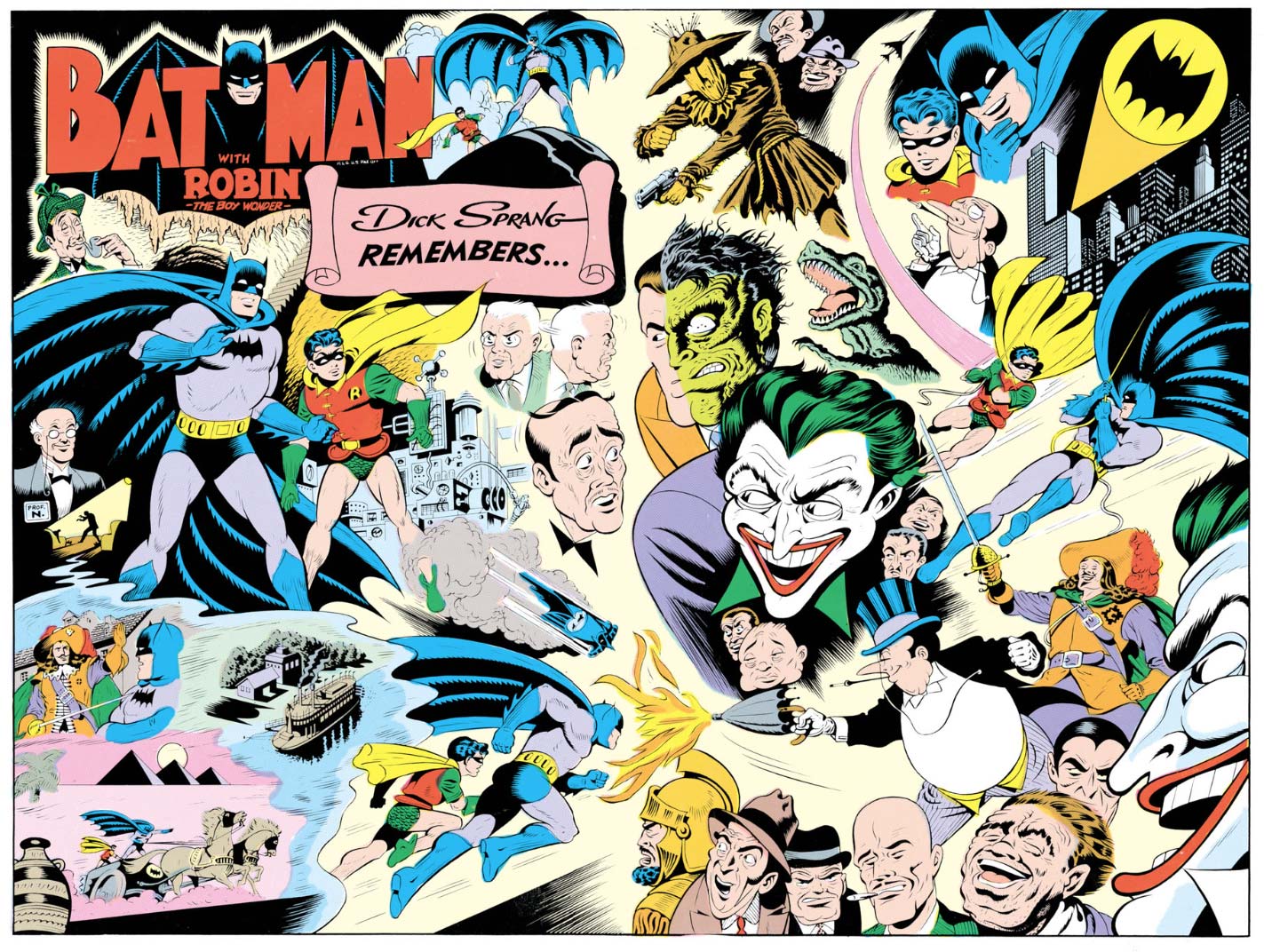
Double page spread by Sprang from Detective Comics’ 50th anniversary issue, #572 (March 1987)
Sprang stood out from the others with stylized figures, grotesque villains, barrel-chested heroes, unique and dynamic panel layouts and dizzying perspective shots. There was a sense of energy and high adventure in every Sprang story that few could replicate.
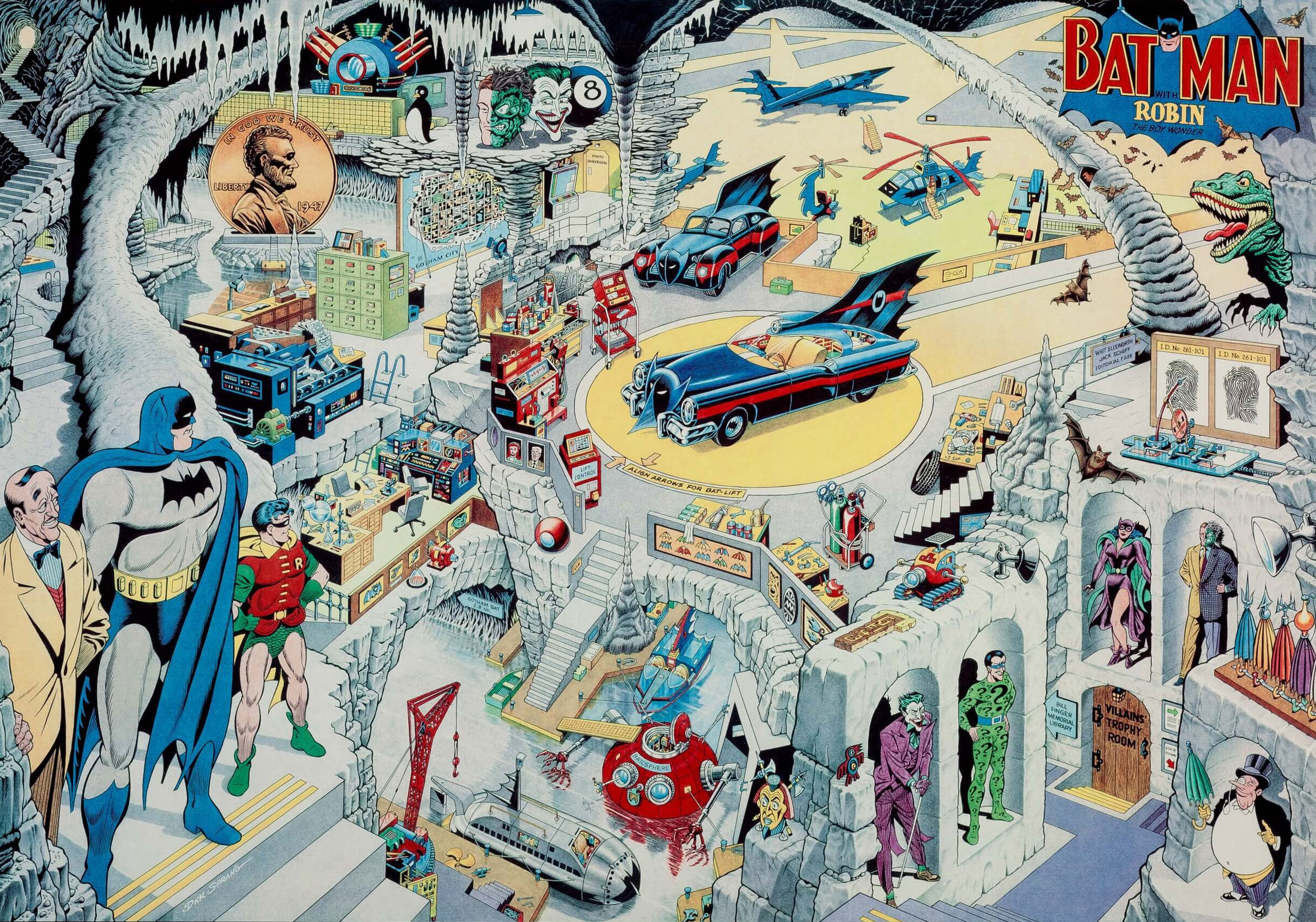
Sprang’s collector print “Secrets of the Batcave,” 1995
Sprang worked on the Batman titles and other DC comics from 1941 to 1963, bridging the Golden and Silver Ages, and creating an impressive body of work. The stories he illustrated ranged from the early noirish crime stories to the strange fascination with aliens and science fiction that dominated the late-’50s and early-’60s comics. But Sprang’s consistent handle on the characters made it all work and feel like Batman. Reprints finally gave the artist the credit he deserved, and he became beloved among fans, returning to DC for special projects and creating collector prints.
To celebrate the date of his birth 110 years ago, let’s take a look at 13 lasting contributions Sprang made to the Batman and DC mythos, still resonating in the canon today.
—
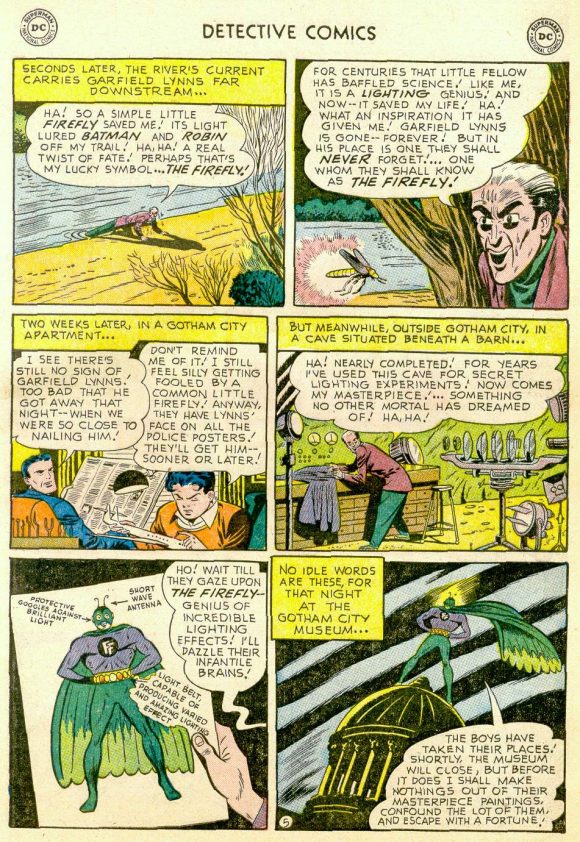
13. Firefly. Sprang and writer France E. Herron created Firefly for Detective Comics #184 (June 1952), initially conceived as a stage-lighting technician who turned to crime. He had relatively few appearances but was reimagined by Chuck Dixon and Graham Nolan for Detective Comics #661 as a pyrotechnic expert turned arsonist. This version has stuck, and the character has made it into various other Batmedia. But the initial inspiration remains.
—
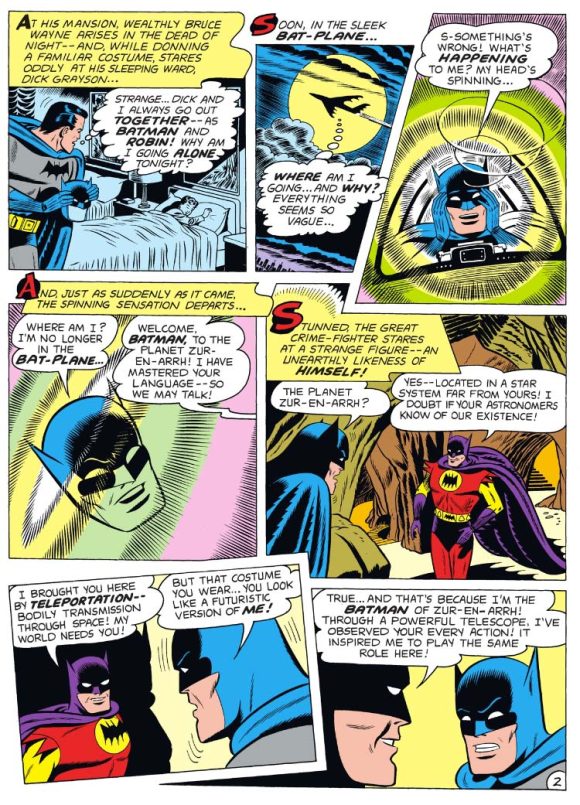
12. Batman of Zur-En-Arrh. An obscure footnote in Batman’s history until resurrected by Grant Morrison during his “Batman: RIP” story arc, the Batman of Zur-En-Arrh teleported our Caped Crusader to his world in Batman #113 (Feb. 1958). Herron handled the scripting chores and Paris the inks, but Sprang designed this alternate Batman, who observed Bruce Wayne from afar, and based his advanced crimefighting identity and equipment on him. Sprang was ahead of the curve, giving the futuristic Masked Manhunter a bat emblem with a yellow circle behind it, predating the “New Look” costume change by six years!
—
11. The Definitive Golden Age Two-Face. Although created by Finger, Kane and Robinson, the iconic image of the Golden Age Two-Face belongs to Sprang, even though he only drew one tale featuring the character. Sprang defined the nuances of Two-Face’s disfigured left side like none had before him, and it proved to be influential to artists who picked up the character after this, his final Golden Age tale.
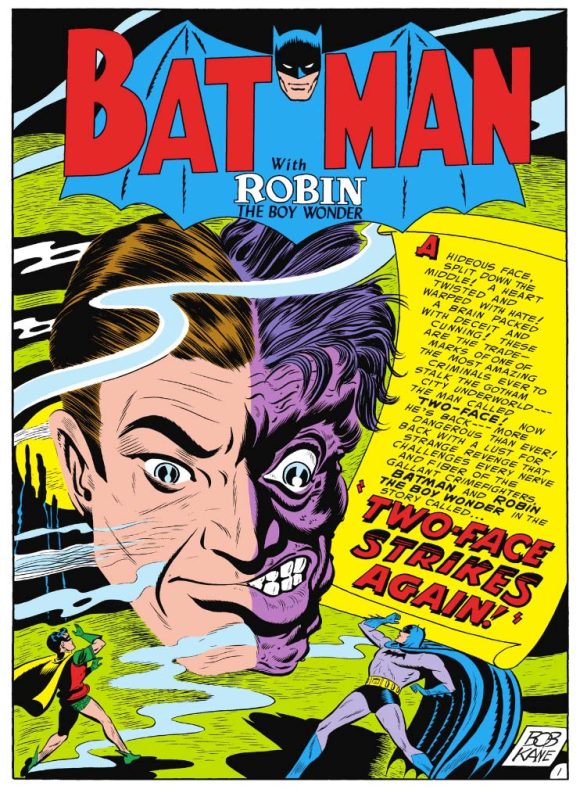
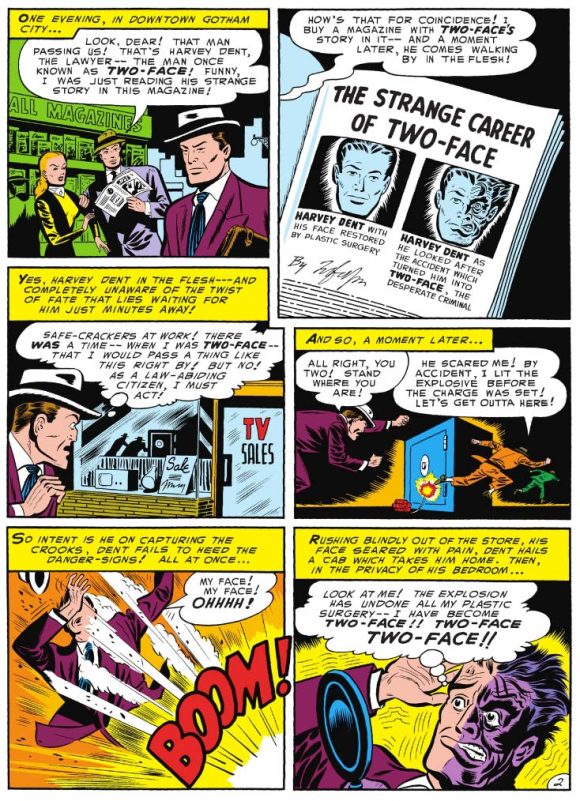
Batman #81 (Feb. 1954) featured “Two-Face Strikes Again,” by David V. Reed, Sprang and inker Charles Paris. Harvey Dent’s sanity and appearance has been restored thanks to plastic surgery. But all of that is undone when the lawyer attempts to stop a robbery and is caught up in an explosion. The panels of Dent in the blast and his reaction to seeing his damaged visage were lovingly recreated by artists Neal Adams and Dick Giordano in Two-Face’s next appearance, 17 years later, in the iconic “Half an Evil” from Batman #234.
—
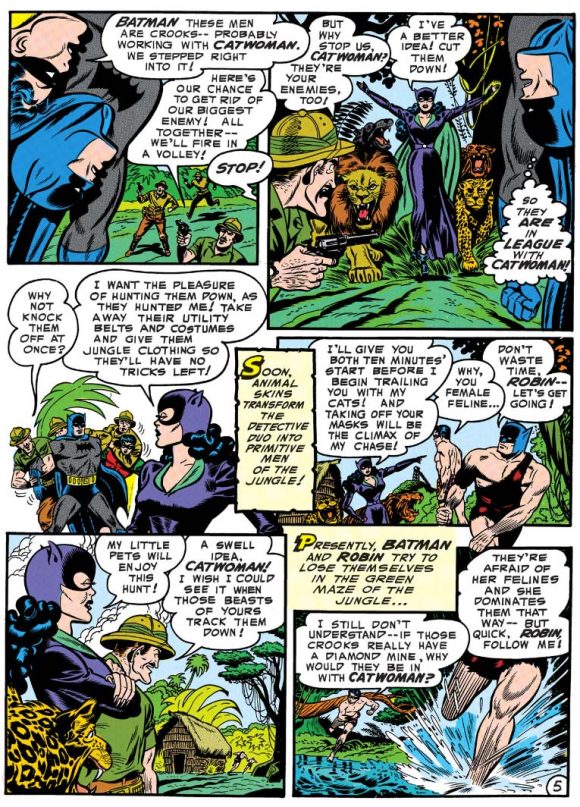
10. Catwoman’s Last Golden Age Hurrah. After a period where Selina Kyle reformed for several appearances, the Princess of Plunder returned to her wicked ways. But her resumed career was soon to be cut short as “The Jungle Cat-Queen” from Detective Comics #211 (Sept. 1954) by Edmond Hamilton, Sprang and inker Paris, was her last comics appearance for 12 years!
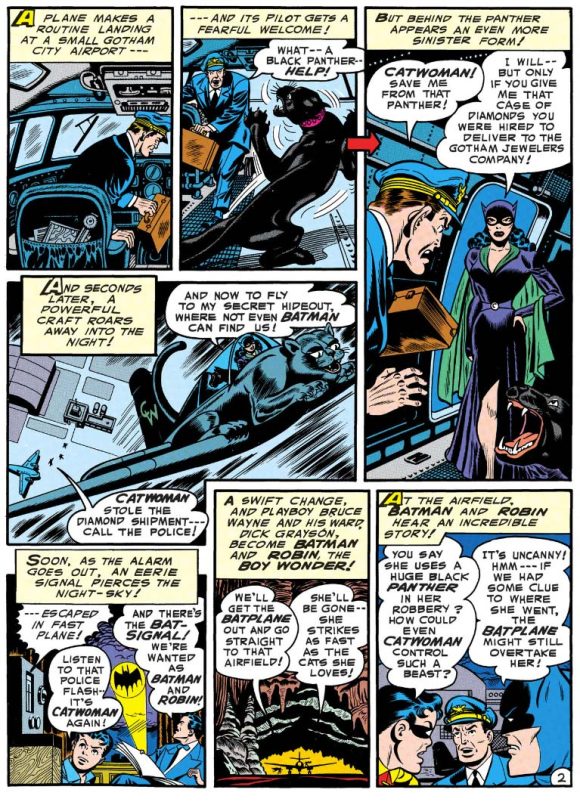
She went out with style, however, as Sprang drew her on the splash, astride a giant tiger, menacing the Dynamic Duo. The story allowed Sprang to design the Feline Fury’s Cat-Jet, and to depict Batman and Robin stripped down to only their masks and some Tarzan-like loincloths! Sprang drew perhaps the most sultry and glamorous Catwoman readers had seen to date.
—
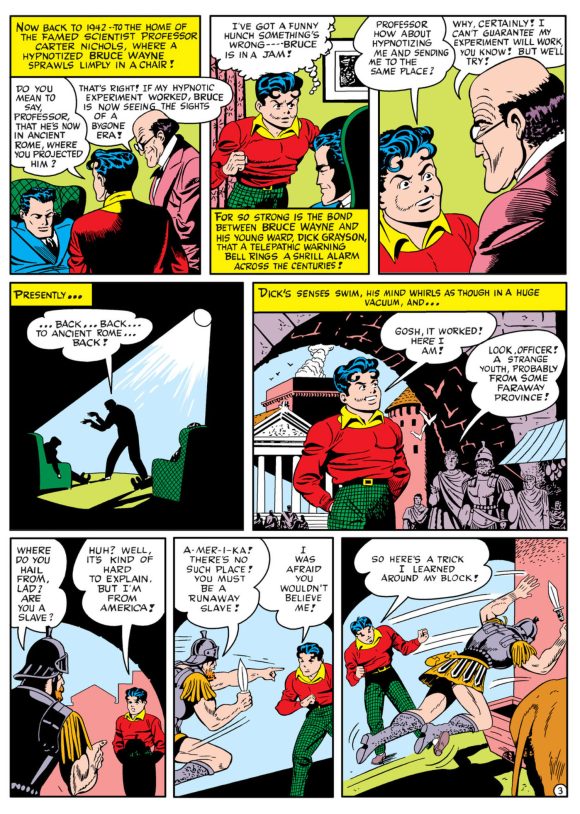
9. Professor Carter Nichols and Time Travel A co-creation between writer Joe Samachson and Sprang, Professor Carter Nichols debuted in Batman #24 (Aug./Sept. 1944) hypnotizing Bruce Wayne and Dick Grayson and sending them back through time to ancient Rome. Carter made 40 appearances across the Golden and Silver Ages, using hypnotic methods and later a time ray to send Batman and Robin to various points in history.

Sprang drew the bulk of these, his love of history allowing him to transport the Dynamic Duo and their readers to some of the past’s most intriguing locales and eras.
—
8. Batplane II. Not content to modernize just the Batmobile (see below), Sprang, along with writer David V. Reed and inker Charles Paris, brought Batman’s often-used flying vehicle into the jet age in Batman #61 (Oct./Nov. 1950). The previous model’s bat-head and perpendicular wings were traded in for a sharp nose with a painted bat-head motif and swept-back wings.

The result was a sleek design that managed to last well into the 1980s before being supplanted by the 1989 film’s Batwing. The innovative abilities of the jet to convert to helicopter and submarine were eventually dropped, however.
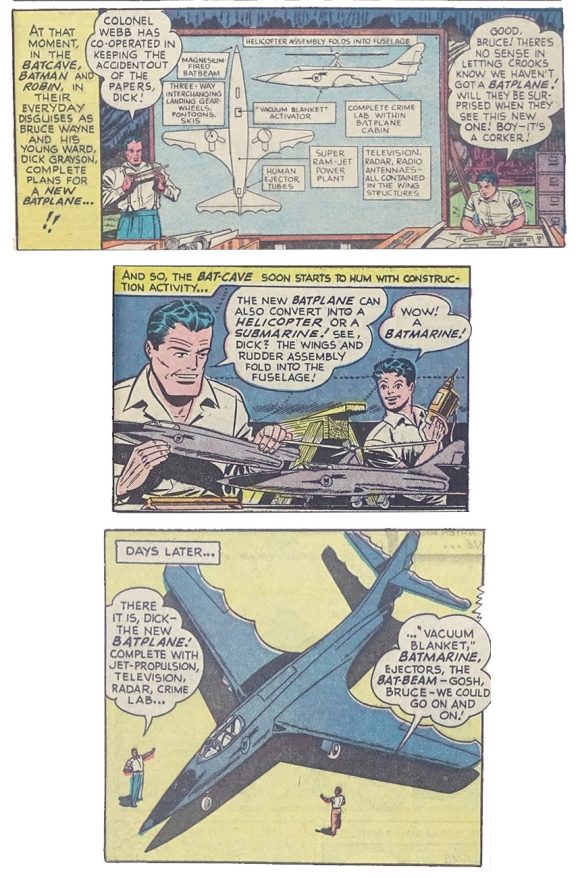
Select panels from Batman#61, script by David V. Reed, inks by Charles Paris
—
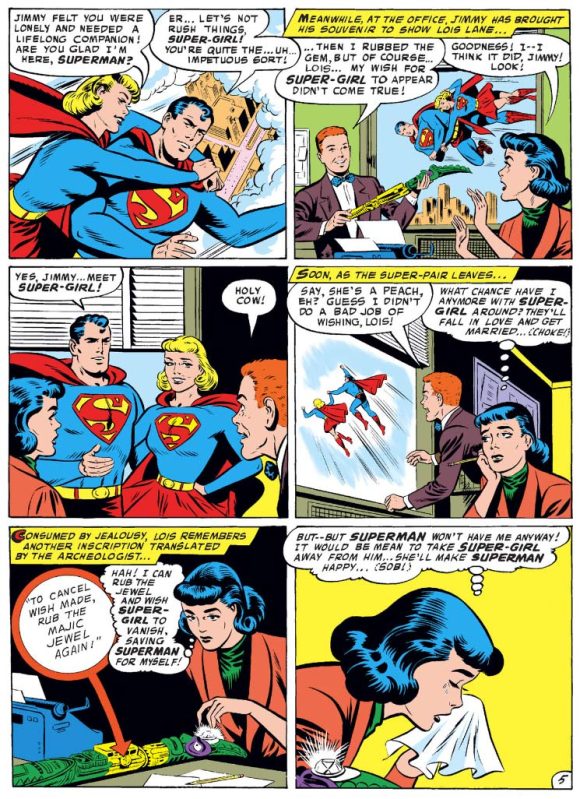
7. The Prototype Supergirl. Leaving Gotham and crossing the bridge to Metropolis for a moment, Sprang, who drew occasional solo Superman tales as well, introduced the world to Super-Girl in Superman #123 (August 1958). No, you didn’t read that wrong, Super-Girl was an early attempt by editor Mort Weisinger to test the waters and see how readers would react to a new female counterpart to the Man of Steel. In the story by Otto Binder with inks by Stan Kaye, Jimmy Olsen wishes this Super-Girl into existence via a magic totem.
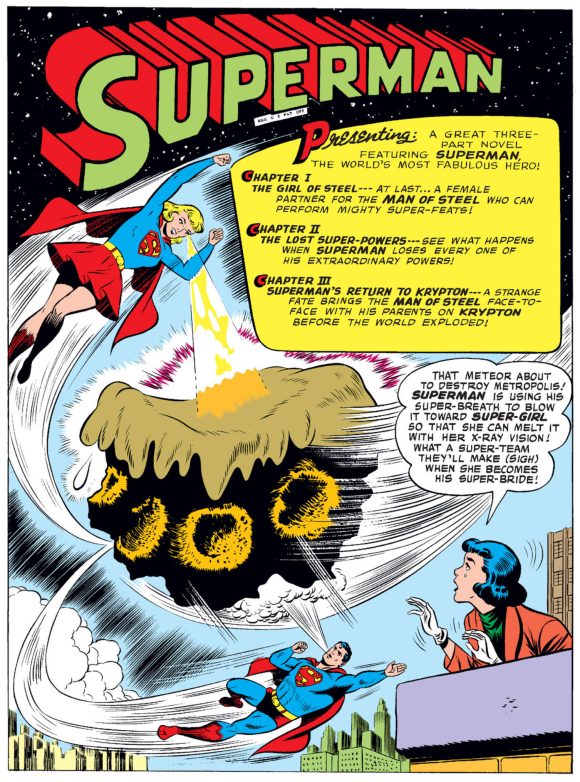
Like her later, more famous namesake, the hyphenated Super-Girl is blonde, and wears a dress that mimics Superman’s uniform, including a red skirt that Kara Zor-El will adopt decades later. Super-Girl interferes with Superman several times, and when she is fatally exposed to Kryptonite, Jimmy wishes her away to spare her suffering. Binder, with Al Plastino, went on to co-create the Kara Zor-El version in Action Comics #252 (May 1959), but Sprang was there for the trial run!
—
6. “The Origin of the Superman-Batman Team.” Sprang took over illustrating the Superman/Batman team-ups from initial artist Curt Swan in World’s Finest Comics with Issue #78 (Sept./Oct. 1955). But he really made his mark with Issue #94 (May/June 1958), and the oft-reprinted story “The Origin of the Superman-Batman Team.”
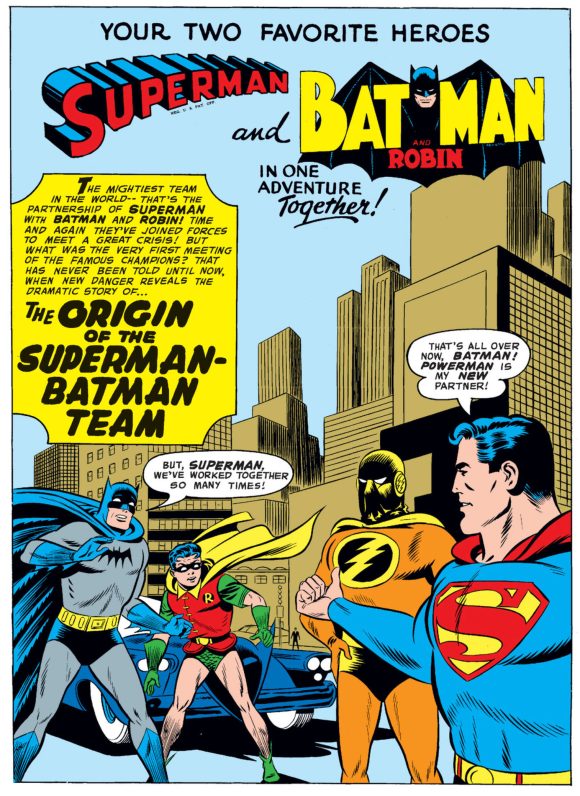
Batman and Robin are perplexed when Superman recruits a new hero, Power Man, to help him track down the escaped Lex Luthor. Sprang’s art deftly shows how hurt and bewildered the Dynamic Duo are over Superman’s dismissal.
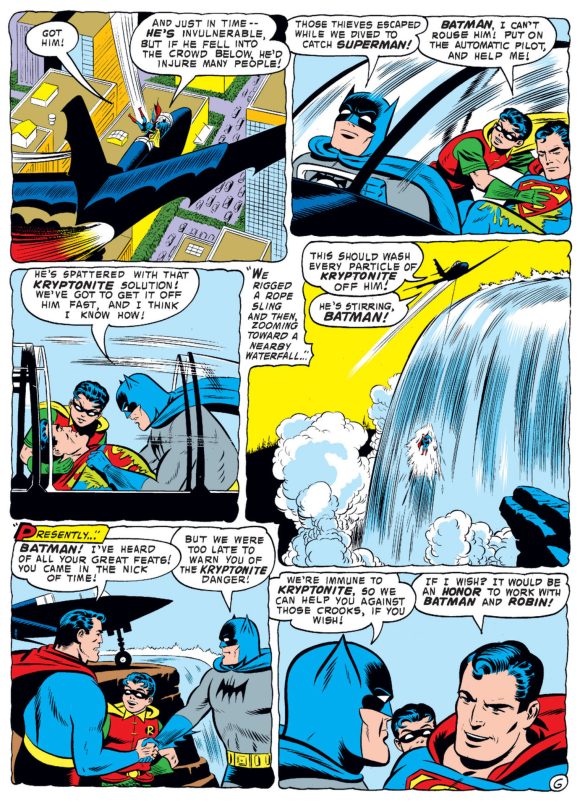
They flash back to the first time they met the Man of Steel, and saved him from Kryptonite poisoning. Of course, in the present, Superman was only trying to protect his friends from Luthor’s latest evil contraption. But this charming tale, written by Edmond Hamilton and inked by Charles Paris, has endured and shown up in just about every “Greatest Stories” compilation you can imagine, for both Batman AND Superman!
—
5. The Definitive Golden Age Joker. Sprang may have had no hand in the Joker’s creation, but he crafted the popular image of the character from Batman’s early heyday. Sprang’s Joker was a grinning gargoyle who only barely looked human. His shifty eyes conveyed a mind that always seemed to be one step ahead of the heroes, until story’s end, at least. Sprang slightly modified the original tailed tuxedo look to a more timely zoot suit, and broadened the Clown Prince’s shoulders, making him look like a physical match for the Caped Crusader.
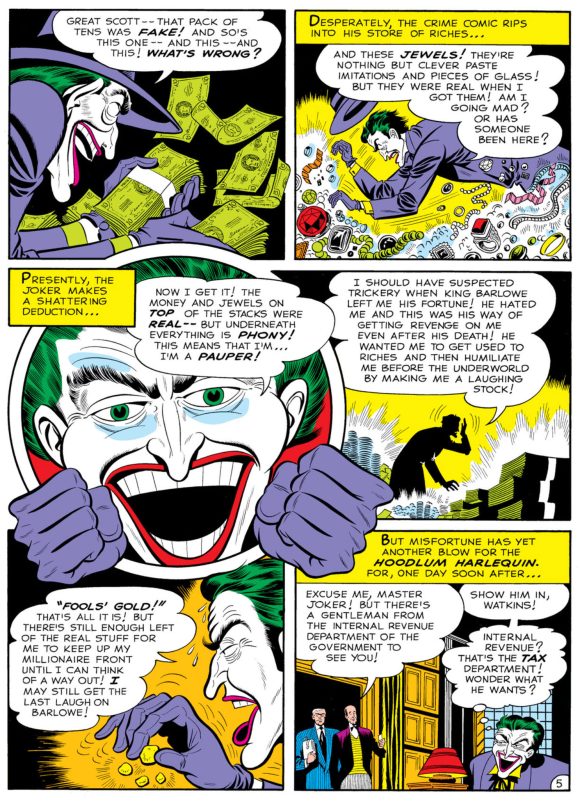
From Detective Comics #180 (Feb. 1952), script by David V. Reed, inks by Charles Paris
Sprang’s Joker was widely utilized on merchandise released during the ’60s Batmania, and would continue to resonate, appearing in The New Batman Adventures episode “Legends of the Dark Knight” (along with Sprang versions of Batman and Robin) and become the basis for the character design of the Harlequin of Hate on Batman: The Brave and the Bold. Mezco Toyz also based their recent Golden Age Joker figure primarily on Sprang’s interpretation.
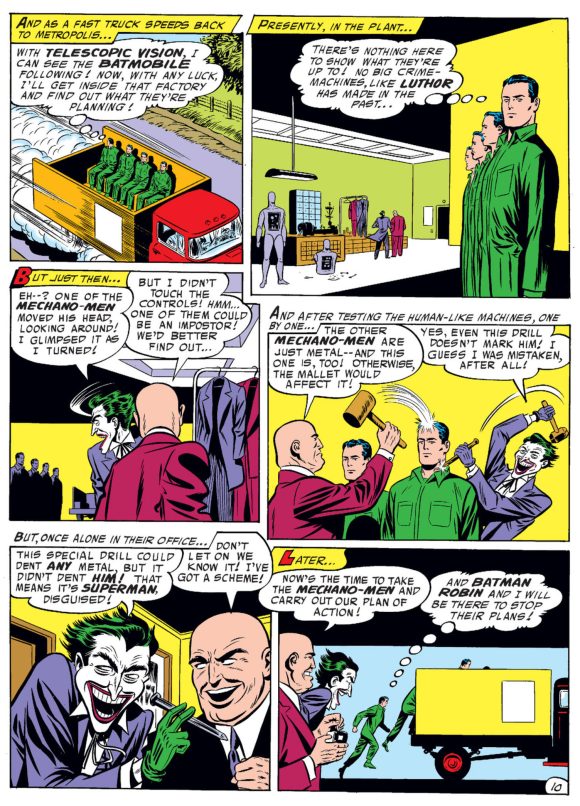
From World’s Finest #88 (May/June 1957), script by Edmond Hamilton, inks by Stan Kaye
—
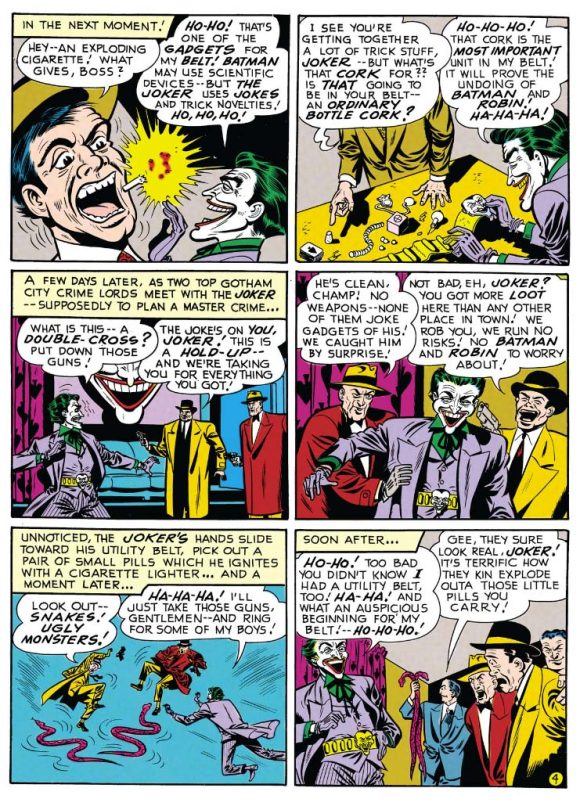
4. The Joker’s Utility Belt. No doubt the most famous Joker story Sprang illustrated, “The Joker’s Utility Belt” from Batman #73 (Oct/Nov 1952) has proved to be an undeniable classic. David V. Reed’s tale of the Joker devising his own arsenal to compete with Batman’s was given a serious boost by Sprang’s inspired pencils. But this was no more evident than the matching cover and splash page by Sprang and inker Charles Paris, showing the Dynamic Duo encircled in the Clown Prince of Crime’s new fashion accessory, while grotesque copies of the grinning ghoul spring upon them.
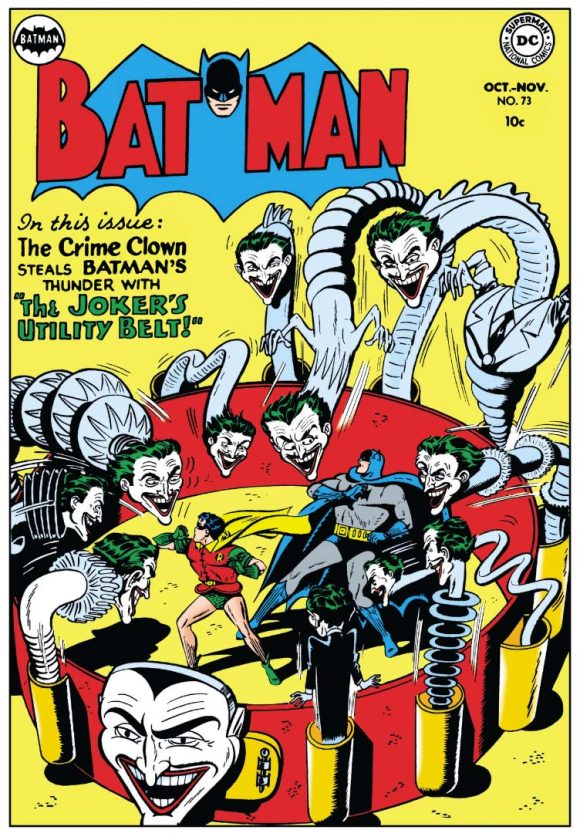
The story was adapted into the first of the Joker’s appearances on the 1966 Batman television series, and the utility belt itself has become a popular accessory for Joker figures aimed directly at collectors.
—
3. The Greatest Batmobile Cover. Sprang’s cover to Batman #20 (Dec./Jan. 1943) shows the high-powered custom sedan literally bursting through the paper, it’s bat-head front working like a battering ram. The windshield is riddled with bullet holes as a steely-eyed Robin mans the wheel, and Batman leans out the passenger window, no doubt prepared to leap on the villainous vehicle that fired upon them.
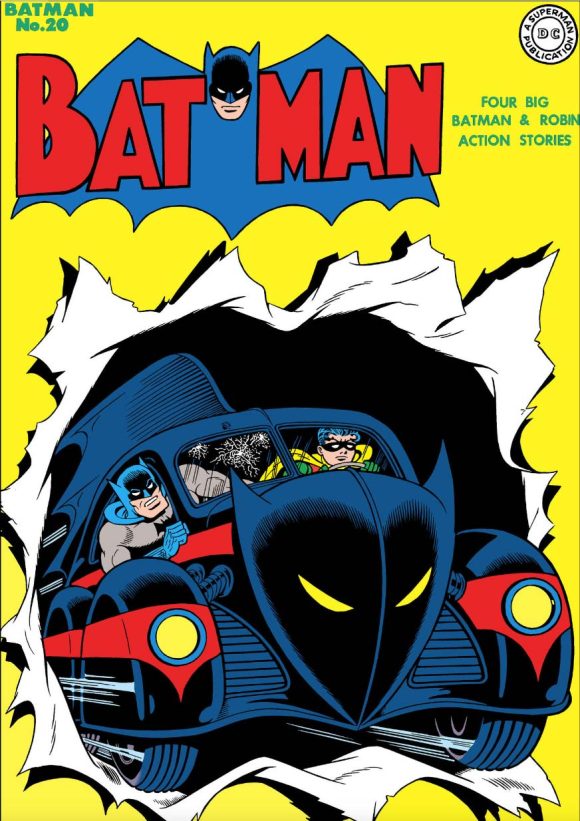
This image tells a complete story unto itself and has become one of the most iconic of the Golden Age. In the 80-plus years since, no cover featuring fiction’s most famous automobile has ever surpassed it.
—
2. The Batmobile of 1950. Sprang not only drew the best Batmobile cover, he also designed the greatest comic book Batmobile (in this author’s opinion). The cover of Detective Comics #156 (Feb. 1950) depicts the Dynamic Duo working on a new ride, with the large blueprints posted on the wall behind them.

Sprang took the off-the-rack sedan of old and discarded it for a futuristic machine full of crime-fighting equipment. From the knife-edge nose on its bat-head front, to the rocket tubes in the back — which would prove to be a mainstay for all Batmobiles to come — this was a vehicular extension of the hero himself. Sleek, formidable and loaded with gadgets and crimefighting equipment, it set the standard for all of Batman’s vehicles to follow, in print and other media. And it remains a favorite for modern artists to call back to.
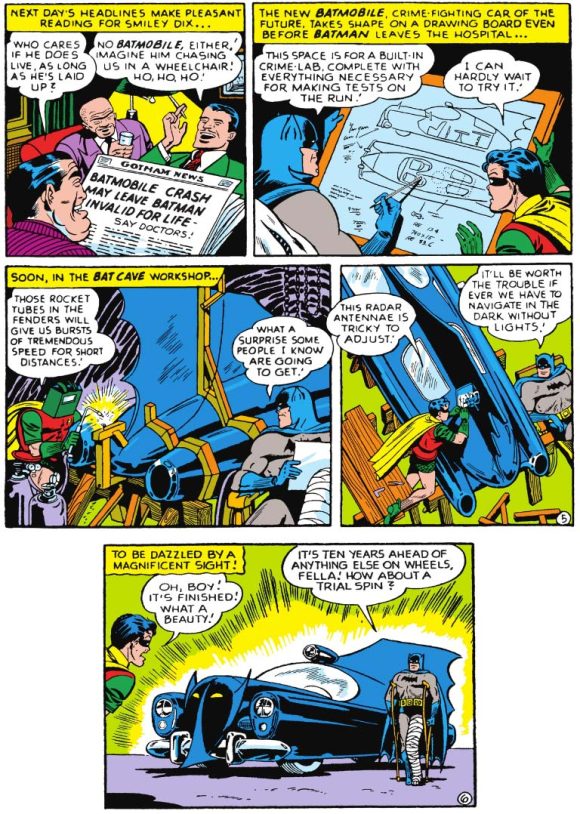
Select panels from Detective Comics #156, script by Joe Samachson, inks by Charles Paris
—
1. The Riddler. No doubt Sprang’s most significant villainous contribution to the mythos was the co-creation and introduction of Edward Nigma himself, the Riddler. Batman co-creator Bill Finger provided the story and Paris the inks for the Prince of Puzzlers’ debut in Detective Comics #140 (Oct. 1948), and the question-mark-festooned felon was the last great Golden Age foe added to Batman’s Rogues Gallery.
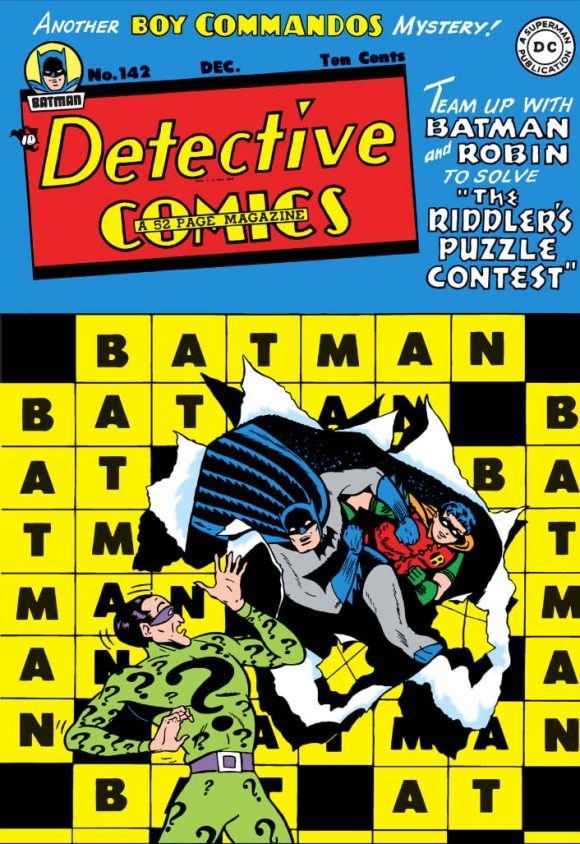
Sprang also drew his second appearance two issues later (including the cover this time), and it turned out to be the Riddler’s last for nearly two decades. Luckily, editor Julius Schwartz and writer Gardner Fox revived the character in 1965. This led to him being selected as the first villain Batman and Robin faced on the 1966 live-action television series. That distinction and Frank Gorshin’s manic performance ensured the Riddler was to become one of Batman’s most famous foes, known by millions worldwide.

—
MORE
— THE CATWOMAN’s MEOW: DICK SPRANG’s Sultry SELINA KYLE. Click here.
— BATMAN #234: What if DICK SPRANG Was Still Drawing the Caped Crusader in 1971? Click here.
—
13th Dimension contributor Chris Franklin is a graphic designer, illustrator, writer, and podcaster, who co-hosts and produces several shows on the Fire and Water Podcast Network, including JLUCast. Check out his illustrative and design work at chrisfranklincreative.com.

July 28, 2025
Wow! Saw some of these in reprints! And I would have loved the print of the Batcave. Sprang was fantastic!
July 28, 2025
Many of these would make great candidates for facsimile editions. As for the Batcave, it’s available as a high gloss print. I found a reasonably priced one off eBay.
July 28, 2025
Sprang, Finger and Schiff: the definitive Batman team!
July 28, 2025
I love Dick Sprang’s artwork. This is probably not a popular thing to say, but I actually spend more time revisiting Sprang’s art than I do Kirby’s art. I have a bunch of Sprang’s work in the Batman and World’s Finest Silver Age Omnibuses, but I wish DC would put a dedicated oversized collection of his greatest hits. He really deserves to be seen as being in the same league as Carl Barks.
July 28, 2025
Dick Sprang is a top three Batman artist for me… along with Neal Adams and Detective 471–479 Marshall Rogers
July 28, 2025
Daniel brings up an intriguing point regarding Jack Kirby and Dick Sprang. Totally different styles, but both can be appreciated for their signature styles. Kirby = grandeur. Sprang = wonder.
Great collection here.
July 29, 2025
I’ve always wondered what the significance of the term “Zur En Arrh”. Was is a spin on “Zero N R”, and what is the meaning of that? It always bugged me that it sounded like a code for something else.