
An ANNIVERSARY SALUTE to an essential series…
By PETER BOSCH
Showcase #1 appeared on the newsstands 70 years ago, though historians differ on the release date — either January 3 or January 5, 1956. The title itself was a perfect description of DC’s publishing philosophy regarding the characters appearing in it… a showcase for them.
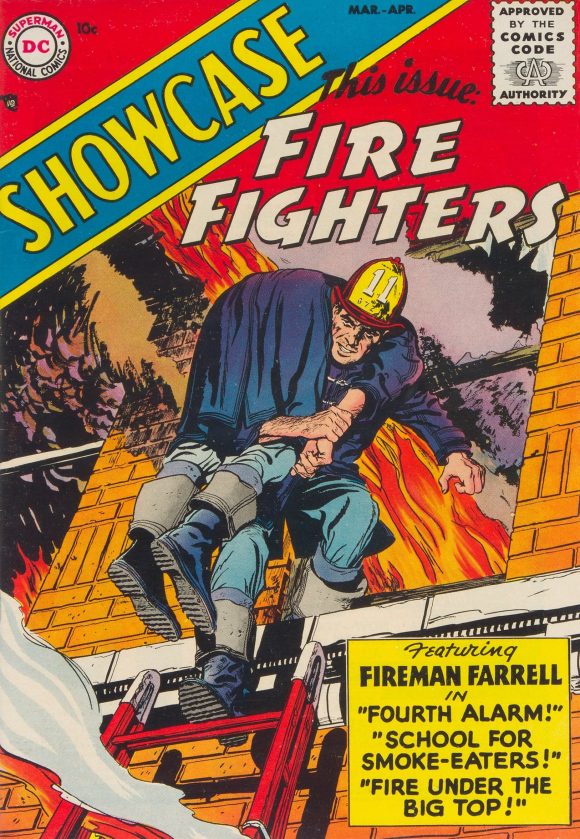
Showcase #1 (Mar.-Apr. 1956, DC). Cover art by John Prentice.
In the 22 years of Showcase’s 104-issue run, some of the most important DC heroes premiered within its pages, including one that transformed the future of comics. In Showcase #4, the Golden Age had come to an end and it was now the start of the Silver Age:
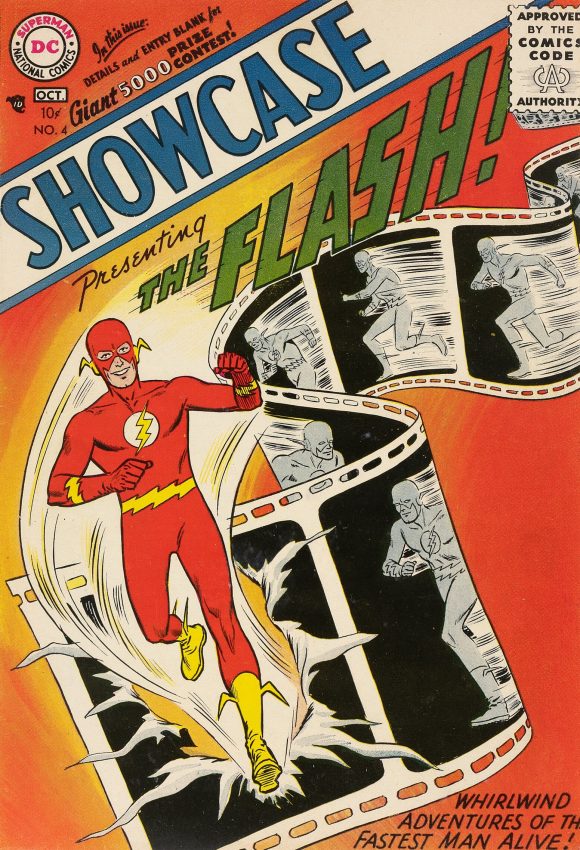
Showcase #4 (Mar.-Apr. 1956). Cover design by Robert Kanigher, with art by Carmine Infantino (pencils) and Joe Kubert (inks).
Future issues contained the debuts of the new Green Lantern, the new Atom, the Challengers of the Unknown, Adam Strange, Metal Men, and many, many more. (I covered 13 of them here. )
Over the history of the title’s run — from 1956 to 1978, including a seven-year gap in the ’70s — some characters were new and exceptional. Some were second stringers who had been around for awhile and DC was testing the waters to see if there was interest in graduating them to their own series. And, yes, there were some dogs along the way.
In honor of the book’s 70th anniversary, here are an additional 13 groovy features that deserved the spotlight given them in Showcase:
—
1. Lois Lane. The most famous female reporter on the planet saw her introduction in Action Comics #1 (June 1938), but it took almost 20 years for DC to give her a tryout for her own title in Showcase #9 (July-Aug. 1957) and #10 (Sept.-Oct. 1957).
And it worked, for just a few months later Superman’s Girl Friend Lois Lane #1 (Mar.-Apr. 1958) hit the comic racks. The title ran through 16 years, with its final issue being #137 (Sept.-Oct. 1974).
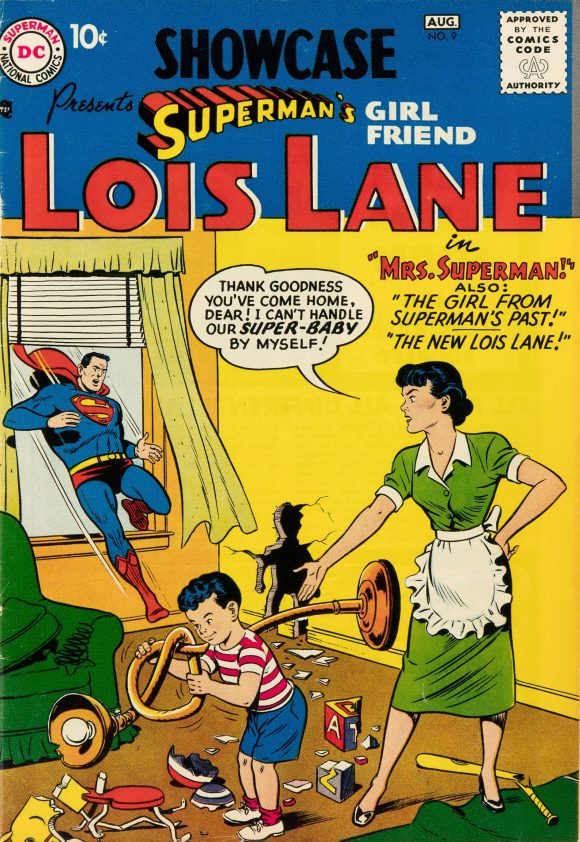
Showcase #9 (July-Aug. 1957). Art by Al Plastino.
—
2. Aquaman. Another character who had to wait years for his own title was Aquaman. He debuted in More Fun Comics #73 (November 1941), and appeared over the years as a backup feature in Adventure Comics from the Golden Age to the early years of the Silver Age.
He was a founding member of the Justice League of America in The Brave and the Bold #28 (Feb.-Mar. 1960), and finally got his shot in Showcase #30 (Mar.-Apr. 1961). DC tested him in the next three issues of Showcase, as well, and then, presto, Aquaman #1 (Jan.-Feb. 1962).
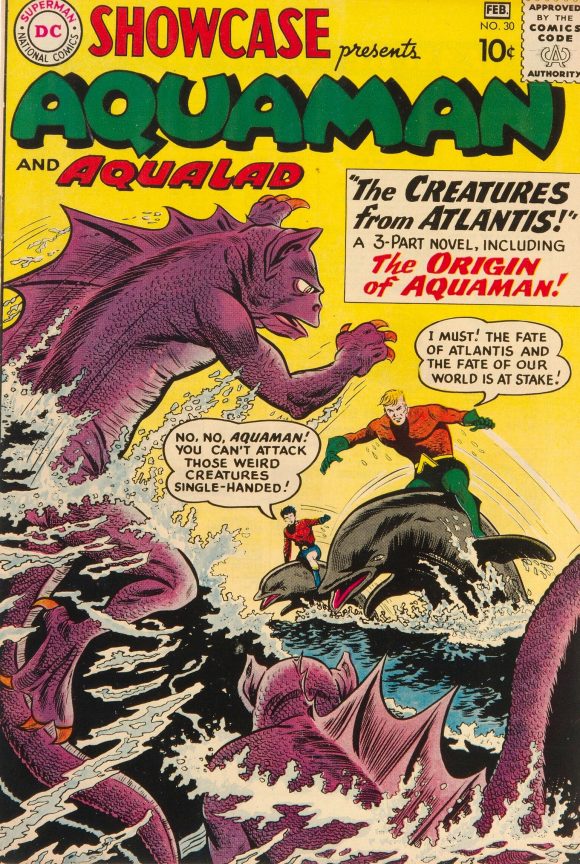
Showcase #30 (Mar.-Apr. 1961). Cover pencils: Dick Dillin. Inks: Sheldon Moldoff.
—
3. Sgt. Rock. The Rock was an unusual choice for Showcase considering he was already the star of Our Army at War, but Showcase #45 (July-Aug. 1963) was an exceptional issue. The story, written by Robert Kanigher and drawn by Joe Kubert, revealed how Rock got his stripes and the one Nazi who haunted him.
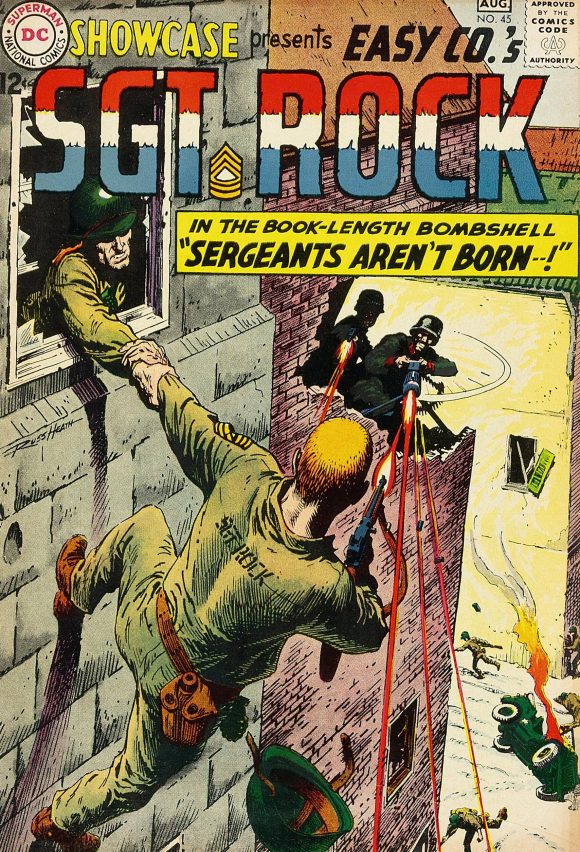
Showcase #45 (July-Aug. 1963). Art by Russ Heath.
—
4. The Justice Society of America. Following the revival of the JSA in The Flash #137 (June 1963), DC teamed up two of its members, Doctor Fate and Hourman, in Showcase #55 (Mar.-Apr. 1965, with a guest appearance by the golden age Green Lantern) and #56 (May-June 1965). The stories for both issues were written by Gardner Fox and drawn by Murphy Anderson.
Fox and Anderson were also teamed for three issues featuring the Spectre in Showcase #60 (Jan.-Feb. 1966), #61 (Mar.-Apr. 1966), and #64 (Sept.-Oct. 1966). (The early- to mid-1960s was a rich time for young readers to get a taste of the Golden Age. A few months after the Showcase issues, Fox and Anderson had Starman and Black Canary together for two issues of The Brave and the Bold.)

Showcase #55 (Mar.-Apr. 1965) and #60 (Jan.-Feb. 1966). Cover art for both by Murphy Anderson.
—
5. Enemy Ace. Two years after Sgt. Rock’s appearance in Showcase #45, DC brought over its newest war comic character, Hans von Hammer — aka Enemy Ace.
Enemy Ace had made its debut as a backup feature in Our Army at War #151 (Feb. 1965) just a few months before. By appearing in Showcase #57 (July-Aug. 1965) and #58 (Sept.-Oct. 1965), it gave the antihero a much better chance to be seen by regular comic book fans who might have shied away from the richness of the war titles. Kanigher and Kubert, the World War I German ace’s original co-creators, were on hand for both issues. While Enemy Ace did not get its own title, it became the lead feature of Star Spangled War Stories beginning with #138 (Apr.-May 1968).
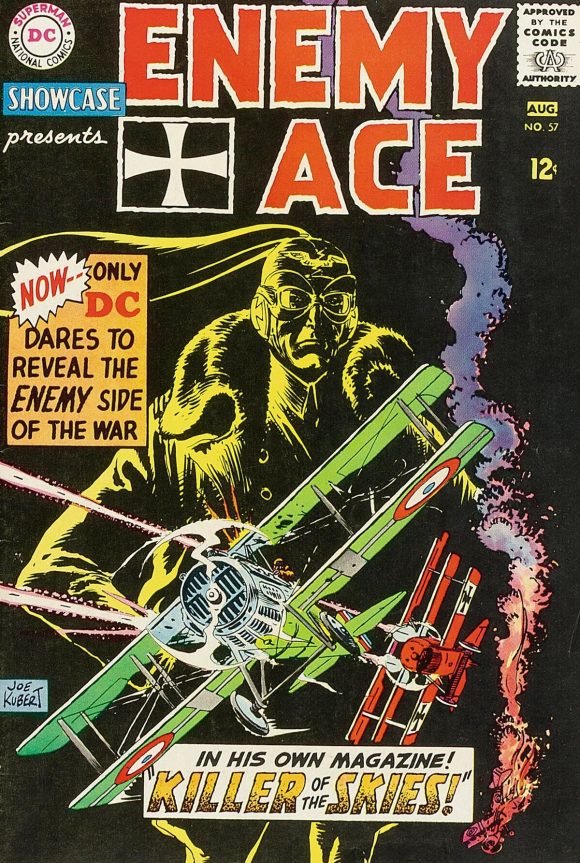
Showcase #57 (July-Aug. 1965). Art by Joe Kubert.
—
6. B’wana Beast. In the same month that the Barbara Gordon Batgirl made her debut in Detective Comics #359 (Jan. 1967), which was a home run, B’wana Beast appeared for the first time in Showcase #66 (Jan-Feb. 1967) and grounded out to first. Co-creators Bob Haney and Mike Sekowsky’s ludicrous jungle hero only made one more standalone appearance, in Showcase #67 (Mar.-Apr. 1967).

Showcase #66 (Jan.-Feb. 1967). Cover art: Mike Sekowsky (pencils) and Joe Giella (inks).
—
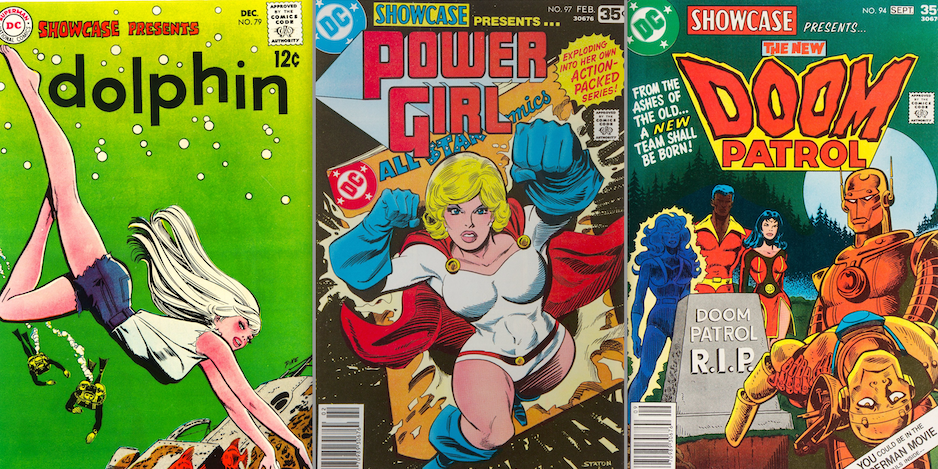
7. Dolphin. A complete change of pace for Showcase #79 (Dec. 1968), with a love story about a mermaid and a sailor. The cover by Dolphin creator/artist Jay Scott Pike shows a great romantic touch and stands alone in the history of Showcase, as does the story. The backup feature had a reprint of Aqualad’s origin from Adventure Comics #269 (Feb. 1960).
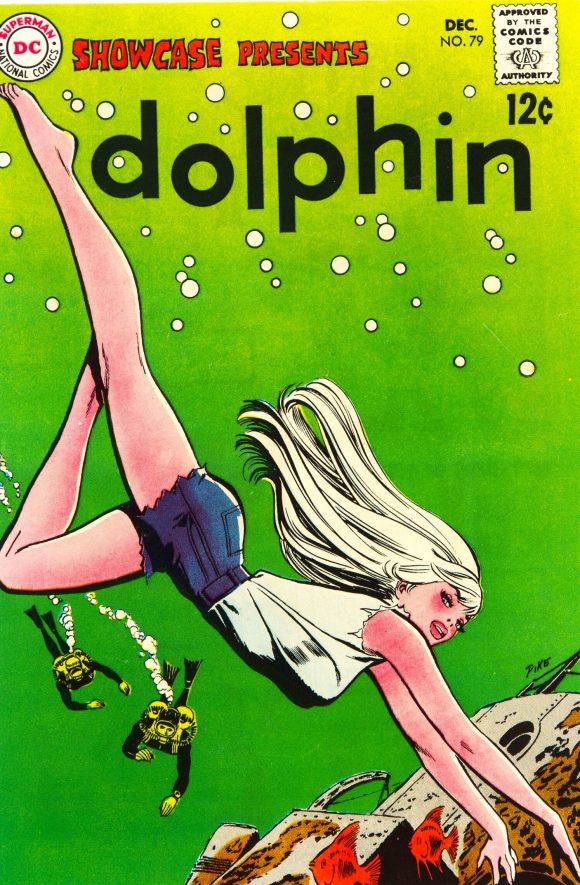
Showcase #79 (Dec. 1968). Art by Jay Scott Pike.
—
8. Nightmaster. Showcase #82 (May 1969) introduced a new hero, Nightmaster, in a sword-and-sorcery tale that could best be described as a sort of “Doctor Strange gets high at DC” story. Written by Dennis O’Neil, the inside art for the first issue was pure psychedelic-type illustration by Jerry Grandenetti (inked by Dick Giordano).
The character continued for two more issues, Showcase #s 83 (June 1969) and 84 (Aug. 1969), but with much more steady fantasy art by a young Berni Wrightson.

Showcase #82 (May 1969). Cover art by Joe Kubert.
—
9. Firehair. Following the nightmares of Nightmaster’s world, Showcase settled back into the Old West, with three issues of a new character called Firehair, a young white man raised as an Indian, but never fully accepted by either the white population or the Indians.
The creation of Firehair was the work of Carmine Infantino and Joe Kubert, with all three issues (Showcase #85, Sept. 1969, to #87, Dec. 1960) written and drawn (magnificently) by Kubert.

Showcase #85 (Sept. 1969), the first of three issues featuring Firehair. Cover by Kubert.
—
10. Jason’s Quest. Jason, a young American, discovers his real father was someone other than the man who raised him and that he was murdered by a criminal gang after an invention he created. He also discovers he has a twin sister living in London, whom the gang is also after to use as a means of obtaining the invention.
For three issues, from Showcase #88 (Feb. 1970) to #90 (May 1970), Jason hops on a motorcycle and searches England and France for his sister, with the gang always in deadly pursuit. Mike Sekowsky was the creator, writer, and penciller of the short series. It was an attempt to appeal to a new generation of readers but it wasn’t a very good plotline, with little depth to the characters.
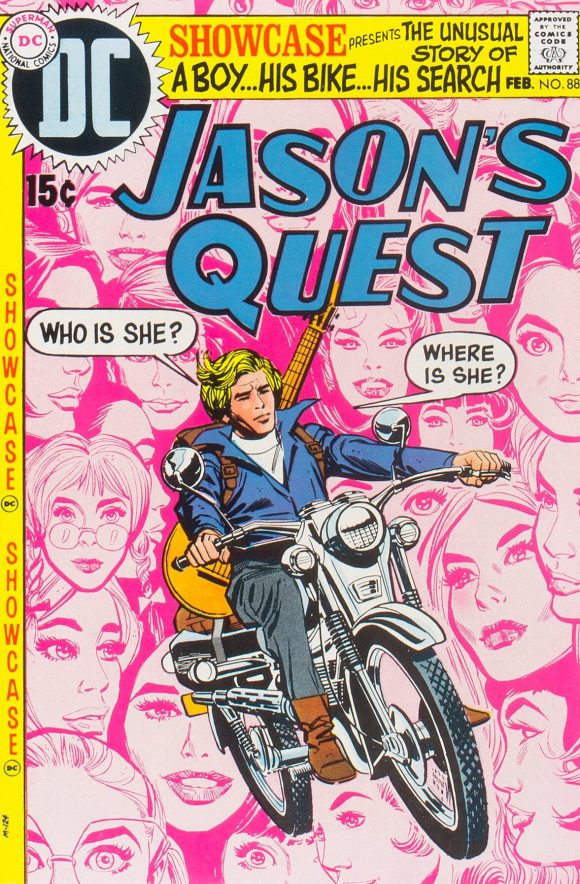
Showcase #88 (Feb. 1970). Art by Mike Sekowsky (pencils) and Dick Giordano (inks).
—
11. The New Doom Patrol. The original members of the Doom Patrol met their end in The Doom Patrol #121 (Sept.-Oct. 1968)… or so everyone thought. Showcase #94 (Aug.-Sept, 1977) revealed that one survived, Robotman (aka Cliff Steele), whose human brain resided safely within his metal body. By sheer coincidence, the surviving parts of Robotman’s form just happened to wash up on shore in front of Doc Magnus, creator of the Metal Men.
Newly fixed up, Robotman returned to the team’s former headquarters to find a new Doom Patrol there! But where any Doom Patrol happens to be, you can bet that General Zahl, the man responsible for his friends’ death, will soon appear. The author of the revival was our pal Paul Kupperberg, with art by Joe Staton. (Issue #94 marked the series’ return from its lengthy hiatus.)

Showcase #94 (Aug.-Sept. 1977). Cover art by Jim Aparo.
—
12. Power Girl. Expanding from the various JSA comics, Power Girl appeared in Showcase #97 (Feb. 1978) to #99 (Apr. 1978). It didn’t lead to a regular comic book title immediately, but she did get a 4-issue limited series in the ’80s — also by Paul Kupperberg. Power Girl finally received her own title in 2009.

Showcase #97 (Feb. 1978). Art by Joe Staton (pencils) and Joe Orlando (inks).
—
13. O.S.S. The final issue of Showcase (#104, Sept. 1978) was based on the war series that first appeared as a backup feature in G.I. Combat #192 (July 1976), co-created by Murray Boltinoff and Robert Kanigher.
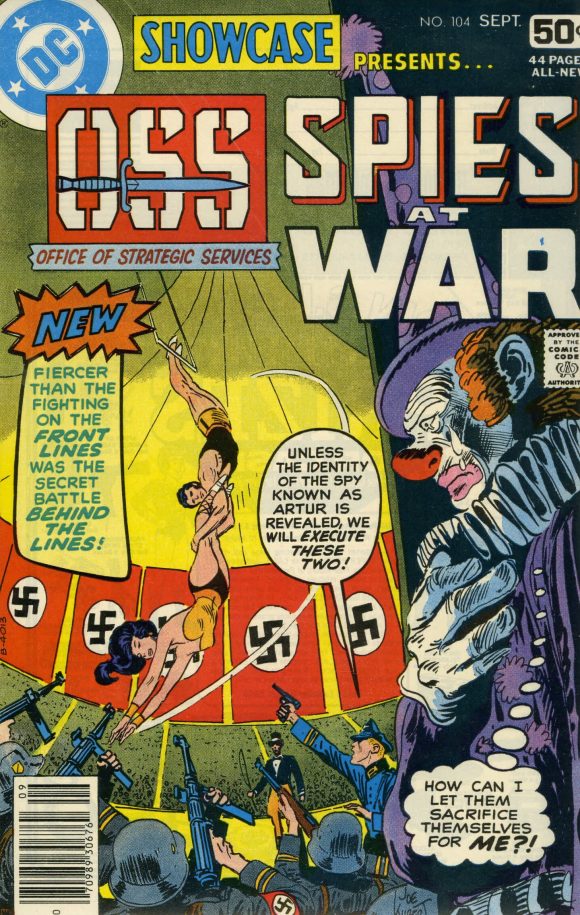
Showcase #104 (Sept. 1978). Art by Kubert.
—
As a side note, a few issues during the Showcase run consisted of reprints, but were often bookended by a few new pages. Among these were Showcase #50 and #51 (the “I – – Spy!” issues with King Faraday reprints); #s 53 and 54 (under the title heading of “G.I. Joe,” DC reprinted several stories from their war comics); #70 (“Leave It to Binky”); #72 (“Top Gun” with Old West tales from All-American Western and All Star Western); and #81 (“Windy and Willy,” which were actually art-retouched reprints of “Dobie Gillis” stories).
The best of the lot, though, was Showcase #80 (Feb. 1969) with a Neal Adams cover highlighting the return of the Phantom Stranger and Doctor Thirteen, with a few new story pages framing reprints of the their tales from the Fifties.
DC had never intended for Showcase #104 to be the last issue of the series. As a matter of fact, they had the schedule planned through Issue #116. The last panel of the “O.S.S.” story in Showcase #104 announced, “Next issue: starring Deadman on sale 3rd week in July!” The rest of the schedule would have featured the Creeper; Paul Kupperberg’s World of Krypton — which ended up becoming comics’ first miniseries; the Huntress; a new character called “The Deserter”; and a new version of the Suicide Squad. However, what suddenly and unexpectedly happened was… the DC Implosion. To read more about that, click here.
—
MORE
— 13 GREAT COMICS SERIES Launched by DC’s SHOWCASE. Click here.
— PAUL KUPPERBERG: My 13 Favorite Things About SHOWCASE #4. Click here.
—
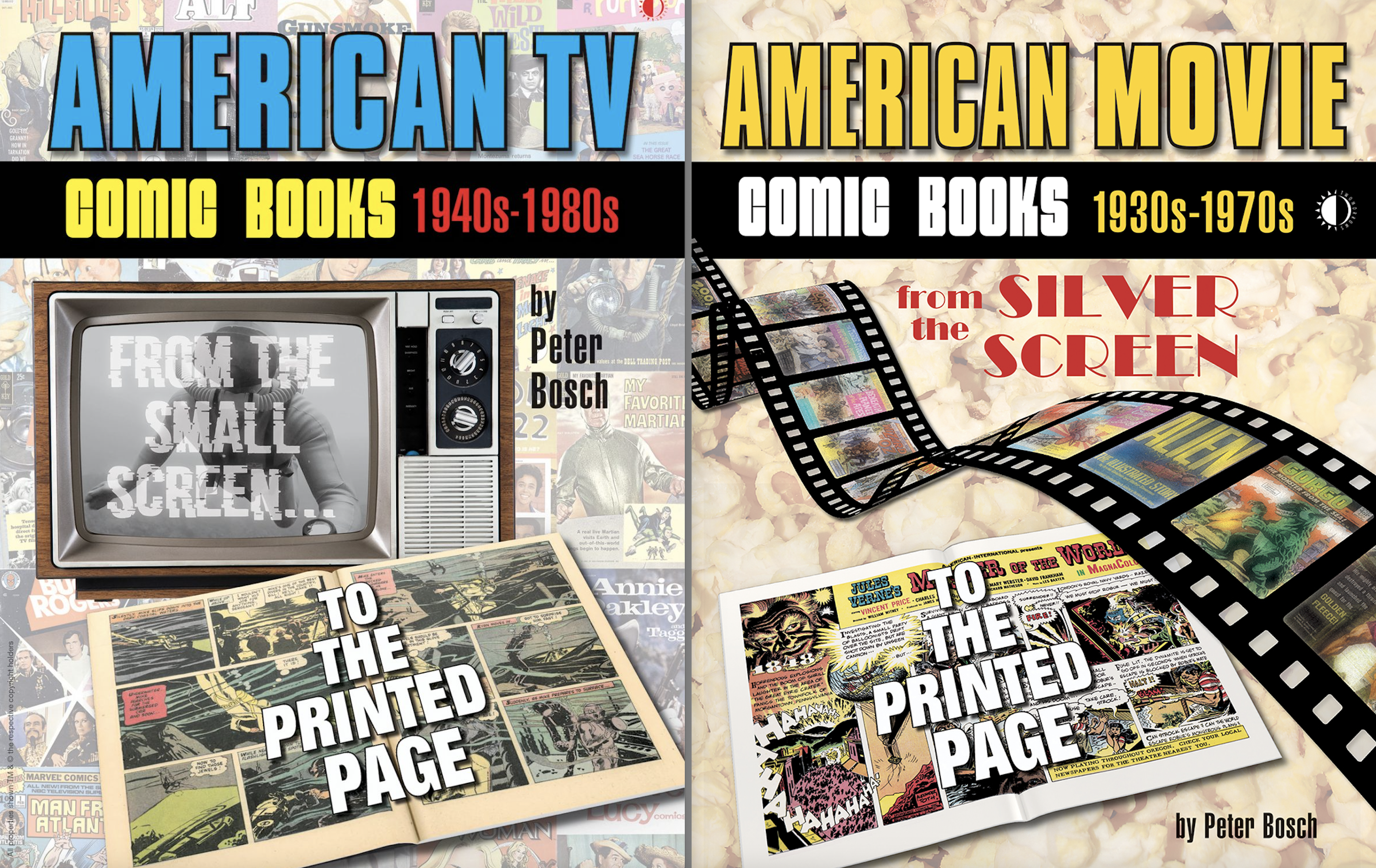
13th Dimension contributor-at-large PETER BOSCH’s first book, American TV Comic Books: 1940s-1980s – From the Small Screen to the Printed Page, was published by TwoMorrows. (You can buy it here.) A sequel, American Movie Comic Books: 1930s-1970s — From the Silver Screen to the Printed Page, is out now. (Buy it here.) Peter has written articles and conducted celebrity interviews for various magazines and newspapers. He lives in Hollywood.

January 3, 2026
Interesting how Nightmaster preceded Conan’s Marvel debut by about a year. It would appear that both Marvel and DC sensed that now was the time for Sword and Sorcery comic books. I think I read once that Tolkien had become quite popular with college students in the late 60s, so maybe that was part of the inspiration?
January 3, 2026
Actually, the two starman & black canary issues ran after the two doctor fate & hourman issues; and madame rogue caused the death of the doom patrol.
January 3, 2026
You are correct about the B&B issues and partially right about Zahl. However, Madame Rouge did not want them killed (see DP #121, page 22, panels 5 and 6).
January 3, 2026
I have always been curious as to how the Earth 2 character issues of Showcase fared in regard to sales? Were they successful or not? Why out of all the Showcased JSA characters why was the Spectre chosen for an ongoing title? Considering how soon the Spectre book was cancelled I have always considered the awarding of his own book a mistake. Also was there a third team-up planned? I thought I read somewhere where a team up of Dr. Mid-Nite and another character was considered for either Showcase or the Brave and the Bold. I’m interested if anyone has input to these questions that have baffled me for more decades than I want to number.
January 3, 2026
Poor B’wana Beast, thrilled to find he’s in an article titled ‘13 Groovy Features That Deserved the Series’ Spotlight’ and then sees himself described as ‘ludicrous jungle hero’.
Anyroadup, fun piece Dan. Was The Deserter a war character?
January 3, 2026
“The Deserter” was about a soldier who deserted the Union Army during the Civil War.
January 3, 2026
Thanks Peter, I’ll have to have a look around for more info, I like to hear about obscure stuff.
January 3, 2026
That Showcase cover with Dolphin is great. The feeling of being under water – it’s almost as if the words are in the process of floating up to the surface.
January 4, 2026
>> The cover by Dolphin creator/artist Jay Scott Pike
>>
Checkout issue #41 of TwoMorrows’ Comic Book Creator DEC 2025. It has an article about Jay and Dolphin.
January 3, 2026
I remember seeing the “house” ad for The Doom Patrol… however, this was pre-Comic Book Store… I couldn’t find the issue…
January 3, 2026
The first I heard of Showcase, being ~10 years old, was the new Doom Patrol (never heard of Doom Patrol before). I bought those three issues when they came out and loved them. Kind of cool to find that one of the contributors to this site wrote the stories! Sadly, those issues are long gone from my collection. I probably sold them to a used bookstore for arcade money.
Funny thing. X-Men has been said to have copied the premise of Doom Patrol. And here, I’m sure by coincidence, is the new Doom Patrol debuting in #94 of Showcase 😀 .
January 4, 2026
>>… or so everyone thought.
>>
DC was wrong. I didn’t know even though I was aware of the team. I must have seen a reprint story somewhere (but can’t recall now). I was furious they were killed off and replaced. In my comic world heroes didn’t lose. For some reason, I’ve had a soft spot for these characters and have enjoyed the more traditional approaches taken with them (e.g. Byrne) through the years.
January 4, 2026
About a 7 year gap between #93 and #94. I was just getting into this title buying the Doom Patrol’s and Hawkman issues, and even picked up that OSS and liked it. Then “poof” gone.
Hooray for Aquaman!
Has any character with a continuous monthly story gone as long as Aquaman without appearing on a cover? From 1941 to December of 1959 when he finally appeared on that famous Brave & the Bold first Justice League story. I mean, not even a headshot! “No respect I tell ya”
January 5, 2026
In a nifty little irony, B’wana Beast features in, and narrates, an excellent and surprisingly moving episode of the animated “Brave And the Bold” TV show.
January 5, 2026
They would all make fantastic facsimiles!