From Books to Movies to Comics to TV, It’s RIMA THE JUNGLE GIRL
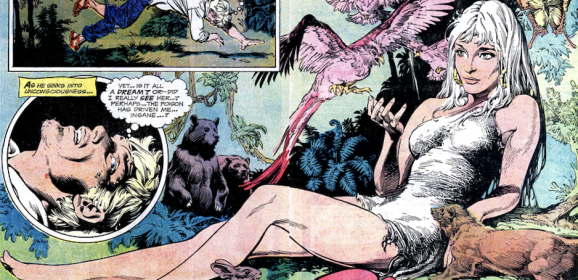
REEL RETRO CINEMA: New looks at old flicks — and their comics connections… By ROB KELLY As a child of the ’70s (Whip Inflation Now!), my relationship to Rima, The Jungle Girl was informed solely by the fact that she had her own DC Comics series and later showed up on various iterations of Super Friends. That told me that she was an official Big Deal, a member of the DC stable on par with the likes of Aquaman, Green Arrow, Hawkgirl, etc. And while all that might not exactly be true, her history in many ways is even more grand and impressive. Rima was one of the many characters DC adapted from other media in the 1970s and tried to turn into a comic-book star, like her fellow jungle adventurer Tarzan, the Shadow, the Avenger (in Justice, Inc.) and, for one glorious, treasury-sized month, Dick Tracy. While I kinda sorta knew Tarzan wasn’t a DC character, exactly, I always assumed Rima was their attempt to combine the Lord of the Apes with Wonder Woman. In fact, in one of those, “Wait, Buck Rogers came before Flash Gordon?” kind of things, Rima actually predates Tarzan by a full decade. She made her debut in the 1904 novel Green Mansions, written by W.H. Hudson, while Lord Greystoke didn’t debut until 1912. Hudson was a naturalist who moved from his home country of Argentina to the United Kingdom, where he found success as an author of both fiction and non-fiction. His most famous work concerns Abel, a failed revolutionary who escapes into the jungle to evade capture. There he meets various denizens of the forest, including a young, wraith-like girl who seems to not only survive in the harsh climate, but possesses supernatural powers. Green Mansions as a book is a fine enough read, if you can put aside the numerous Lolita-like mentions of how attractive this small, very young girl is to this much older man. Abel is undoubtedly the main character (Rima actually dies near the end of the book), but I will mention that the paperback version I read (published in 1959), does feature some quite beautiful illustrations by artist Sheilah Beckett. The reason the book was republished in 1959 was as a tie-in to a big-budget movie adaptation, also called Green Mansions. Starring Audrey Hepburn as Rima,...
Read more