
A great read on America’s 250th birthday, too…
By JIM BEARD
I remember the Bicentennial.
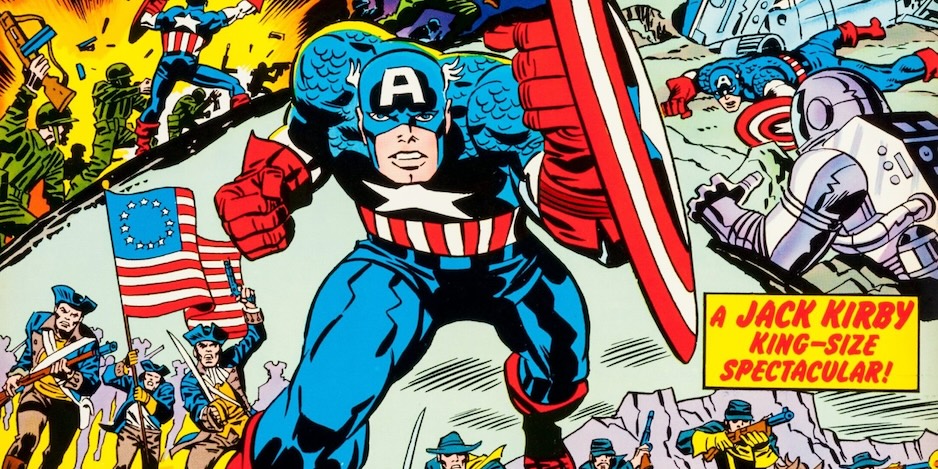
I remember Marvel Treasury Special Featuring Captain America’s Bicentennial Battles.
I remember the big, oversize comic stuck out from the other treasury editions of the day. My Dad was picking up nearly all the treasuries for me back then, but Kirby’s bombastic firework of an offering was an original among the mostly reprints in the big books, so it rose a bit above in my estimation. Sure, there was Superman vs. the Amazing Spider-Man and, later, Superman vs. Muhammed Ali, and Superman vs. Shazam! and all that jazz (why was he always fighting someone?), but Jack’s ode to the Bicentennial seemed to be something… different. Its fame today is notable, and rightfully so.
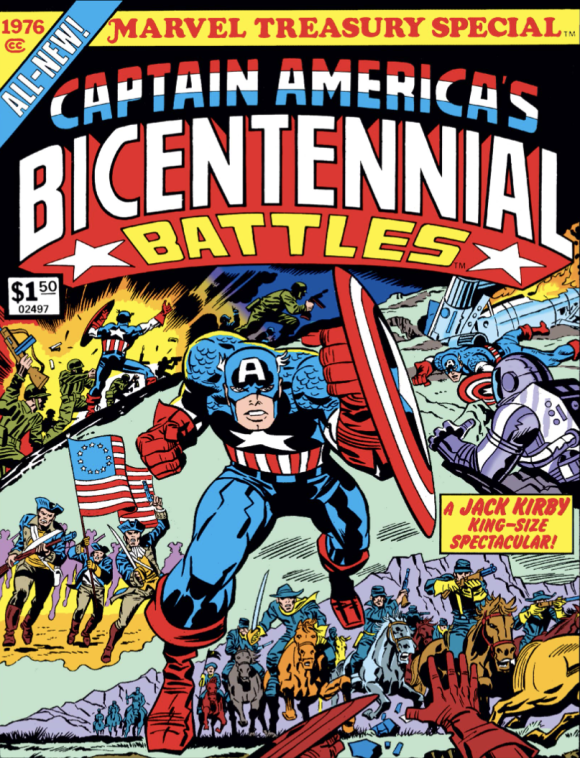
1976’s Captain America’s Bicentennial Battles is a singular work, even in the sea of singular works from the King of Comics. It feels very personal and even quiet at times, a look into something Kirby was passionate about, his country and what it stood for — the book often gives the impression that the Bicentennial couldn’t have come sooner for Jack to be able to say the things he wanted to about the Red, White, and Blue.
And Captain America, his own co-creation, the ol’ Winghead himself, was the perfect character to host the whole whiz-bang of a shebang.
If you’re not familiar with the story, the basics are that Cap is waylaid by a mysterious little guy called Mister Buda who “merely teach[es] people to believe… and in doing so, they understand all time and space.” What that means is that Buda is a sort of life-lessons coach who more or less forces people to learn something they need to learn. In Cap’s case, it takes form in the question of what America is as a concept, and who or what represents it. That’s a bit cerebral for what is ostensibly a kiddie comic book, but this is Jack Kirby, so it’s big and bold and colorful and, like I said, a bit bombastic.
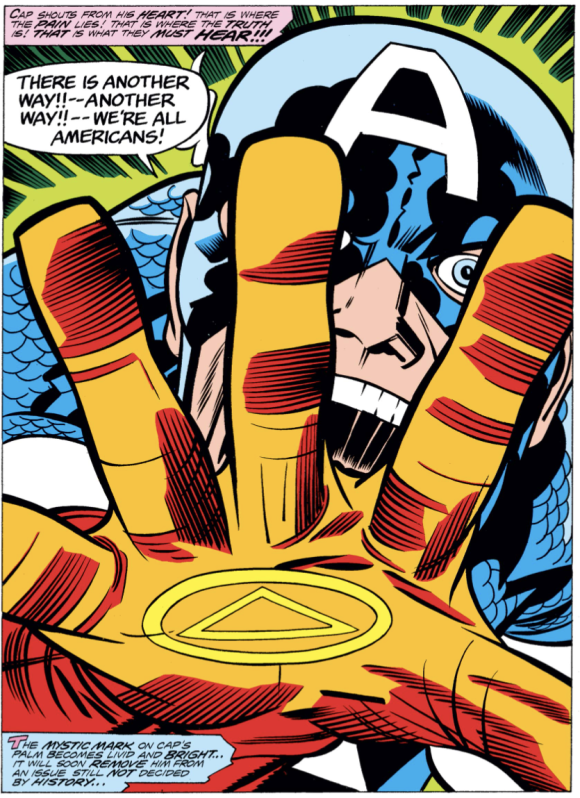
Captain America’s Bicentennial Battles unfolds as a series of vignettes as Steve Rogers is transported by Buda into different eras of United States history and among its diverse denizens. He meets common folk and uncommon, all the while somewhat bewildered by his surroundings, but building toward a revelation at the end. The eras include more recent times to Cap’s then-present, but also World War II, the Civil War, and even the future (my favorite part as a kid). Heck, there’s also a cameo by the writer-artist himself at one point.
This being Kirby, we’re also treated to splash pages that blew my mind as a kid reading this for the first time—and I do mean reading. Jack’s dialogue and captions are wordy, as was his wont, and in all, it’s not a story you can travel through lightly or quickly. There’s a lot to read, to put it mildly. And it’s pure Kirby, if you know what I mean.
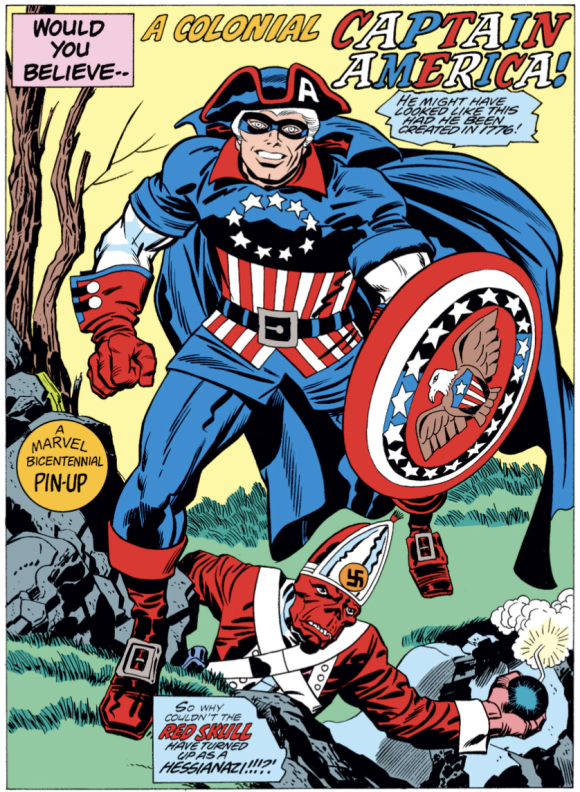
One of the other cool things about Captain America’s Bicentennial Battles is the three inkers scattered throughout the pages: Kirby-clone Herb Trimpe, rock-solid John Romita, and, in a surprise burst of a unique touch, Barry Windsor-Smith. His delineations of Jack’s pencils are almost worth the price of admission alone.
I won’t spoil how the story ends when Cap hits upon the “answer” to the question he didn’t know he was asking (it involves the youth of America), but if you haven’t ever perused this very special book before, I urge you to seek it out for a read on this 250th anniversary of the good ol’ U.S. of A. At the very least, you’ll see the King reveling in his glory, the master of his domain and serious in his passion for the country he fought for.
I remember it, and will never forget it.
—
MORE
— AMERICA AT 250: The STATUE OF LIBERTY in 13 COVERS. Click here.
— 13 COVERS: Hey, Baby, It’s the Fourth of July — With CAPTAIN AMERICA! Click here.

July 4, 2026
I just read it yesterday! I figured it was about time — and the right time. And what a read it was! It’s pure, unrestrained Kirby. I’m not sure if I would have liked it 50 years ago, but I think it was just what I needed today. America was coming out of Watergate and Vietnam back then, but there’s a sense of optimism. Maybe that was just Kirby, but it felt comforting. And the art is incredible. Nobody could do what Kirby did as well as Kirby. The man invented his own visual language. I really like Trimpe’s inks over The King’s work here, but it was fascinating to see BWS (a genius!) embellishments. I believe Romita only did the pin ups in the back. Turning the clock back 50 years felt like the right way to go into the semisesquicentennial.
July 4, 2026
I remember reading this story like it was just yesterday. I was becoming a huge fan of Jack’s storytelling during this period.
July 4, 2026
I thought it was boring compared to the captain America and falcon comic
July 4, 2026
OK.
July 4, 2026
This comic holds a special place for me because I had purchased it on the actual day of the Bicentennial – July 4, 1976 – when I was 12. Today I pulled out my copy which I still have to re-read it since two events that I had planned on attending this afternoon for America’s 250th were cancelled because of the excessive heat that my area was having. I think this is the first time that I’ve read it again from cover to cover since the day I bought it 50 years ago. It’s just as I remembered it.
July 4, 2026
My third grade teacher had this in her classroom–it belonged to her son. I first read it in the early 2000s, thanks to her.