
Perhaps not exactly “buried,” but a treasure nonetheless…
By PETER STONE
You could probably build a house with the number of pages Jack Kirby drew. The neighbor’s house could be built with John Buscema’s work. Neal Adams’ comics and advertising output could fill Yankee Stadium. However, there are some artists who didn’t draw as many pages, but were still tremendously influential. Paul Smith is one of those artists.
We all know Smith’s excellent 1980s Uncanny X-Men run, following Dave Cockrum and just before John Romita Jr. “Professor X is a jerk!” from Issue #168 remains one of the greatest splash pages in the history of the team. His Doctor Strange issues from the same era were remarkable, and he had other stops here and there, mostly for Marvel.
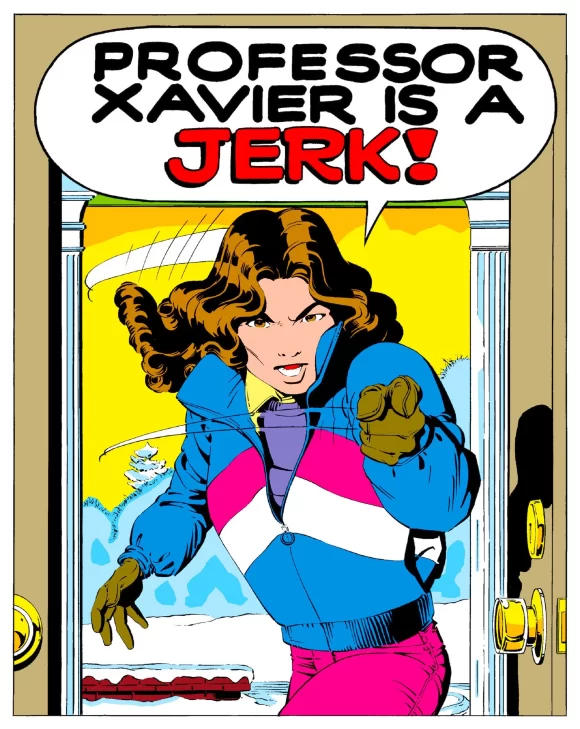
Bob Wiacek inks
A number of those other stories are worth pointing out — especially The Golden Age, the ’90s Elseworlds miniseries for DC, written by James Robinson. Smith pencilled and inked the entire project, which ran from 1993 to 1994: four issues, each one 48 pages, featuring a post-World War II Justice Society of America beset by a lurking conspiracy. (They’re the same team that created my beloved Leave It to Chance.)
Smith’s art is clean, clear, and heavily influenced by his history of working with Ralph Bakshi on The Lord of the Rings animated movie. It’s wonderfully readable.
The Golden Age was published about seven years after Moore and Gibbons’ groundbreaking Watchmen and roughly 11 years before the revolutionary DC: The New Frontier by Darwyn Cooke, and plays with many of the same motifs. The concept of the Justice Society (and its descendant, the Justice League) is terribly attractive. Each hero is distinct: Green Lantern, the Atom, Manhunter, Johnny Quick, Hawkman, and so many more. They weren’t the irradiated heroes of early Marvel, mutants, or New Gods.
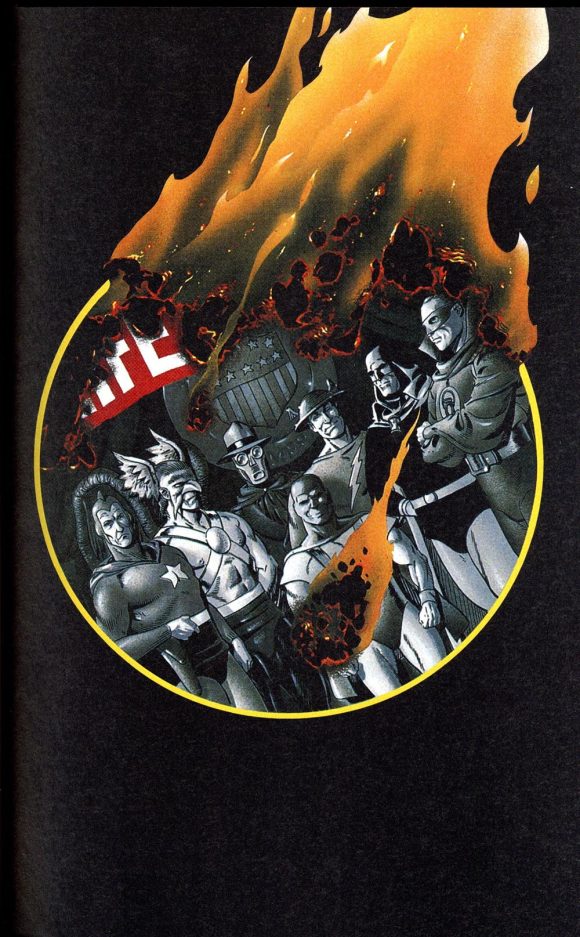
They take a pill, use a ring, are given a magic device (or being), speak a mathematical formula, or are even doused by chemicals. That diversity of ideas made the fights against villains specific. Robinson threw himself into the mythology of early superhero comics, and it’s glorious.
Did I say glorious? Yes, but also dark, reflecting the ups and downs of “real life.” Characters have gotten married and divorced and then married again. Others have turned into successful businessmen. One admits to being a terrible addict, and others have gone insane. Biotechnology plays a terrible role in this story. James Robinson delves into the non-fictional history of the United States, using German rocket scientists to help us get to the moon. What else could those German scientists have been working on?
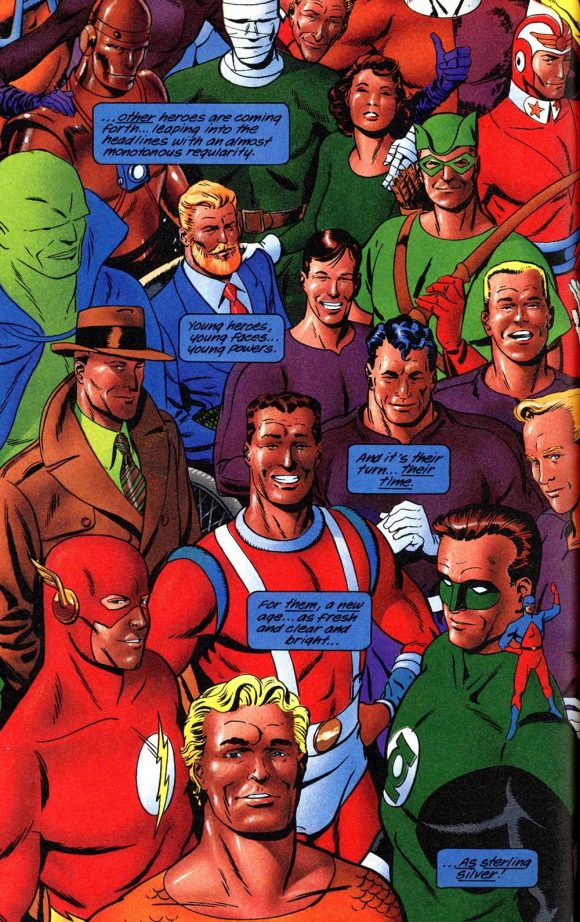
Smith more than meets the challenge of a compelling story that’s both personal and sociopolitical in scope: His women are beautiful and his men are handsome in that 1950s style. His storytelling is so smooth that each page is interesting. When the gruesome battles happen, he structures the images so that we don’t see the graphic violence of today. Sure, there is blood but it is almost always a spray from off panel.
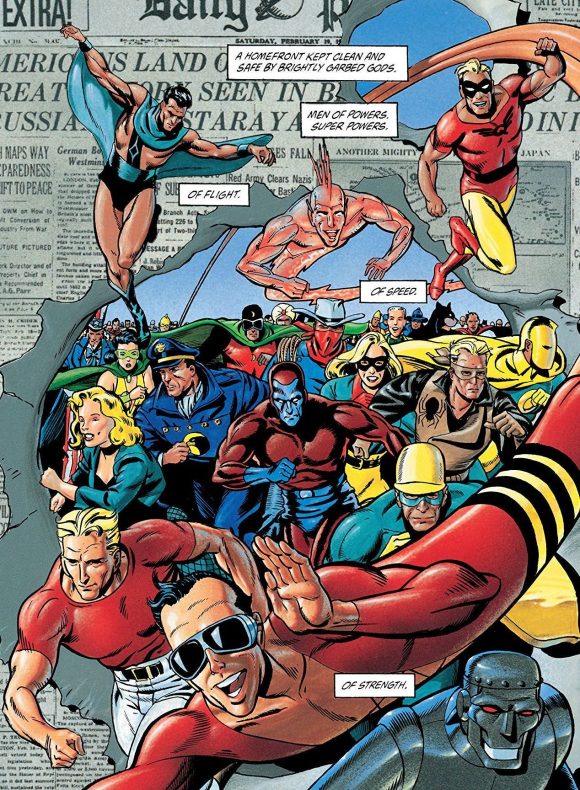
The draftsmanship straddles the border between the realism of a Neal Adams and the minimalism of an Alex Toth. It’s intelligent.
Smith drew less than a year of Uncanny X-Men, but his run turned out to be legendary. So, to get four issues of the Justice Society was a little bit of heaven, some of the best comics ever.
—
MORE
— BURIED TREASURE: James Robinson and Paul Smith’s LEAVE IT TO CHANCE. Click here.
— BURIED TREASURE: Gerry Conway and Jose Luis Garcia-Lopez’s CINDER AND ASHE. Click here.
—
Peter Stone is a writer and son-in-law of the late Neal Adams. Be sure to check out the family’s online Facebook auctions, as well as the NealAdamsStore.com.

October 7, 2025
>> but also dark, reflecting the ups and downs of “real life.”
>>
I loved those issues. Anything JSA and I’m (mostly) there. But just once I’d like a modern master of the time (whenever that is) to give us skillfully produced art/story in all their Golden Age glory but without the dark of “real life”. For me personally, I simply don’t want to read dark in my escapism of the superhero world. I get enough “real” in the real world. At the end of the day none of it is real so I’m okay with stories that don’t show my heroes with issues (Spider-Man aside). I’m not saying there can’t be dark stories but can we also have stories where BATMAN smiles too? Maybe different earths? Hmmmm….theres an idea to ponder.
Another good look back, Peter. Thanks!
October 7, 2025
I just read this book for the first time about a year or two ago. I mostly really liked it…until the ending. I’m not going to spoil anything, but the big revelation in the last chapter literally made me roll my eyes. It doesn’t destroy all that came before, but it does keep it from being a top-tier book.
Peter Stone mentioned DC: The New Frontier, and in a lot of ways the two books are very comparable (although DC: TNF (my favorite comic of all time) is far, far better). The main difference is that DC: TNF is about beginnings, whereas The Golden Age is about endings.
The only other caveat about this book is that the coloring is very, very dense, so when it’s printed, it can come across a kind of muddy, particularly night scenes.
All that said, the book is worth reading. This book and Sandman Mystery Theatre were probably the last wave of 1980s post-Crisis reboots/re-imaginings.
October 7, 2025
Thanks for this thoughtful article about one of my favourite mini-Series. I bought the original single issues when they came out more than 30 years ago. I read them, loved them, did not notice anything wrong with any issue, bagged them and stored them alongside my other Golden Age era books. Then, last year my friend pulled out his copies and asked me to pull out mine. He discovered that his copy of issue 3 had a defect. The thin plastic film that produced the glossiness of the front and back covers had deformed and was all bubble. And lo and behold, my copy had the same defect. At a local comic convention this weekend, I found two other copies that both had the same defect. Has anyone else noticed this on this issue? Are there copies that exist without the bubbles? I have not seen this on any other prestige format issue. Thanks
October 7, 2025
This is one of those series that I can’t believe isn’t held in higher regard, alongside DC’s other seminal “literary” works (Watchmen, TDKR, Kingdom Come, etc.). It’s fantastic. I discovered it in the early 90s when I was still learning what DC’s Golden Age was and fell in love with it immediately.
I would highly recommend people watch the 1946 film “The Best Years of Our Lives” alongside this book. The film is about three men who return home from World War II and have significant trouble re-integrating into normal society. War defined and broke them, and the larger world doesn’t seem to have a place for them anymore. That’s very much what’s happening in this series–the grand conspiracy is great, but the real struggle is over what superheroes do with themselves when their big defining battle is over.
October 7, 2025
I’m with Buck on this one. Nice art examples here, but the story has kept me away from this version of the JSA.
October 7, 2025
I love this series, both art and story. I for one enjoyed the twist, and remember being pretty gobsmacked by it when I first read the trade shortly after it was published. No internet had spoiled it for me.
Parts of it became canon to DC (when that actually meant something), especially in Robinson’s Starman, but I’m glad it’s still considered an Elseworlds. Some of the roads taken by the characters here….brr!!!
October 7, 2025
Let’s not forget the phenomenal painted colors by Richard Ory.
October 7, 2025
I’m very surprised that they didn’t do a “The Silver Age” follow-up. Also, this would’ve been a totally different story had Superman, Batman, and Wonder Woman been included.
October 8, 2025
This story intentionally kept the heavy hitters out of it, probably to keep it a little more grounded. You’ll notice the Spectre is missing and the mystics only get a cameo in the initial splash. The most you get are Alan Scott and the Thunderbolt.
October 9, 2025
This was actually commissioned shortly after the Crisis on Infinite Earths as a send off to the JSA, so it reflected the post-Crisis version and was meant to be canon. However, real life, the project took a while to get to production, and by then, the JSA’s fortunes in the mainstream DCU had taken a turn for the better, and contradicting The Golden Age as a result.
Robinson did have the SA all planned, but he really wanted Howard Chaykin to be the artist, and Chaykin’s schedule was crowded. By the time Chaykin was in a place to work on it, many of the things Robinson wanted to do with the series had been done in other works, and he felt that a Silver Age book wouldn’t add much.
October 7, 2025
This story should be in a future DC Compact Comics edition! I loved reading it the first time and won’t mind reading it again in a smaller format
October 7, 2025
Thanks, Peter. Whenever I happen to be looking through my collection for one reason or another and I happen to come across an issue of this miniseries, I usually stop and sit down to look through it. It’s compelling stuff.