
It’s the 85th ANNIVERSARY!
By PETER BOSCH
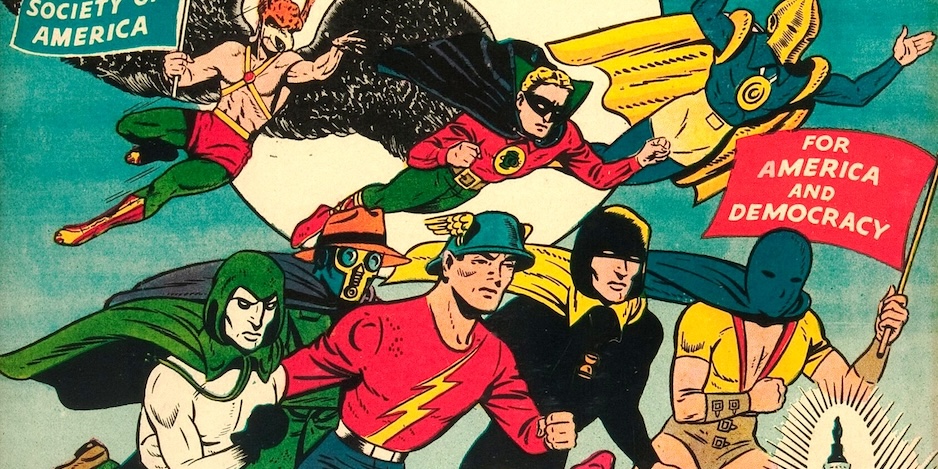
All-Star Comics #3 has a special importance for being the first major team meeting of superheroes, in which each member of the Justice Society of America told a story about their most exciting adventure. However, All-Star Comics #4 (Mar.-Apr. 1941), which was released a few months later, on February 7, 1941 — 85 years ago! — is considered to be the Holy Grail issue of superhero team comics, as it was the JSA’s first actual adventure together… even if they still worked individually in the comic up until near the end of the story.
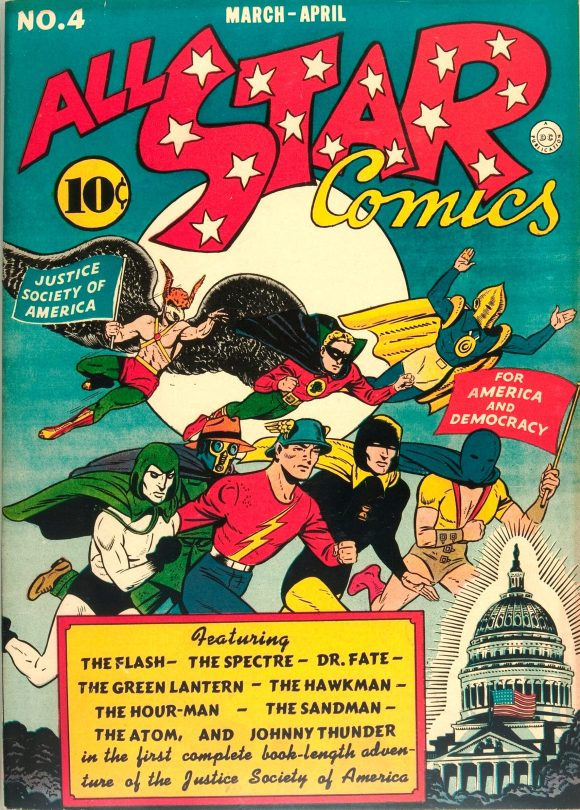
All-Star Comics #4 (Mar.-Apr. 1941). Cover art by E.E. Hibbard, with Sheldon Moldoff touching up the wings on Hawkman’s mask/helmet.
Here are 13 HIGHLIGHTS from that special issue! (NOTE: Each chapter was written by Gardner Fox, except where indicated.)
—
1. The story begins where All-Star Comics #3 left off, with a partially obscured image of an unidentified J. Edgar Hoover, who requests — no, demands with a desk-banging fist — that the Justice Society deal with the enemy in America.
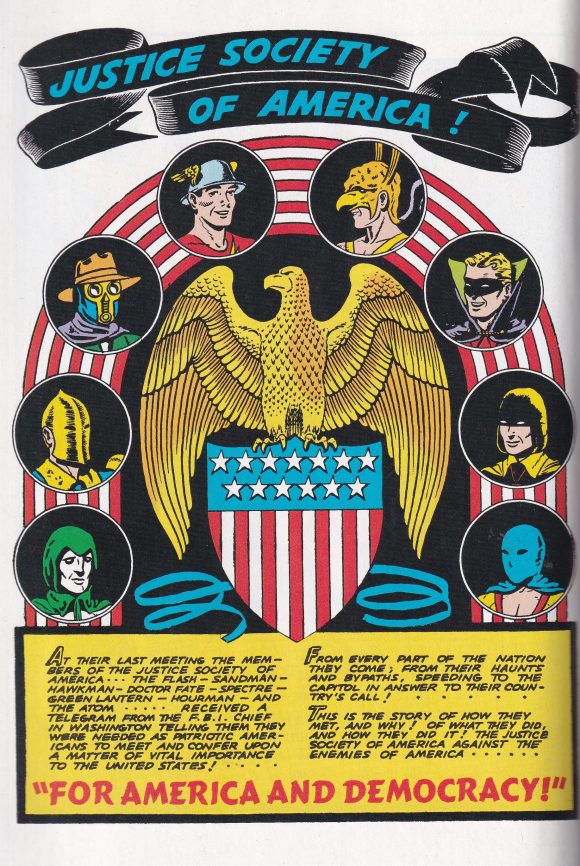
Art by Hibbard
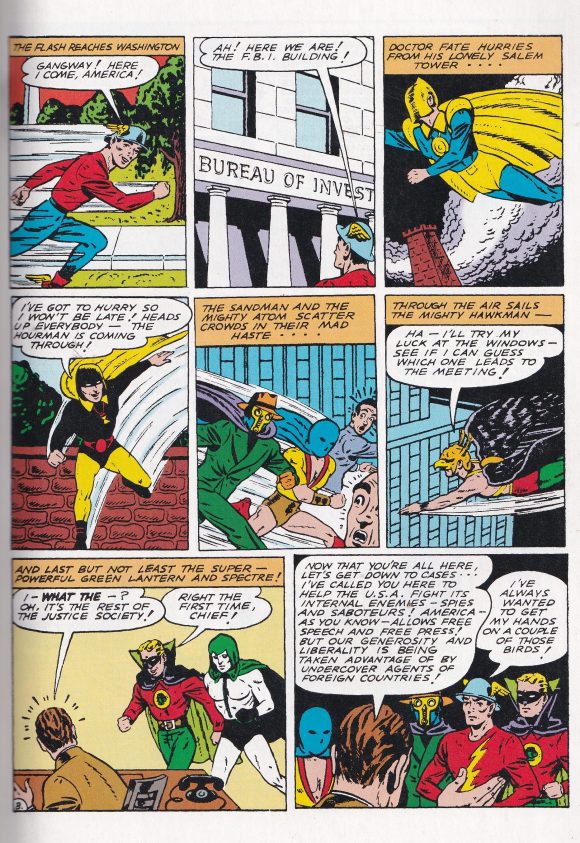
Art by Hibbard
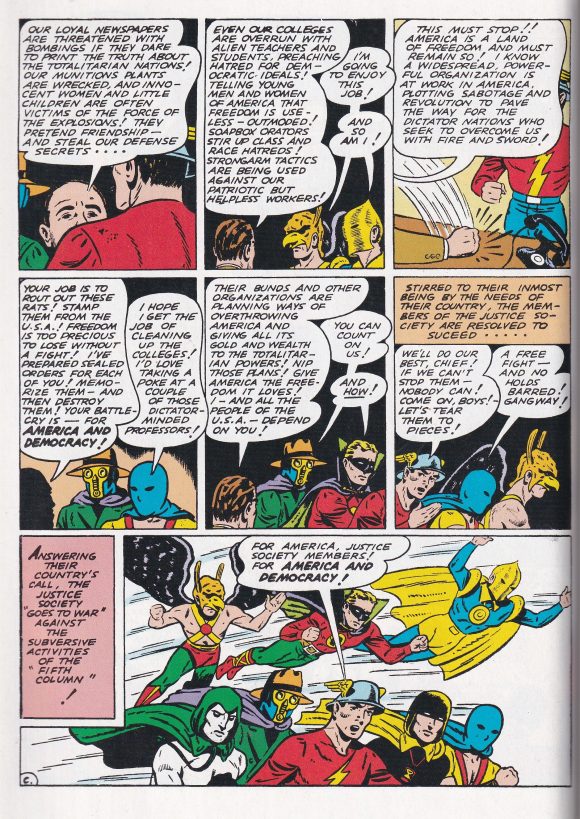
Art by Hibbard
While the villains in the issue are never called Nazis (this was 10 months before the Japanese attacked Pearl Harbor and the U.S. had yet to enter the war), the German-American Bund — who called their fascist plan “America First,” in order to get us to think only of ourselves and delay us helping our allies who were being conquered by Hitler’s armies — had been working within our shores for several years. They had even had a demonstration at Madison Square Garden in 1939, with 20,000 sympathizers in attendance.
February 20, 1939, Madison Square Garden
They may not have been called Nazis or Germans in the comic but it was clear to the young readers what they were, using terms like “grey-shirts” (similar to the Nazi “brown-shirts”), “the Fatherland,” “blitzkrieg,” “freedom is useless,” and that “the best government… is under a dictator.” So, let’s call them what they were — a subversive Nazi movement.
—
2. The Flash (Jay Garrick) is first up, ready to go after the Fifth Columnists with great relish. His destinations are the auto manufacturers and shipyards of Detroit.
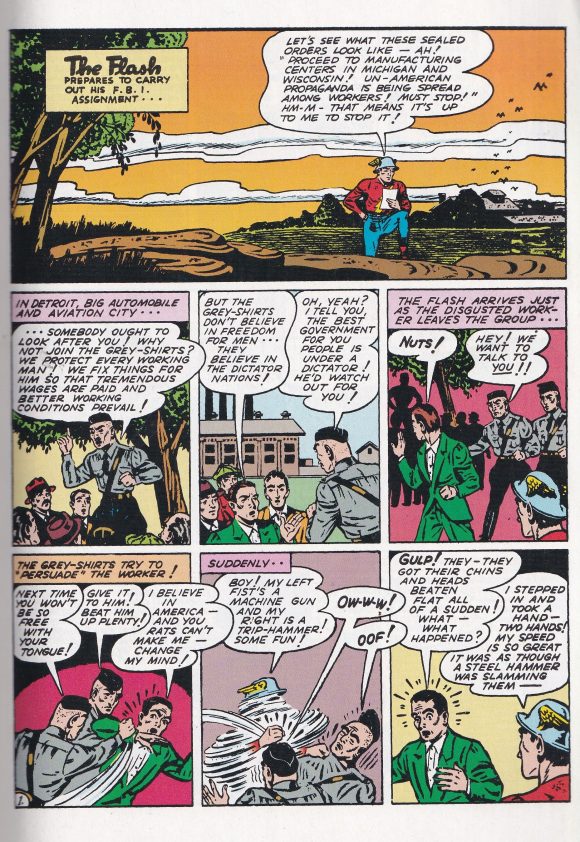
Art by Hibbard
He sees true Americans trying to stand up to the propaganda-spewing minions of Hitler but getting beaten up by his German agents. The Flash uses his speed to have the Nazi infiltrators begging for mercy and, breaking into an agent’s room, he sees propaganda handouts with symbols of swastikas. He also identifies their American leader as Fritz Klaver, who has complete records of the entire fascist operation within the United States at his house in Toledo, Ohio.
—
3. Next up was the Green Lantern (Alan Scott).
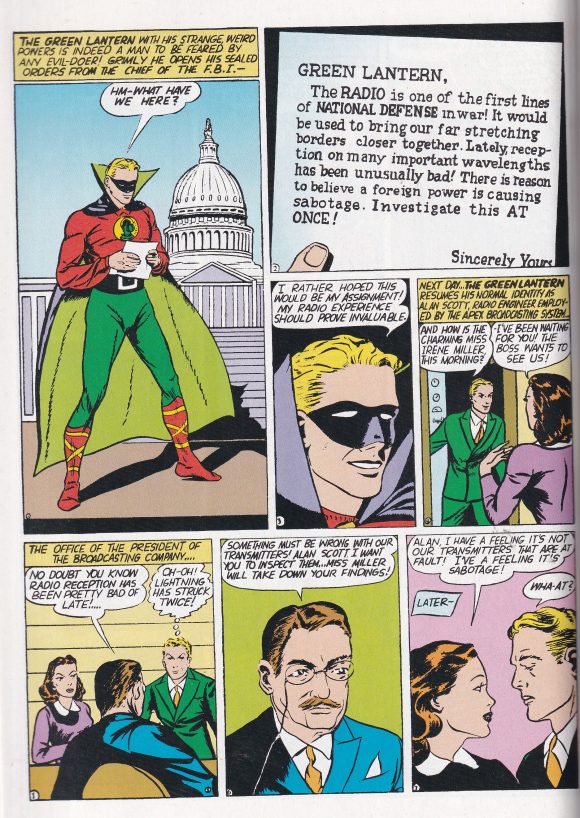
Art by Martin Nodell
The Lantern’s assignment is to stop the sabotage of America’s airwaves, perfect for him since in his alter ego he is a radio network engineer. The Lantern, like all the others whose tales follow, learns the leader’s identity and heads to Toledo. Also, it turns out that the Lantern is not only vulnerable to wood, but his ring has no power of protection from glass.
—
4. The Spectre’s tale has him protecting armament factories in Pittsburgh, which he does by mostly being invisible and overhearing plans of sabotage and of the leader Klaver. At one point in the tale, the Spectre has a chance to finally find eternal peace in another dimension but chooses to stay on Earth in order to help those in immediate danger of the Nazi menace.
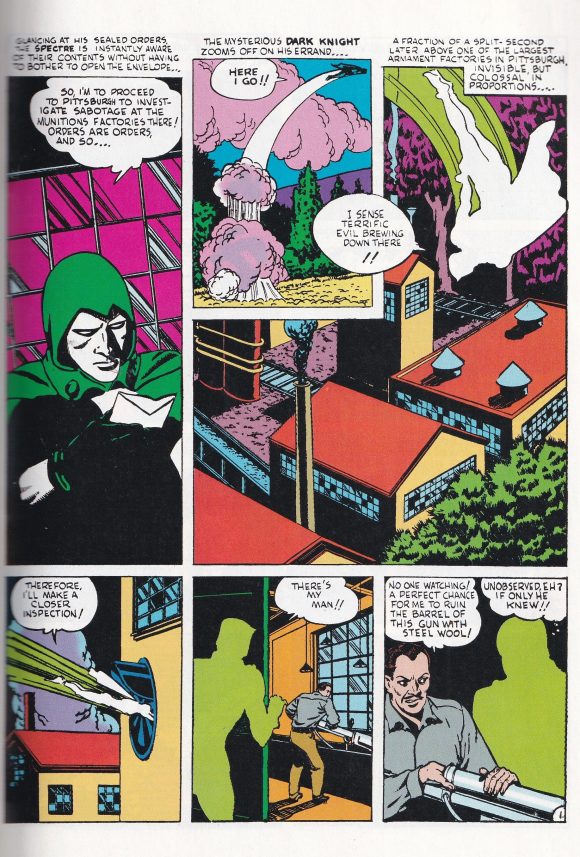
Art by Bernard Baily. Note how the Spectre is referred to as “the Dark Knight.”
—
5. Hourman opens his envelope from Hoover and discovers he is to look for saboteurs in the oil fields of Oklahoma. Getting a job as a worker, he interrupts their plans, which includes murdering American guards on our oil fields.
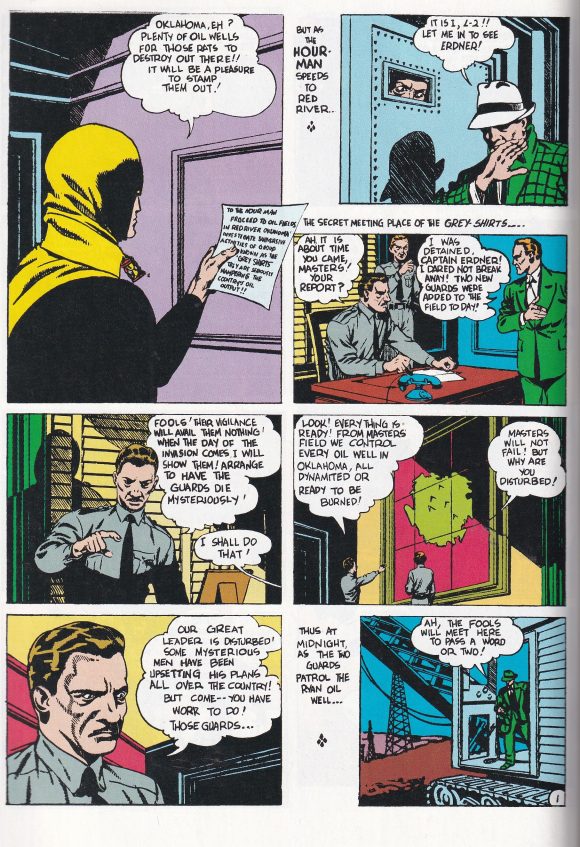
Art by Baily
—
6. The Doctor Fate chapter in this issue may be the strongest of the stories, with the hero protecting the Eastern seaboard and its string of naval bases. He turns a bomb back upon the enemy, as well as uses mental torture to discover their plot and the identity of their leader. In the climactic finish to his role in saving America, he forces a Nazi broadcast operative to summon all spies and saboteurs along the coast to his location… where he has the F.B.I. ready to arrest them. His next goal: capture Kraver.
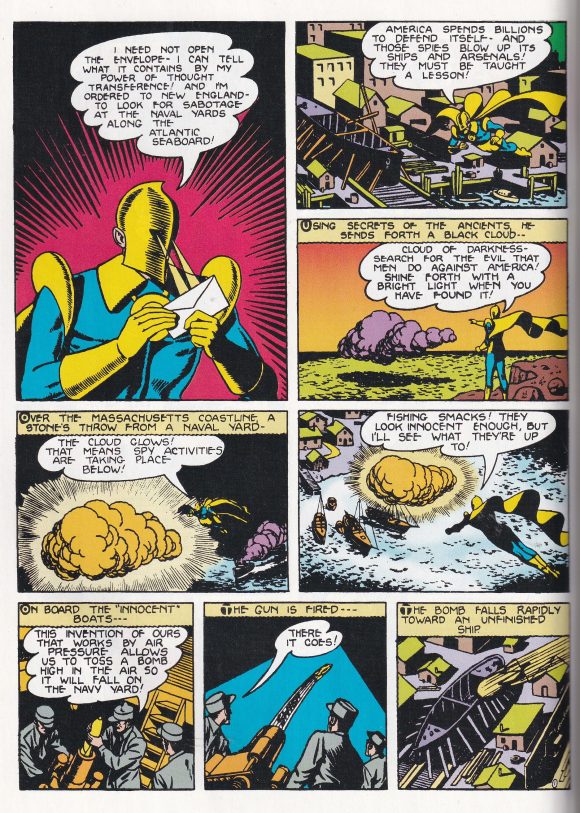
Art by Howard Sherman
—
7. On his way to Toledo, Fate lets Sandman and the Flash know about Kraver.
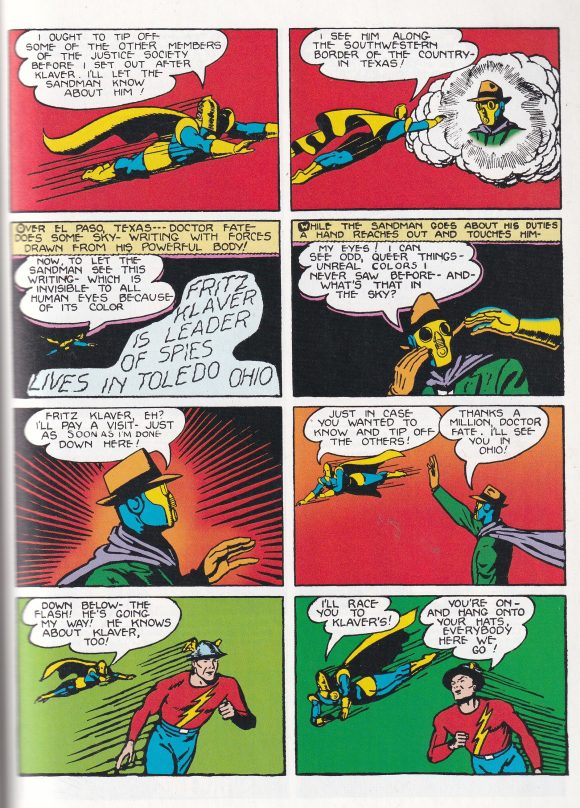
Art by Sherman
—
8. Hoover’s request of the Sandman is to help a threatened newspaper editor in El Paso who is besieged by American youths who have been misguided into joining the fascist movement for the excitement of it all. The only way for the young men to see that the enemy is not strong is by the Sandman single-handedly standing up to them.
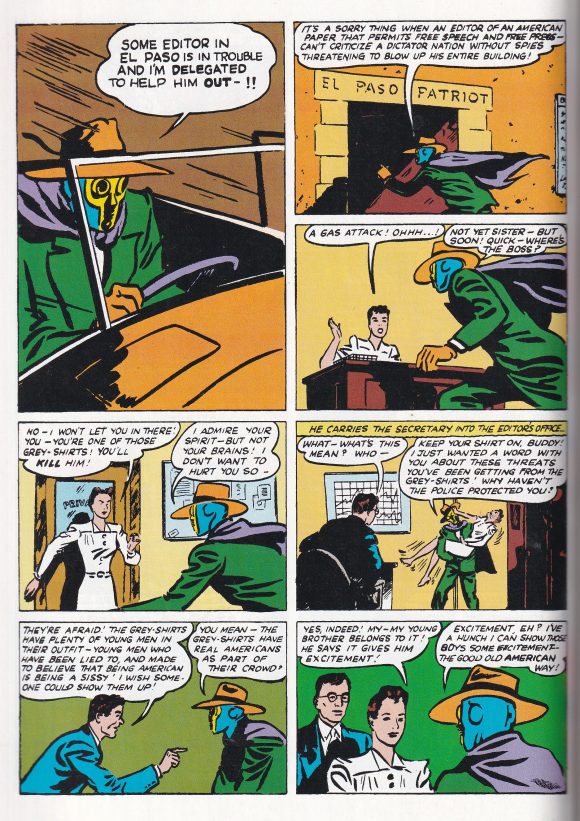
Art by Chad Grothkopf
—
9. Up next is a two-page text story of Johnny Thunder and his Thunderbolt. It was the only tale in the issue that did not address a fascist angle. Instead, it was about a phony fortune teller hypnotizing Johnny’s girlfriend and stealing her pearl necklace.
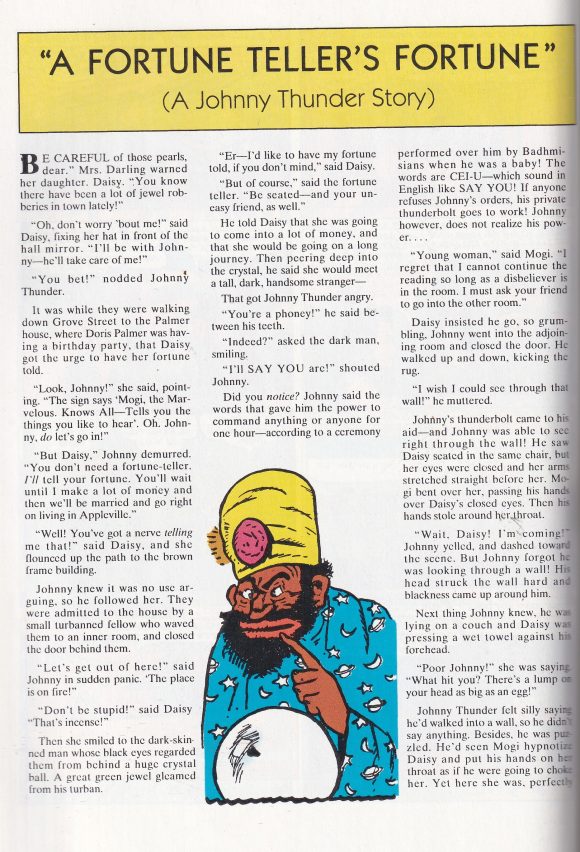
Unconfirmed writer. Spot illos by Sheldon Mayer.
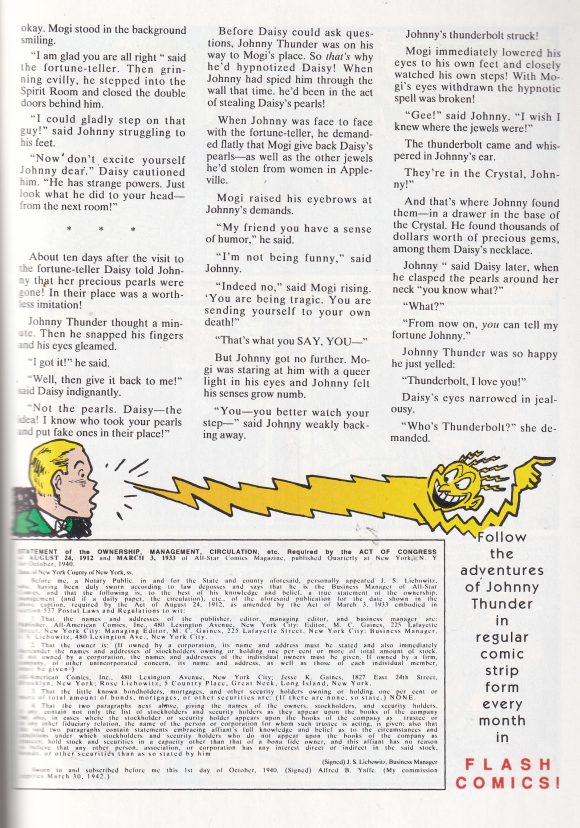
Unconfirmed writer. Spot illos by Sheldon Mayer.
—
10. Hawkman’s orders, naturally, include protecting America’s skies. Enemy agents fail to capture an experimental airplane and its inventor thanks to the Winged Wonder. They then turn to attacking a Los Angeles aviation plant, but Hawkman gives them a thorough walloping before the authorities arrive to take them into custody.
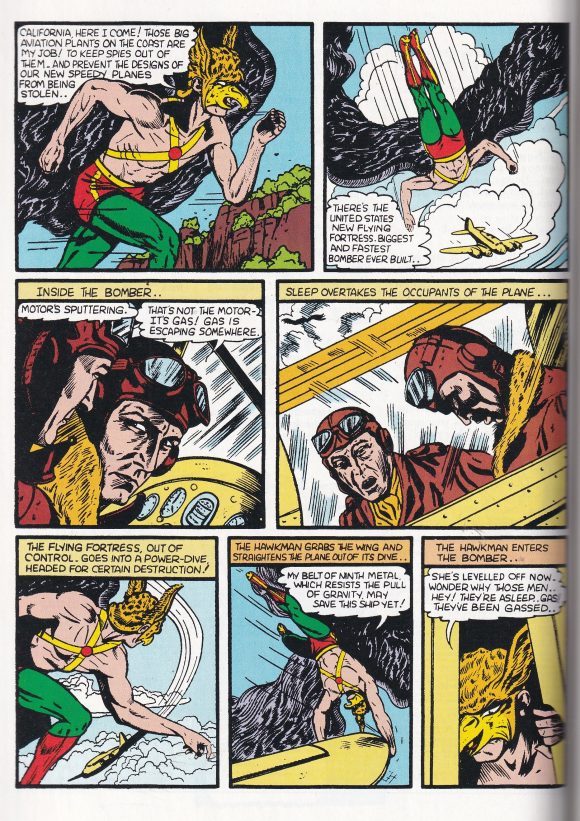
Art by Shelly Moldoff
—
11. Being the youngest of the heroes, the Atom in his true identity of Al Pratt is sent to a tri-state college to break up groups of Hitler youths who tell American students to either join them or be beaten, possibly to death.
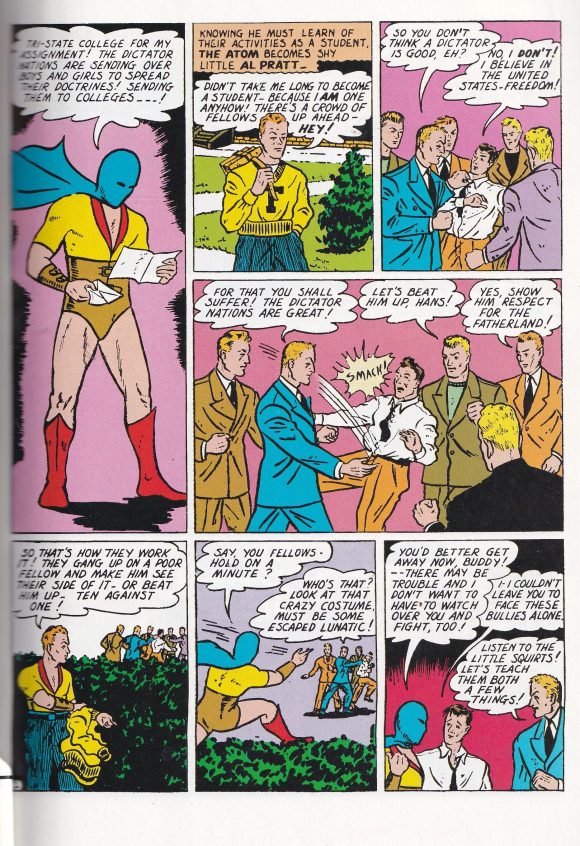
Art by Ben Flinton
The goose-steppers are so full of themselves that they openly have a “Fatherland Club” on campus, which Al breaks into and beats them into submission until they sing the praises of America — literally.
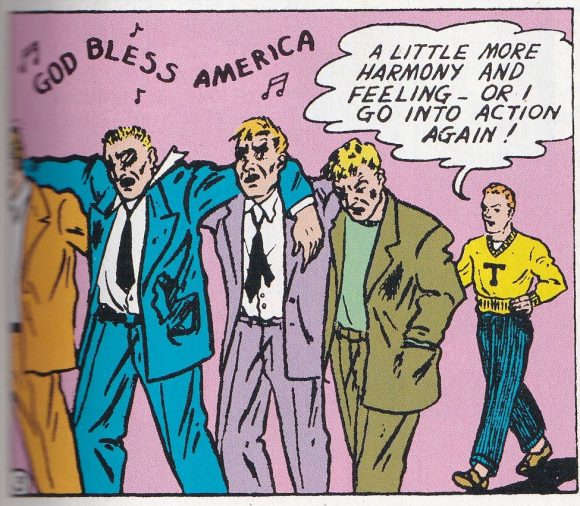
Art by Ben Flinton
But the Atom hears a radio broadcast from Kraver, who has suffered the losses of his minions everywhere due to the JSA. Kraver orders his faithful legions to rush to Toledo in a last-ditch effort to take over the country. The Atom arrives at Kraver’s HQ and is captured, along with Johnny Thunder, but before they can be killed, the JSA arrives en masse to kick the would-be conquerors right in their Axis.
—
12. The wrap-up to the JSA’s first adventure. Powerful stuff for a pre-war comic book but it had to be told. And DC did just that.
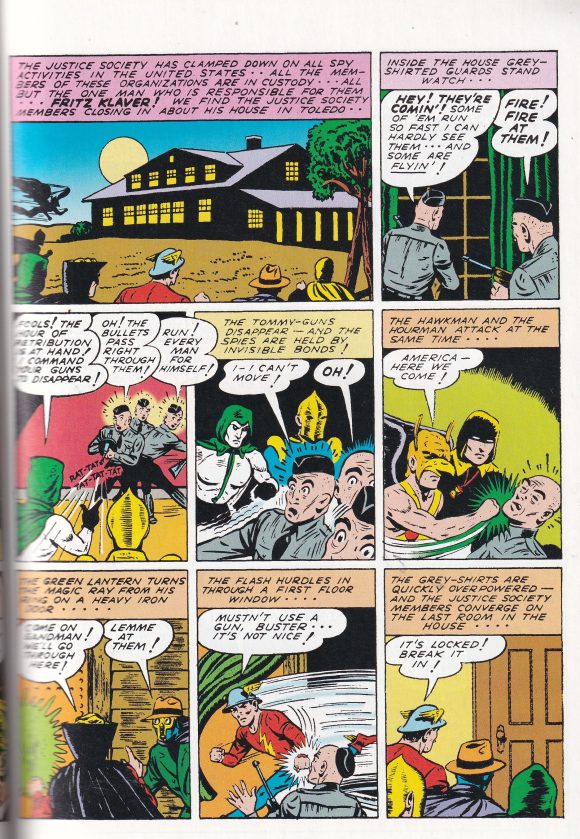
Art by Hibbard
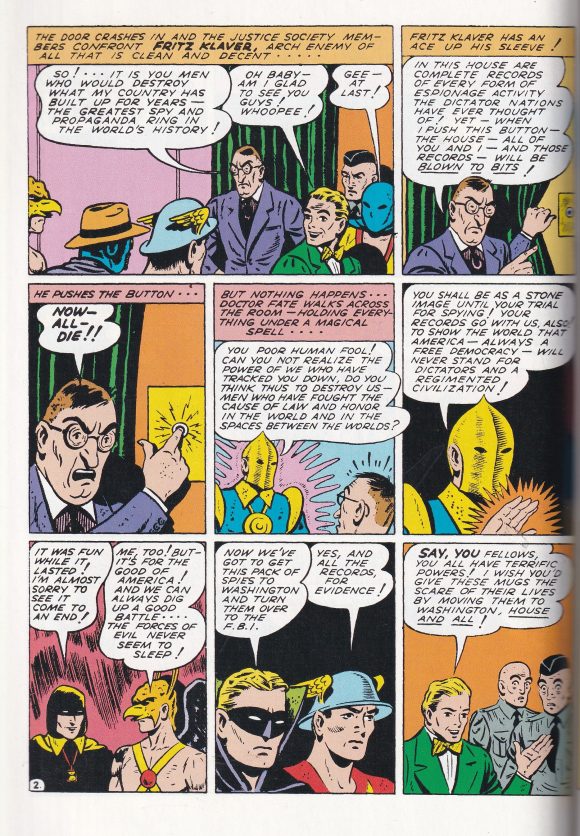
Art by Hibbard
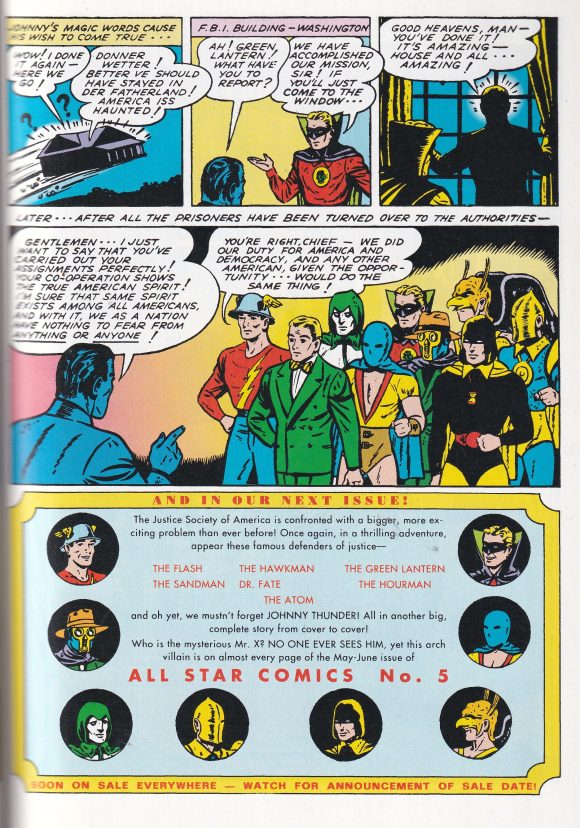
Art by Hibbard
—
13. As a bonus, here are three ads from the issue, featuring DC’s great Golden Age heroes!
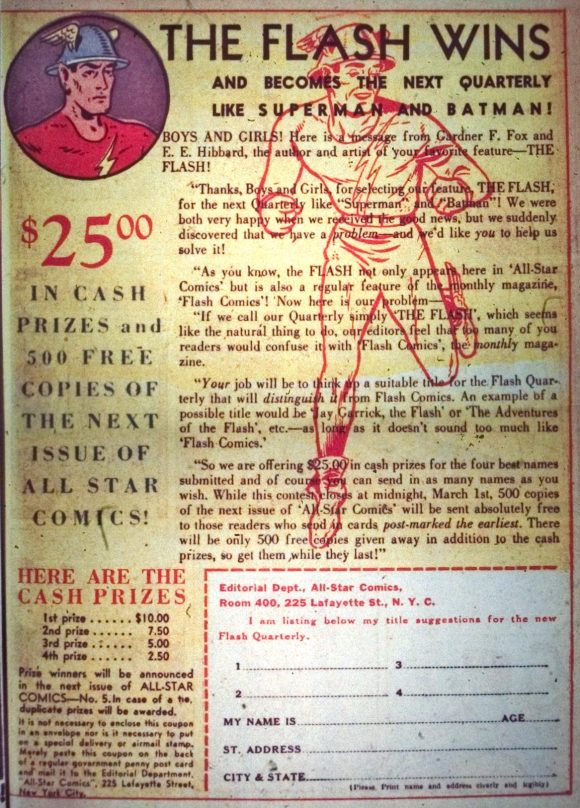
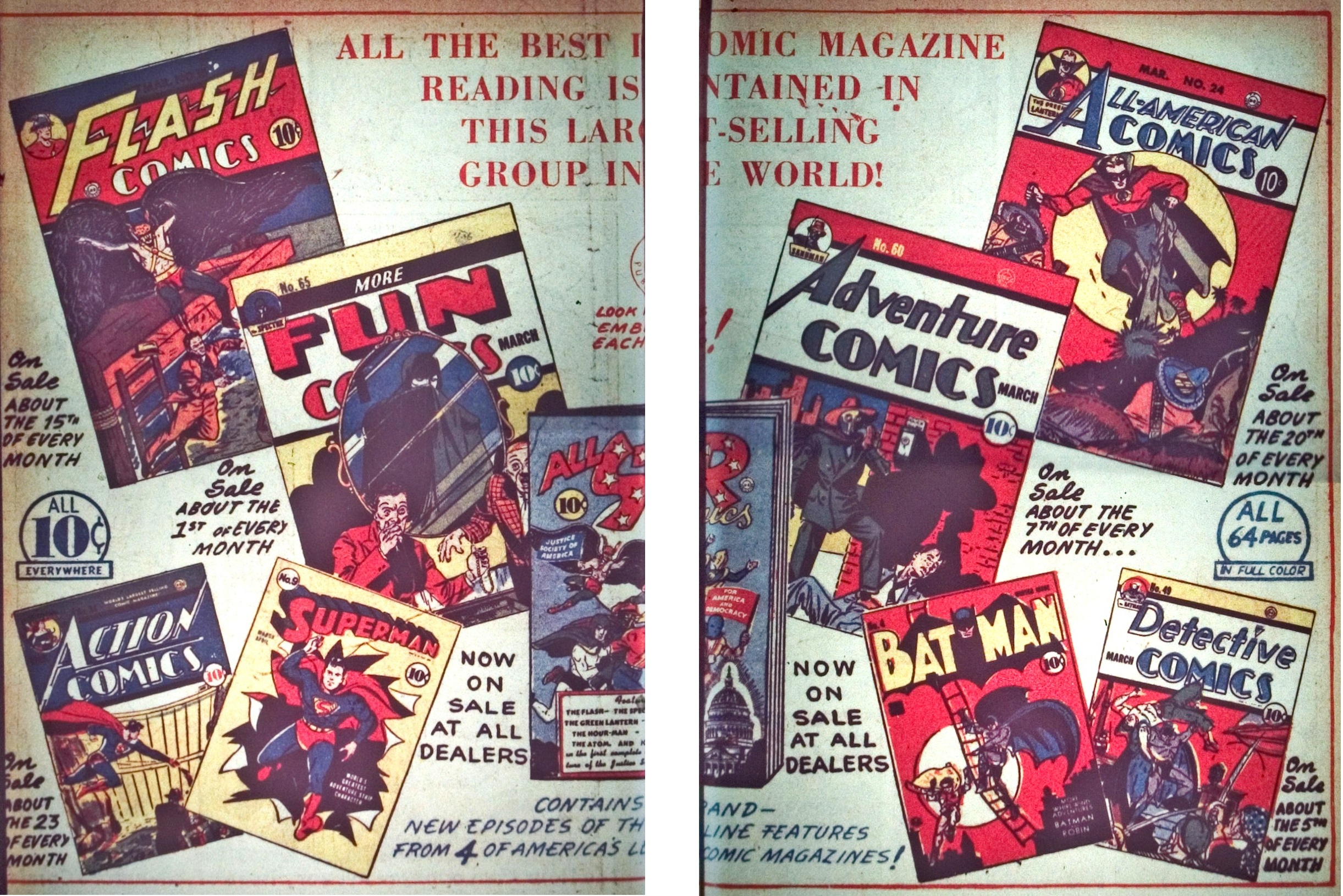
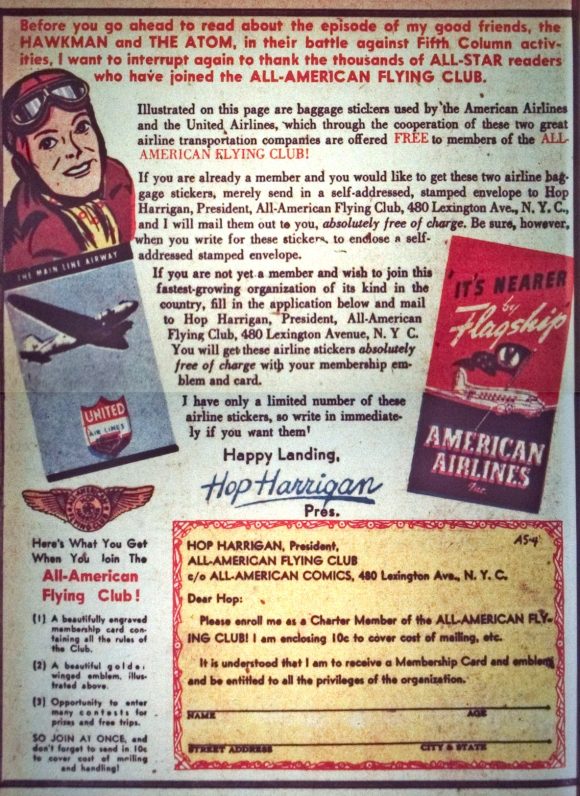
—
MORE
— THE JUSTICE SOCIETY TURNS 85: 13 Fascinating Facts About ALL-STAR COMICS #3. Click here.
— 13 JUSTICE SOCIETY OF AMERICA Toys That Do Them Justice. Click here.
—
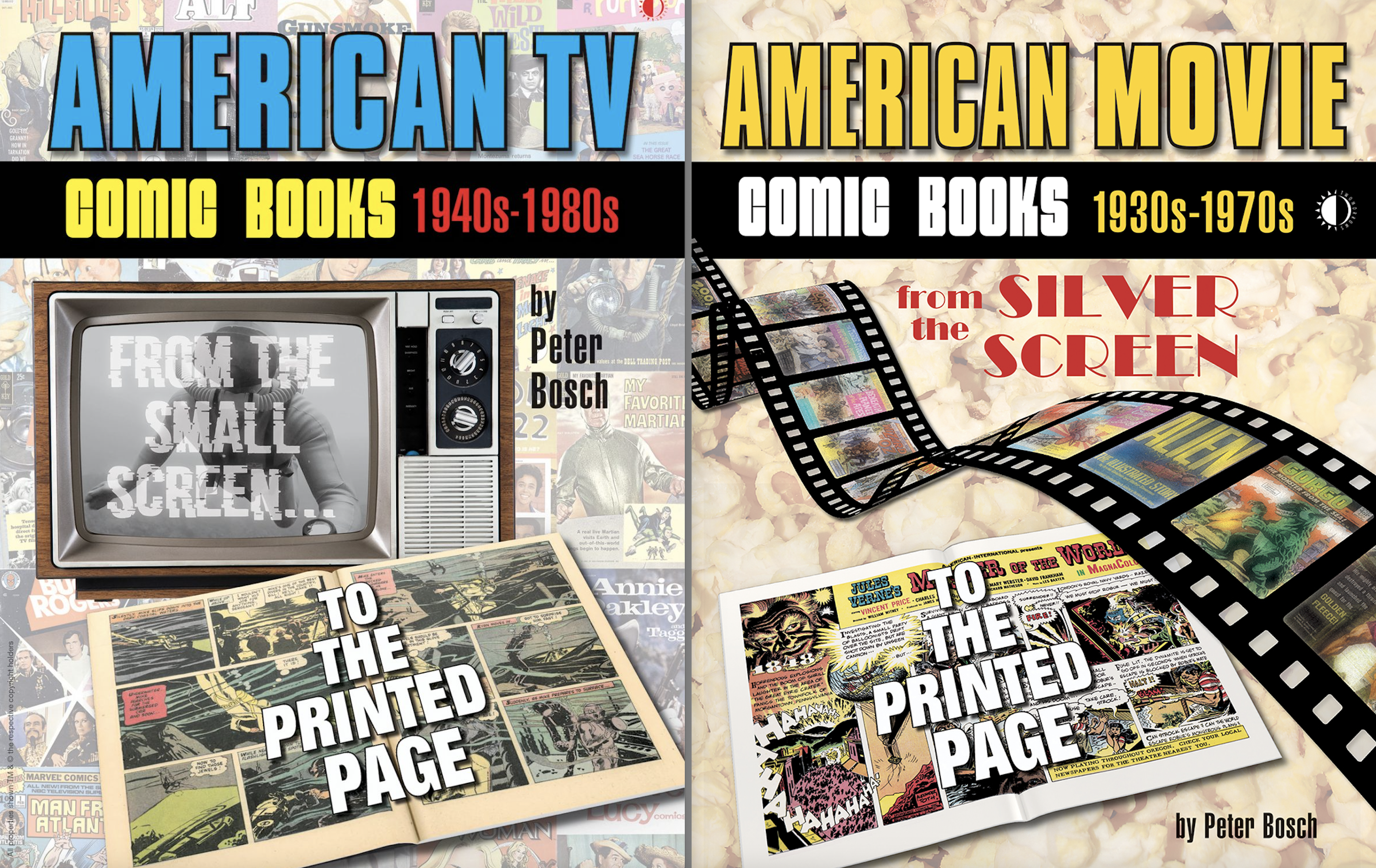
13th Dimension contributor-at-large PETER BOSCH’s first book, American TV Comic Books: 1940s-1980s – From the Small Screen to the Printed Page, was published by TwoMorrows. (You can buy it here.) A sequel, American Movie Comic Books: 1930s-1970s — From the Silver Screen to the Printed Page, is out now. (Buy it here.) Peter has written articles and conducted celebrity interviews for various magazines and newspapers. He lives in Hollywood.

February 7, 2026
No wonder (the Nazis) couldn’t conquer America, if they thought Toledo was the best location for a coup…
February 7, 2026
Struck by the text-driven style of storytelling back in the day. Word balloons dominate many of the panels almost to overflowing. Certainly a sharp contrast to many of the more modern art-driven school of storytelling.
February 7, 2026
How about a facsimile edition, DC?