
A 95th ANNIVERSARY SALUTE…
By PETER BOSCH
September 8, 2025, marked the 95th anniversary of Chic Young’s Blondie comic strip. However, even after all this time, there are a lot of things many people may not know about it. Here are 13 of them:
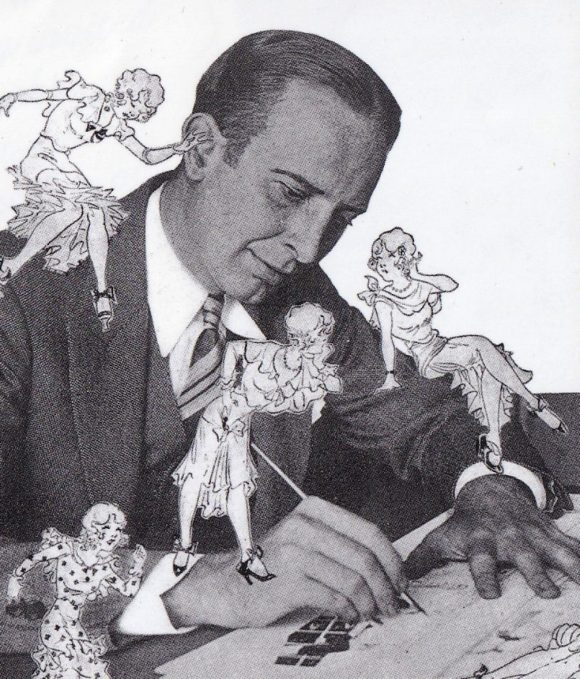
Chic Young, early 1930s.
1. Chic Young was actually born Murat Bernard Young on January 9, 1901, in Chicago, and Blondie was his fourth newspaper strip. The first three were The Affairs of Jane (from 1921-1922), Beautiful Bab (which began and ended in 1922), and Dumb Dora, which lasted the longest of the three (from 1924-1930).
(Art and scripts below believed to be by Chic Young, unless specified otherwise.)
—
2. And then came Blondie. Many today would be surprised to learn that, when the strip started, Blondie was actually a Jazz Age flapper and Dagwood was the scion of a very wealthy family.
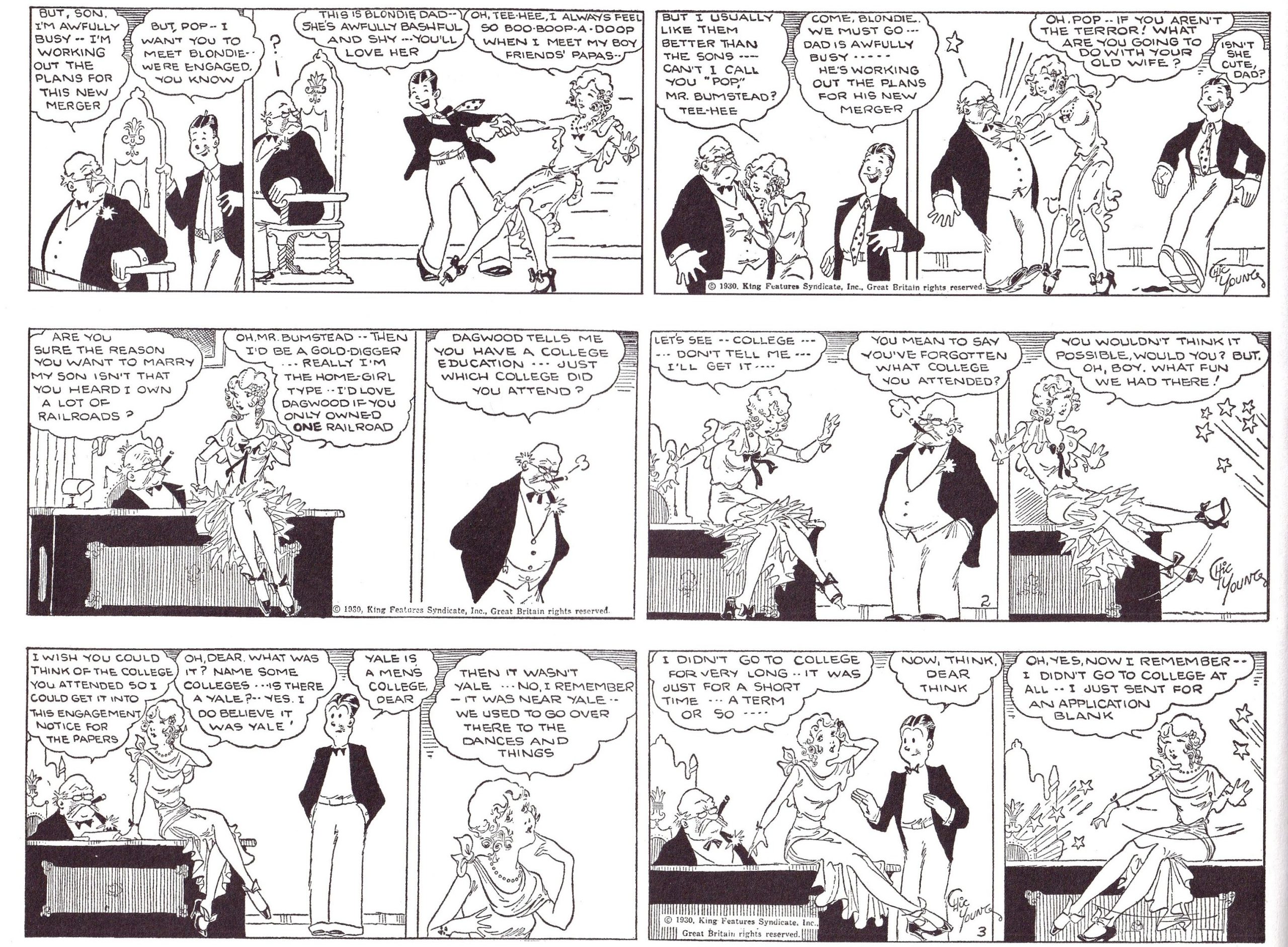
The first three strips of Blondie, September 8 to 10, 1930.
—
3. And befitting a true flapper, Blondie’s surname was Boopadoop. Really. It was.
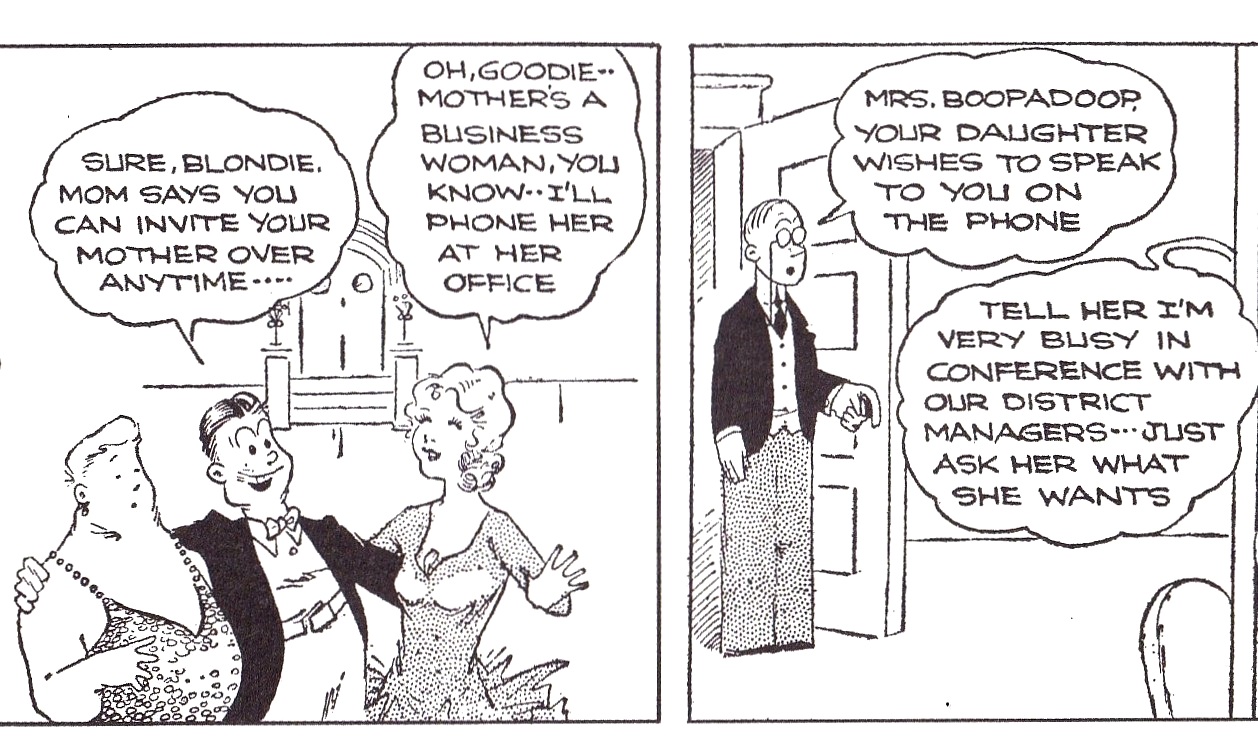
Panels from the September 30, 1930, strip.
—
4. In the early years of the Blondie strip, it was not a great circulation success. The tumultuous romance between flapper Blondie and rich Dagwood was not getting much sympathy from a public going through some of the worst times of the Great Depression. For awhile, it looked like Dagwood was going to disappear from the strip entirely. During 1932, there was a period where he was absent from it for almost three months, while Blondie was pursuing a new beau named Gil.
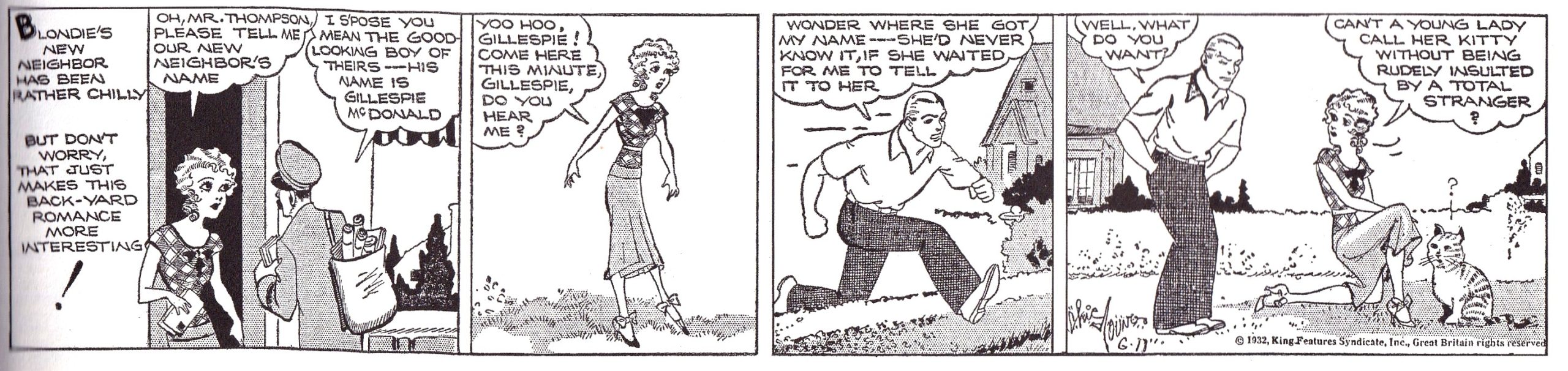
June 11, 1932.
A special note about Gil – aka “Gillespie” – in that strip above: The character was likely drawn by one of Young’s assistants, a relative newcomer to the field who would soon make a major impression of his own. The fellow’s name was Alex Raymond and he would soon astonish readers every week with Flash Gordon. Oh, as to his connection to the character of Gillespie — Raymond’s middle name was Gillespie.
—
5. Trouble loomed for the future of the Blondie strip when, in 1932, the daily was cancelled by the New York American, the most important newspaper in William Randolph Hearst’s publishing empire. Young asked Joseph Connolly, the general manager of the King Features Syndicate (and the man who signed Young to a contract for the Blondie strip), what he should do. Connolly suggested that Young let Blondie and Dagwood marry. And, so, starting on January 3, 1933, Dagwood went on a hunger strike, refusing to eat unless his parents consented to his marrying Blondie (Dagwood was only 19 and needed his parents’ permission). The following starvation period got readers’ attention and circulation grew every day Dagwood did not eat.
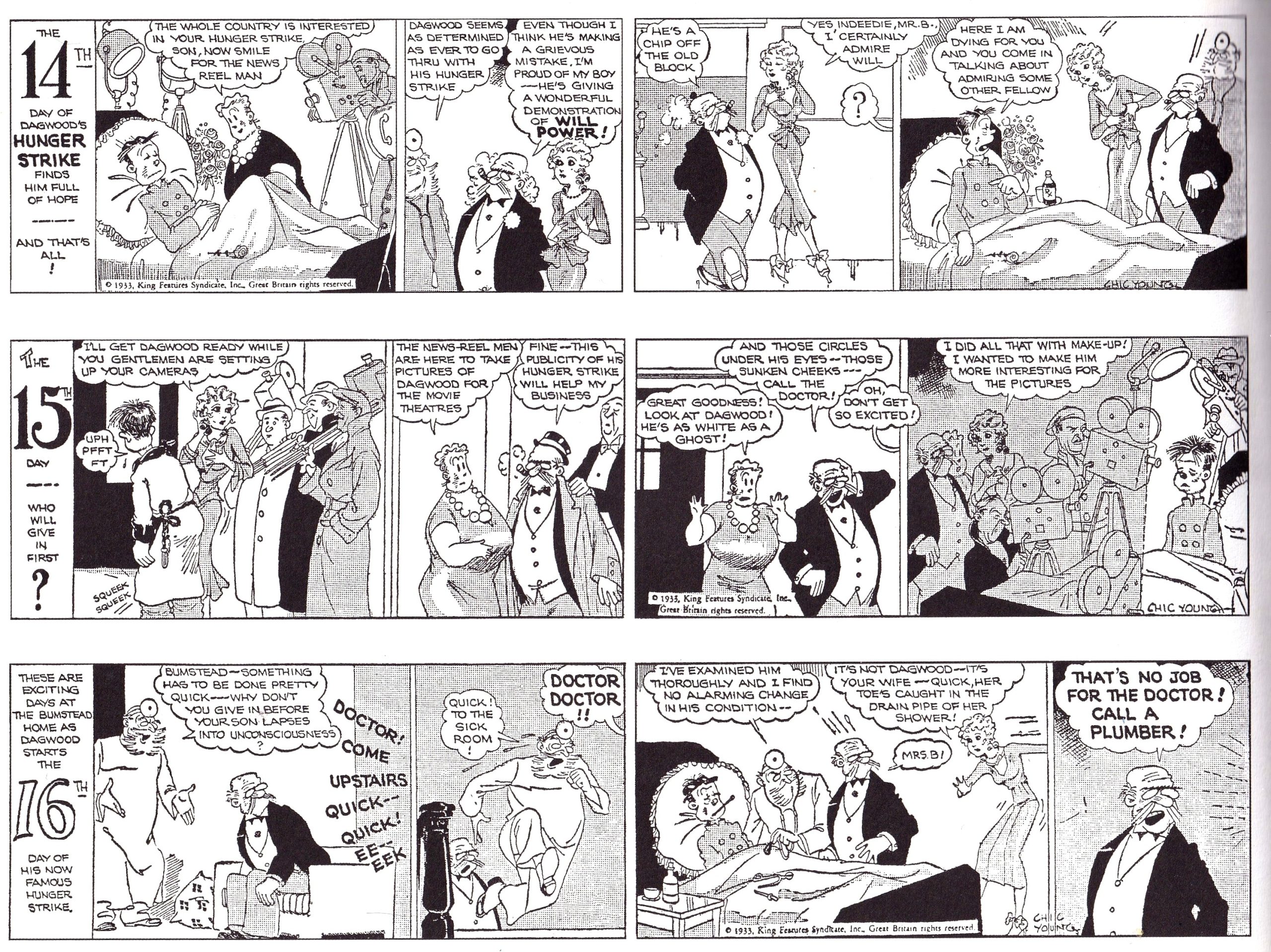
Days 14, 15, and 16 of Dagwood’s hunger strike for love. January 16-18, 1933.
—
6. Finally, after 28 days of real time, his parents said yes! And on February 17, 1933, Dagwood and Blondie were married in a grand ceremony — but the marriage came with a consequence that Dagwood agreed to heartily: He was disinherited from the family fortune. And, thus, was created the happy middle-class family situation that has survived to this day.
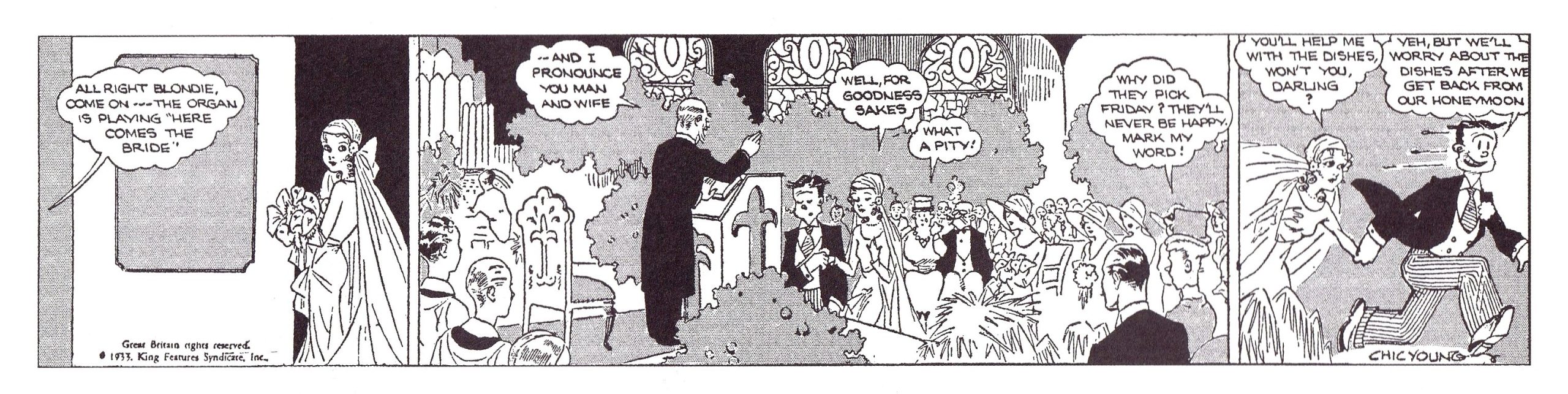
February 17, 1933
7. However, in 1937, there was incredible tragedy for Young and his wife, Athel. Their 6-year-old son, Wayne, died of jaundice. Following his son’s death, Chic Young was unable to draw the strip at all because one of the most popular characters in it was Dagwood and Blondie’s son, Baby Dumpling (also known as Alexander). Just trying to draw the character on paper was devastating to him. The Youngs were so overcome by their loss that they left the country for a year, going to Europe to try to deal with their grief.
During Young’s absence, the strip was turned over to Jim Raymond, Alex’s brother, who had been working for Young as an assistant since 1935. Raymond wrote and drew the strip, but still signed it as “Chic Young.”
A dozen years later, in 1950, Jim Raymond was again called upon to handle the strip, this time because Young’s eyesight was failing. Raymond would basically do the drawing from that point forward and Young would still write it. However, again, only Young’s name appeared on the strip.
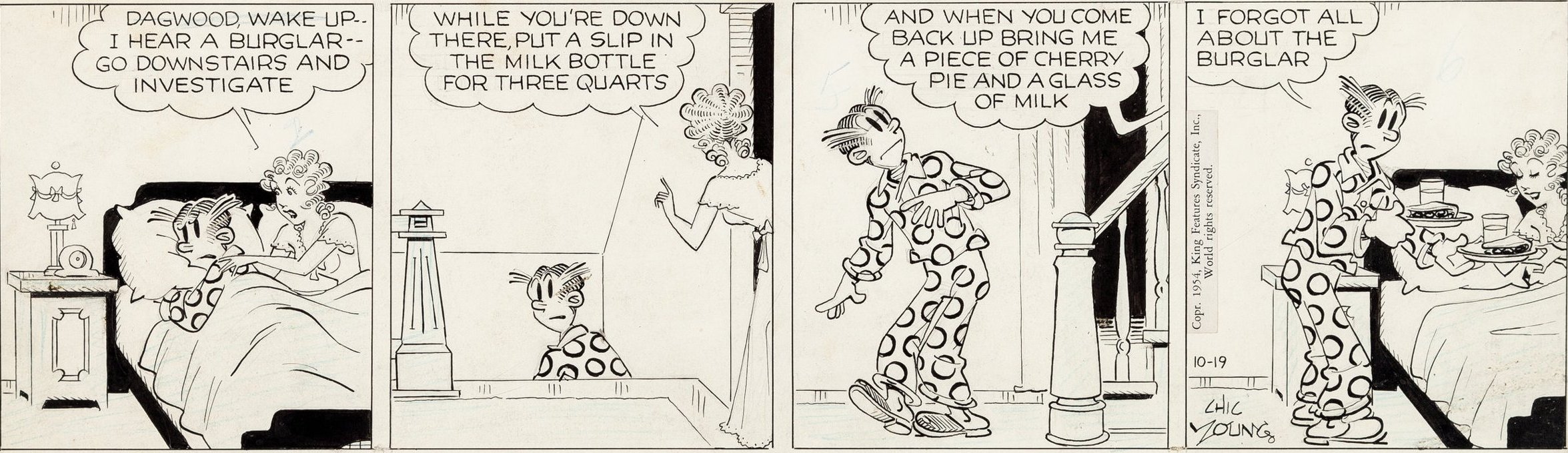
Original art for the October 19, 1954, strip, drawn by Jim Raymond but signed as “Chic Young.”
—
8. Between 1938 and 1950, there were 28 movies starring Penny Singleton as Blondie and Arthur Lake as Dagwood. They even starred in a Blondie radio series that began in 1939 and continued until 1950 — but with an important change in 1949 that will be discussed in a moment.

3-sheet movie poster for the first Blondie movie (1938)
Prior to his role as Dagwood, Arthur Lake played another comic strip character, Harold Teen, in the 1928 silent film comedy of the same name.

1928 movie poster for Harold Teen, starring Arthur Lake
—
9. A sign that the strip was doing well was the merchandising that accompanied it. Over the decades, there has been an enormous amount of Blondie and Dagwood items: dollhouses, greeting cards, games, jigsaw puzzles, watches, paint sets, and much, much more. In 1947, there was one that – conceptually – stands out as one of the most ludicrous toys of all time. It was a kazoo incorporated within a Dagwood toy sandwich. When you held the “sandwich” up to your mouth, with your friends observing you, you pretended you were about to take a bite of it, but you blew into it and music came forth (well, as close to “music” as a kazoo could produce).

Plus, you can add to that, all of the strip reprints and new stories published in various comic books, including Blondie Comics (222 issues between 1947-1976; actually 221, as #176 was never printed) and Chic Young’s Dagwood Comics (140 issues between 1950-1965).
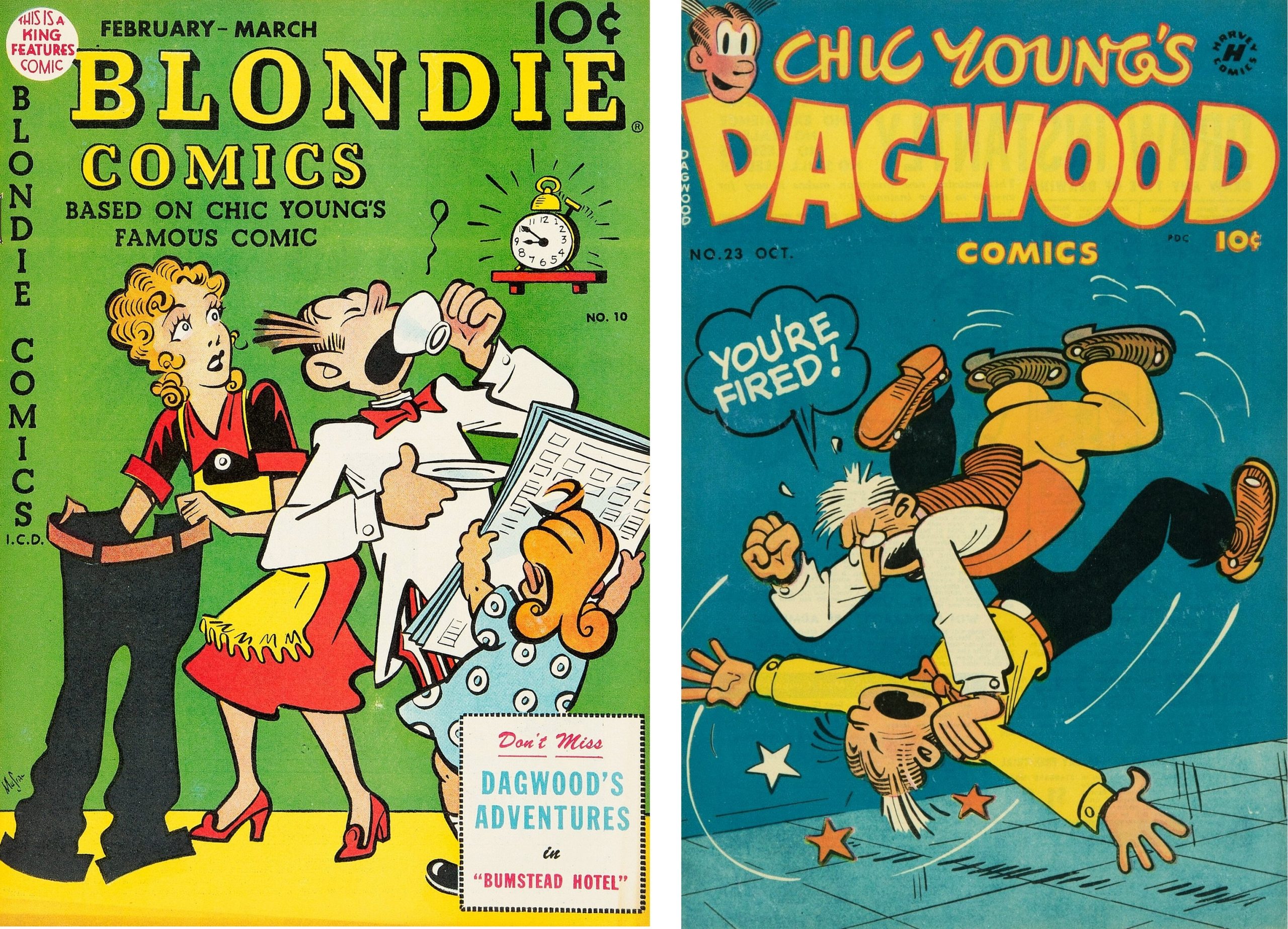
Blondie Comics #10, Feb.-Mar. 1949, David McKay, with cover art by Joe Musial, and Chic Young’s Dagwood Comics #23, Oct. 1952, cover artist unknown.
—
10. Now, as mentioned earlier, there was, in addition to the movies, a Blondie radio series with Penny Singleton and Arthur Lake, which first went on the air in 1939.
However, in 1949, the radio’s sponsor told Singleton they had come to the decision that they wanted to take the part of Blondie in another direction. After playing the character in dozens of movies and on radio for all those years, Penny Singleton was told they were replacing her!
Different reasons for the dismissal have been suggested, including that Singleton was being too vocal in public life about supporting unions. (A number of years later, she was elected president of the American Guild of Variety Artists). After Singleton, Blondie was played on the radio program by Ann Rutherford and then by Patricia Lake (Arthur Lake’s wife).
—
11. In 1957, there was a short-lived (26 episodes) TV sitcom, which ran from January 4 to September 27. Lake again starred as Dagwood, but Blondie was played by Pamela Britton. (If Britton looks familiar to baby boomers in the episode in the link below, it’s because she went on to play Mrs. Brown, the landlady, in My Favorite Martian a few years later.)
One other attempt at a Blondie TV comedy series was made in 1968, with Patricia Harty as Blondie and Will Hutchins as Dagwood, but it was met with even less success than the 1957 program, this time running only 14 episodes.
Jump ahead to 1987 and Marvel, in partnership with King Features, produced an animated Blondie TV special, Blondie & Dagwood, with Loni Anderson providing the voice of Blondie and Frank Welker as Dagwood.
Two years later, they did another animated special, Blondie & Dagwood: Second Wedding Workout, with the same cast.
—
12. In 1973, Chic Young died, and his son Dean took over the writing, with Jim Raymond finally getting credit as the artist of the strip.
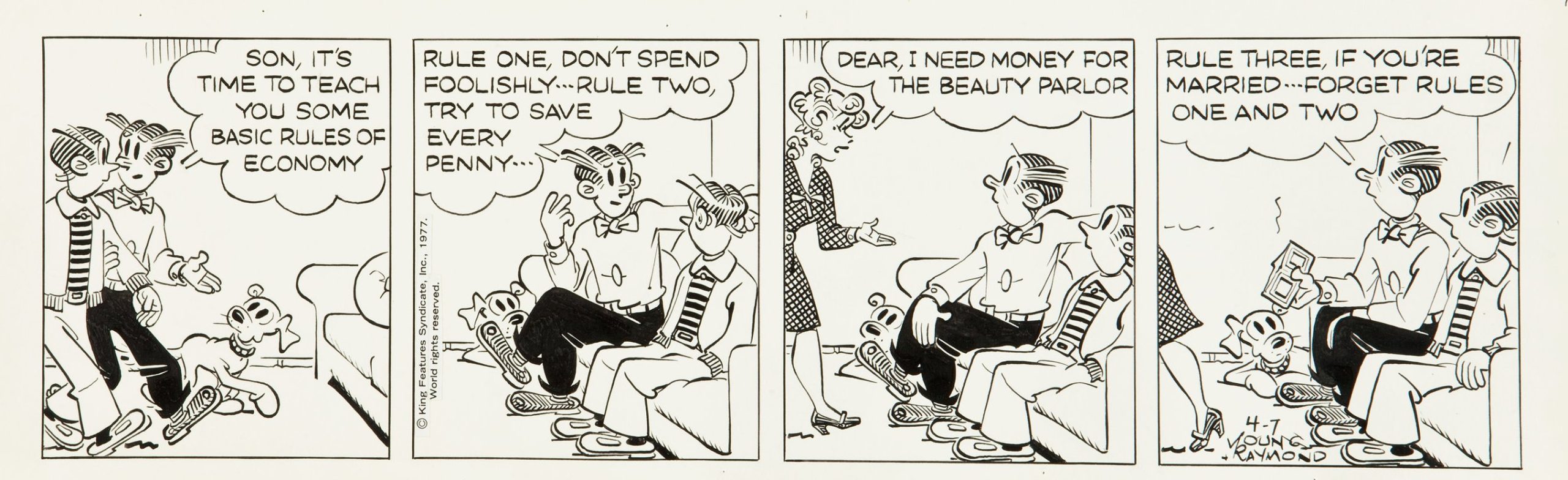
Original art for April 7, 1977 strip. Writing by Dean Young. Art by Jim Raymond.
Raymond stayed on the strip until his own death in 1981. Other Blondie artists over the years have been:
— Mike Gersher (from 1981 to 1984):
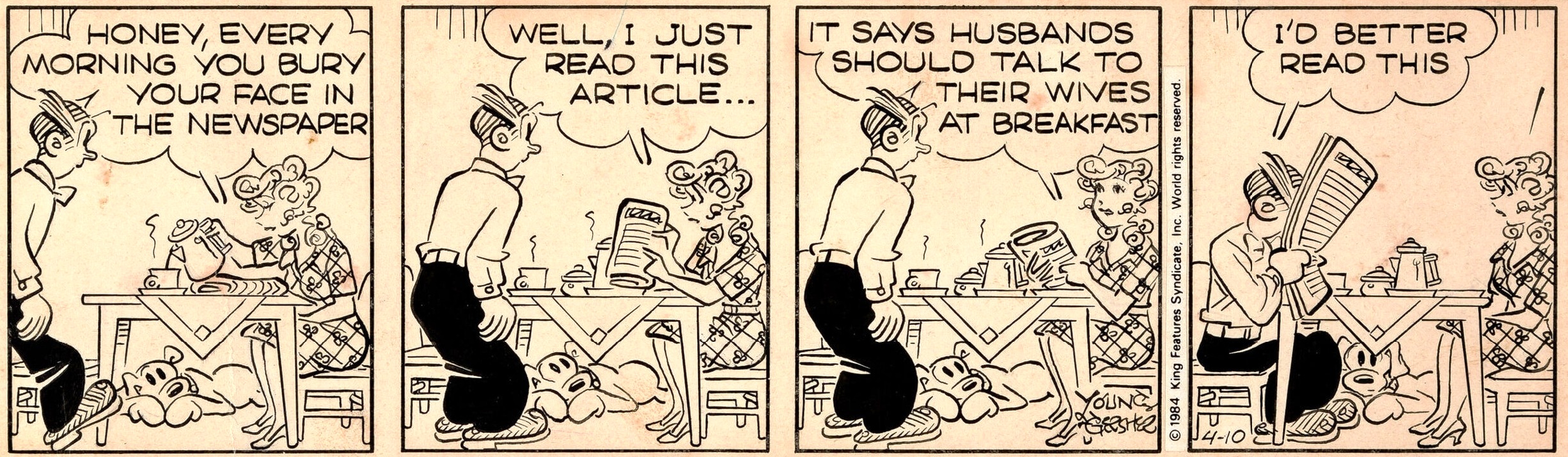
Original art for April 12, 1984, strip. Writing by D. Young. Art by Mike Gersher.
— Stan Drake (1984 to 1997):
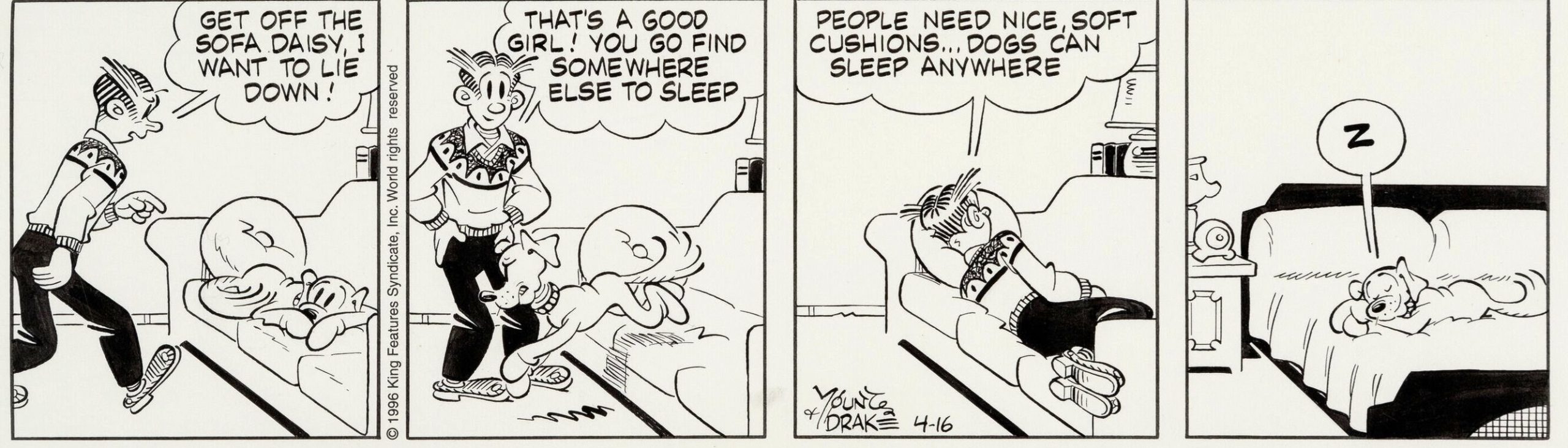
Original art for April 16, 1996, strip. Writing by D. Young. Art by Stan Drake.
Denis Lebrun (1997 to 2005):
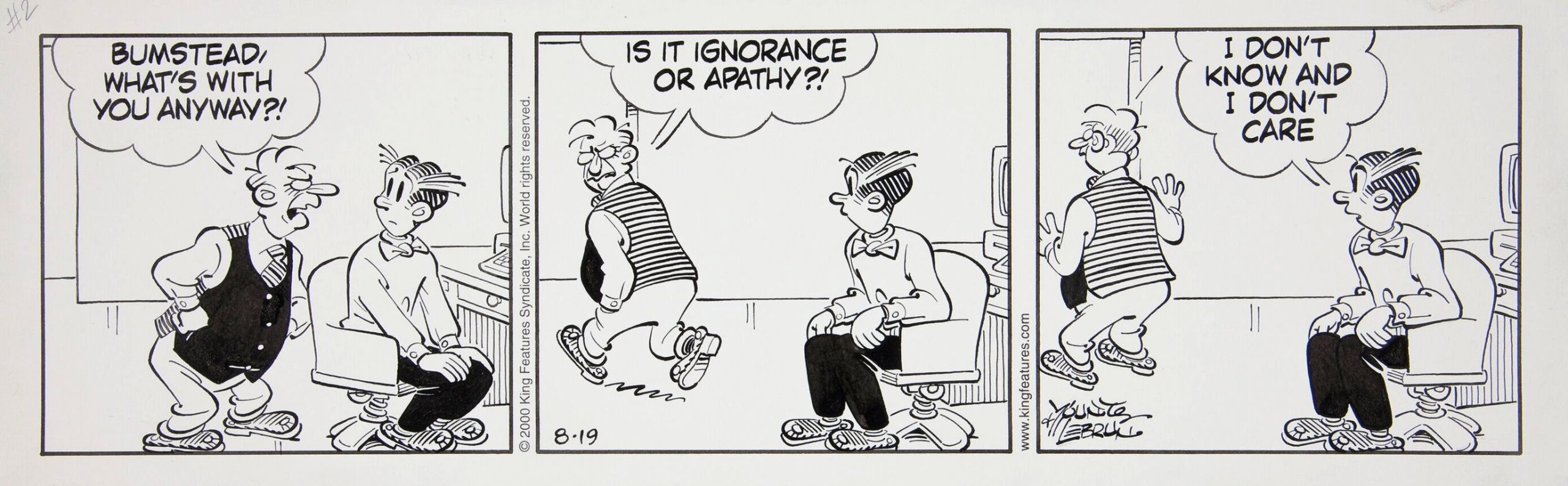
Original art for August 19, 2000, strip. Writing by D. Young. Art by Denis Lebrun.
— John Marshall from 2005 to the present day:
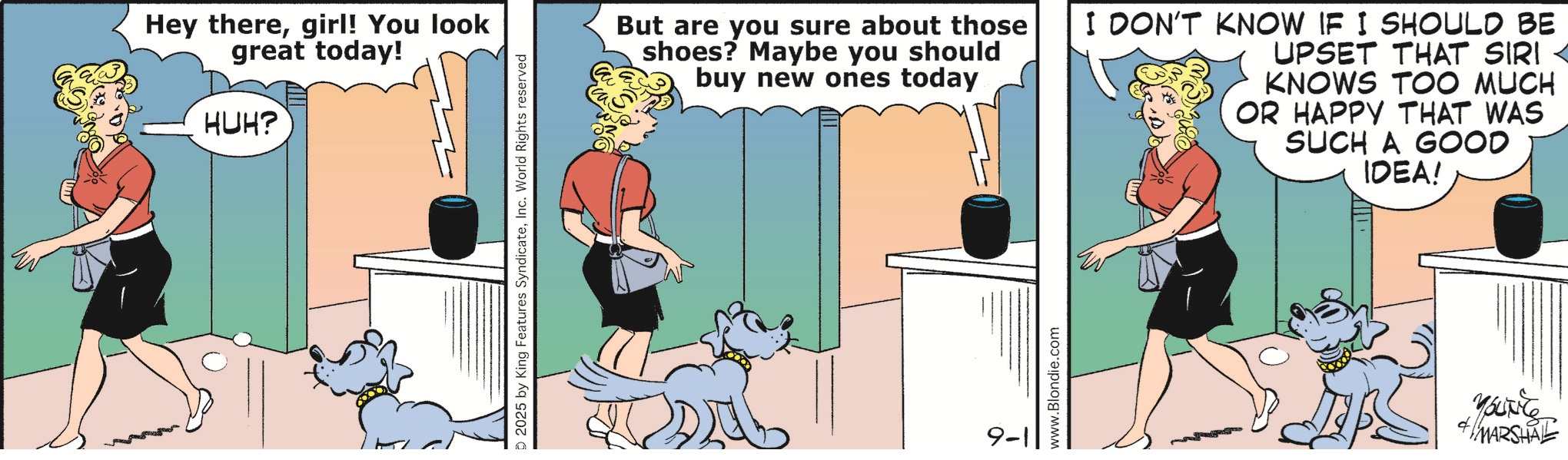
September 1, 2025. Writing by D. Young. Art by John Marshall.
—
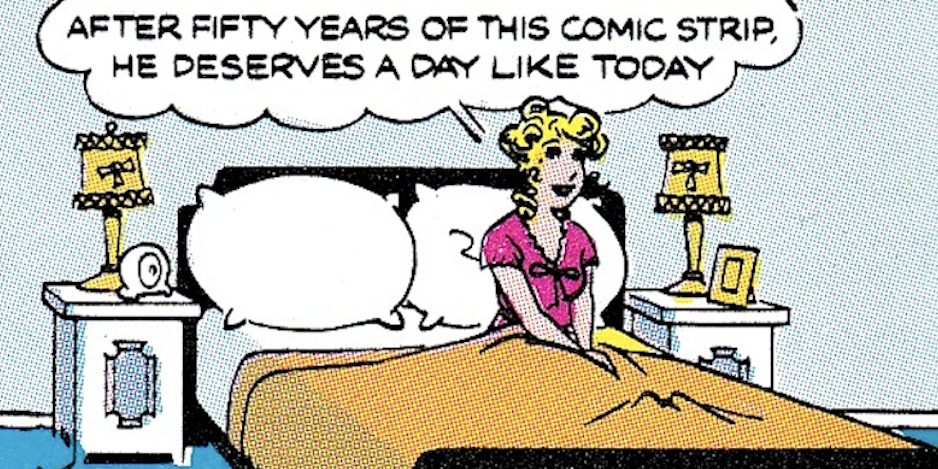
13. In 1980, in honor of the strip’s 50th anniversary, Dean Young and Jim Raymond did a special Sunday, finally allowing Dagwood a day without frustration. We only have five more years to wait to find out what is planned for the 100th!

Sunday strip, September 7, 1980. Writing by D. Young. Art by J. Raymond.
—
MORE
— Dig This 1980 Comics Documentary — Hosted by LONI ANDERSON. Click here.
— POGO’s WALT KELLY: A Life in the Swamp. Click here.
—
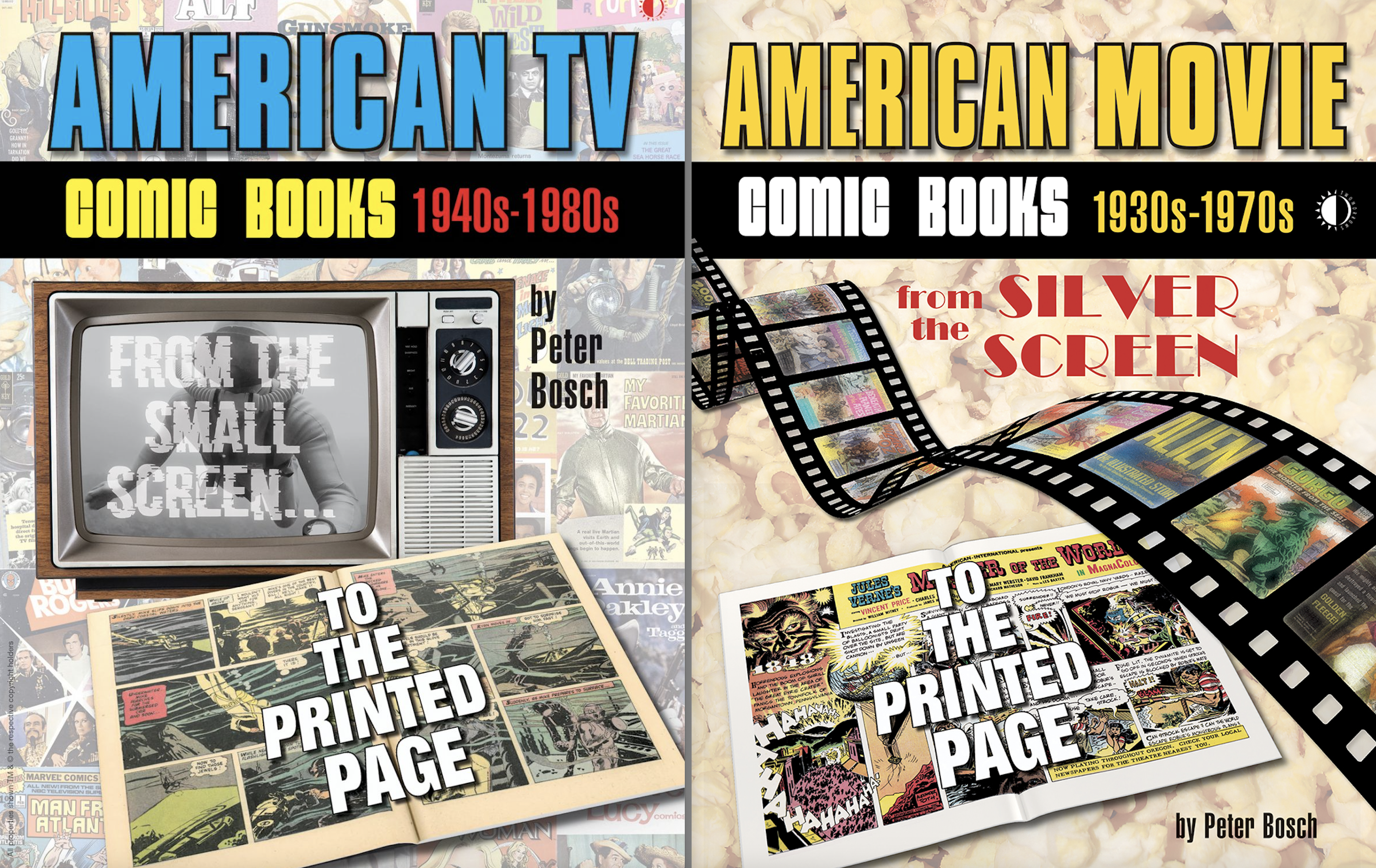
13th Dimension contributor-at-large PETER BOSCH’s first book, American TV Comic Books: 1940s-1980s – From the Small Screen to the Printed Page, was published by TwoMorrows. (You can buy it here.) A sequel, American Movie Comic Books: 1930s-1970s — From the Silver Screen to the Printed Page, is out now. (Buy it here.) Peter has written articles and conducted celebrity interviews for various magazines and newspapers. He lives in Hollywood.

September 9, 2025
Thanks for a fantastic piece Dan, I’ve read very little Blondie – if it’s ever run in the UK it hasn’t been in any papers I know – but find those I do see charming.
Even if Dagwood, with those killer clown eyes, IS terrifying.
September 9, 2025
Thanks! All credit to Peter Bosch!
December 13, 2025
It says “(written) by Peter Bosch*” and “posted by Dan Greenfield” so I am not certain exactly whom to thank the most. Thanks to both guys, I guess!
It’s a crime that much original art was thrown away after it went to print followed by nobody bothering to save their pulp Sunday funny pages. I will personally archive this fine digital 13th-dimensional page right now for posterity.
No, I did not know that Blondie’s maiden name was Boopadoop. Cute!
Great trip into the “Lost World of Dagwood & Blondie” and glad that I seem to have stumbled upon it by accident.
*Any relation to Hieronymus Bosch?
Best, ~ Lloyd
December 13, 2025
All the credit goes to Peter! He pitched the story, wrote it and provided the art. As editor, I approved it, formatted it and posted it.
September 10, 2025
Thanks for a thorough history of one of my favorite comic strips. I think it really has held up well for being as old as it is. But I think, to offer more story possibilities, it’s time for Alexander and Cookie to grow up and make Blondie and Dagwood grandparents!
September 11, 2025
Peter, another great look back at such a fantastic strip. I’m going to need to do some research on some treasuries to add to the library. What a great opportunity you’ve been blessed with in being able to research and write about this lost art.
September 11, 2025
I wish they would reprint those Blondie comic books. MadCave Studios, who publishes the King Features Syndicate superhero characters, should get the rights to publish the humor characters as well.
September 12, 2025
I’ve been reading Blondie since I started reading as a little kid. I never dreamed there would be the links between the strip and Flash Gordon!!