A BIRTHDAY SALUTE bounty from the Golden and Silver Ages…
By PETER BOSCH
Edmond Hamilton was one of last century’s greatest science-fiction novel writers. He was also one of the best comic book scribes that ever worked for DC (for 25 years, from 1941 to 1966).
In past years, I’ve written of his work on the Superman titles, as well as his Superman/Batman/Robin team-up stories for World’s Finest Comics. So, it is about time I do the same for the decade and a half he came up with some very fun, and some very serious, scripts for the Gotham Guardian in Batman, Detective Comics, and World’s Finest (before Batman and Superman teamed up).
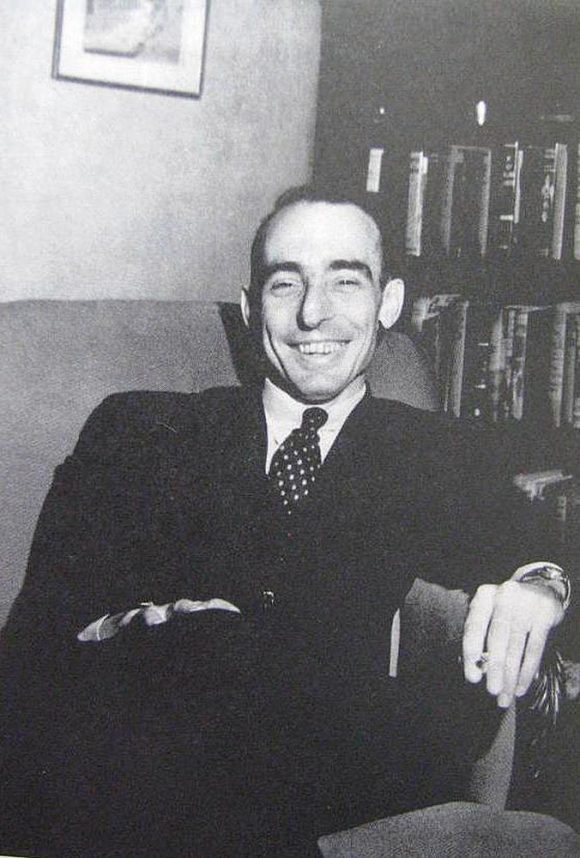
Hamilton
Of course, probably the most famous of his Batman stories was the introduction of Batwoman 70 years ago, in Detective Comics #233 (July 1956):
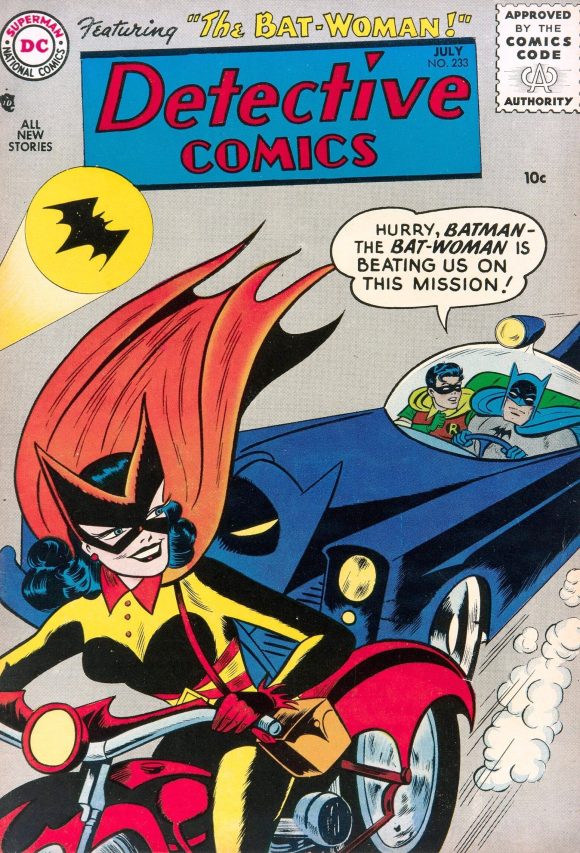
Cover art by Sheldon Moldoff
However, I sincerely believe there were many others, just as entertaining, so here are 13 of my favorites in celebration of his birthday (born October 21, 1904).
In chronological order, by cover date. Enjoy!
WARNING: SPOILERS FOR DECADES-OLD COMIC BOOKS AHEAD!
—
1. “Killer for Hire!” World’s Finest Comics #34 (May-June 1948) contains one of Hamilton’s earliest and most powerful Batman stories. The tale opens with the ending, a corpse on a slab, a toe tag saying he is “Unidentified” and “Shot by Police, resisting arrest.” The story then looks back at the life of Jim Durfee, a psychotic youth who loves using guns and dreams of killing so he can see people scream and fall over dead. It is not long after that he starts his life of crime, stealing and then cold bloodedly murdering the victims so they can’t talk.
As an adult, he becomes a hired assassin at $1,000 per assignment. After Gotham’s district attorney is killed, Batman learns the assassinations were arranged by leaving the money at a specific location with a note saying the name of the person to be killed. In disguise, Batman drops off the cash with the name of the victim — Bruce Wayne.
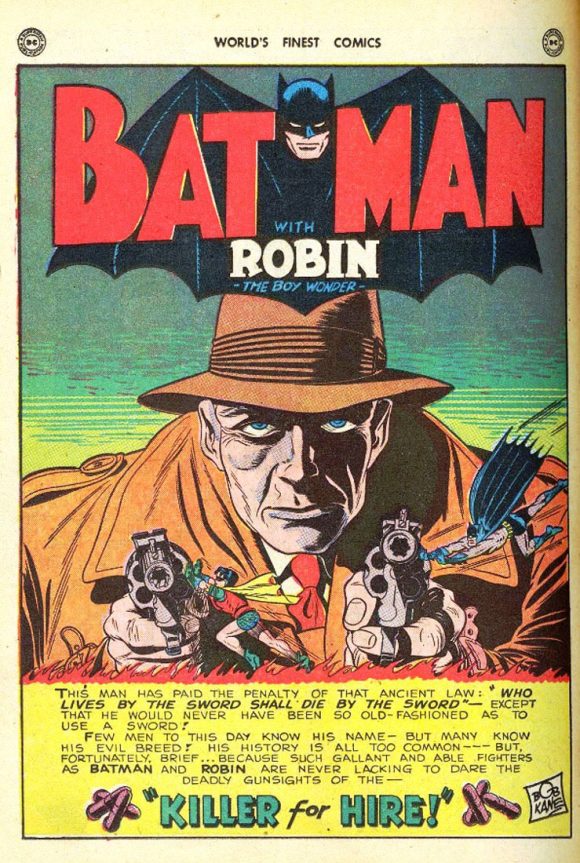
Dick Sprang art
Bruce arranges it so Durfee fails, shaking the killer’s confidence. He plants an item in the newspaper that he will be opening the county fair, which the assassin reads. Durfee sets himself up in a tower — but Batman and Robin are ready for him. Realizing it’s a trap, he manages to escape them. However…
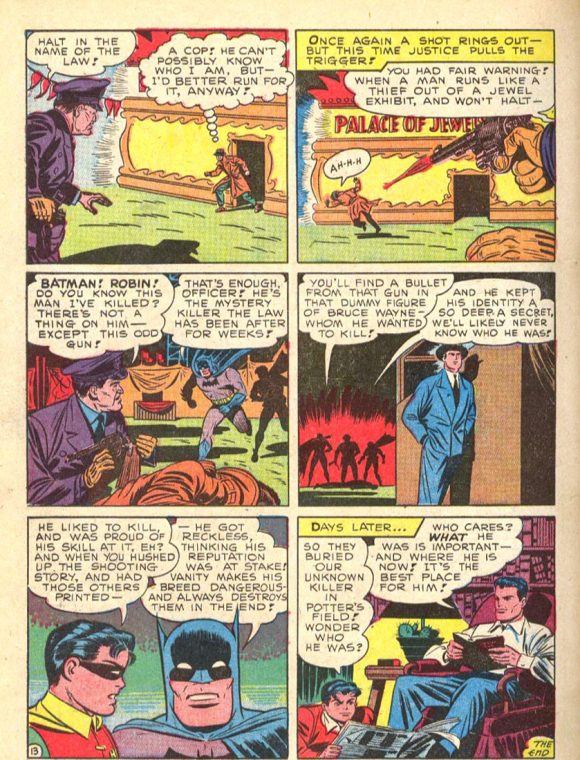
As I said, one of the most powerful Batman tales of that period!
—
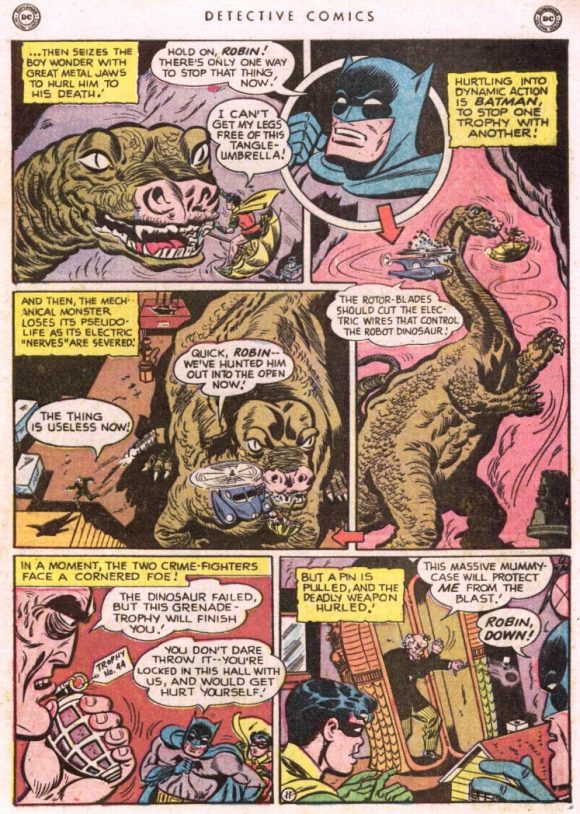
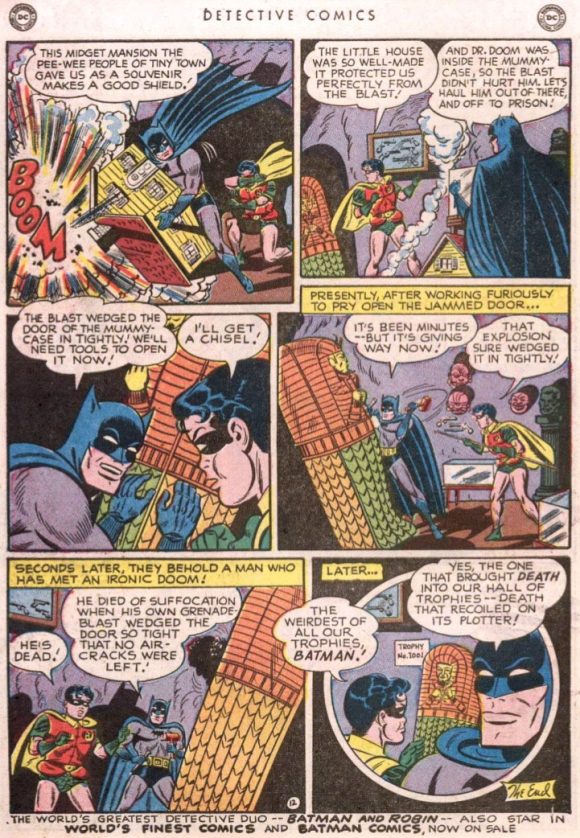
2. “The Thousand and One Trophies of Batman!” Detective Comic #158 (Apr. 1950) contains a terrific premise: What if the crime souvenirs in the Batcave were turned against Batman and Robin? Hamilton’s story began with the Dynamic Duo being called to the Gotham pier by Commissioner Gordon as he cornered a notorious smuggler by the name of “Dr. Doom” (12 years before Marvel’s). Doom claims he is just importing some ancient Egyptian relics, including statuettes and an empty sarcophagus. Batman detects the statuettes were recently made and he breaks one open to reveal a cache of rare jewels. Doom dives off the pier to escape capture. When he doesn’t come up, they believe he has drowned and the case is closed.
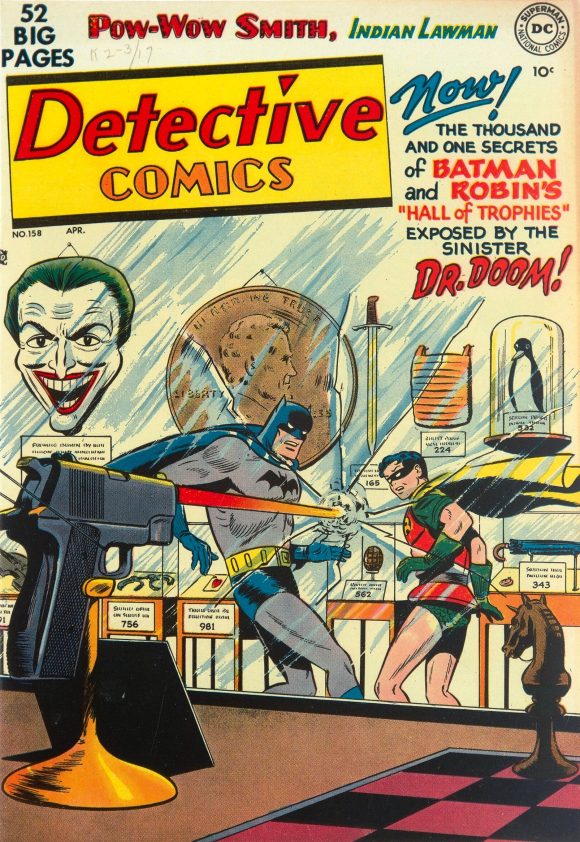
Cover art by Win Mortimer
Doom climbs back onto the pier when they are distracted and hides in the sarcophagus, which he can breathe in because the mummy case is old and the cover has developed small cracks that let in oxygen. Unaware of his being in there, Gordon gives Batman the sarcophagus as a “trophy” for the Batcave. Batman accepts, little knowing he’s actually smuggling the smuggler away from the pier — and into the Batcave!
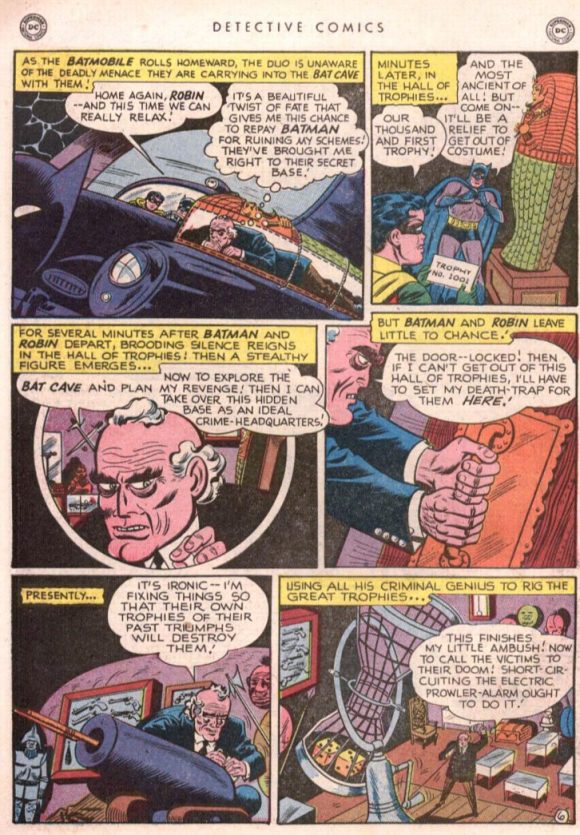
Bob Kane (pencils) and Charles Paris (inks)
In his battle inside the hall of trophies, Doom even uses the famous mechanical dinosaur against the crimefighters.
—
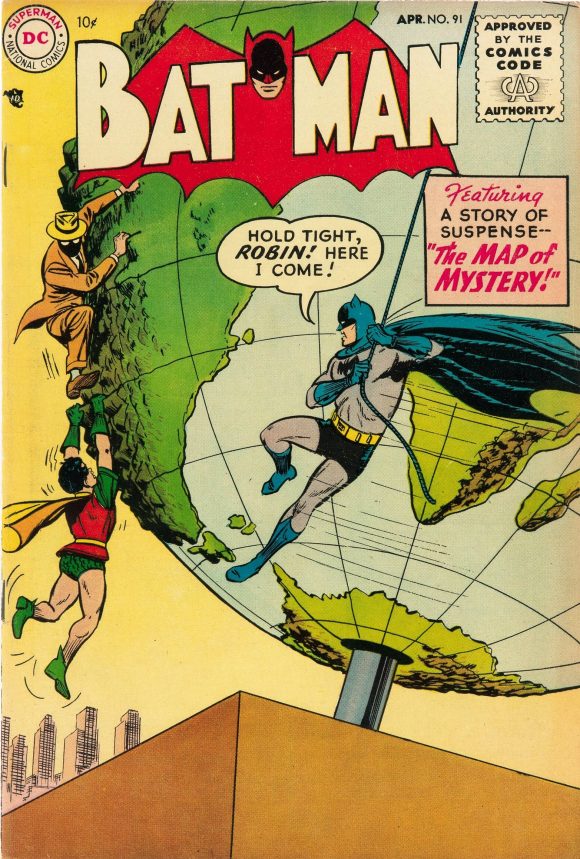
3. This choice is actually a combo salute to four mystery stories that Hamilton wrote: “The Danger Club” (Batman #76, Apr.-May 1953); “The Mystery of the Four Batmen! (#88, Dec. 1954); “The Map of Mystery!” (#91, Apr. 1955); and “Mystery of the Sky Museum!” (#94, Sept. 1955).
Mortimer
The premises are the same as many whodunit movies and detective novels of old: Have several suspects on hand, one of whom is usually after some treasure and is willing to kill the others to get it, until a great detective comes along to reveal who it is. These Batman tales were always fun to try to solve.
—
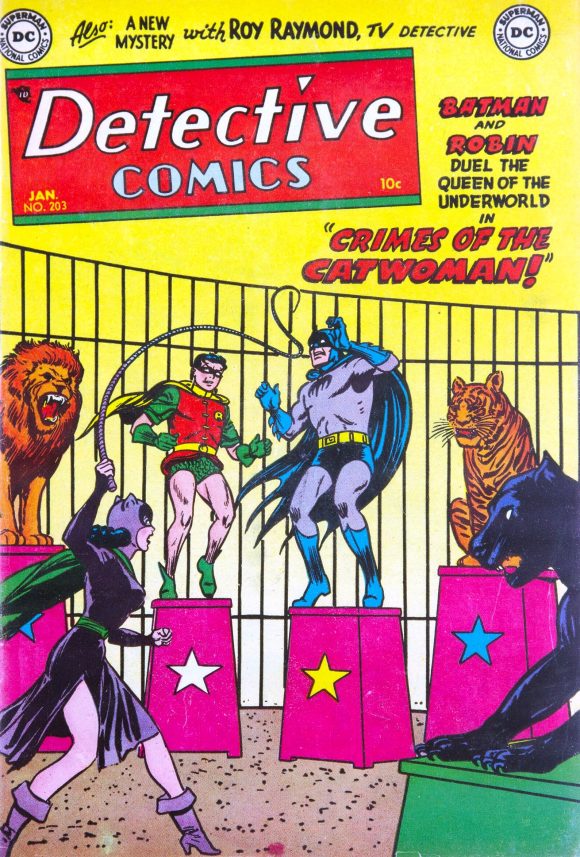
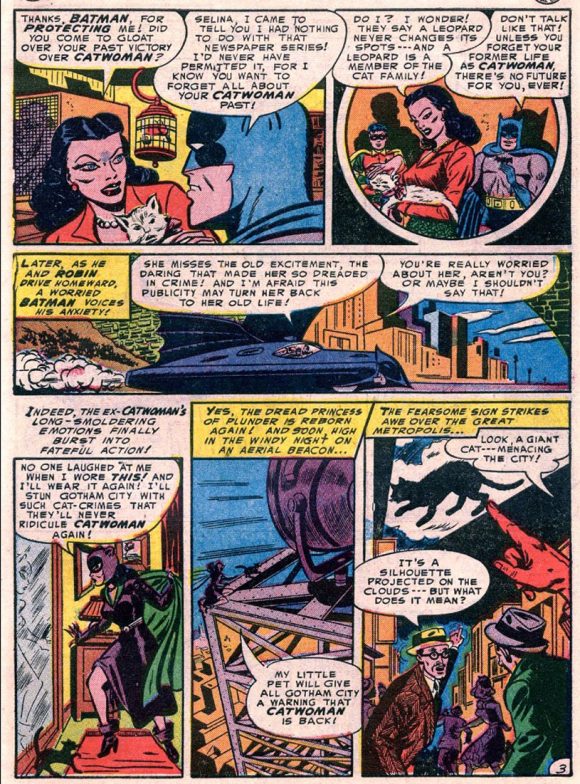
4. “The Crimes of the Catwoman!” She’s back! After a try at retiring and running a pet shop, Selina Kyle returns to a life of crime in Detective Comics #203 (Jan. 1954).
Mortimer
Hamilton equips her with a new catacomb hideout, a super-charged Kitty Car, and “cat” gimmicks to use in her various robberies. A battle of wits ensues between her and Batman… as well as a battle of suppressed emotions. When her gang has Batman helpless and are about to kill him, she stops them and admits, “I couldn’t bear to see him killed. I — mean, we’ll take him along — as a hostage!” He escapes, of course, and thwarts her big crime of robbing a yacht owner of his collection of cat’s-eye jewels. She gets away, as she has many other times, and her fate is unknown. (The last panel is a big question mark.)
Bob Kane (pencils) and Paris (inks)
Actually, her fate remained unknown for only a few months, as she returned in Batman #84, June 1954, and then in a Hamilton-written story in Detective Comics #211, September 1954 – which would be her last Golden Age appearance. The next time Catwoman was seen was in the Silver Age in Superman’s Girl Friend, Lois Lane #70, November 1966.
—
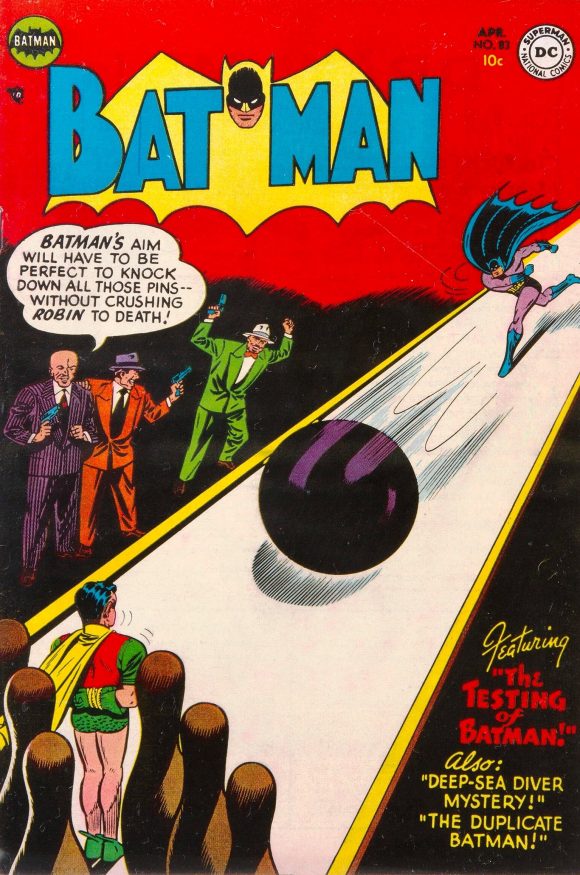
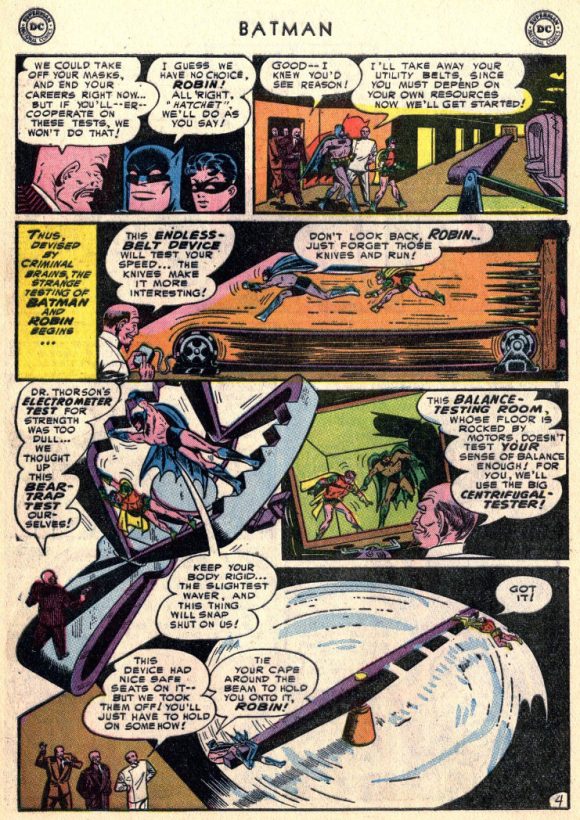
5. “The Testing of Batman!” There are stories Hamilton wrote where it is clear he was having the time of his life. Batman #83 (Apr. 1954) contains one of his best, wherein our heroes are captured by criminals who – for fun – put them through endurance tests on a series of giant, absurd machines that Dick Sprang excelled at drawing (with Charles Paris inking).
Mortimer
The real tests are next, in which the crooks’ plan is to have Batman unknowingly show them how to get through a series of mockups that duplicate the tight security of the Gotham Mint. Needless to say, he catches on to the scheme and turns the tables — or, rather, the giant machines — on them!
Sprang (pencils) and Paris (inks)
—
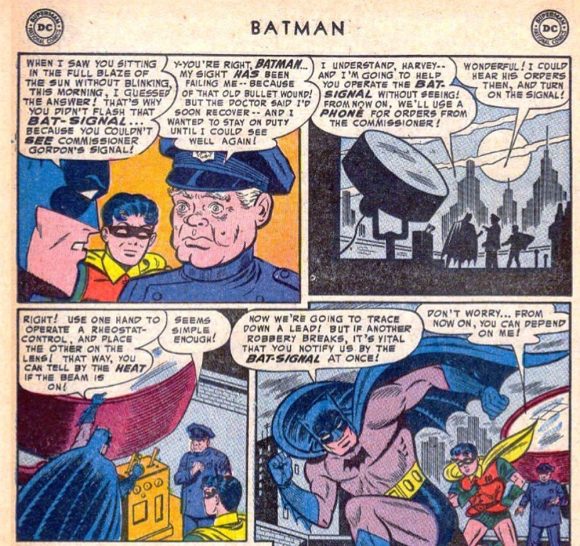
6. “The Guardian of the Bat-Signal!” A very human tale about an elderly police sergeant, Harvey Hainer, appears in Batman #85 (Aug. 1954). An old gun wound from a crook has made him slower, and Commissioner Gordon feels Hainer is past his usefulness and he should retire. The sergeant pleads to keep his job and Batman convinces Gordon to have him maintain the Bat-Signal. However, Hainer fails to activate it when the need for Batman arises and Gordon wonders if Hainer is in league with criminals. The Caped Crusader observes him secretly for a while and suddenly realizes the truth — Hainer is blind!
Kane (pencils) and Paris (inks)
Hamilton sets this complication up for the true obstacle to come — which, in turn, opens the way for a man to overcome the limitation life has put upon him.
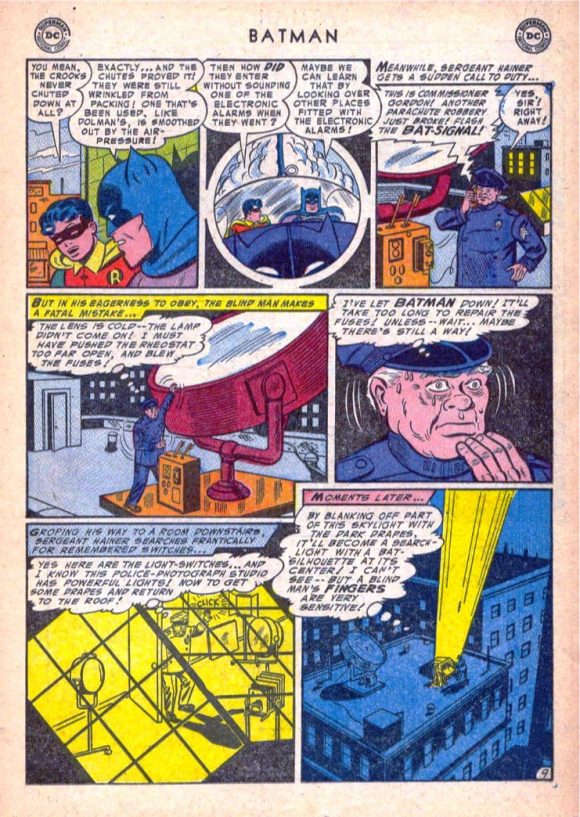
Gordon rewards him with a paid vacation and Hainer requests the same assignment when he returns, stating, “It isn’t everyone who can say he’s a partner of Batman!”
—
7. “The New Batman.” Fans of the Batman TV show will remember when Alfred wore a Batman outfit to divert suspicions away from Bruce Wayne. Alfred has also done so in the comics, but he always knew he wasn’t really the Caped Crusader. That is until Batman #94 (Sept. 1955) when he tries on one of Batman’s costumes while the duo are out fighting crime and his head is struck very hard by a crime souvenir. He gets amnesia, but as soon as he looks in the mirror and sees himself in the costume, he remembers who he is — Batman!
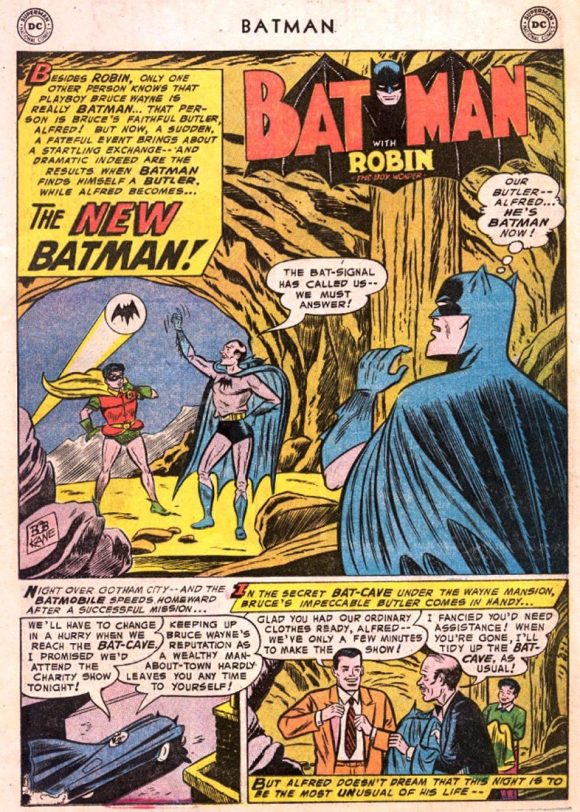
Moldoff (pencils) and Stan Kaye (inks).
In order to find a way to gently restore his memory, Bruce and Dick go along with the farce, with Robin now working with “Batman” — and Bruce becoming his butler’s butler.
—
8. “If I Were Batman.” Detective Comics #225 (Nov. 1955) features another humorous tale, with several very unqualified men of Gotham City getting a chance to be Batman for a day, while he is away, as their reward for raising money for a police widows and orphans fund. Robin tutors the men each day individually, but the most unskilled of all is the last to play Batman in public: Bruce Wayne.
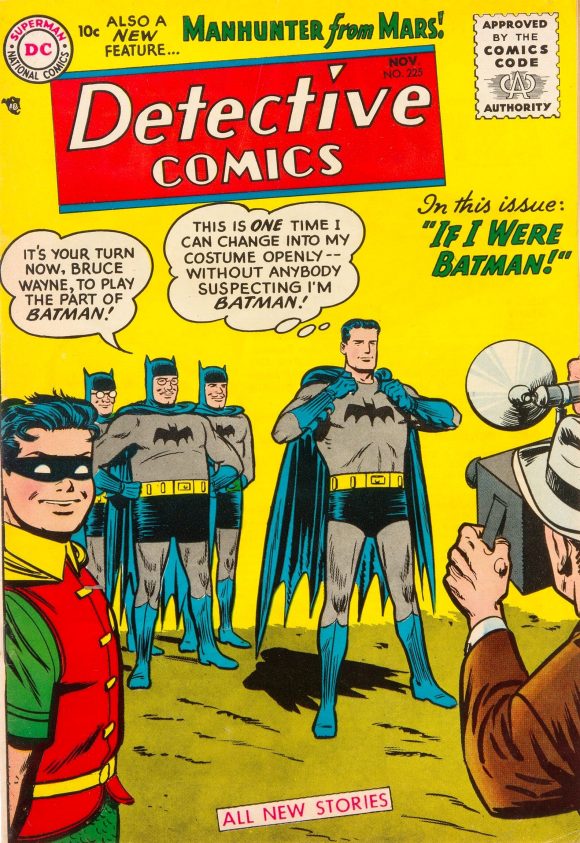
Mortimer
—
9. “Batman – Frontier Marshal.” Way back in Batman #24 (Aug.-Sept. 1944), writer Joe Samachson had Professor Carter Nichols send Bruce and Dick on their first trip back in time. Following that, other writers contributed their fair share of century-hopping tales involving the Dynamic Duo — including Hamilton, who flung them back to ancient Greece (Batman #38, Dec. 1946-Jan. 1947), the Stone Age (#93, Aug. 1955), and the Roman Empire (#112, Dec. 1957)!
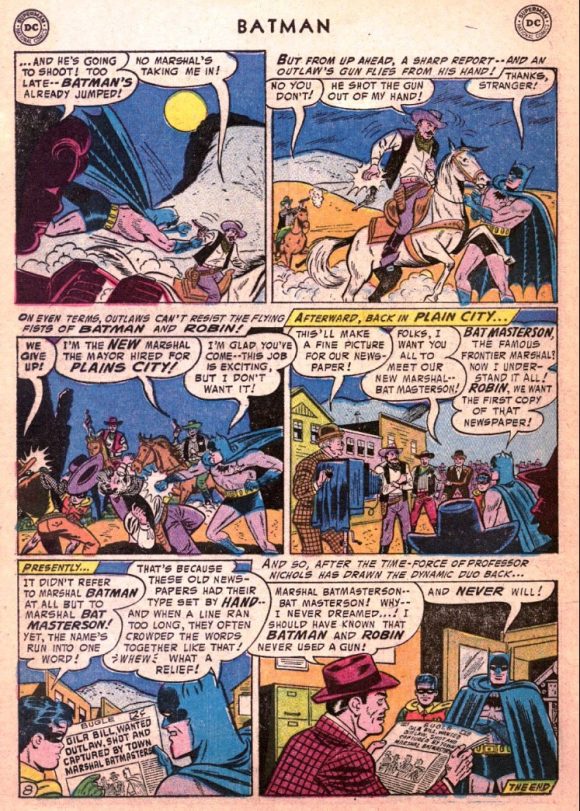
Those stories were all engaging (and sometimes educational), but Hamilton definitely had his tongue in cheek when the pair went to the Old West to investigate a recently discovered newspaper headline from 1880 in Batman #99 (Apr. 1956):
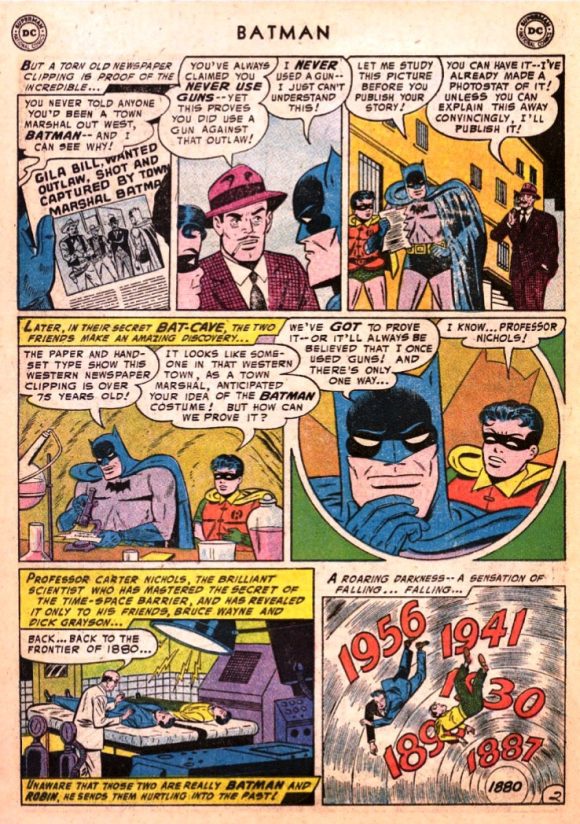
Moldoff (pencils) and Paris (inks)
No sooner do they arrive than they see a badman sabotaging a train’s safety valve, and they quickly switch into their costumes and capture him. The townspeople, waiting for a new marshal to arrive, make Batman their temporary lawman and Robin becomes his deputy. With no Batmobile, Robin paints a stagecoach in dark colors and adds the image of a bat, making it their Bat-Coach. During his time as the temporary Marshal, Batman stops a cattle stampede, a prairie fire, and uncovers a secret boss planning to destroy a bridge and the train. Batman and Robin are about to capture the gang but —
—
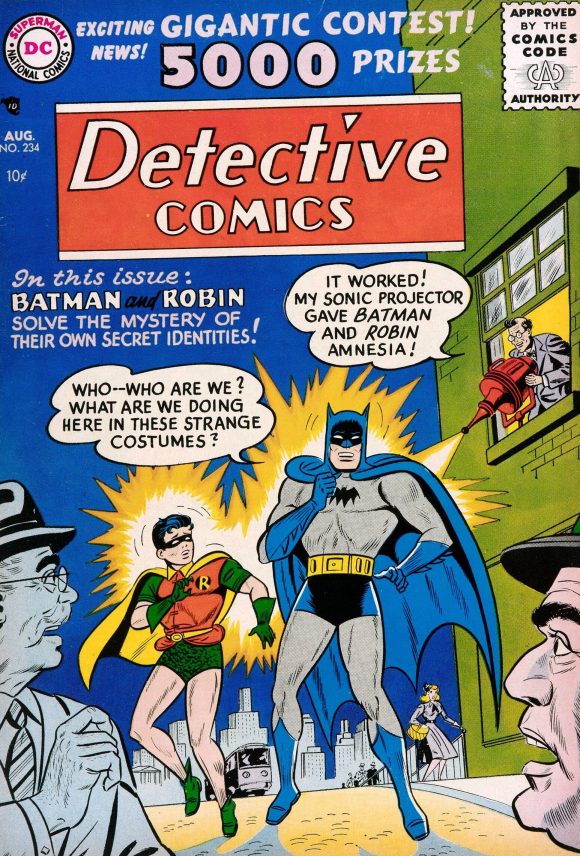
10. “Batman and Robin’s Greatest Mystery.” How do you discover who you are when you lose your memories? That’s what the Dynamic Duo has to figure out in Detective Comics #234 (Aug. 1956) after criminals turn a stun ray on them, which gives them – you guessed it – amnesia. Commissioner Gordon would know who they were if he saw them without their masks, but he continues to let their true identities remain a secret, even from him. When they are alone, Batman and Robin unmask for each other but still don’t know who the other is. Since they are the world’s greatest detectives they begin to piece together clues from looking at police case files and talking to people.
Moldoff
Gordon says Batman told him early on he chose to help the police because he was a victim of a crime himself. A company owner tells them he wrecked his own machines when crooks tried to use them to kill Batman, and the next day the Caped Crusader showed up with $90,000 from his “personal fortune” to help the owner buy new machinery. Newspaper stories related his expertise flying the Batplane. Callouses on his hand match those caused by a polo mallet. And Batman reasons that Robin must be his son. Putting it all together… victim of crime, wealthy, a pilot, a polo player, and lives with a young boy… they arrived at Wayne Manor. Alfred greets them and they suddenly remember who they are. And they rush right out to capture the crooks who did this to them!
—
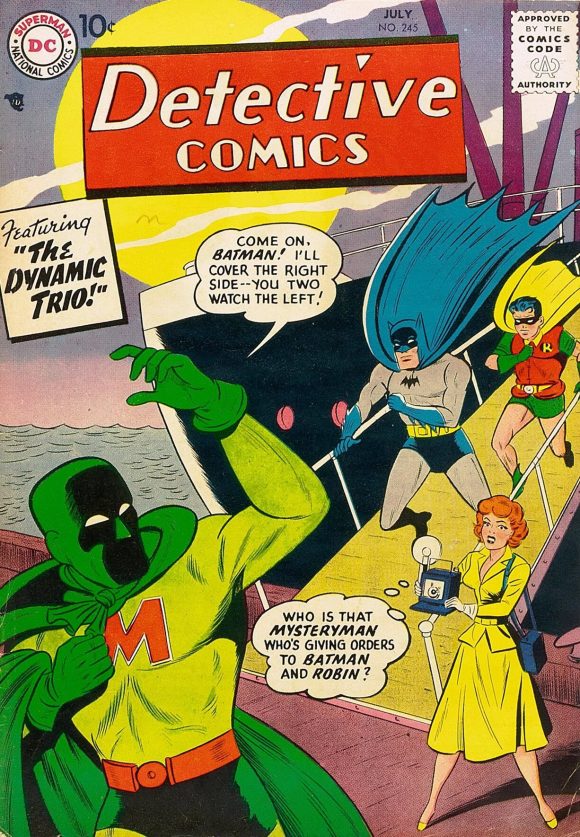
11. “The Dynamic Trio.” In Detective Comics #245 (July 1957), the citizens of Gotham are shocked to see Batman and Robin teaming up with a new hero, Mysteryman, and they are twice as stunned to hear him telling the Dynamic Duo what to do. Vicki Vale, the Gotham City version of Lois Lane, determines Mysteryman must either be a robot or Superman, and sets out to get the scoop on which he is. (He is neither, by the way, nor is he Alfred… but – hint, hint – Mysteryman is related to a future star of the Batman Family.)
Moldoff
—
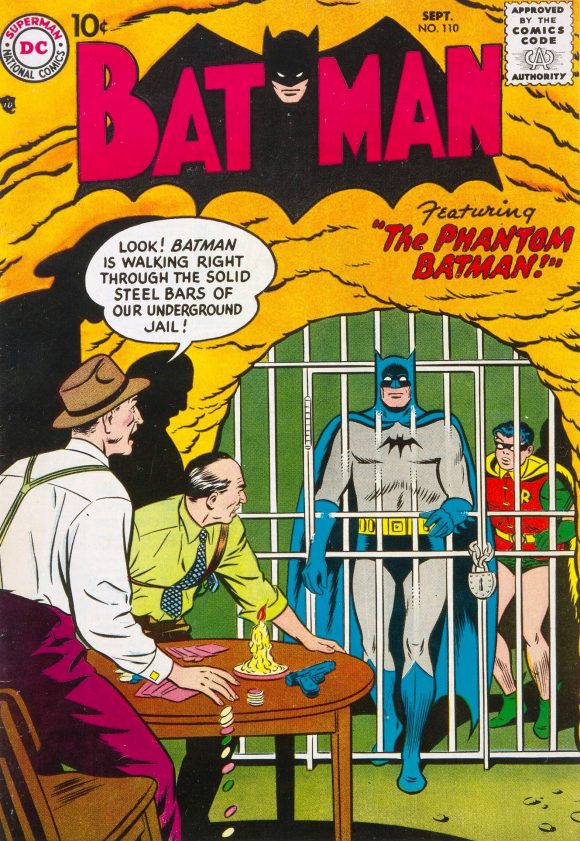
12. “The Phantom Batman.” One of my favorite tales from this era is in Batman #110 (Sept. 1957). Batman is suddenly transformed by a scientific accident into a semblance of himself but with no bodily substance. He can walk through solid objects but he can’t touch anyone or anything because he is like a ghost. However, this does mean Robin – still fully solid – is in danger from crooks who capture him and it stops Batman from taking any action. With no physical body, Batman is forced to rely entirely on his wits alone… and that is something Edmond Hamilton excelled at in his story plotting.
Curt Swan (pencils) and Kaye (inks).
—
As earlier mentioned, all the above are in chronological order by cover date. However, I’ve left off one until now because I feel it is Hamilton’s best Batman story:
13. “The True Story of Frankenstein!” As befitting one of the greatest horror stories of all time, Hamilton’s tale in Detective Comics #135 (May 1948) is filled with many a moment of dread and menace. (Capably illustrated by Kane, pencils, and Paris, inks, it was said by DC at one time the artwork was by Lew Sayre Schwartz.)
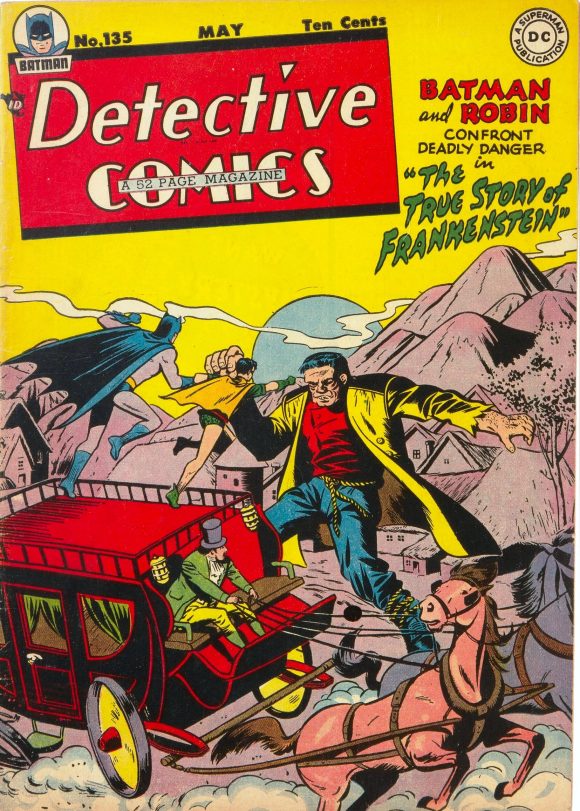
Kane (pencils) and Paris (inks) with art on the Batman and Robin figures by Moldoff.
This is a story that is best read by you and not described by me… so here it is:
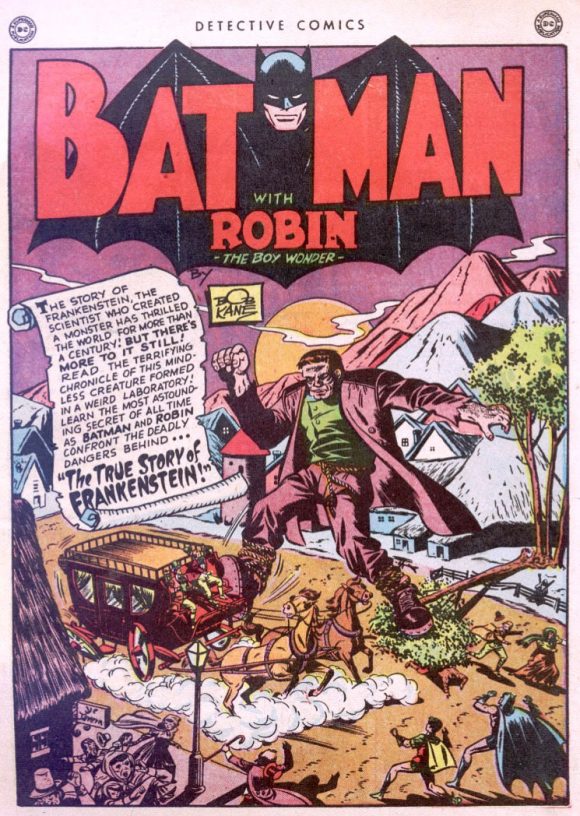
Kane (pencils) and Paris (inks)
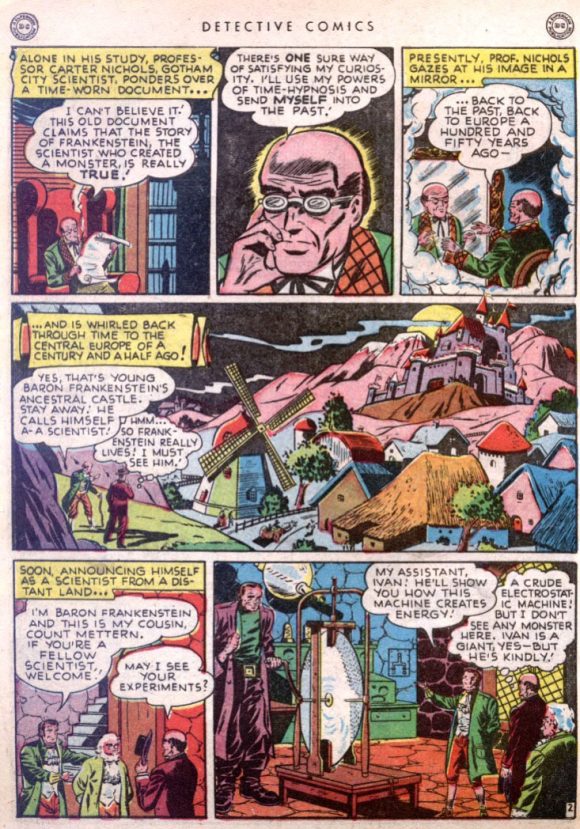
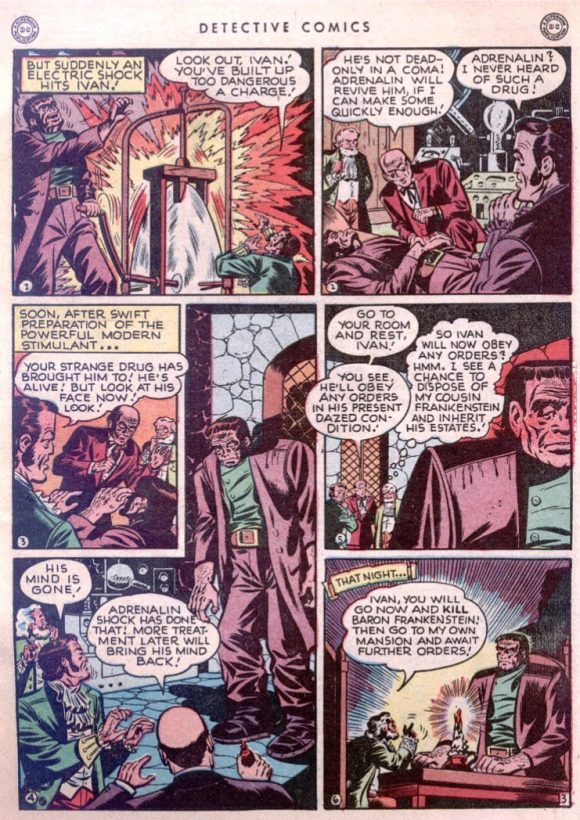
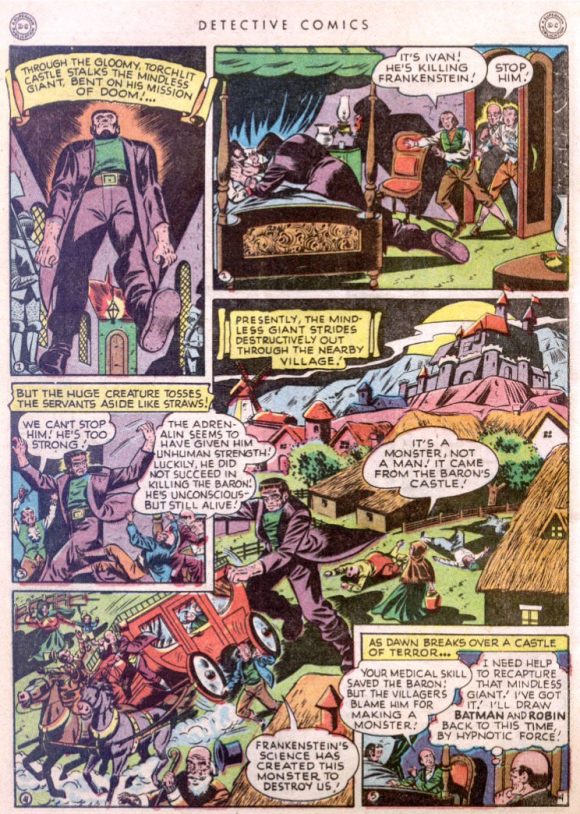
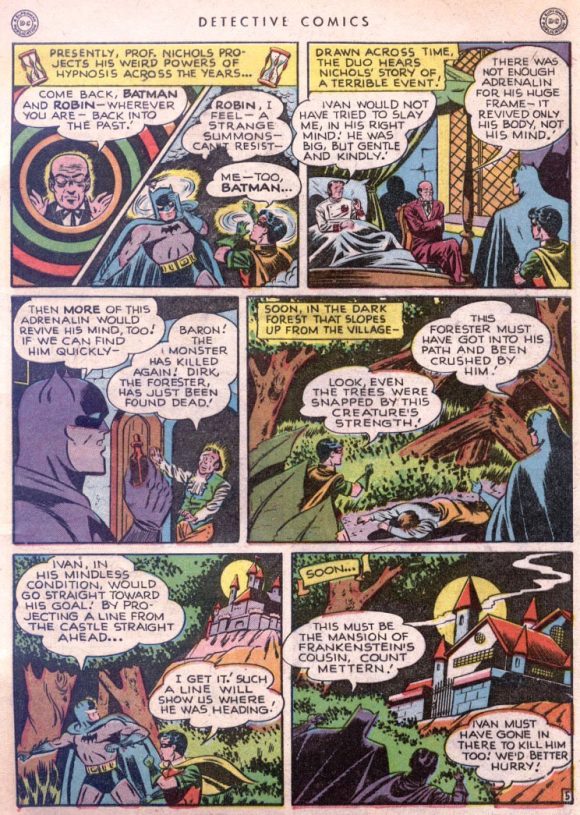
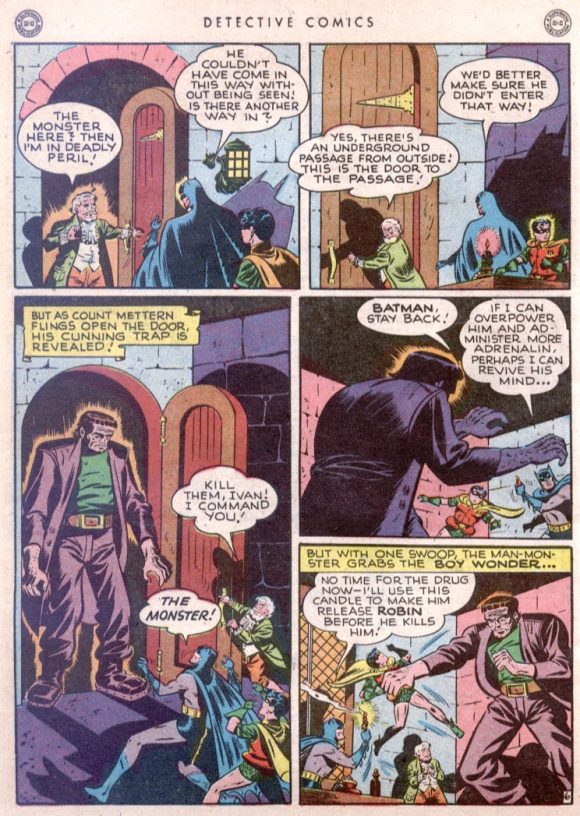
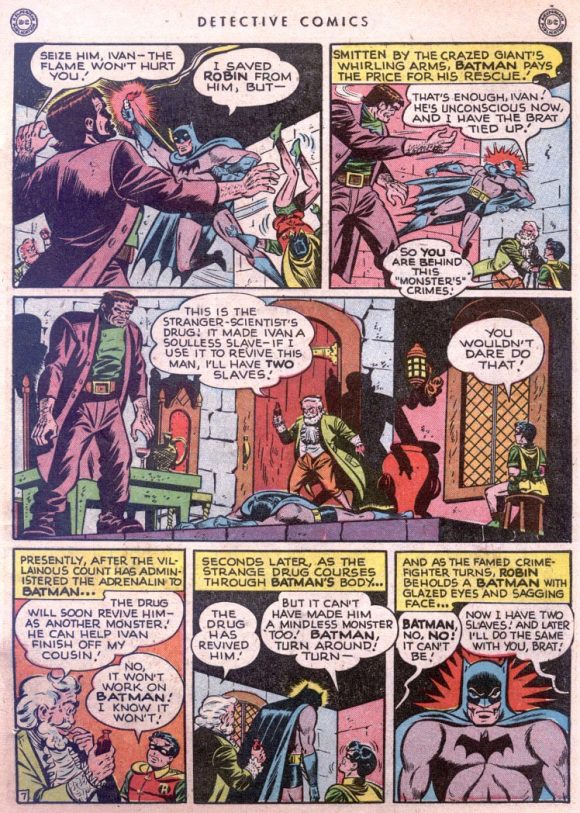
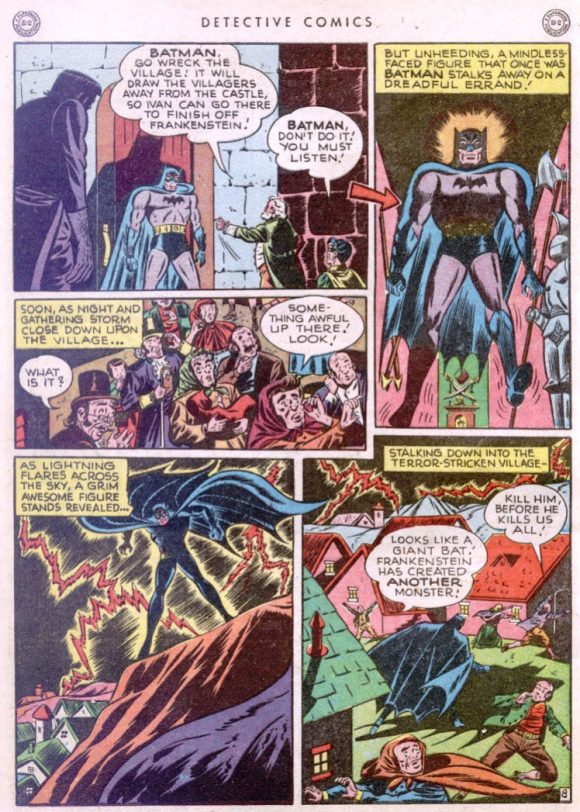
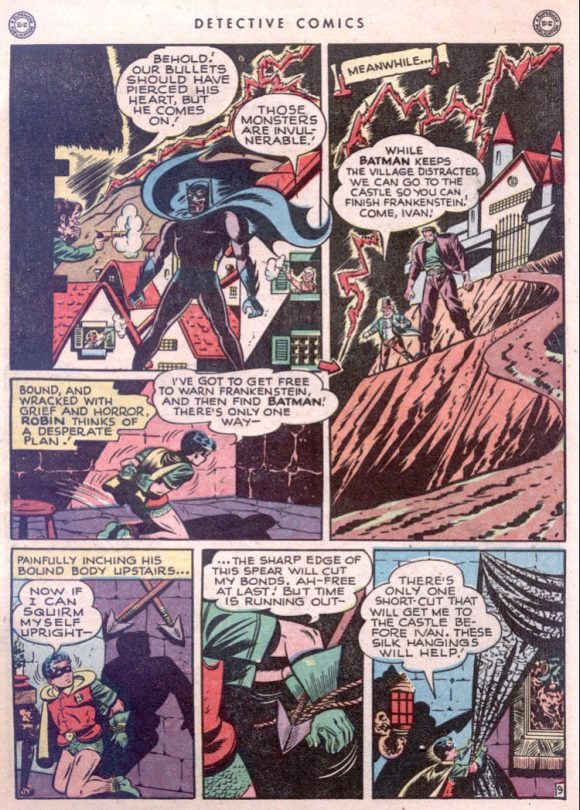
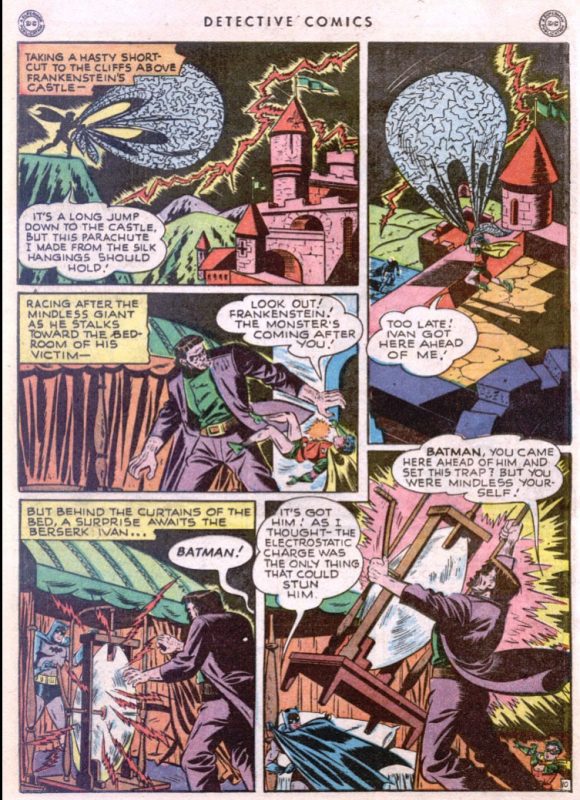
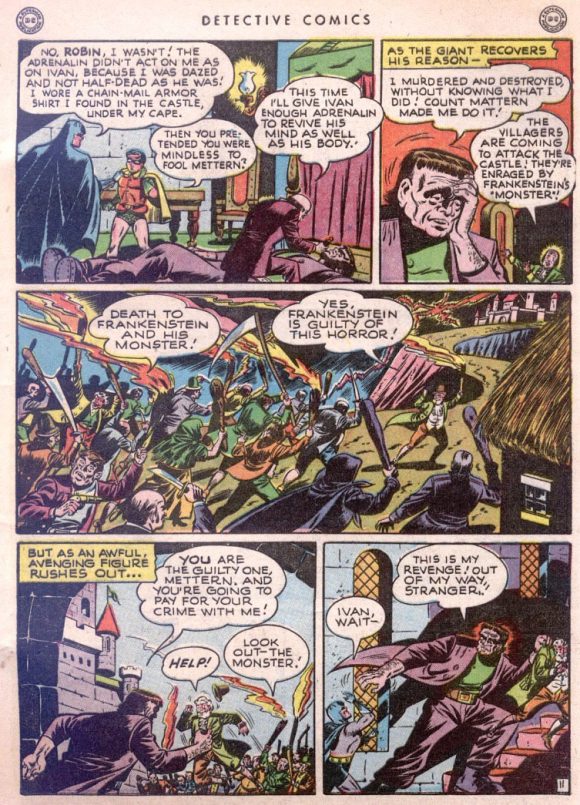
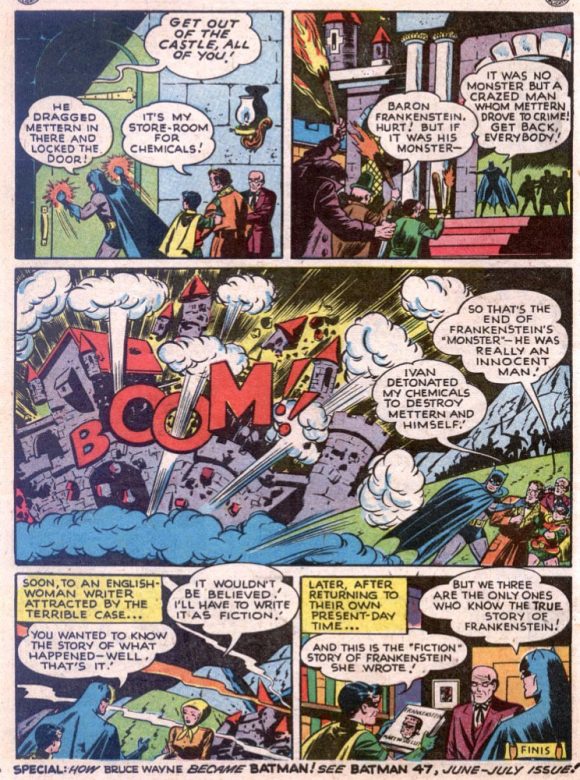
Hamilton’s skill in storytelling was such that you may not even have noticed that Batman and Robin did not make an appearance in the tale until Page 5. In retrospect, though, I do have one query: The capability of Nichols to just summon the Dynamic Duo to that time period was something new in the canon. Previously, Nichols had only hypnotized Bruce and Dick, never Batman and Robin. So, how did he know he had control over them? Did the Professor know Bruce and Dick were Gotham City’s protectors? Did they have a slip of the tongue while sitting in the chair under hypnosis during a previous session?
On a final note in this tribute to Edmond Hamilton, to prove what I said at the beginning of this article that he was a well-regarded author of tales of the future, here are two Batman splash pages that just may have inspired DC in years to come:
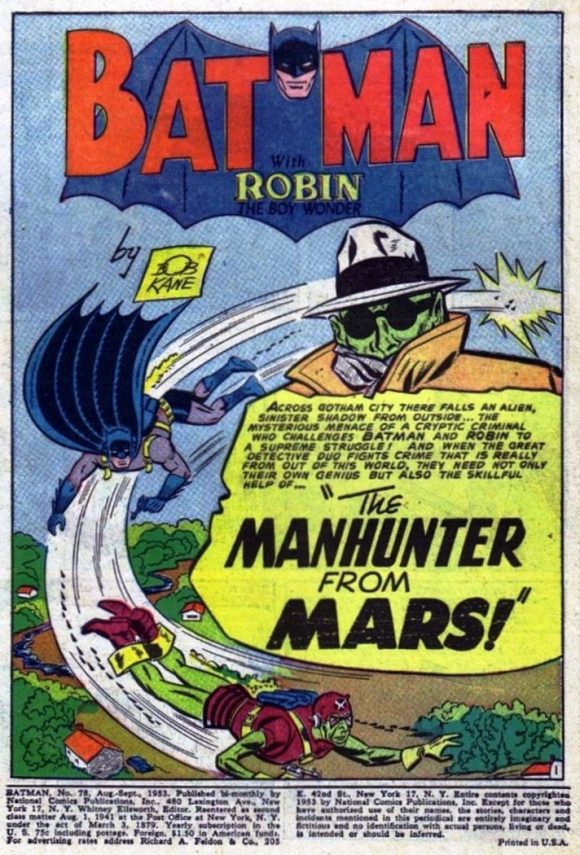
Batman #78 (Aug.-Sept. 1953). Pencils: Bob Kane (Batman and Robin figures) and Lew Sayre Schwartz. Inks: Paris. (The Martian Manhunter we know was officially introduced in Batman #225, seen above in the No. 8 spot.)
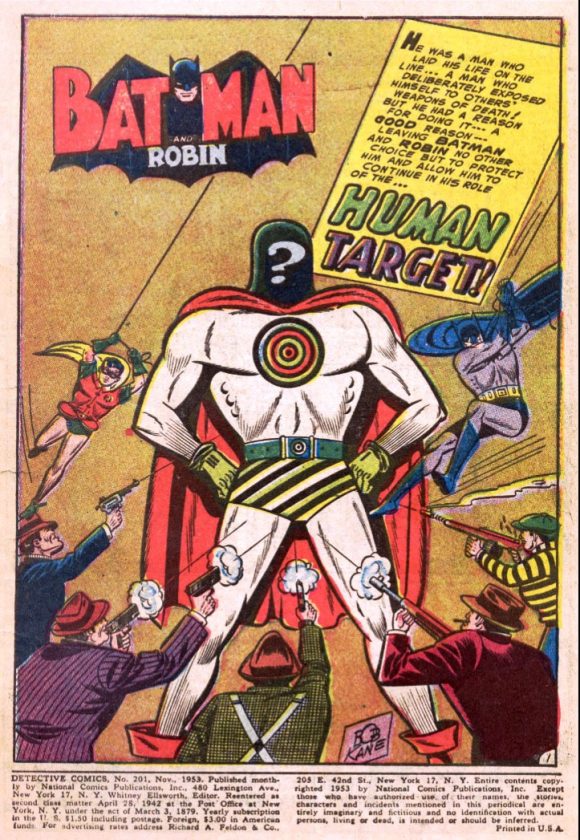
Detective Comics #201 (Nov. 1953). Moldoff, pencils, and Paris, inks.
—
MORE
— 13 Groovy WORLD’S FINEST Stories: An EDMOND HAMILTON Birthday Celebration. Click here.
— 13 SUPER STORIES: An EDMOND HAMILTON Birthday Celebration. Click here.
—
13th Dimension contributor-at-large PETER BOSCH’s first book, American TV Comic Books: 1940s-1980s – From the Small Screen to the Printed Page, was published by TwoMorrows. (You can buy it here.) A sequel, American Movie Comic Books: 1930s-1970s — From the Silver Screen to the Printed Page, is out now. (Buy it here.) Peter has written articles and conducted celebrity interviews for various magazines and newspapers. He lives in Hollywood.