
SCOTT SHAW! SATURDAYS: An early birthday tribute to Mike Sekowsky…

By SCOTT SHAW!
I’ve liked Mike Sekowsky’s artwork since I was a kid, and I never thought I’d become his friend and even have the opportunity to ink so many pages of his pencil art for comics. I even got him a job at an animation studio!
I think my first exposure to Mike’s work was in 1956’s Four Color #721 (Dell), which featured TV’s Captain Kangaroo, and included a story about a dinosaur and a Kong-sized gorilla. At the time, I was four years old.
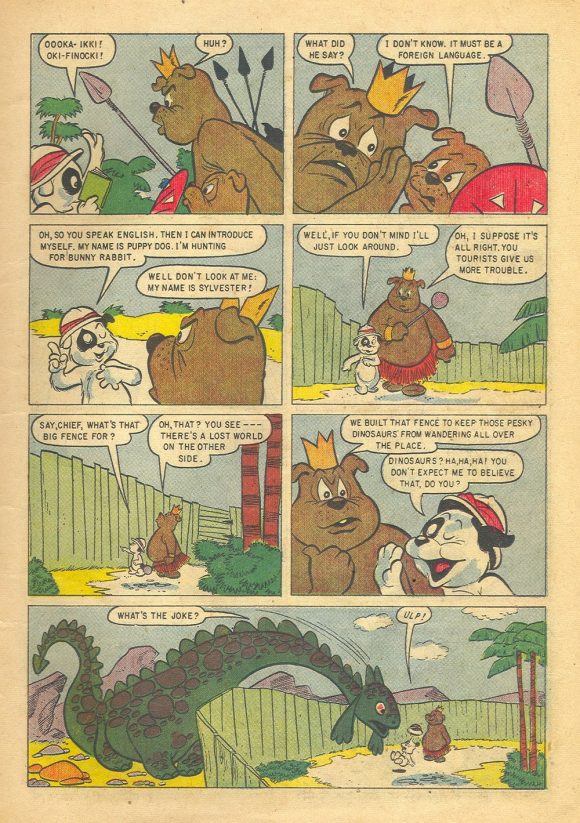
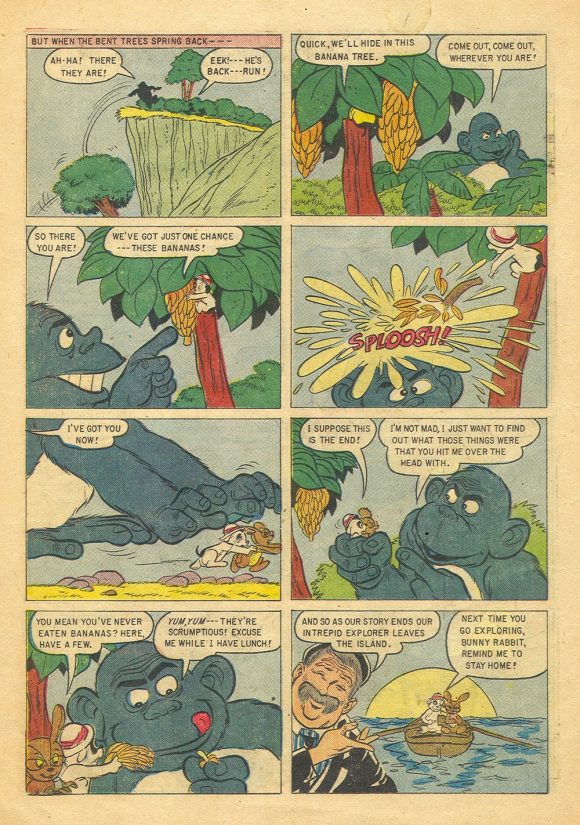
Growing up, I liked a lot of Mike’s art, including DC’s humorous futuristic private eye “Star Hawkins,” his work on the early Justice League of America issues (and especially his designs for the Crime Syndicate of America), as well as his stint on the “new” Wonder Woman with (mostly) Dick Giordano’s inks.
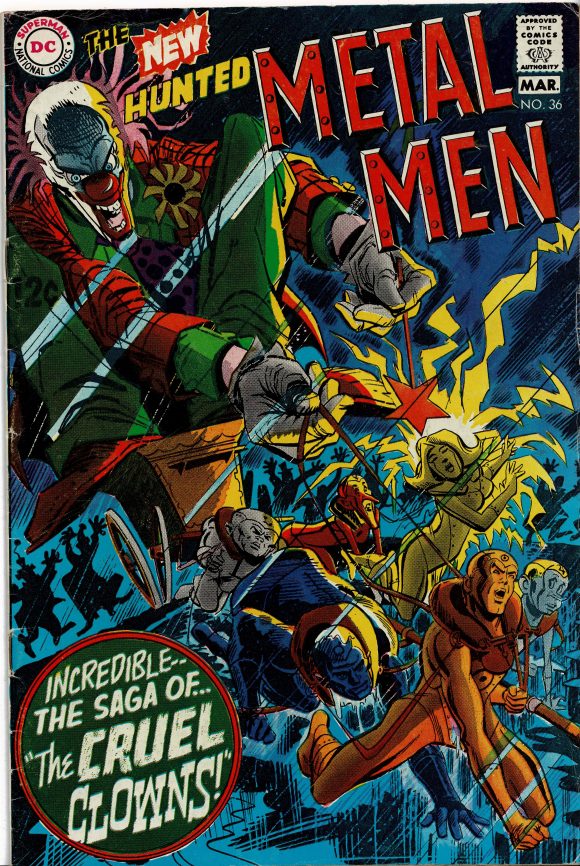
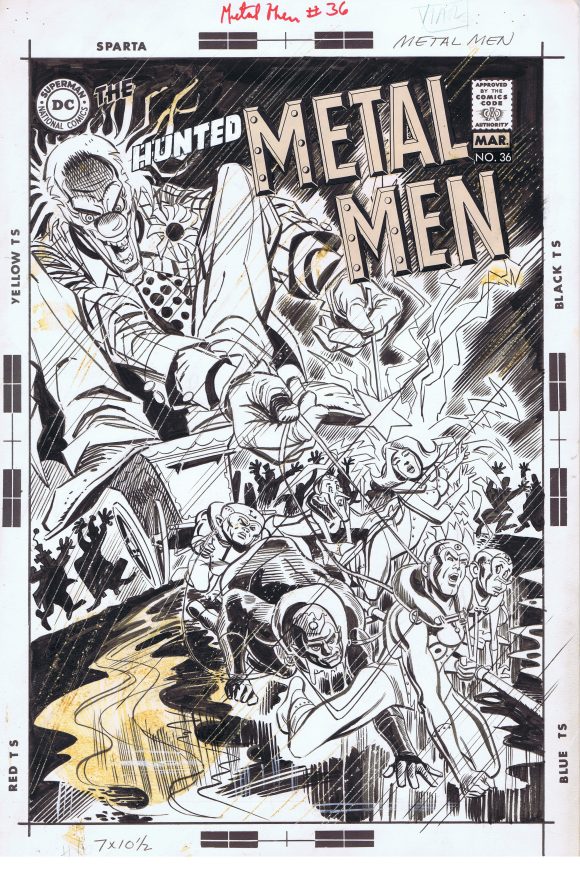
And this cover – and its original art, which Mike gave to me — for 1968’s Metal Men #36 (inked by Giordano):
But it wasn’t until decades later that I learned that the genres that Mike really enjoyed working on were romance comics and humor comics, and his favorite artists were the guys who drew women in the latest fashions for the newspaper advertisements for the May Company, as well as British illustrator Ronald Searle. Mike applied Searle’s influence to DC’s Inferior Five.
Created by E. Nelson Bridwell and Joe Orlando, the Inferior Five first appeared in 1966’s Showcase #62. The team consisted of goofy “loser” superheroes: eyeglasses-wearing Merryman, Awkwardman (a rather lame play on “Aquaman”), Dumb Bunny (now known as Tough Bunny), the overweight Blimp, and effete White Feather (y’know, like Green Arrow?), a model photographer/archer. It seemed to be a hit because Inferior Five became a series, written by Bridwell and now drawn by Sekowsky, with inking by Mike Esposito.
Sekowsky and Esposito
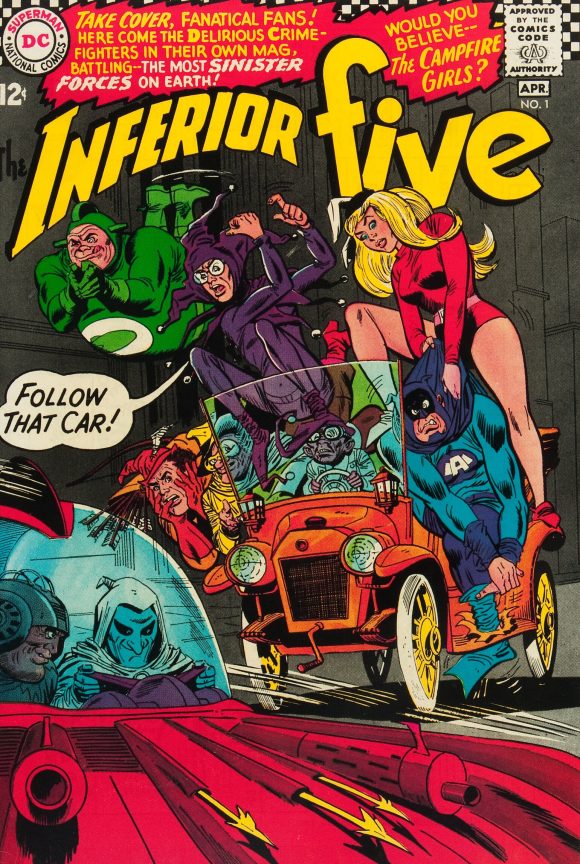
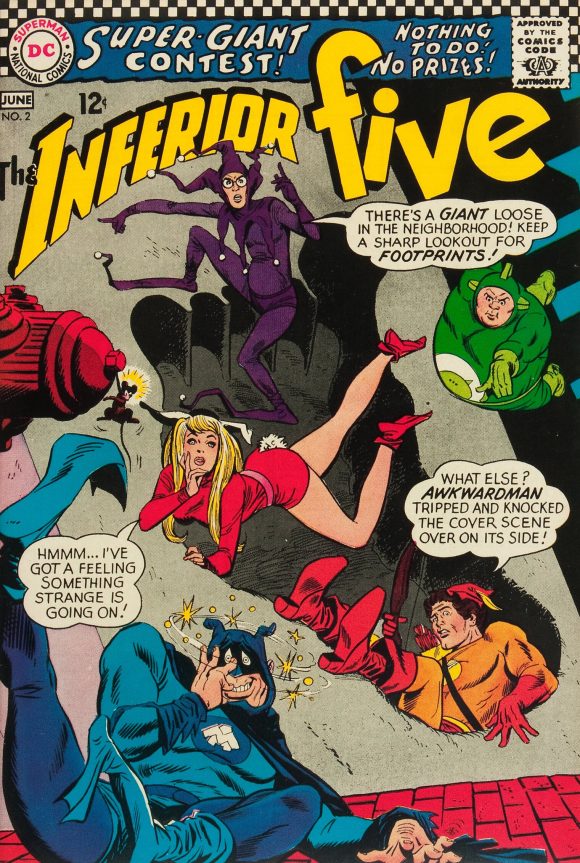
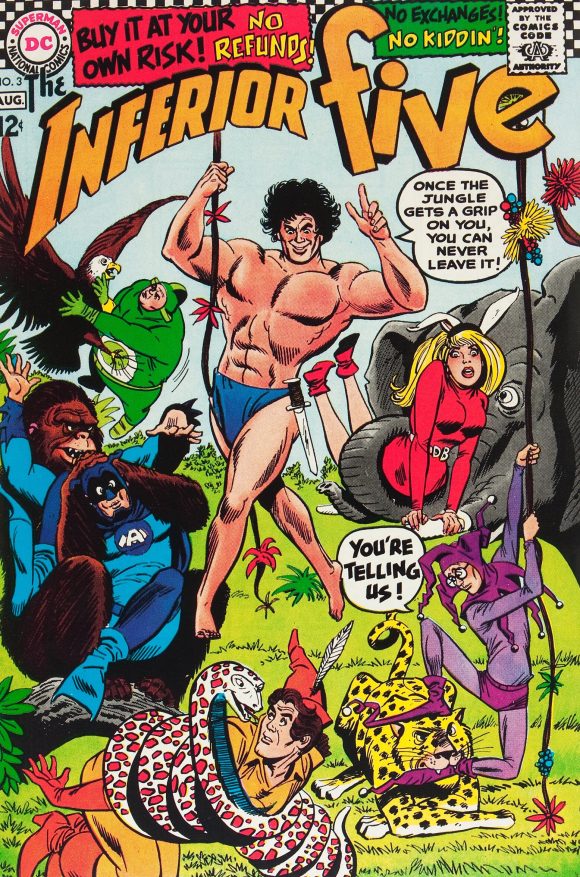
The first issue was a parody of The Man from U.N.C.L.E., complete with Mike’s excellent caricatures of the show’s stars. (Mike drew a lot of The Man from U.N.C.L.E comics for Gold Key, too!) The second issue made fun of Marvel’s Avengers, the third was a parody version of Tarzan as “Darwin of the Apes,” and the fourth was a visit to an alternate interpretation of Asgard and its gods. But the next issue used time-travel to send the Inferior Five back to the French Revolution, not a theme that’s necessarily a comic reader’s fave for parody — but E. Nelson Bridwell loved history and apparently, Jack Miller edited with a light hand.
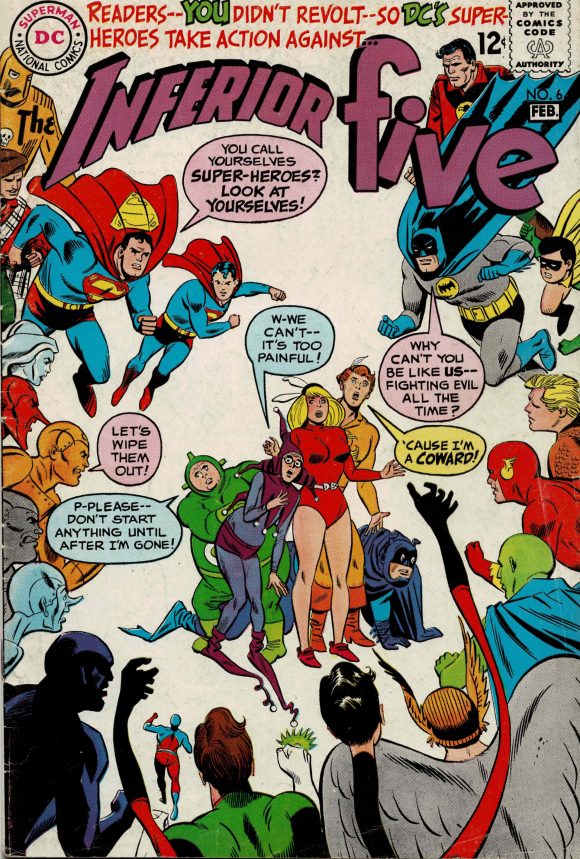
And then Issue #6 came along, with a cover that still impresses me, with most of DC’s superheroes attacking the Inferior Five. Was this DC’s version of Marvel’s Not Brand Echh, parodying its own characters?
Nope.
Sekowsky and Esposito
Although this issue’s cover features many of the company’s best-known characters, Robin the Boy Wonder is the only one to appear in the actual story, “How to Make a Bomb!”
The story was Bridwell’s attempt to reveal the sheer madness of DC Comics’ staff. He was a near-genius with a perfect memory of DC history (among many other things) and a short, chubby guy with thick-lens glasses who looooooved comic books. He also had digestive problems that were very obvious. Therefore, some of those at DC, especially his onetime boss Mort Weisinger, considered Nelson an easy target to mess with. I spent an afternoon with the man when I was summoned to DC in the mid-1980s. I really liked him and we had a great time looking through a stack of Sugar and Spike comics by Sheldon Mayer that had never been published in America. (Some of them were eventually printed in a few of those DC Digests.)
Mike Sekowsky (November 19, 1923 – March 30, 1989) was a tall and heavy man, with white hair and pink skin. When he was a kid, his mother unintentionally ran over him, pulling back his scalp, which left a scar on his forehead. (He always grinned when I’d tease him that he’d make a memorable Bond villain!) Mike was the kinda guy who would help out his cartoonist friends who couldn’t meet their deadlines by ghost-drawing their pages — for free. Like Mr. Bridwell, Mike was intelligent but he had a very dark sense of humor. Unfortunately, the comic book industry is often cruel to its freelancers, no matter how talented they may be.
By the time I met Mike, he had been working in the biz since 1941. By the time I began to work with him at Hanna-Barbera Productions in 1978, his art had appeared in approximately 1,500 different comics. That’s when I learned his favorite themes in the funnybook industry. But Mike had a lot of anger within him and was openly furious about how he had been treated by DC Comics. Considering the venomous visual tone of Inferior Five #6, it’s rather amazing that he still worked there – freelancing and on staff (as the editor of Wonder Woman and Adventure Comics) working well into the ’70s for the publisher. He also worked for other comics publishers into the ’80s, and even did a few back-up stories with me for DC’s Captain Carrot and his Amazing Zoo Crew!
In the mid-’80s, after I recommended Mike to the people I was working for, animation studio Tom Carter Productions, they hired him. Mike was never happier working than at that job, although the nutty studio never produced much to mention.
I’d never read Inferior Five #6 before I met Mike — because I never saw a single copy of it on a spinner rack. It came out late in 1967. I had recently turned 16 and drove my Dad’s car around San Diego to every 7-Eleven and liquor store in San Diego that carried comics but no luck. (I doubt if DC asked its distributors to pull them from display, but I’ve always wondered if any other Inferior Five fans had the same frustration I experienced.)
I finally procured a copy about 20 years ago, and man, was this a shocker, kinda like the first time I read Jack Kirby’s Mister Miracle #6, which introduced the controversial Funky Flashman.
I never had the chance to ask Mike about this Oddball gem. However, my pal Mark Evanier – who’s helped me out by identifying the DC staff that show up here – thinks that Nelson had a hunch that he wasn’t going to be doing Inferior Five much longer, possibly because the comic’s editor, Jack Miller, was about to be fired. (He was, too, along with DC editors Jack Schiff and George Kashdan.)
Mark thinks that Bridwell thought it would be fun to write an Inferior Five story with a similar vibe as Mad magazine (to which he had sold a few articles.) However, Sekowsky’s intention was to get back at the DC bullies and butt-kissers throughout this issue. Here are key pages from this story that explain and display blatant usage of rather savage caricatures of DC’s staff! I’ll tell you the rest.
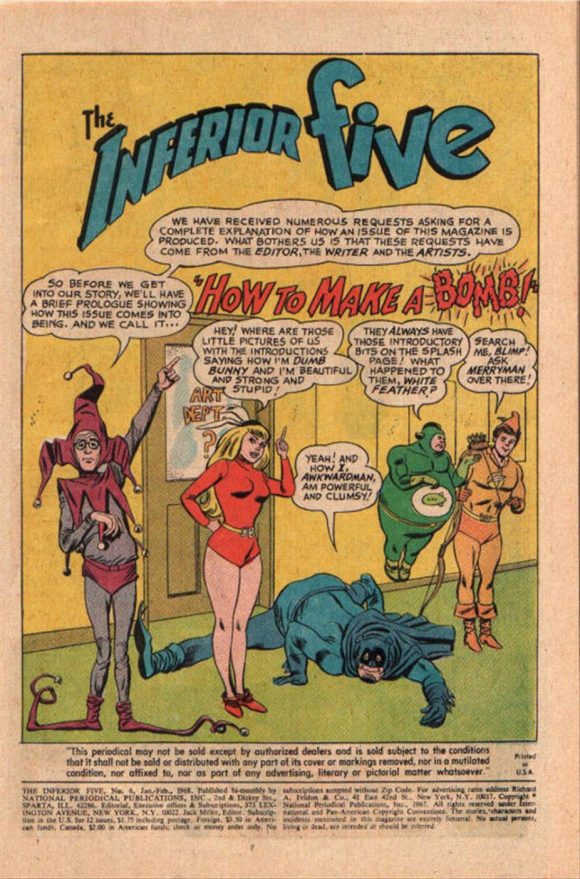
We begin with the Inferior Five hanging outside DC’s art department, where Merryman gives the readers the overall theme of their issue, (And take a long look at the Inferior Five, because we’re not gonna see much of ’em from now on!)
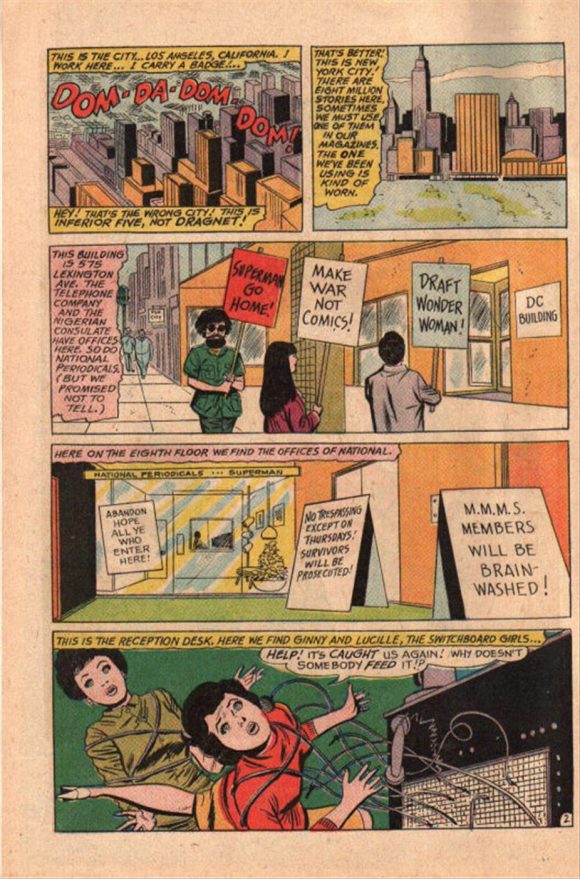
Drawn from the point-of-view of a camera, we pass a group of protesting hippies to enter the 575 Lexington Avenue skyscraper and take an elevator to reach the building’s eighth floor and past DC’s reception desk, where we meet the switchboard girls, Ginny and Lucille (probably based on actual women).
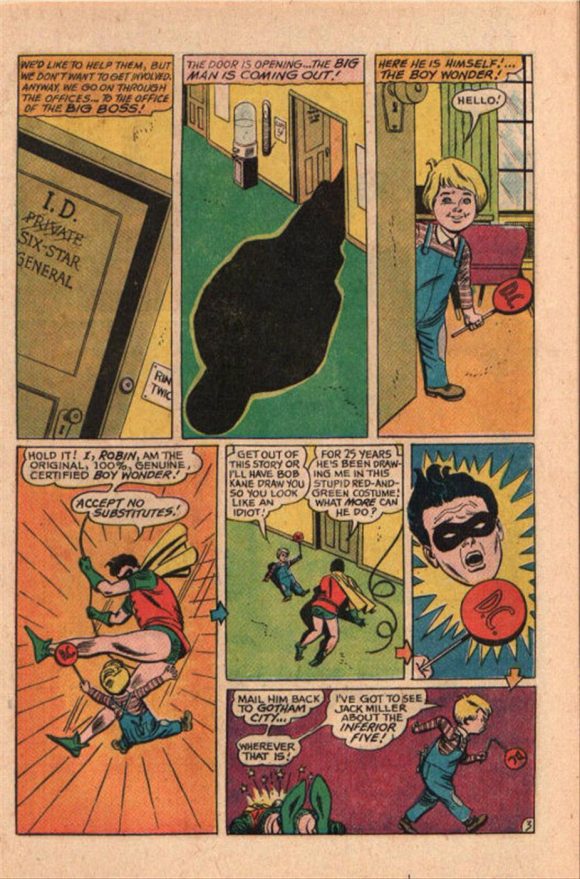
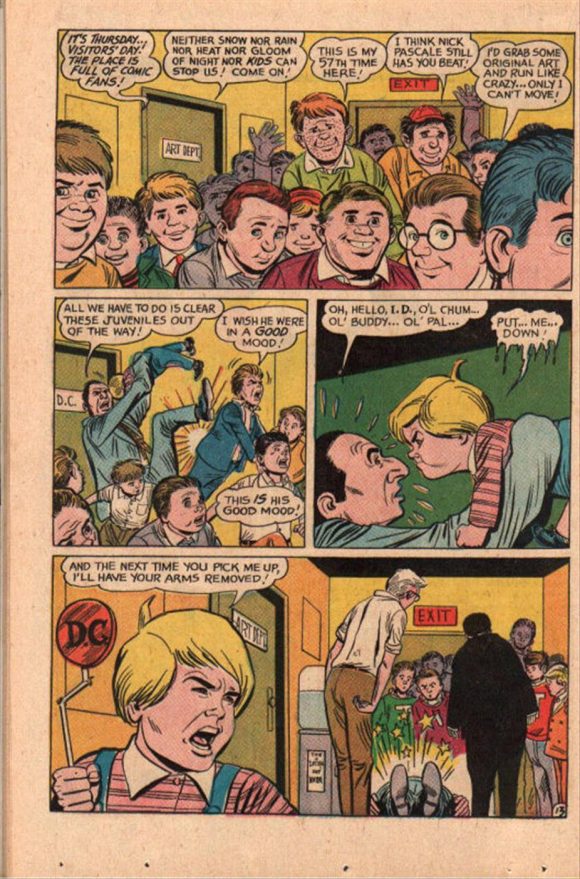
Suddenly, we encounter the “Boy Wonder,” a little blond kid resembling Dennis the Menace and based on DC Executive Vice President Irwin Donenfeld (a grown man who was about to be squeezed out of the company his father had founded). When the real Robin shows up, Irwin knocks him out with a lollypop labeled “DC” (probably a reference to ACG’s Herbie Popnecker.)
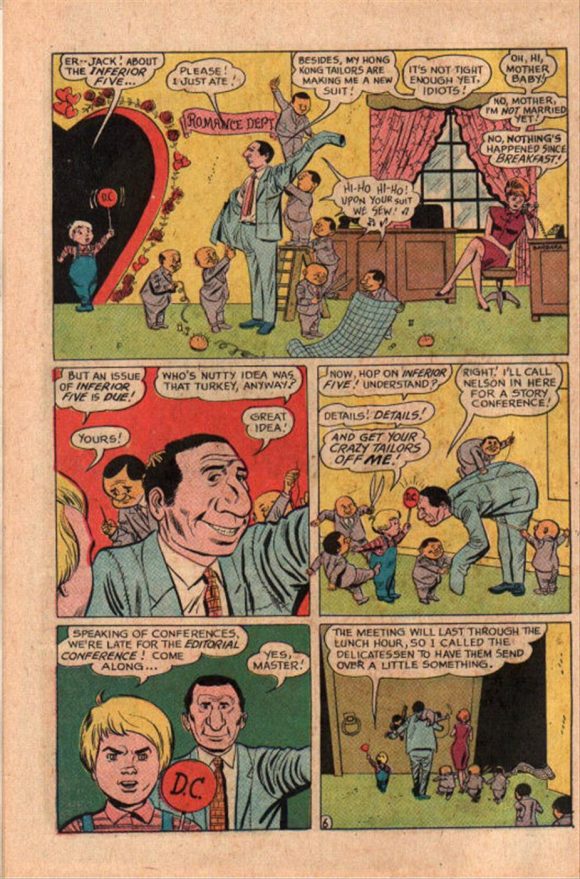
The bratty little Irwin takes his private elevator down to DC’s Sub-Sub-Sub-Cellar, across a room full of alligators and monsters to the heavily protected office of Inferior Five‘s editor, Jack Miller. There, Jack’s getting measured by seven dwarfs whose skin is orange (which DC usually used for their racist depiction of Asian people back then.) That red-haired lady is comics writer Barbara Friedlander. Li’l Irwin leads Jack Miller to the office’s editorial conference, which has been catered by a nearby deli.
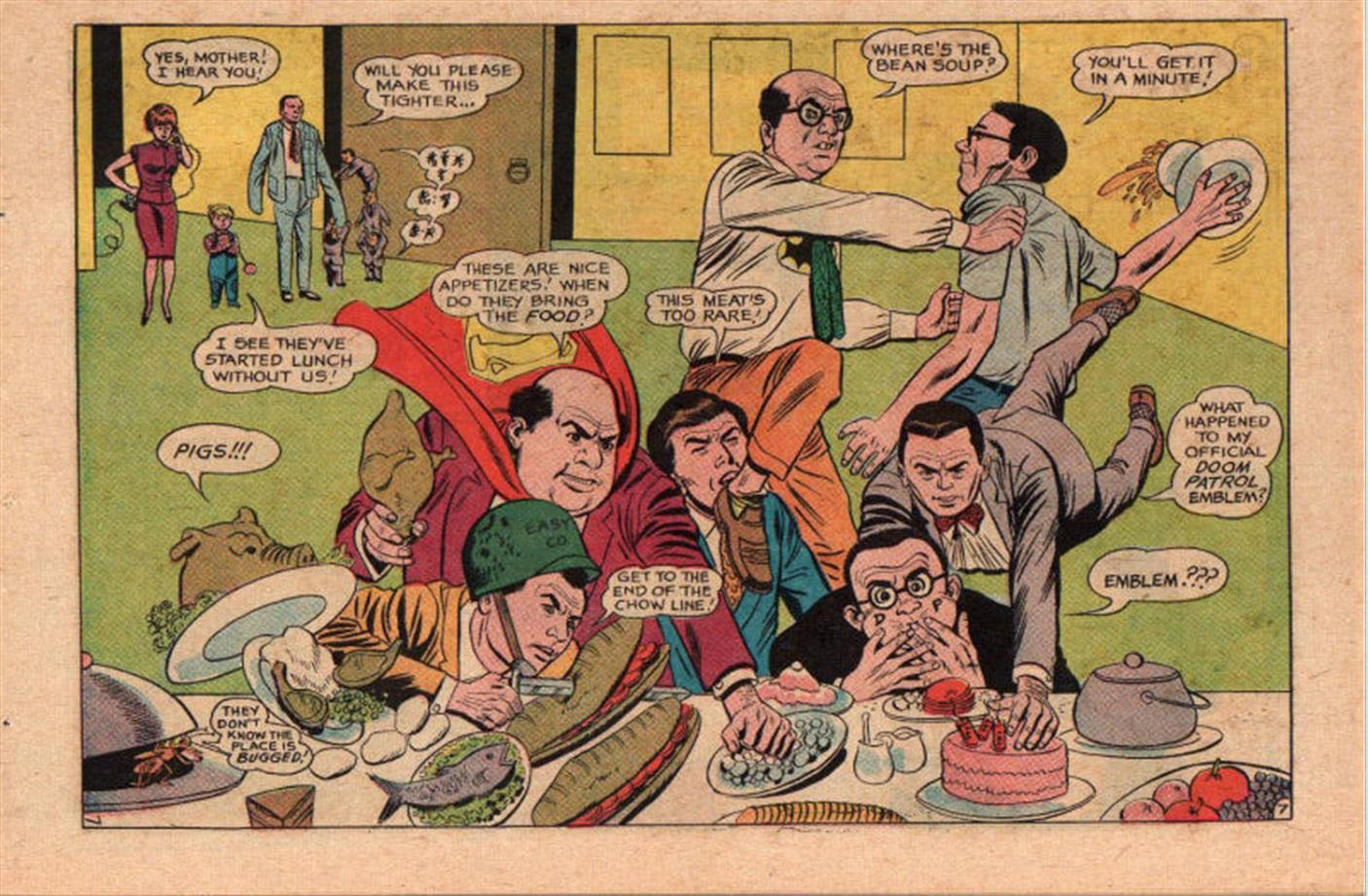
Published on its side, this page features a lot of DC’s staff fighting over the deli buffet: The man with the Superman cape is Mort Weisinger; the gent in the Army helmet is Robert Kanigher; the guy who wants that bean soup is Julius Schwartz (apparently a running office gag); the man in the bowtie is Murray Boltinoff; and the chubby fellow with glasses who’s stuffing his face is Bridwell. Based on Mark’s guess, the man who’s biting Julie’s foot is George Kashdan, and the guy in the blue shirt with the bean soup is Jack Schiff, but they could be reversed.
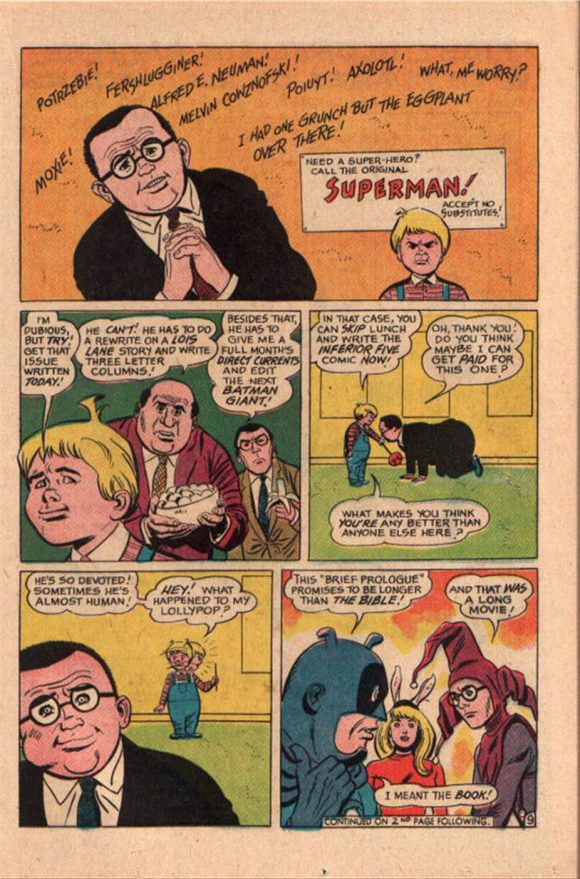
Irwin gives Murray Boltinoff, Mort Weisinger, and Nelson a hard time, while a mature woman named Gerda suddenly appears to give the blond brat more lollypops. (Gerta Gettel was DC’s head proofreader.) Nelson gets down on his hands and knees to kiss Irwin’s lollypop-hand. Oh, and the Inferior Five finally appear again, with a total (so far) of one mere splash page and three panels — spread over nine pages!
Editor Jack Miller beats the soup out of Nelson!
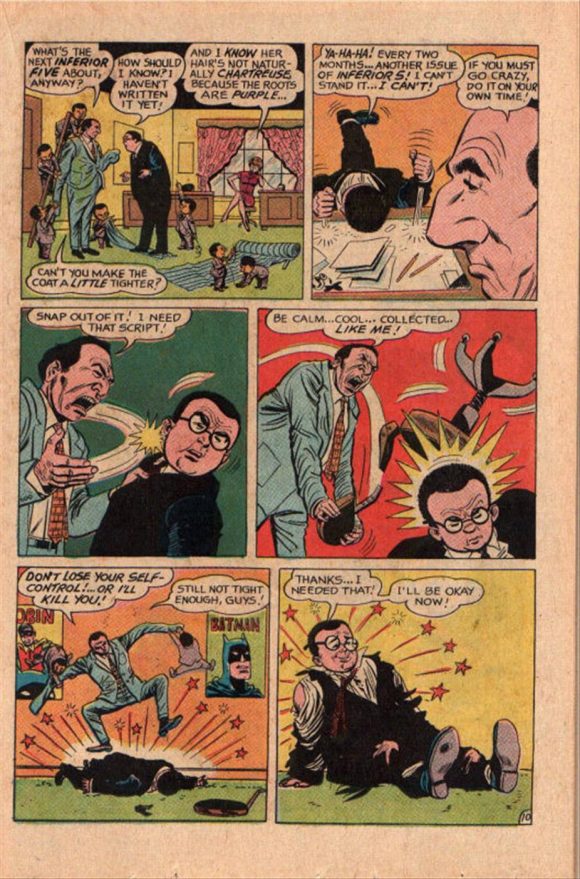
Am I imagining or am I seeing another another panel of the entire Inferior Five, almost halfway through the story? If I was one of the five, I’d jump over to Marvel!
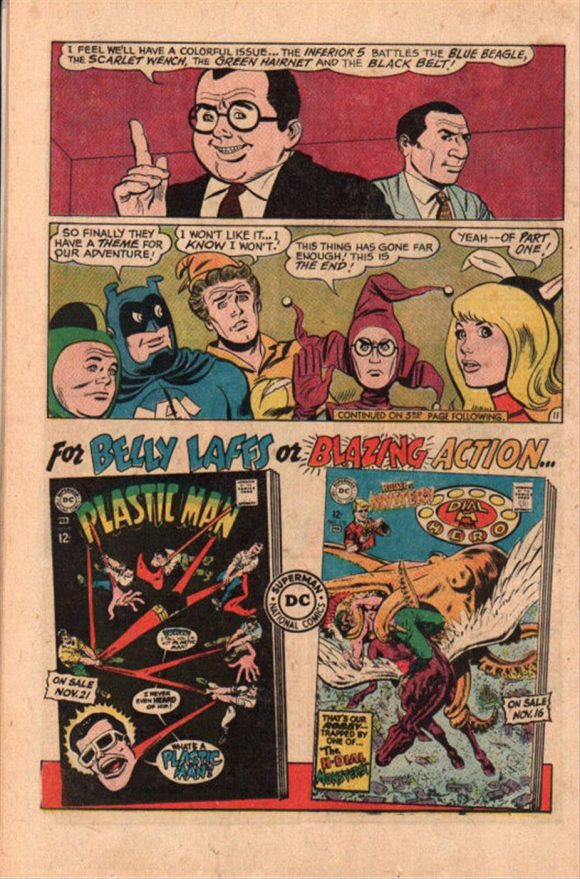
Towering but shy, Mike Sekowsky finally arrives, but he never draws his face. (Note that in Panel Five, he gets kicked in the gonads by Jack Miller!)
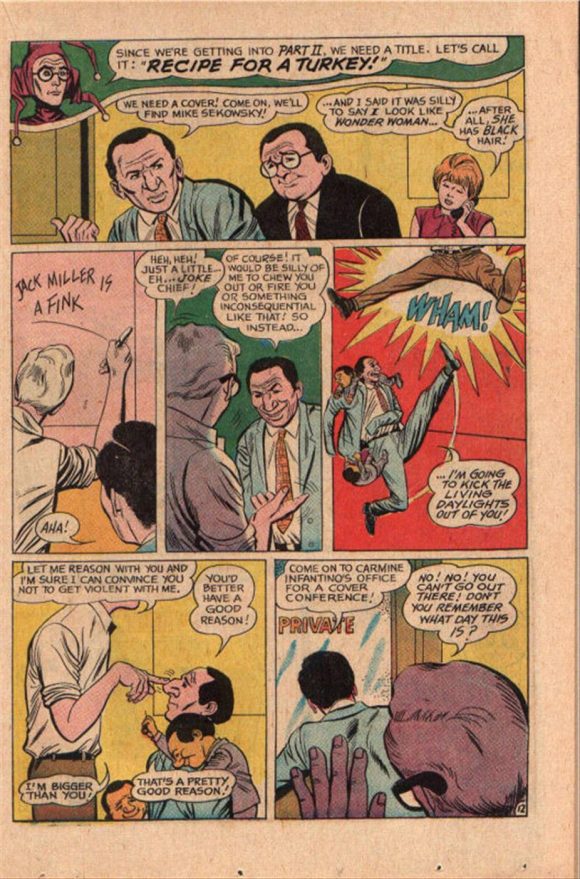
After Miller goes berserk amid dozens of eager fanboys clogging the office, he accidentally picks up Irwin. The next thing you see is Jack laying flat on the office floor.
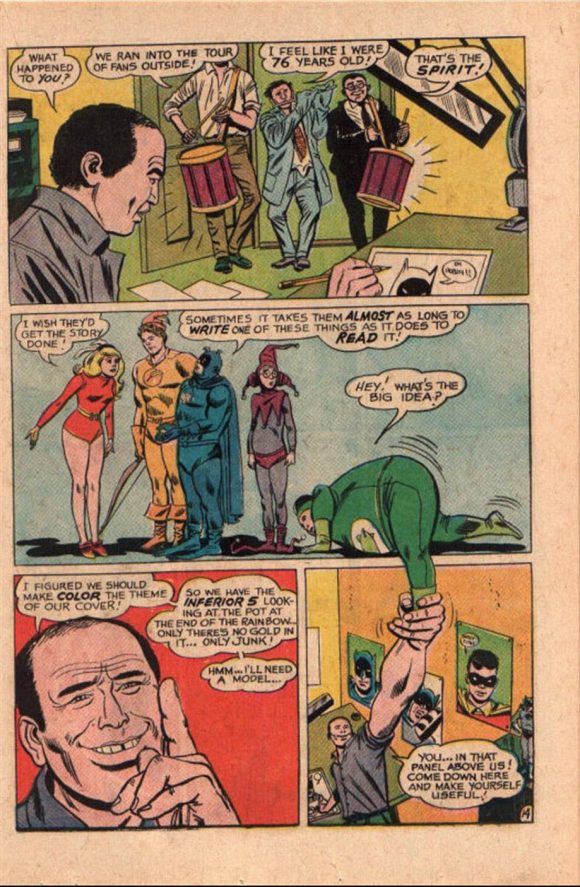
Mike, Jack, and Nelson – behaving like a Revolutionary trio — bust in on Carmine Infantino, who grabs the foot of Inferior Five’s the Blimp and drags him across the page’s gutters.
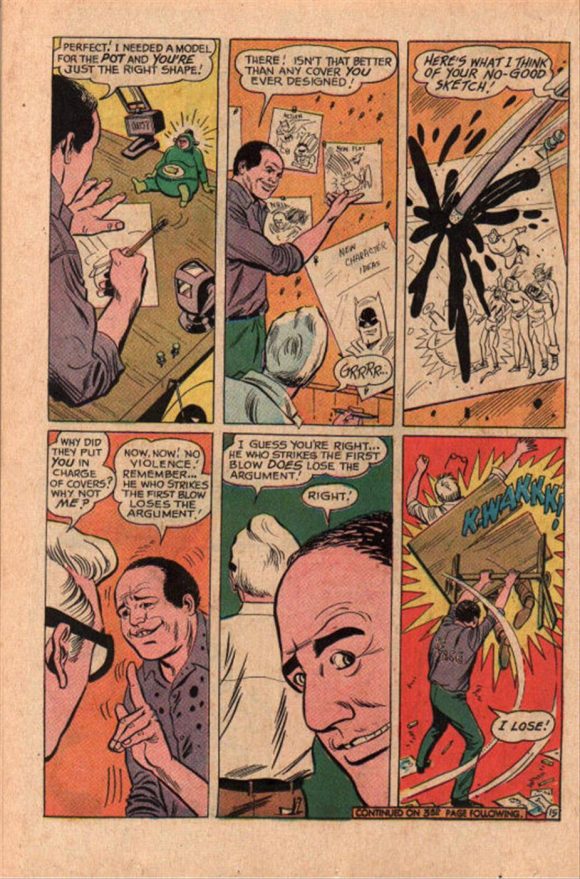
When Carmine brags that one of his covers is better than anything Mike ever designed, things turn toxic, not humorous.
Miller has recovered and receives groveling Mike Esposito with the finished inks on the issue. Then Jack takes the inked art into the Art Department, where Sol Harrison (the big guy) and Jack Adler (the guy with the glasses and mustache) are dueling over production issues.
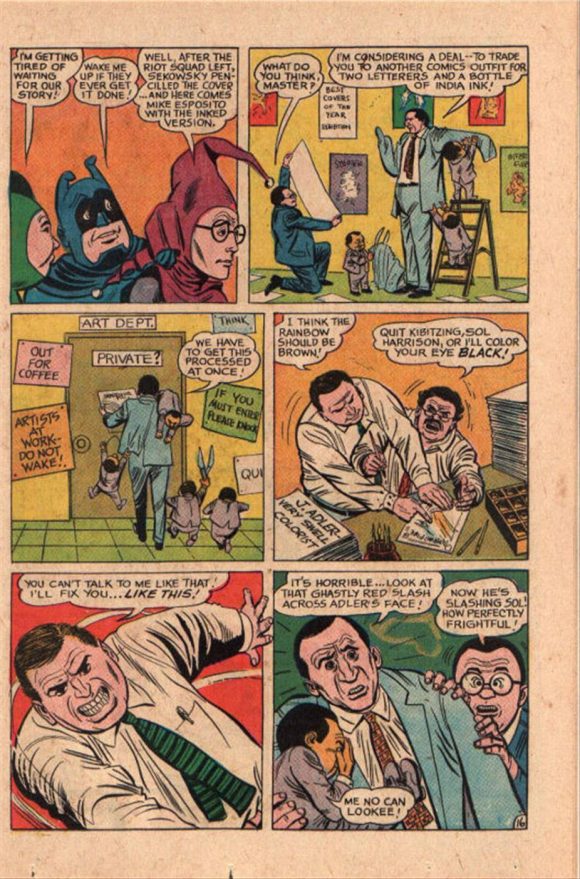
Nearby are Murphy Anderson, at a drawing board amid the chaos between Harrison and Adler, and Gil Kane in a basketball uniform.
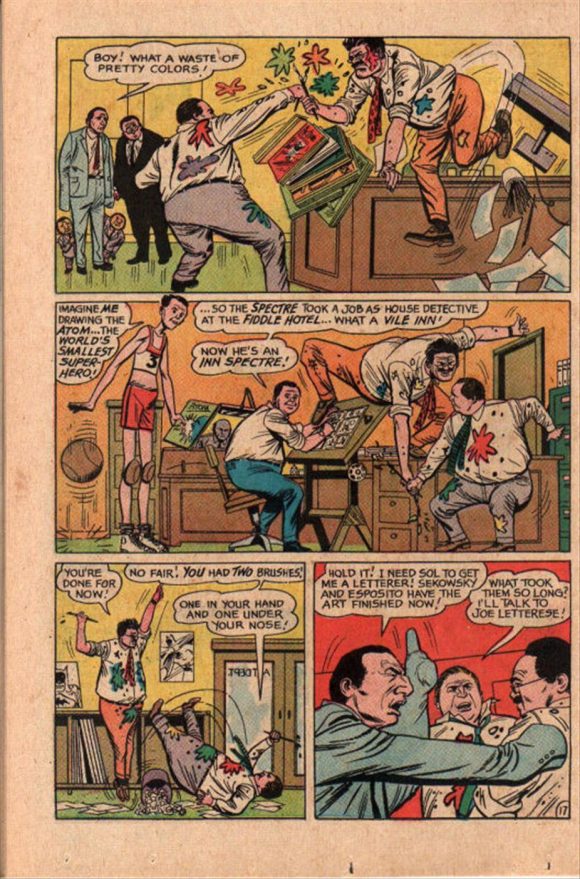
While Mort Weisinger flies by in a Superman suit, Sol Harrison chats with letterer Joe Letterese and a new tryout.
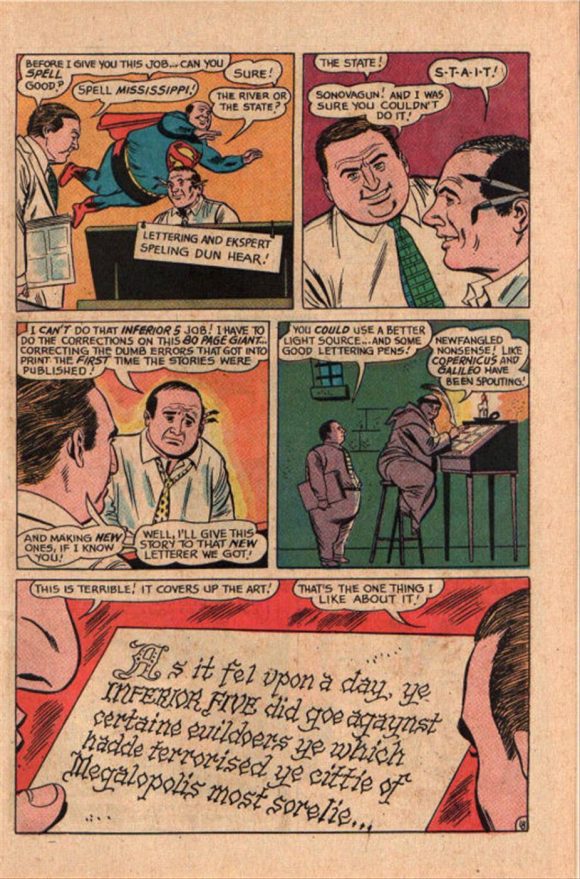
From this point on, there are no more actual DC employees to introduce. It’s mainly Nelson, Miller, writer Barbara Friedlander, and a short, mad scientist who looks a lot like Dr. Sivana, and who blasts them all with an anti-gravity ray. We also get to see a few more panels with the Inferior Five.
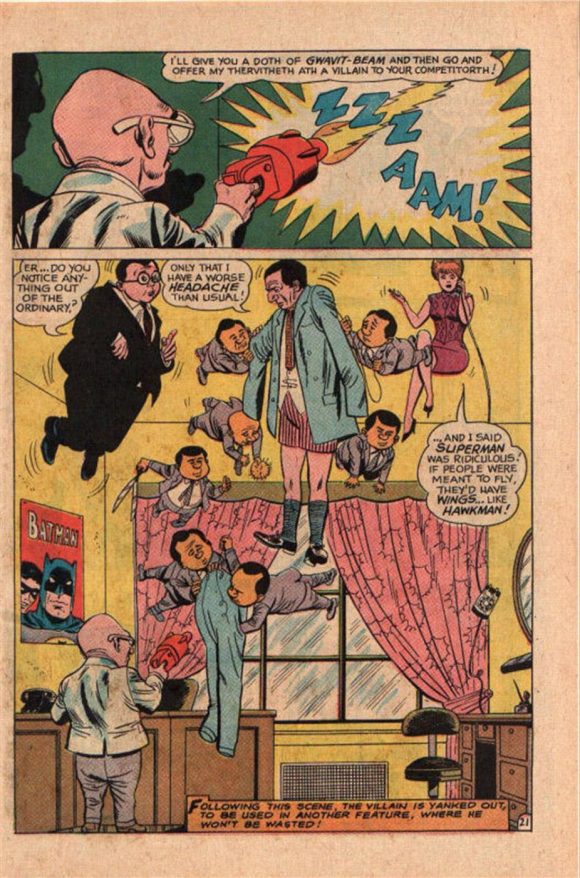
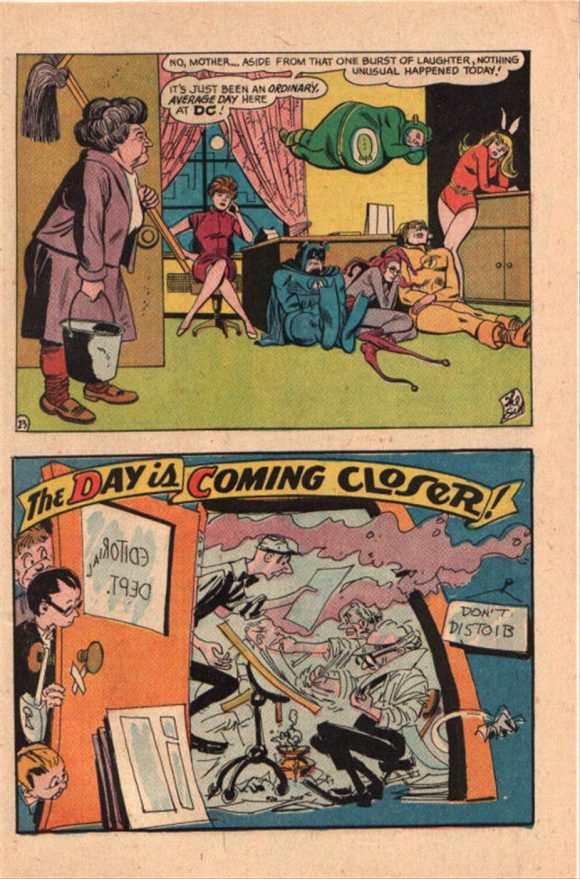
By the time this issue is ready for print (don’t ask me how that happened), the Inferior Five gripes that they only have a half page left for them. In fact, all they get is a visit from the cleaning lady, but it really doesn’t matter. The Inferior Five are fast asleep — with Barbara Friedlander on the phone with her mother, saying, “It’s just been an ordinary, average day here at DC.”
Again, thanks to Mark Evanier!
—
Want more ODDBALL COMICS? Come back next week!
And get this: Scott’s involved in a new, unauthorized documentary about San Diego Comic-Con! Click here for the scoop.
—
MORE
— ODDBALL COMICS: When SMOKEY (the) BEAR Was Macho. Click here.
— ODDBALL COMICS: Archie’s 1950s COSMO THE MERRY MARTIAN. Click here.
—
For over half a century, SCOTT SHAW! has been a pro cartoonist/writer/designer of comic books, animation, advertising and toys. He is also a historian of all forms of cartooning. Scott has worked on many underground comix and mainstream comic books, including Simpsons Comics (Bongo); Weird Tales of the Ramones (Rhino); and his co-creation with Roy Thomas, Captain Carrot and his Amazing Zoo Crew! (DC). Scott also worked on numerous animated series, including producing/directing John Candy’s Camp Candy (NBC/DIC/Saban) and Martin Short’s The Completely Mental Misadventures of Ed Grimley. As senior art director for the Ogilvy & Mather advertising agency, Scott worked on dozens of commercials for Post Pebbles cereals with the Flintstones. He also designed a line of Hanna-Barbera action figures for McFarlane Toys. Scott was one of the comics fans who organized the first San Diego Comic-Con.
Need funny cartoons for any and all media? Scott does commissions! Email him at shawcartoons@gmail.com.
And check out the upcoming collections of his Sonic the Hedgehog comics here.

November 15, 2025
Wow that sounds like a lot of inside baseball stuff an completely impenetrable and unfun for fans
November 15, 2025
Man, was this a mind blower at the time for this then-young fan.
Meanwhile, I’m wondering: Clearly, this book was produced around the time Donenfeld had sold to Kinney (eventually Warner’s) but what was the approximate dates the sale closed and the book was produced? Best I can ascertain is overlap but I’m curious. Too, given that this issue was something of a shaggy dog story, I wonder whether it was a rush production as its editor was on his way out the door, a resignation letter of sorts.
November 15, 2025
This extended tour of Oddball (DC) Comics today was fantastic! Thanks for sharing your Mike Sekowsky memories Scott.
November 15, 2025
I soooo need a DC Finest humor collection that would include all of the Inferior Five and more.
November 15, 2025
I know I never had that issue. Thanks for the article!!
November 15, 2025
I just read my collection of Inferior Five issues and this one was a real shark-jumper. After this, the series re-focuses and Win Mortimer takes over the art for a handful of issues to the series’ conclusion, doing some really beautiful, well-rendered work.
November 16, 2025
In the early 70s, Junior-High me stumbled on a bunch of I-5 back-issues at our used store and loved them!! I’d happily pay for an overpriced collection of the first six issues and the Showcase run! It influenced the style of humor in my own writing (including stuff I wrote in class in High School; pity my poor teachers!) The French Revolution story was a hilarious send-up of “Tale of Two Cities” and “The Scarlet Pimpernel” which is why I’m snickering now that I’m actually reading the Dickens book. I wondered about I-5 issue 6 when I read it but didn’t realize it was a slam not a spoof. Losing Miller and the rest took some of the life out of the book. Thanks for the memories.
November 16, 2025
Can’t resist quoting my favorite line from “I Was A Guillotine-Age Hero.” “Hmmm…I should have some deathless last words. How about: ‘It is a far, far better thing I do than I have ever done before. It is a far, far better rest…’ I LIKE it!!” And lastly, I didn’t know who was being parodied in Issue One (Agents Of T.U.N.D.E.R. that is) until I read about them here! (Okay, I’ll shut up now.)