
New looks at old-time radio shows — and their comics connections…
By PETER BOSCH
Hello, we’re back with another installment of FOUR COLOR RADIO. This time, we bring you two shows featuring two popular characters from the same publisher — MLJ Magazines (aka Archie Comics). However, “popular” on radio only applied to one, and not the other.
First up (as well as first aired) was Archie Andrews, which was not only the name of the character but also the name of the program (though, the latter was also referred to as The Adventures of Archie Andrews).
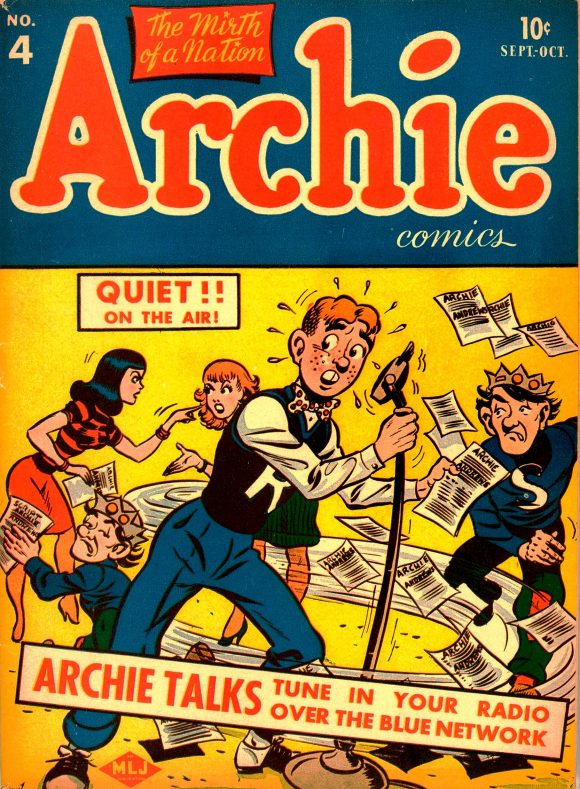
Archie Comics #4 (Sept.-Oct. 1943, MLJ). Art by Harry Sahle.
The series began May 31, 1943, on NBC as a five-times-a-week program, at 15 minutes each day.
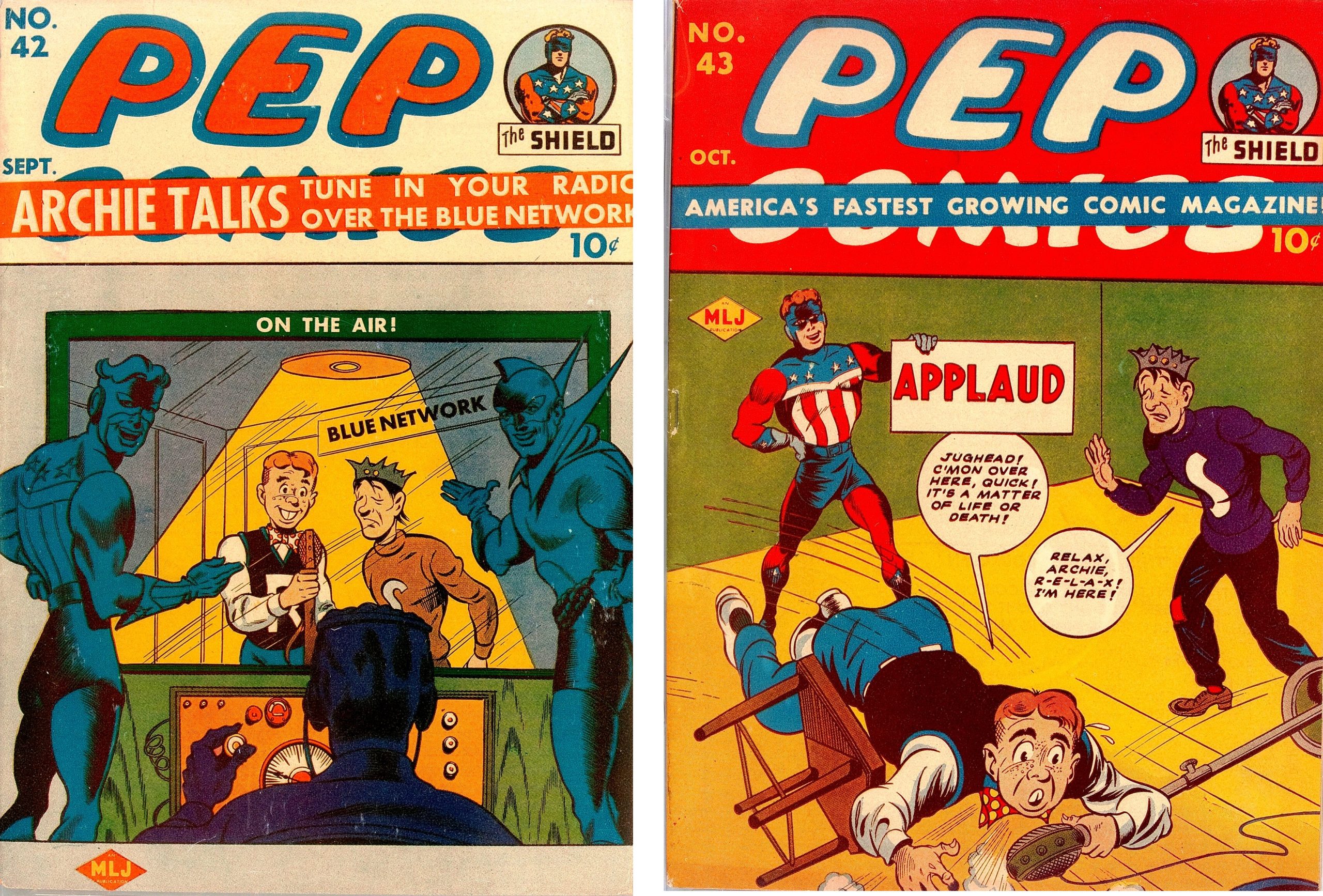
Check out this pair of promo covers for the new show, both drawn by Bob Montana — Pep Comics #42 (Sept. 1943) and #43 (Oct. 1943):
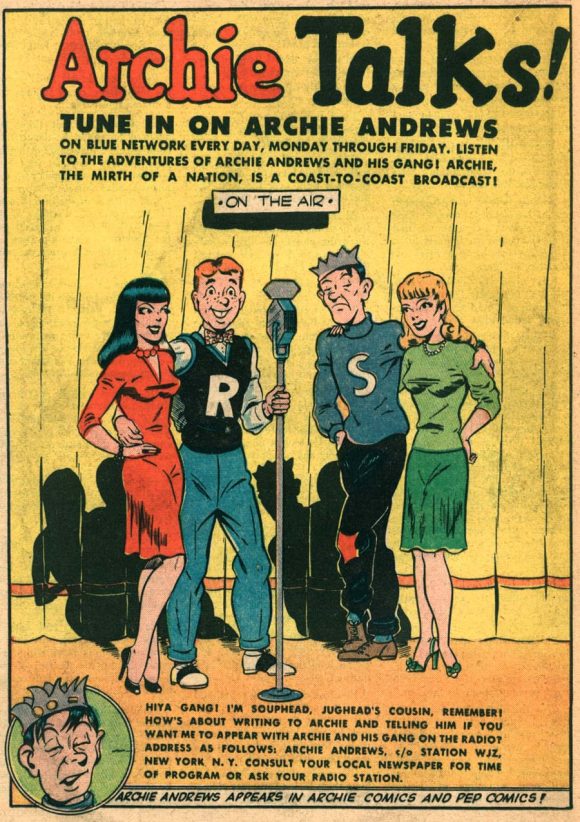
The following ad in Pep #43 also plugged the show:
A few months after its debut, the program’s format was changed to a once-a-week, 25-minute entry on Friday evenings. In 1944, an NBC competitor, the Mutual Broadcasting Network, acquired the program from January to June, and switched it back to a 15-minute daily format.
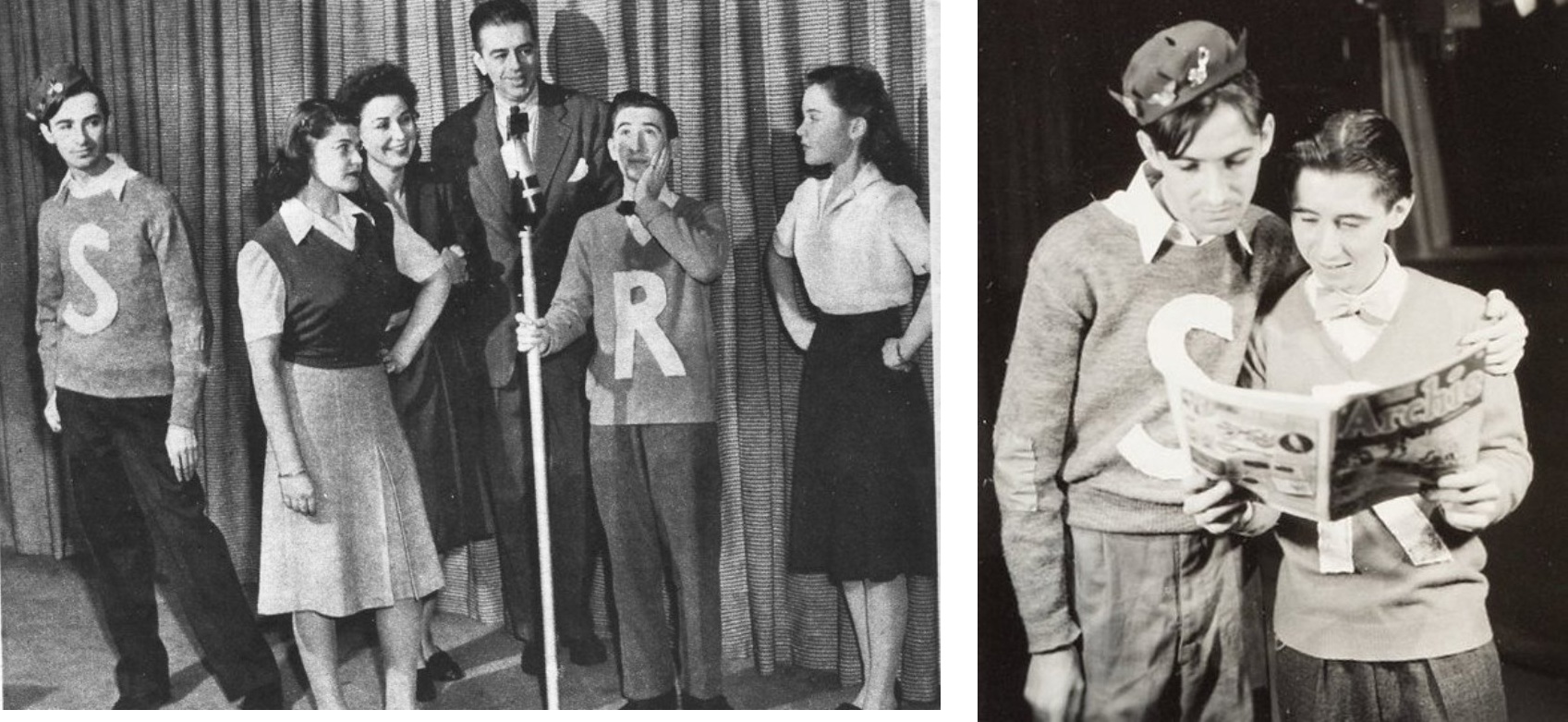
The 1944 Archie Andrews cast: (L-R) Cameron Andrews (Jughead), Vivian Smolen (Veronica), Peggy Allenby (Mary. Andrews), Reese Taylor (Fred Andrews), Jack Grimes (Archie Andrews), and Joy Geffen (Betty). (Right) Cameron Andrews and Jack Grimes checking out the source material.
However, Archie Andrews returned to NBC a year later, with the show also going back to its half-hour length. NBC remained its home from June 2, 1945, through the final episode eight years later, on September 5, 1953.
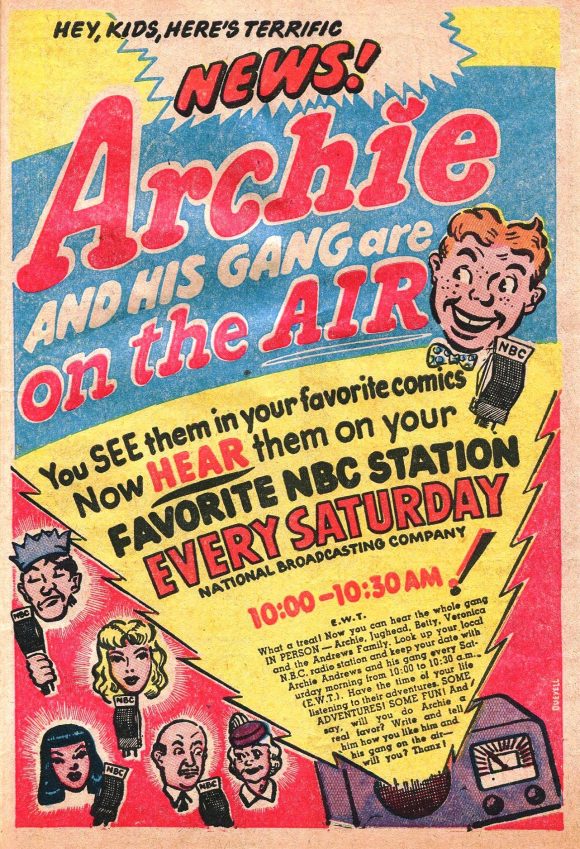
Ad in Wilbur Comics #6 (Fall 1945) featuring the switch back to NBC.
During the series’ 10 years on the air, there were a total of four different Archies, played in turn by Charles Mullen, Jack Grimes, Burt Boyar, and Bob Hastings. Likewise, there were three Jugheads (Cameron Andrews, Hal Stone, and Arnold Stang) and two Veronicas (Gloria Mann and Vivian Smolen). Paul Gordon took on the role of Reggie, and the part of Mr. Weatherbee was played by Arthur Maitland.
Oh, and there were three Bettys — played by Joy Geffen, Rosemary Rice, and Doris Grundy, who happened to have the same last name as Archie’s teacher, Miss Grundy. (In “Twisted Youth,” a 1999 episode of the cartoon Archie’s Weird Mysteries, Miss Grundy’s first name is revealed to be “Doris.” In the same episode, Miss G drinks a youth serum and is shown to be a beautiful blonde, just like you-know-who.”
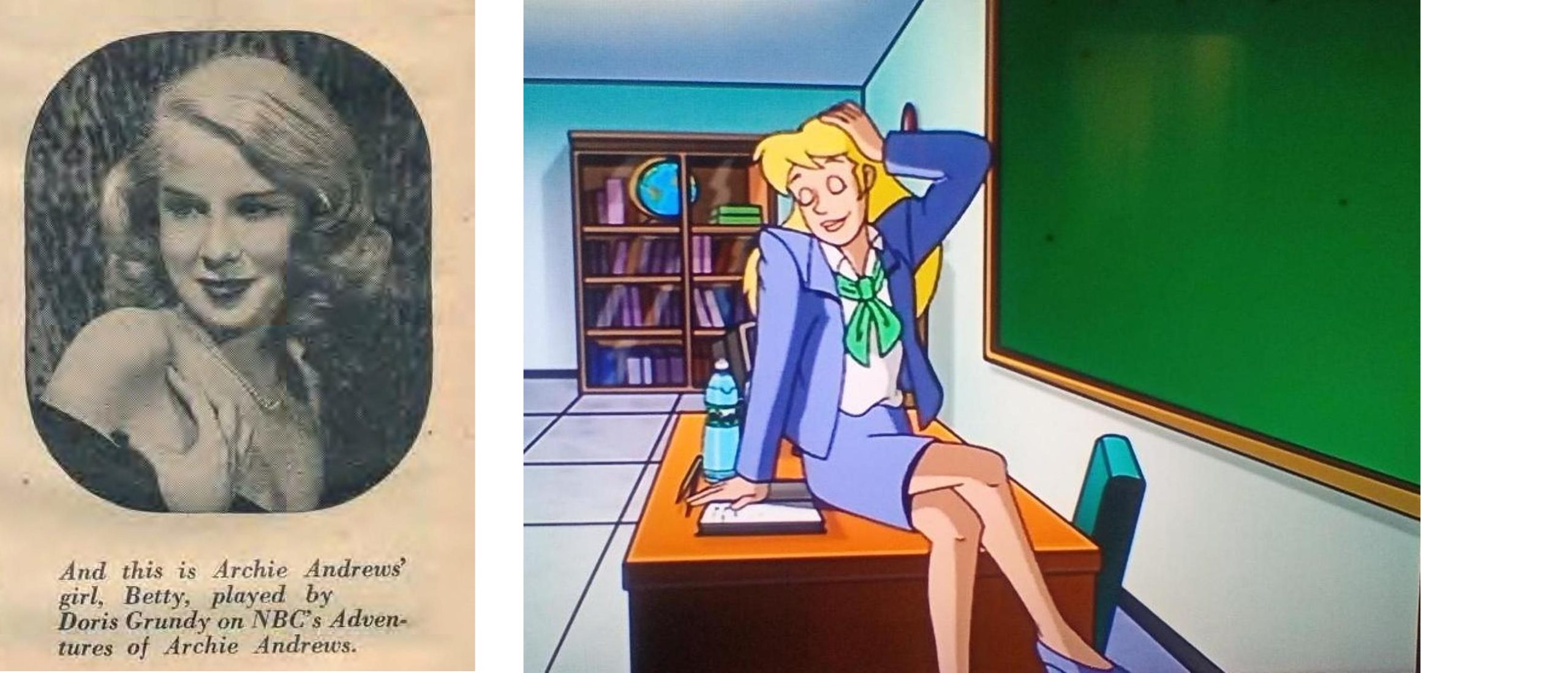
Left: Radio Mirror magazine, April 1946. Right: Archie’s Weird Mysteries, “Twisted Youth” (Season 1, Episode 13; Dec. 25, 1999).
The longest-running Archie of the series was Bob Hastings, pictured here standing at the microphone with (left to right) Hal Stone as Jughead, Gloria Mann as Veronica, and Rosemary Rice as Betty.
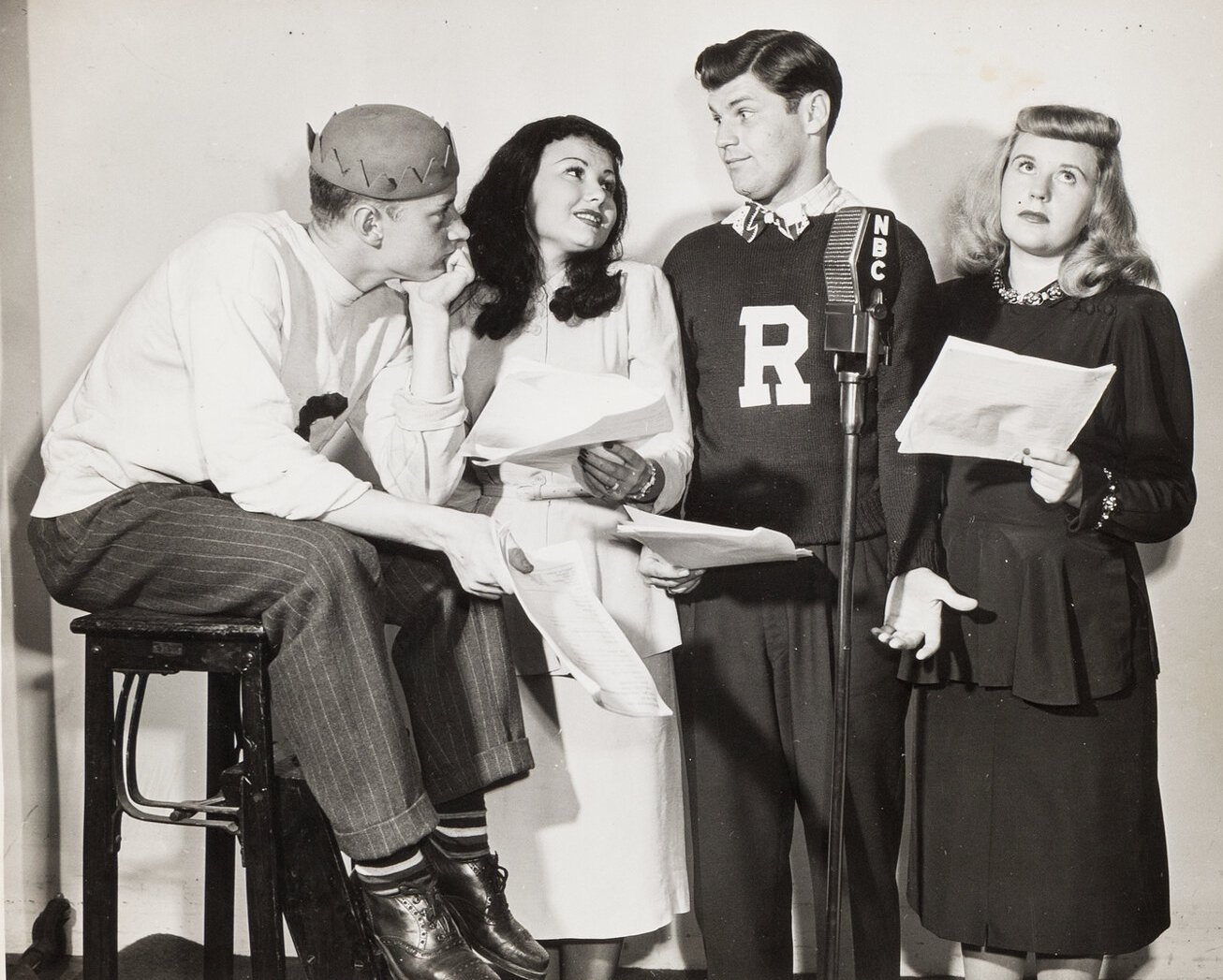
Baby Boomers will recognize Hastings from his time in the Sixties as Lieutenant Elroy Carpenter on TV’s McHale’s Navy. (He was also on Sgt. Bilko, and provided Superboy’s voice for Filmation and Commissioner Gordon’s for Batman: The Animated Series.)
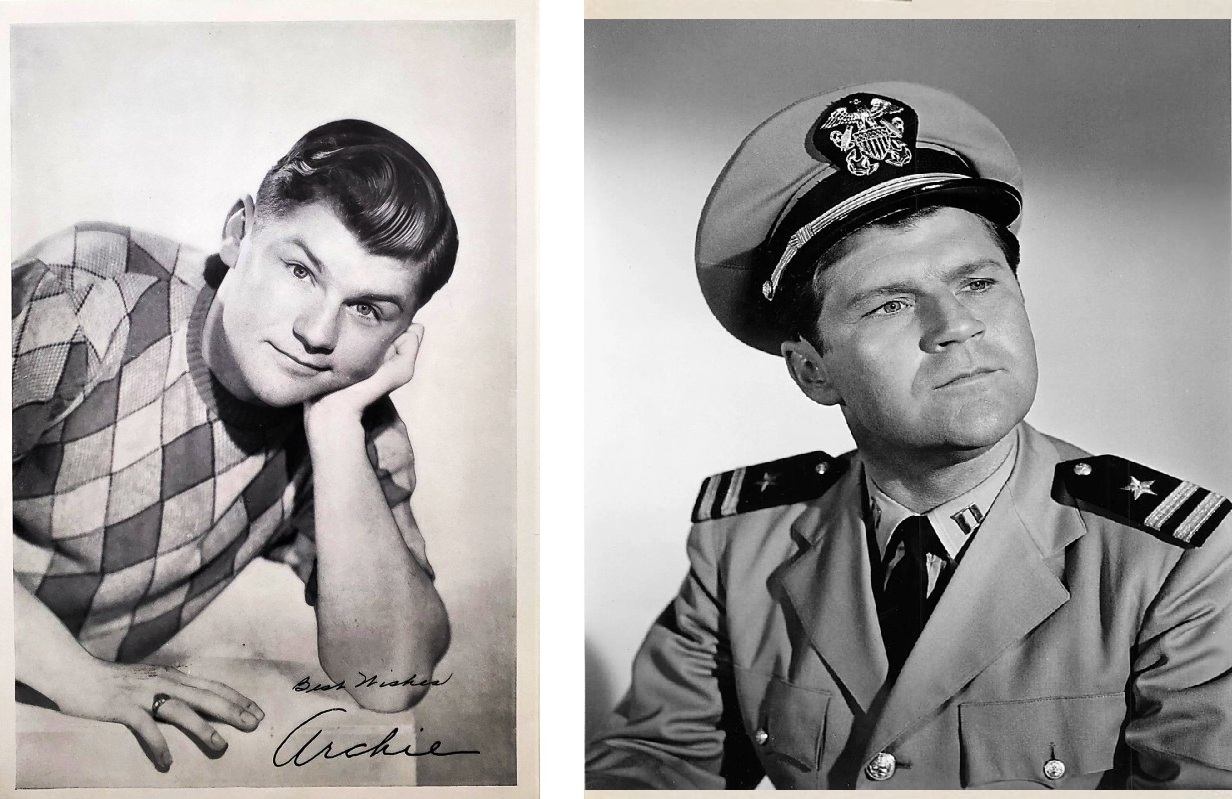
(Speaking of other roles: Jack Grimes, the second Archie Andrews, played Jimmy Olsen in the final years of The Adventures of Superman radio program. And a number of soldiers who visited the New York Stage Door Canteen during World War II would recognize Veronica’s Vivian Smolen as a hostess who danced with them.)
Of the hundreds of episodes that were produced, approximately 50 or 60 survive, all of which were from the 1945-1953 NBC run. The comedy situations each week would easily have fit in as plots for the Archie comic book line.
Here’s a sample of Archie trying to impress Veronica by agreeing to wrestle “The Masked Marvel”:
—
And now, on to the second MLJ character who had his own radio program… the Black Hood!
Oh, you didn’t realize there was a radio program of the Black Hood? Don’t worry, hardly anybody does.
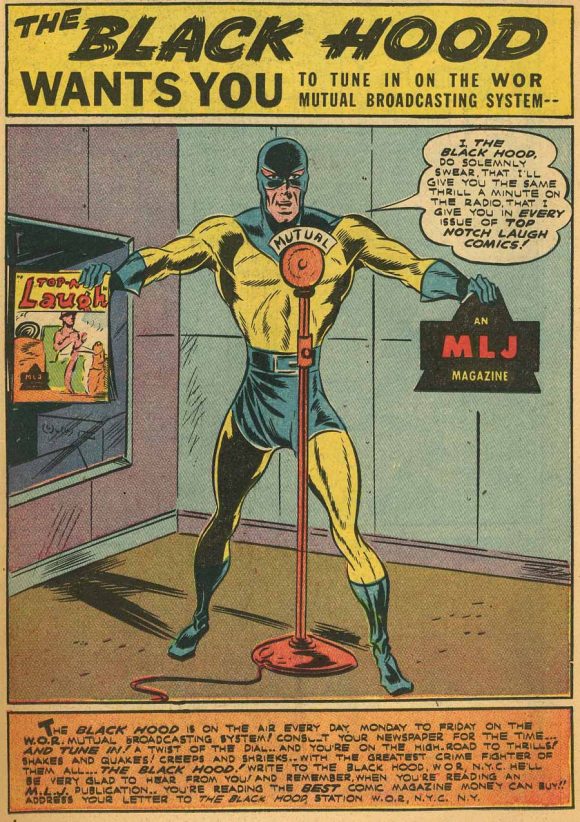
Ad from Zip Comics #42 (Dec. 1943). Artist unidentified.
Starting July 5, 1943, just one month after the debut of the Archie Andrews program, The Black Hood also started appearing five times a week, at 5:15 p.m., running 15 minutes each episode on the Mutual Broadcasting Network. As in the stories appearing in Top-Notch Comics and Black Hood Comics, Kip Burland was a rookie patrolman who took up the identity of the fearsome, mysterious Black Hood to go after criminals.
The opening of the show had the Black Hood (played by Scott Douglas) making a determined pledge that was similar to that on the cover of Black Hood #9 (Winter 1943):
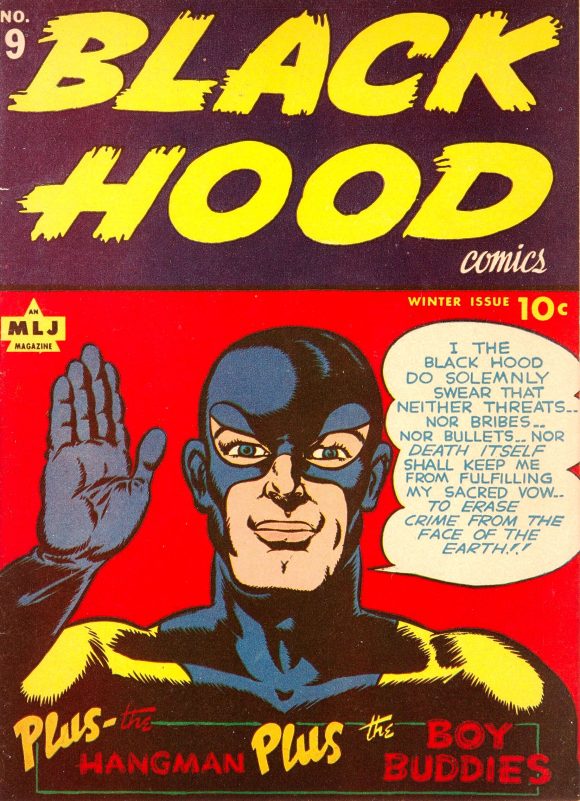
Black Hood Comics #9 (Winter 1943, MLJ/Archie). Cover art possibly by Clem Weisbecker.
However, for all the popularity of the Black Hood in MLJ comics at the time, he just never caught on with radio audiences on any large-scale level. As a matter of fact, the show was broadcast without a sponsor because they could not find one.
Ads within the comics appeared for both programs, such as this one from Zip Comics #43 (Jan. 1944), which had the top half highlighting the success of Archie Andrews, while the lower half for The Black Hood almost appeared to be a cry for help.
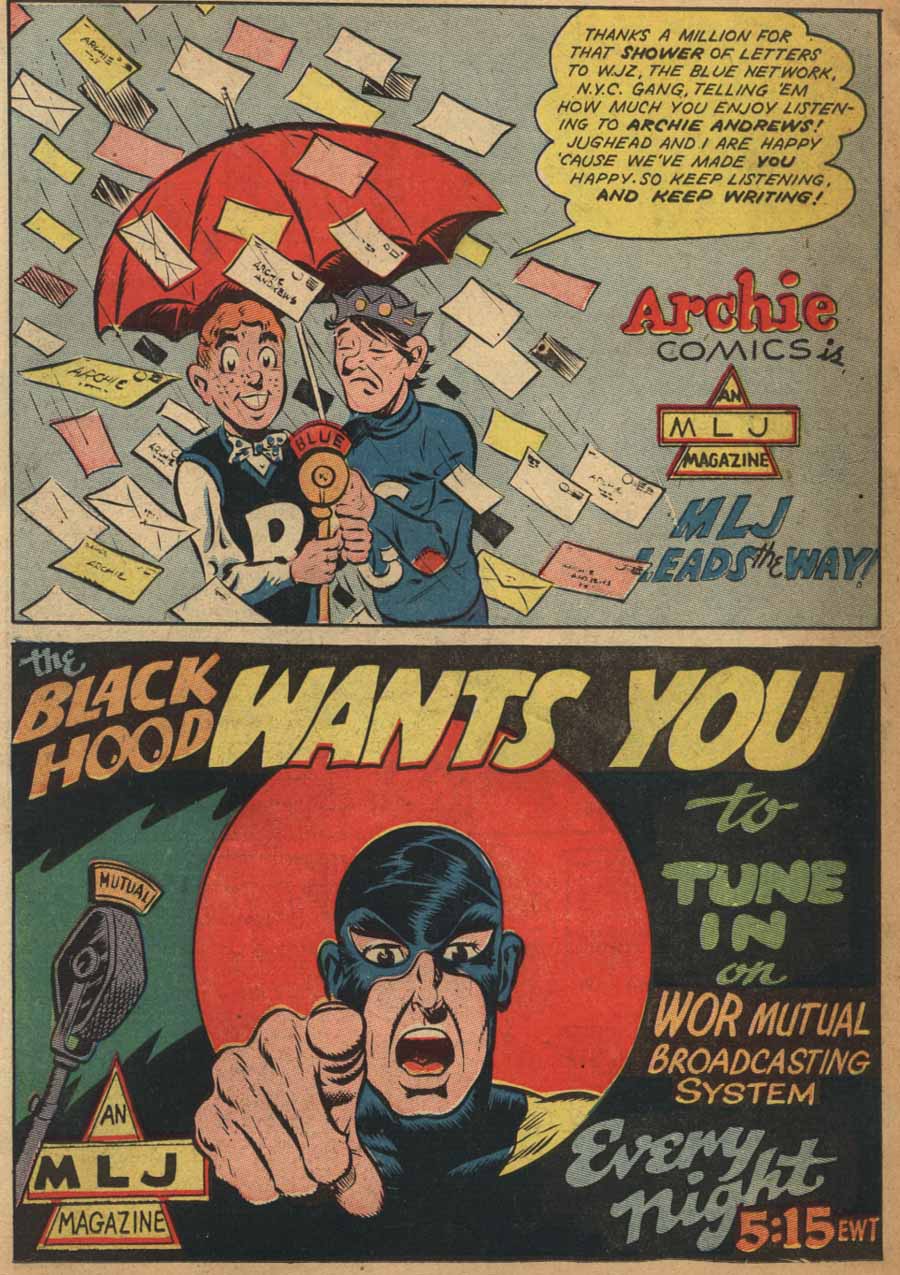
On January 14, 1944, after 120 episodes, the program was cancelled. The sad thing today for fans of the Black Hood is that out of all those shows, only the very first episode — which was the one the producers used as their audition sample to sponsors — has survived:
(When listening to this episode, you might feel you’ve heard the theme music before. You have if you ever saw Walt Disney’s Fantasia. It’s part of “The Sorcerer’s Apprentice,” the 1897 composition by Paul Dukas.)
Now, it’s time to return to the present. Until next time, I remain your humble host.
—
MORE
— FOUR COLOR RADIO: The First Time the CAPED CRUSADER Hit the Airwaves — 21 Years Before BATMAN ’66. Click here.
— FOUR COLOR RADIO Presents: 13 THINGS You Might Not Know About THE ADVENTURES OF SUPERMAN Radio Show. Click here.
—
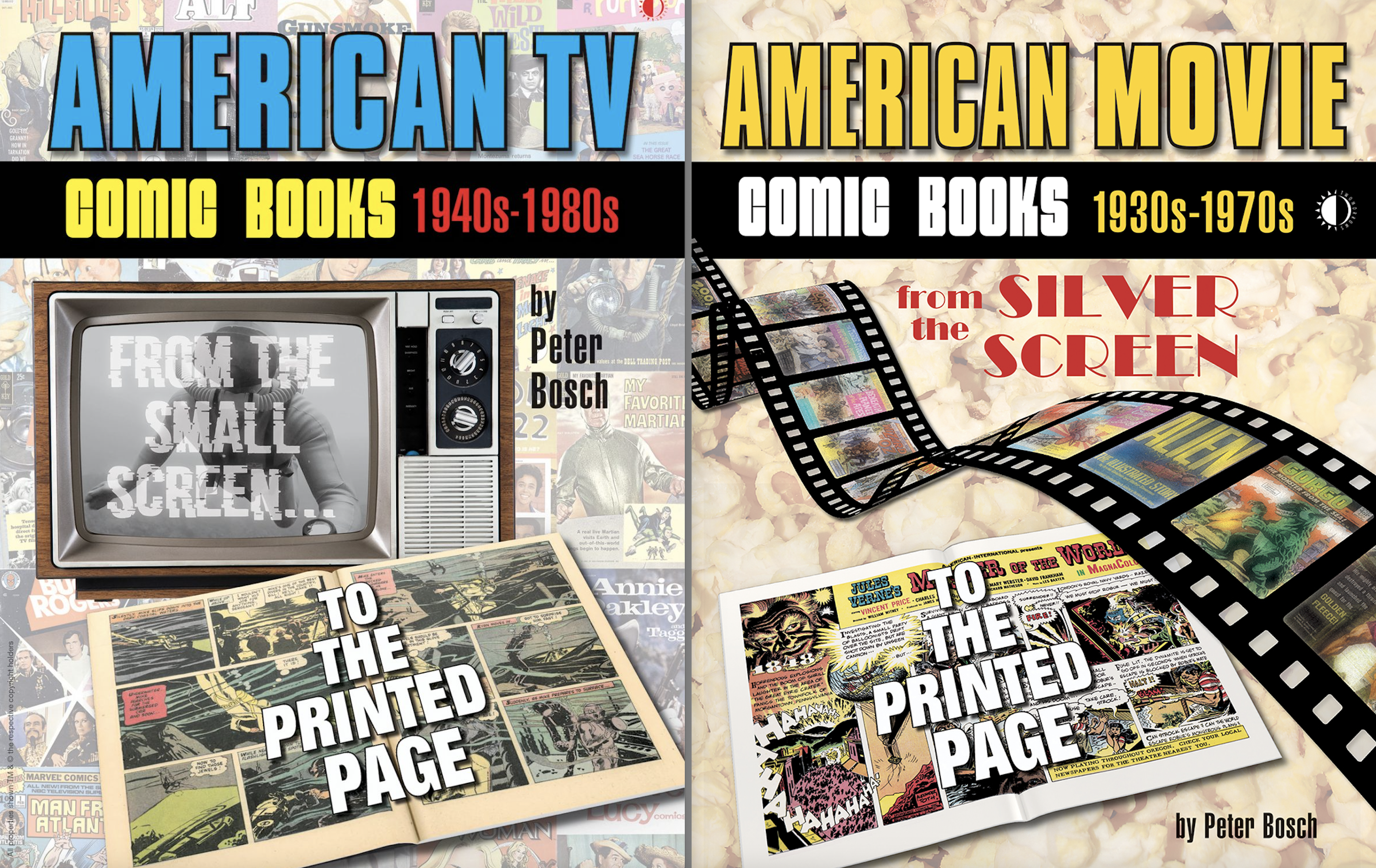
13th Dimension contributor-at-large PETER BOSCH’s first book, American TV Comic Books: 1940s-1980s – From the Small Screen to the Printed Page, was published by TwoMorrows. (You can buy it here.) A sequel, American Movie Comic Books: 1930s-1970s — From the Silver Screen to the Printed Page, is out now. (Buy it here.) Peter has written articles and conducted celebrity interviews for various magazines and newspapers. He lives in Hollywood.

February 1, 2026
Thanks for these posts on old radio shows. I wasn’t aware of the Black Hood’s foray into radio.
February 2, 2026
I was privileged to play Jughead twice opposite Bob Hastings and Rosemary Rice in re-creations of Archie scripts at 1990s nostalgia cons. After that, Bob talked Hal Stone into coming in later years. Bob introduced me to him as his Jughead stand-in and we did maybe 10 minutes of improv banter as Jughead in the lobby of the hotel. We drew a crowd! Hal later called it “Dueling Jugheads.”