
TOYHEM! From Planet of the Apes to Godzilla to Thunderball and MORE!

—
Welcome to TOYHEM! For the seventh straight holiday season, we’re bringing you a series of features and columns celebrating the toys of our youth, which often made for the best memories this time of year. Click here to check out the complete index of stories — and have a Merry Christmas, a Happy Chanukah and Happy Holidays!
—
By PETER BOSCH
It’s TOYHEM 2025! Following up on my selection last year of 13 TV board games you may not have known existed, here are 13 more!
This year’s selection includes a few board games based on movies and – as I am now doing a regular column called FOUR COLOR RADIO for 13th Dimension – I will start with a game inspired by a super-popular radio program of its time.
(By the way, while some of these collectors’ board games can be purchased at reasonable prices on eBay or through auctions, there are some that – just like comics – have skyrocketed in value. With that in mind, I will list recent sales to give you an idea of how much that game you haven’t played in decades, and is now sitting on an upper shelf in your closet, could be worth.)
—
Charlie McCarthy’s Radio Party. Would you believe that a ventriloquist’s dummy was once one of this country’s favorite celebrities? “His” name was Charlie McCarthy. And, while ventriloquists are celebrated for being seen as not moving their lips, the man operating Charlie, Edgar Bergen, could easily be seen moving his. Also, hard as it is to believe, Edgar Bergen and Charlie McCarthy achieved their fame on radio! A ventriloquist on radio. The concept seems unlikely — except for one thing – they were hilarious together! The banter and timing of Edgar and Charlie was incredible, including Bergen’s switching voices so quickly and easily. Their popularity was such that they were the stars of The Chase & Sanborn Hour (Chase & Sanborn, maker of coffee, was the show’s sponsor). For an understanding of how good “they” were, listen to the audio clip below, starting at the 1:39 point. And, remember, this was done LIVE! They would also appear in movies. (W.C. Fields became a foil for Charlie in both media.)
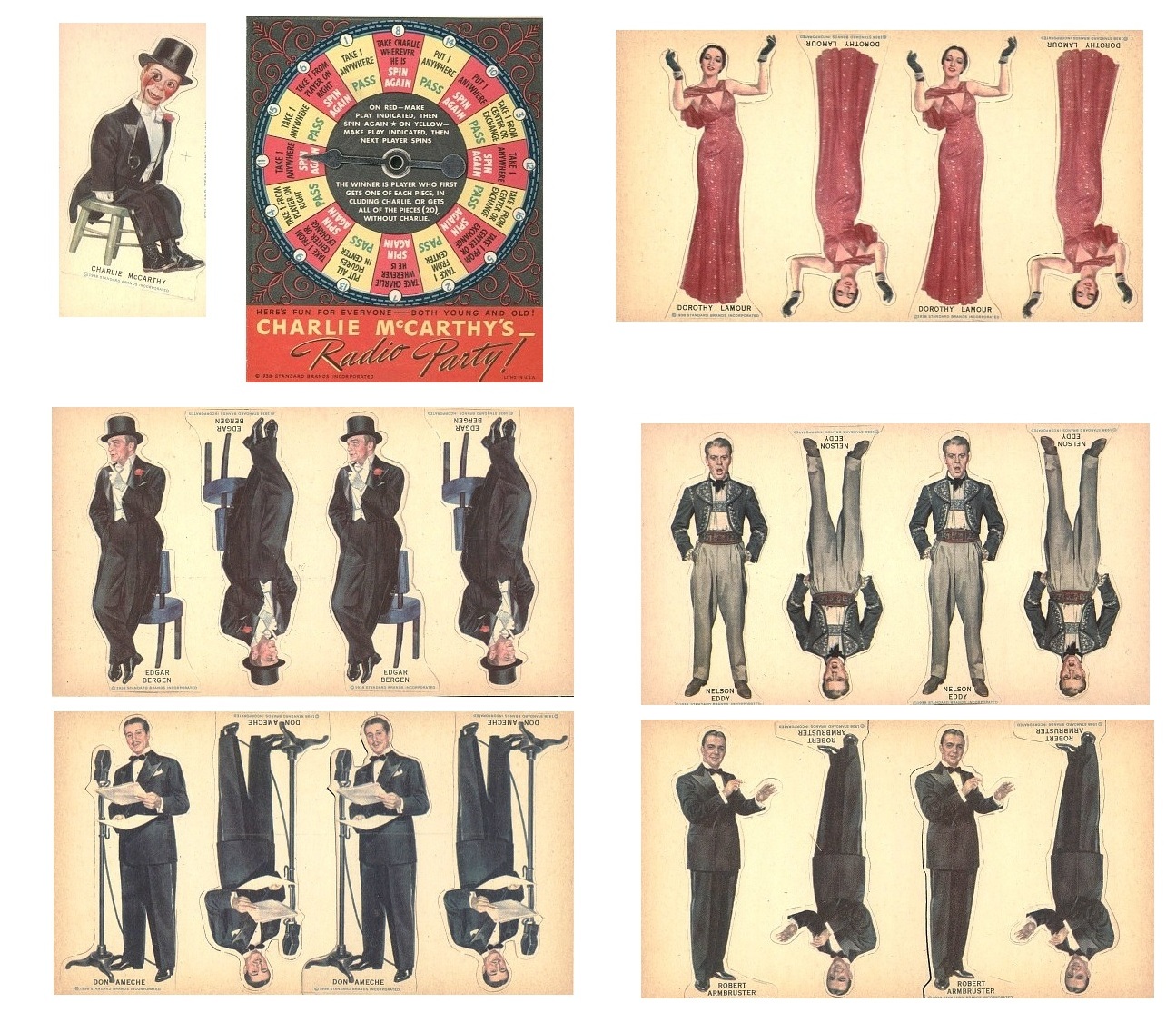
Charlie McCarthy’s Radio Party (Standard Brands, Inc., 1938)
A game was issued by Chase & Sanborn, Charlie McCarthy’s Radio Party, that was available to listeners who sent in two labels of the coffee and 10 cents. What was received in return was an envelope containing a spinner, a Charlie McCarthy punch-out figure, plus four punch-out figures each of the cast of the radio program, including Edgar Bergen, singers Dorothy Lamour and Nelson Eddy, host Don Ameche, and bandleader Robert Armbruster. No box and no board. The figures were placed upon a table in their individual groups. Using the instruction on the spinner, players picked up or had to give up one each of the figures. The winner was declared when the first person acquired a complete set, which had to include the sole Charlie McCarthy figure. (Sold by Heritage Auctions in December 2024 for $89.)
—
The Mickey Mouse Club in Disneyland. M – I – C…see if you can win…K – E – Y…why? Because it’s fun. M – O – U – S – E. This very early game (1955) from Disney had players on a mini-tour of Disneyland in its opening year. (1955 also saw the TV debut of The Mickey Mouse Club.)
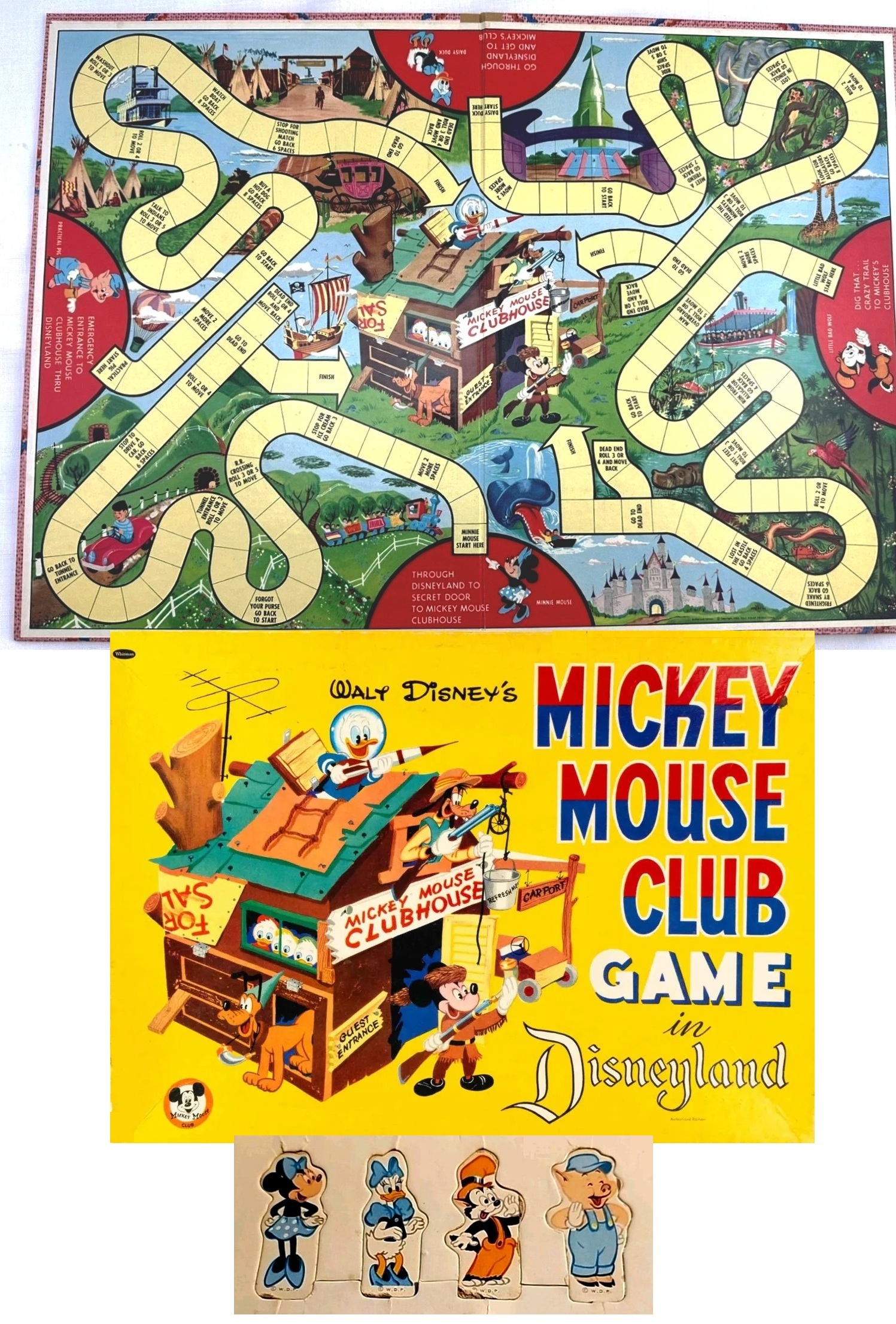
Walt Disney’s The Mickey Mouse Club in Disneyland (Whitman, 1955)
Depending on which character the player selected (Minnie Mouse, Practical Pig, Daisy Duck, or Little Bad Wolf), the path they followed contained individual instructions on certain squares they must follow if the player stopped on them (Practical Pig’s path contains one that reads “Buy a Hot Dog, go back 8 spaces”). To win the game, a player had to be the first to reach the clubhouse in the center of the board. (Sold on eBay for $29.00 in Sept. 2025.)
—
Around the World in 80 Days. One of the grandest motion pictures in cinema history is 1956’s Around the World in 80 Days, based on Jules Verne’s 19th century novel about Phileas Fogg and his manservant Passepartout out to win a bet that a person could encircle the globe within 80 days. Producer Mike Todd used that premise to film in many exotic locations, with David Niven as Fogg and Cantinflas as Passepartout, along with Shirley MacLaine as an East Indian widow who is rescued by the pair from being burned alive. Along for the trip was Robert Newton (in his last film) as a police inspector who believed Fogg was fleeing England with money from a bank heist. The film, which won the Oscar for Best Picture, included a ton of guest appearances by practically every star in Hollywood.
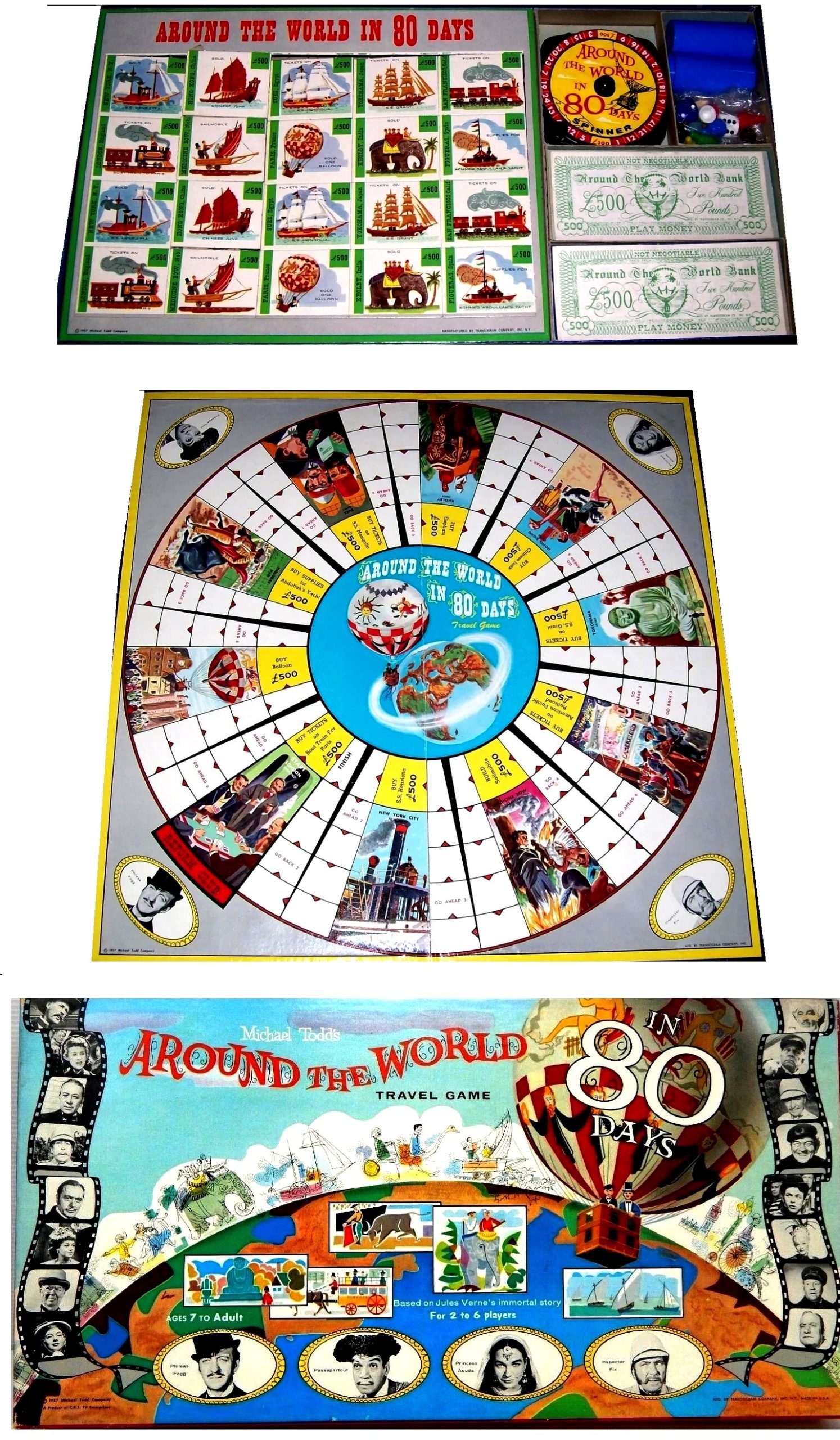
Around the World in 80 Days (Transogram, 1957)
The game version from Transogram in 1957 featured photos of the main cast on the box lid, along with 16 of the many guest stars. The lid also had an interesting note on one of its flaps: “Recommended by child psychologists for family play, the lively action on the board lets children compete with adults and will stimulate their interest in learning more about far-off places in the world.” (Sold on eBay for $99.95 in October 2025.)
—
Gunsmoke. One of TV’s most enduring Westerns (it lasted 20 years and then there were five TV movies after that!), Gunsmoke told of Marshal Matt Dillon keeping the peace in Dodge City, Kansas, during the latter part of the 1800s. The game’s board graphics were impressive with its fort stockade towers, but it was not really an adaptation of the television program; rather, it was a case of slapping the Gunsmoke brand name on a game of cowboys and Indians.

Gunsmoke (Lowell, 1958)
The object of the game was for the player(s) representing warring Indians to get six pieces inside the town of Fort Riley (top right on the board) or for the player(s) who were the cowboys to get one piece through Indian Territory to Dodge City (bottom left) where Dillon could be notified. (Sold on eBay for $99.99 in October 2025.)
—
King Kong vs. Godzilla was a highly-ludicrous (as you can see in the clip below) 1962 movie from Japan that pitted the giant gorilla against the prehistoric dinosaur. It is likely the Ideal Toy Company saw this as an opportunity to make money off it, but still respect the original King Kong movie from 1933 by basing their 1963 game upon the original motion picture.
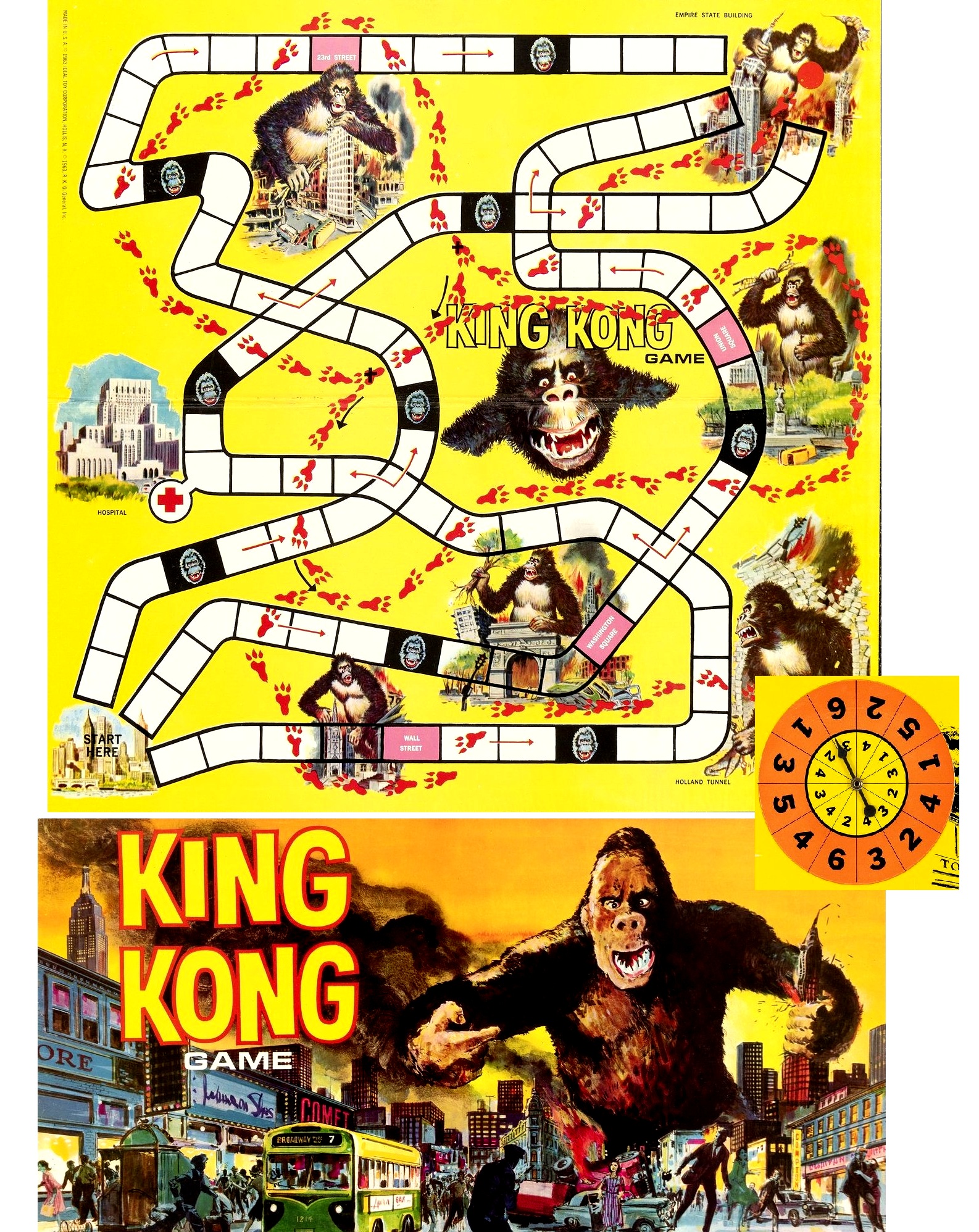
King Kong (Ideal, 1963)
King Kong. In the Ideal game, the giant ape was brought to New York and wreaked havoc all over the game board as the player and the King Kong marker (also moved by the player) tried to get to the Empire State Building first. Kong’s path was along his footprints, while the players followed the regular white paths. However, if a player’s turn ended on a white area with a Kong footprint, the player was automatically taken to the hospital located at the middle left of the board, where the player must wait until the next spin to be “released.” (Sold on eBay for $399.99 in September 2025.) (A King Kong board game based on the later cartoon TV series was produced by Milton Bradley in 1966.)
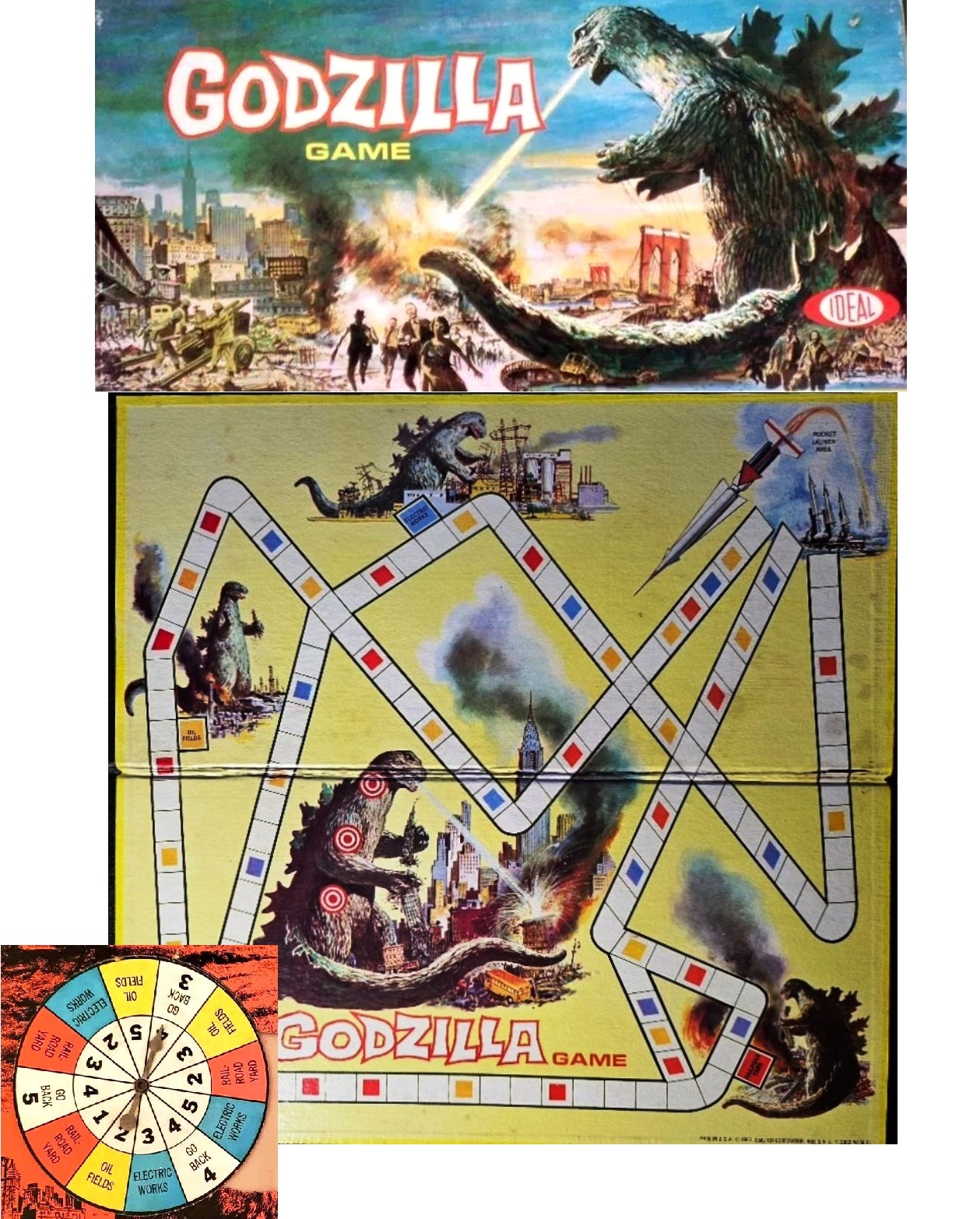
Godzilla (Ideal, 1963)
Godzilla. Ideal also put out a Godzilla game that same year, which had players starting in the lower left corner and then going their separate ways around the board. The object of the game was to get to the upper right area where a missile base was located. The first player there to fire a radioactive missile (attached to the spinner arrow) that struck one of the three targets on Godzilla was declared the winner. (Sold on eBay for $649.99 in August 2025.)
—
Combat! A TV war series that lasted longer than America’s entry into World War II itself, Combat! was on air for five years in all. Even more amazing is that the program was set after D-Day, so the combined stories over five seasons were actually about just a year in real time. It was a gritty series with Vic Morrow and Rick Jason as the continuing characters, Sgt. Saunders and 2nd Lt. Gil Hanley, respectively (the stars would alternatively get first billing in the opening credits throughout the run of the program), as each star would get a chance at being the main character in different episodes. Prior to becoming a famous film director, Robert Altman directed 10 episodes of the first season. Richard Donner also directed one script, and star Vic Morrow sat in the director’s chair for six times throughout the run of the program.
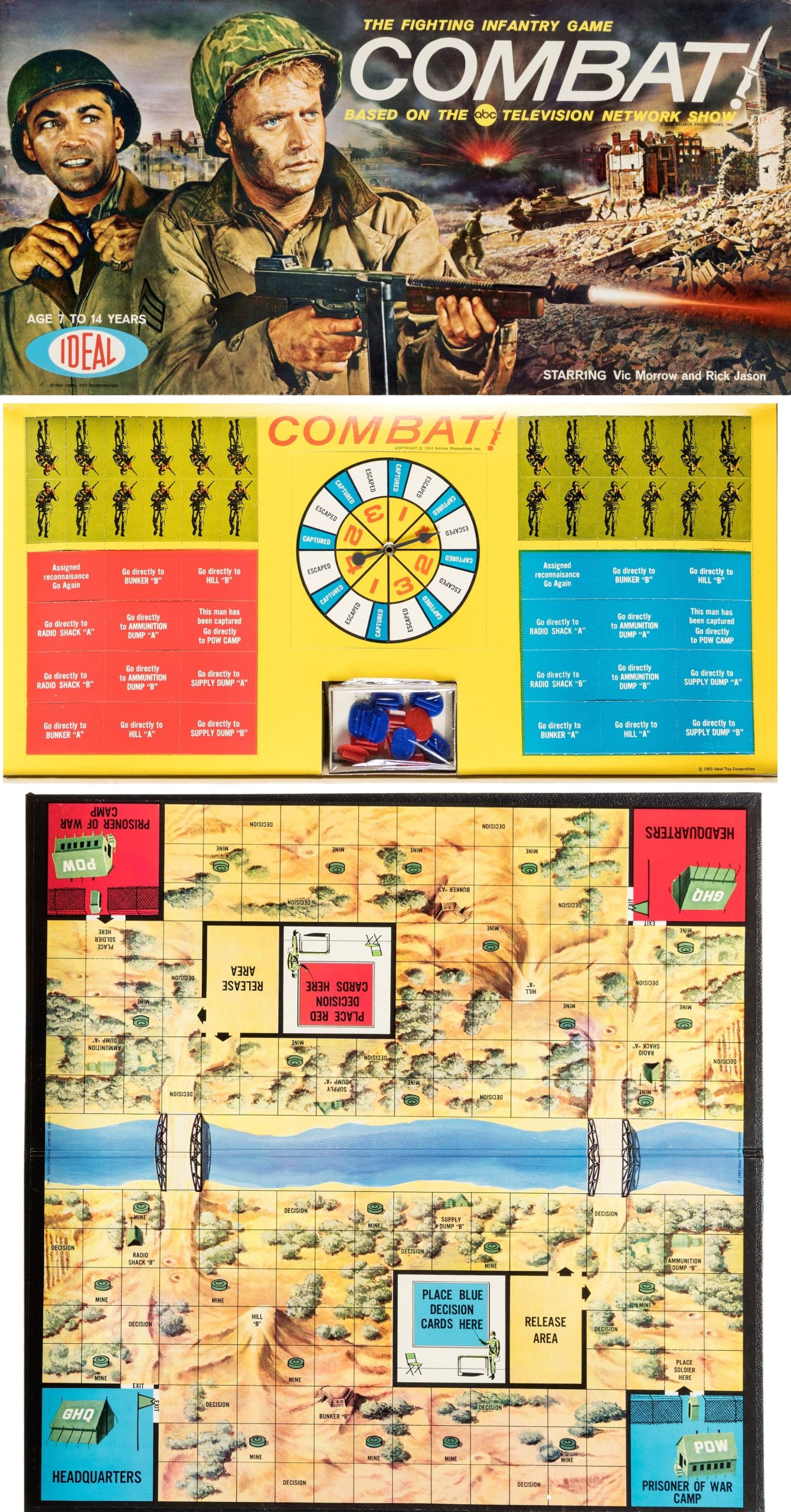
Combat! (Ideal, 1963)
The game featured two enemy camps, with the goal to be the first player to get two soldiers inside the enemy’s HQ or to capture all the opponent’s soldiers. Along the way, however, there were mines, and if a player’s soldier passed over one or on a turn ended on one, that soldier was sent directly to the enemy’s POW camp. (Sold on Heritage Auction for $372 in September 2025.) (There was also a Combat! Card Game issued in 1965 by Milton Bradley.)
—
Jonny Quest. In the 1960s, one tended to think of a TV cartoon/animation series as something that was restricted to Saturday mornings, but there were several that were actually prime-time programs (long before The Simpsons or South Park). Among those series were The Flintstones, Rocky and Bullwinkle, The Jetsons, and Top Cat. Jonny Quest was my Friday night pleasure and it was different from the rest in that it was a serious adventure series (for kids, sure, but still an adventure series) with Jonny, Dr. Benton Quest, “Race” Bannon, Hadji, and Jonny’s dog, Bandit — plus that great pulse-pounding theme music by Hoyt Curtin. And the talent behind the series: Doug Wildey as creator (listed as “Supervising Art Director” in the end credits), Alex Toth doing character designs — wow! Regretfully, the ABC series ended after just one season.
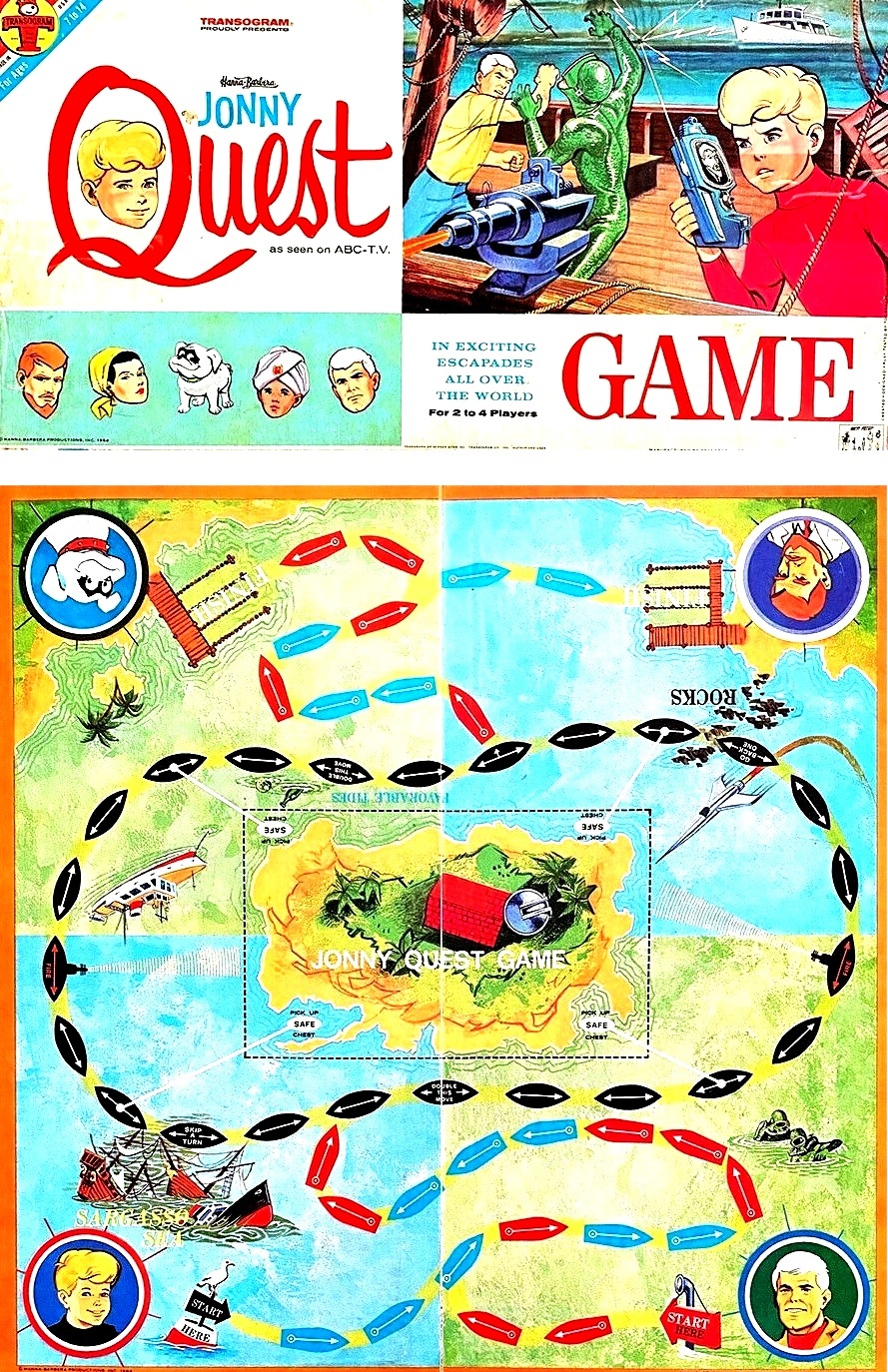
Jonny Quest (Transogram, 1964)
However, one holdover from its time on the air is the Jonny Quest Game… and the idea for it is one that would have made a good TV episode. Dr. Quest invents a future-predicting machine but enemy agents want to seize it before Race and Jonny can get it to the mainland. He dismantles it into small pieces and places them into separate chests, which players must retrieve and get to their own safe mainland docks. When all the chests are there or the enemy agents’ vessels all sunk, the players look for the first time at the bottom of each chest they have for a number. The player with the highest total wins. (In October 2025, the game sold on eBay for $750.) Milton Bradley also issued a Jonny Quest Card Game in 1965.
—
James Bond 007 Thunderball Game. Did you ever stop to wonder what “Thunderball” meant in the title or in the theme song’s lyric “And he strikes like Thunderball”? (Of course, if you just liked the way it sounded when Tom Jones sang the title song, I can totally understand that.) And, yes, I know within the story, “Operation: Thunderball” was the mission that James Bond was assigned to. But what did “thunderball” mean?! It turns out the word came from an unofficial military term for a mushroom cloud from a nuclear explosion (which definitely tied into the novel and the film’s plot of stolen nuclear warheads). Aren’t you glad you know now?

James Bond 007: Thunderball (Milton Bradley, 1965)
(By the way, I just did a 60th anniversary deep dive into Thunderball, which is my favorite Bond movie, in celebration of its U.S. release in December 1965.)
The game stuck close to the basic premise of the movie. Atomic bombs had been hijacked by SPECTRE and one of them was armed. In order to help Bond, agents/players joined in the search and, through coded messages, had to determine which bomb that was. After encountering SPECTRE agents along the way, the first person to get to where the armed bomb was won the game. (Sold on eBay in November 2025 for $55.00.)
—
Get Smart. For details about the series, check out this 60th anniversary salute from a few months ago. As to the Ideal Get Smart game (one of two from the company, with the other being a card game in 1967), the object was to collect clue cards in order to complete a picture of an enemy agent.
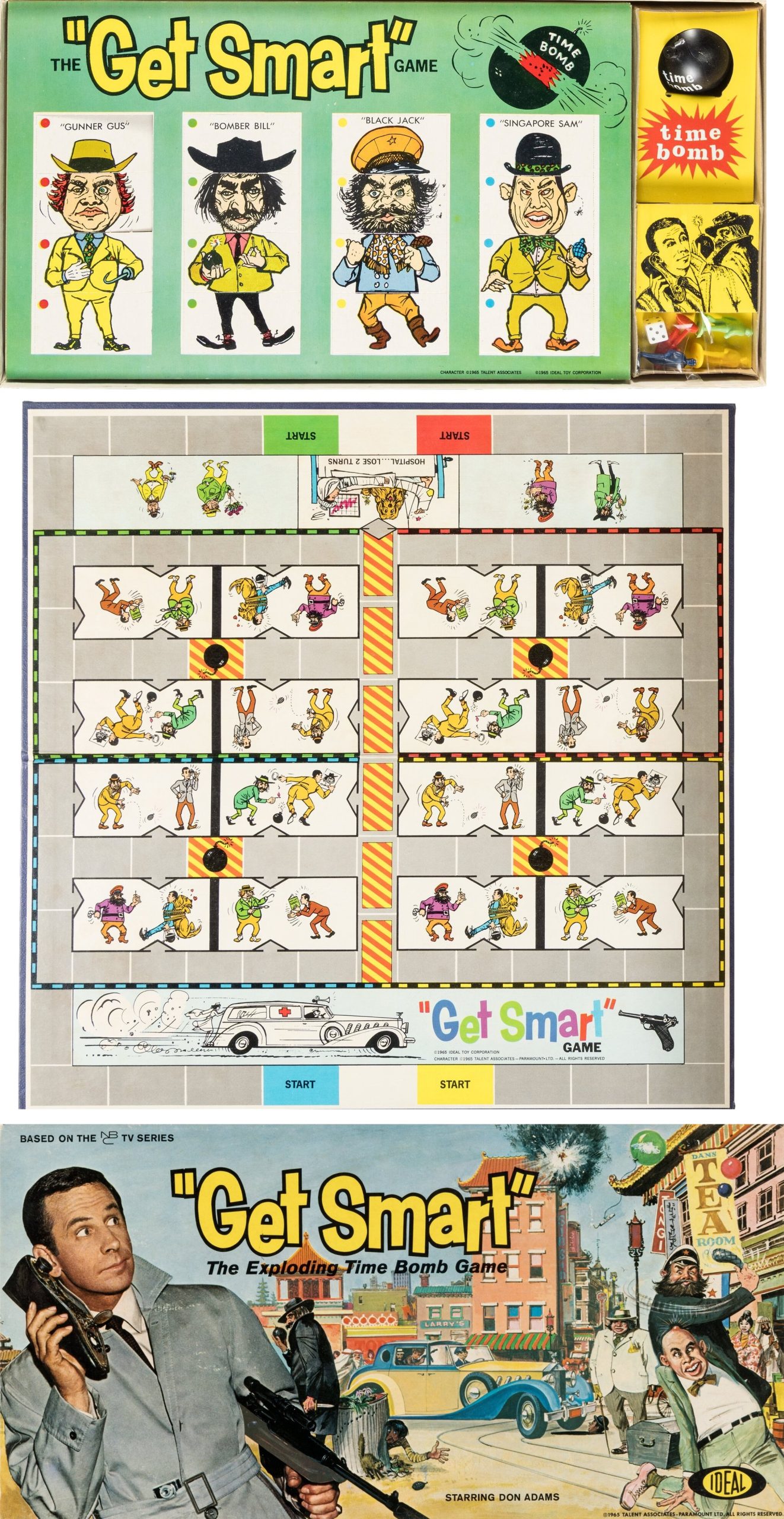
Get Smart (Ideal, 1965)
However, if the spring-loaded time bomb went off with a player in that area, the player would be sent to the Hospital space and lose two turns. (The game sold on Heritage for $930 in September 2025.)
—
The Time Tunnel. The Irwin Allen television series featured Tony Newman (James Darren) and Doug Phillips (Robert Colbert), two scientists who were thrust together into famous historical time periods. In the program’s episodes, they would arrive just before some tragic event, including the sinking of the Titanic (see the video clip below), the standoff at the Alamo, and the attack on Pearl Harbor. In one episode, they’re unable to get Custer to believe them about the upcoming slaughter at Little Big Horn. Speaking of Custer, while The Time Tunnel was a success, somehow ABC was convinced to cancel the series after its first season and put in its place The Legend of Custer, which turned out to be a total ratings bomb.
Before moving on to the game, here is a clip of the show’s opening credits — with a theme by John Williams!
Now, to the game. Actually, there were three of them: The Time Tunnel Game and The Time Tunnel Card Game were both from Ideal in 1966, and The Time Tunnel: Spin-to-Win in 1967 was produced by Pressman. The regular board game from Ideal was the best of the three. In it, the goal was to be the first to traverse the board’s four time periods (prehistoric, the middle ages, 19th/20th century, and the future). (Sold on eBay for $349.95 in October 2025.)
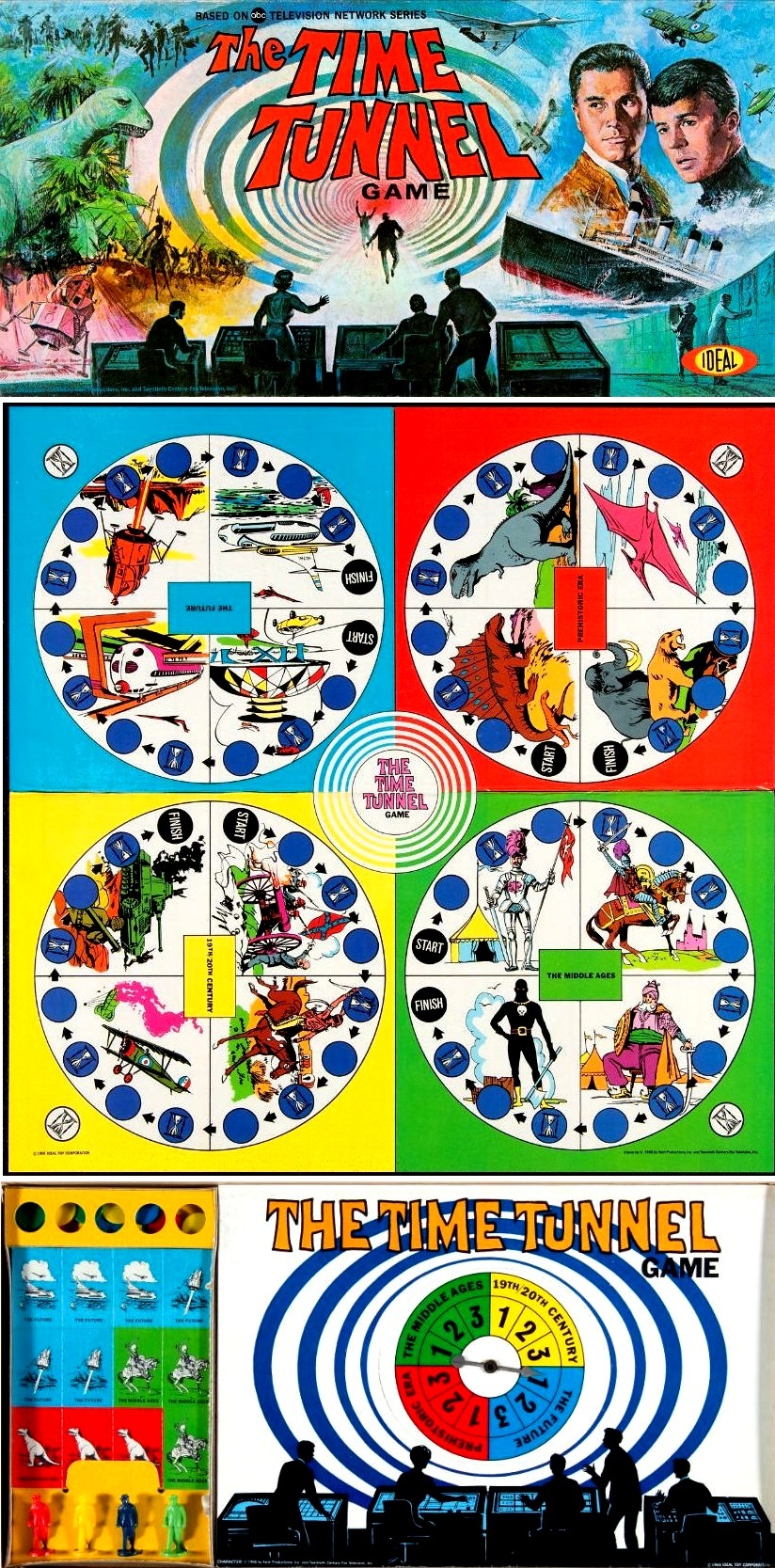
The Time Tunnel (Ideal, 1966)
—
Planet of the Apes. This Milton Bradley game came out in 1974, a year after the release of Battle for the Planet of the Apes (1973), the fifth (and final) film in the original Planet of the Apes franchise, but just in time for the new television series. (Roddy McDowall returned to take on his third role in the franchise.)
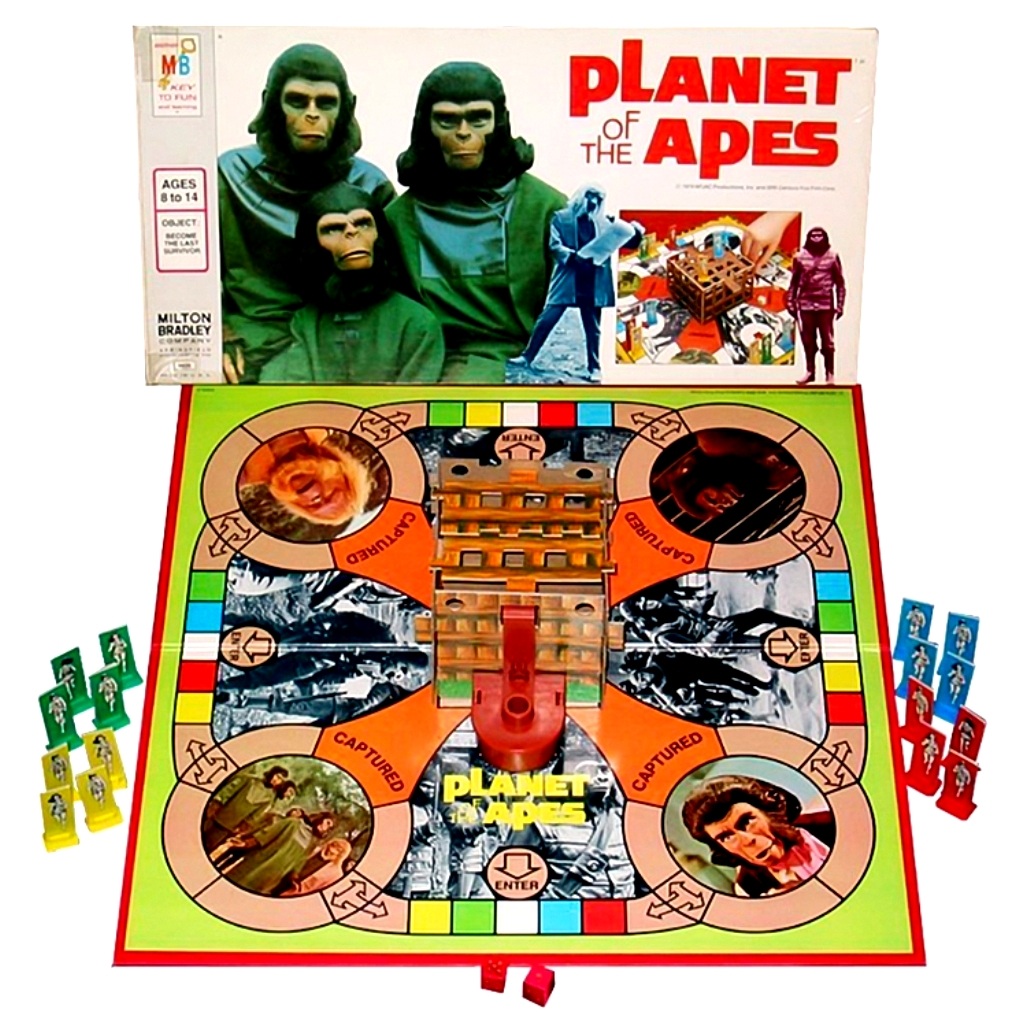
Planet of the Apes (Milton Bradley, 1974)
The game concentrated on just one aspect of the original film, the hunting of human beings and rounding them up. A cage (included) was put together by the players prior to the start of the game, with trap doors on top of it, and placed at the center of the board. Each player is allotted four pieces, with each piece picturing a terrified human running. The focus of the game was to force a player’s opponents’ pieces into “Captured” areas where they might be dropped into the cage and removed from the game one by one. The winner was the player with one human remaining. In retrospect, while it was deemed a game of strategy, it came across more as sacrificing fellow human beings in order to be the last one surviving in a world of apes. Some win. (The game sold on eBay in September 2025 for $160.)
—
Electra Woman and Dyna Girl (or ElectraWoman and DynaGirl, if you prefer – though the pilot script shows a space between the words). Sigh… Judy Strangis. Some teenage crushes you just never get over. Huh? Oh, right, sorry… the game from Ideal in 1977:
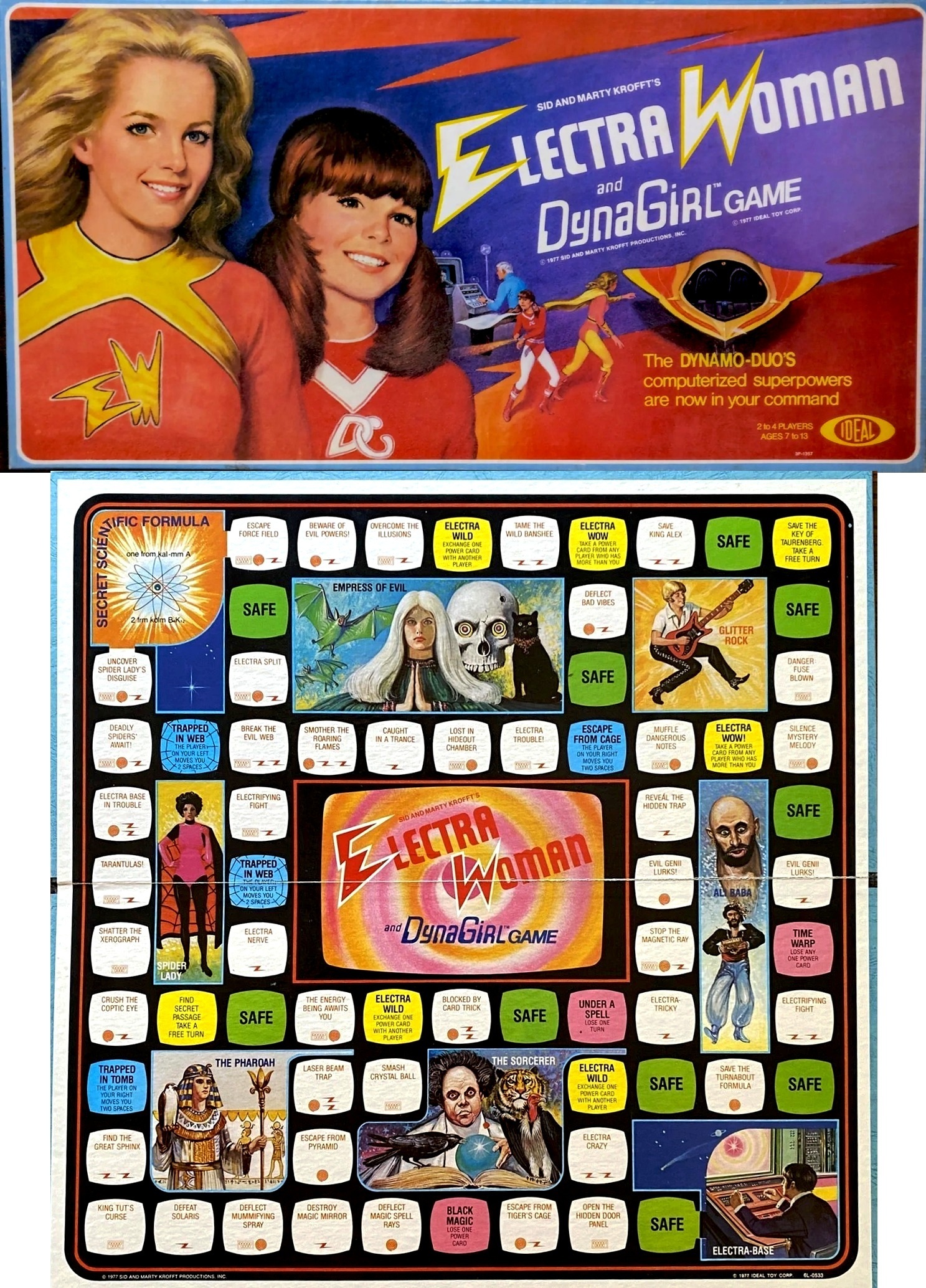
Electra Woman and Dyna Girl (Ideal, 1977)
The goal is for 2-4 players to help Electra Woman and Dyna Girl travel across the board, get ahold of one of four secret formula cards in the top left corner, and then race back to be the first to return with it to the Electra Base. (Sold on eBay for $200 in October 2025.)
Tune in next year for 13 more!
—
MORE
— The Complete TOYHEM INDEX of Stories and Features. Click here.
–– Dig These 13 Groovy TV BOARD GAMES From (Mostly) the 1960s. Click here.
—
13th Dimension contributor-at-large PETER BOSCH’s first book, American TV Comic Books: 1940s-1980s – From the Small Screen to the Printed Page, was published by TwoMorrows. (You can buy it here.) A sequel, American Movie Comic Books: 1930s-1970s — From the Silver Screen to the Printed Page, is out now. (Buy it here.) Peter has written articles and conducted celebrity interviews for various magazines and newspapers. He also writes the FOUR COLOR RADIO column for 13th Dimension. Peter lives in Hollywood.

December 22, 2025
I had the POTA one. Great fun as a kid.
December 22, 2025
El del agente 86, qué sorpresa ! Aúnque probablemente nunca en español
December 22, 2025
Planet of the Apes was one of the best board games ever made…
December 23, 2025
Transogram made some great games but my favorite TV related game was the Ideal game for the Man from U.N.C.L.E.