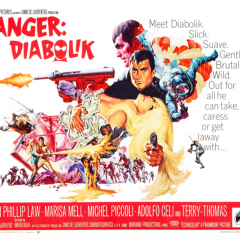
REEL RETRO CINEMA — Danger: Diabolik
Think comics movies are cool now? You ain’t seen nothin …

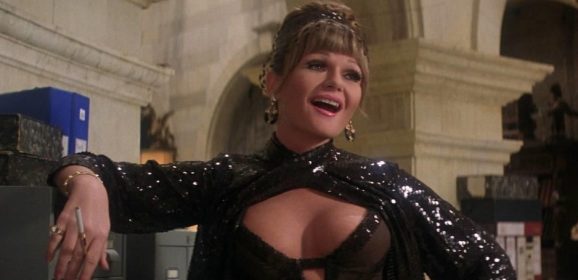
The REEL RETRO CINEMA columnist pays tribute to the screen siren, who has died at 82… By ROB KELLY The iconic Miss Teschmacher, Valerie Perrine, has died at age 82 due to Parkinson’s disease. Born in 1943, Perrine was an Army brat who ended up as a Vegas showgirl in the late 1960s. For many people, “Late ’60s Vegas Showgirl” would be the defining experience of their life. But for Perrine, it was just the beginning. Moving to Los Angeles in the early 1970s, Perrine found herself at a dinner party where an agent was looking to cast a small, but key, role in director George Roy Hill’s adaptation of Kurt Vonnegut’s Slaughterhouse-Five. Despite not being an actress, she was offered the role of soft-core porn actress Montana Wildhack. Her combination of sweetness and undeniable sex appeal made Perrine pop off the screen, and she was on her way to a Hollywood career. In just her third film, she was nominated for an Academy Award for Best Actress for her role as stripper Honey Bruce, girlfriend to tortured comedian Lenny Bruce (played by Dustin Hoffman) in Bob Fosse’s Lenny. She appeared in other films alongside actors like Jeff Bridges, Jackie Gleason, and Rod Steiger, but it was in 1978 that she achieved silver screen immortality. Superman director Richard Donner originally pictured superstar Goldie Hawn as Lex Luthor’s gal pal Eve Teschmacher, but the producers refused to pay her requested salary. They then turned to Ann Margret, who was also deemed too expensive. Donner then went to Valerie, who took the role and made it her own. As Donner later remarked in the audio commentary to the film, “Sometimes the third choice is the best choice.” Valerie’s Miss Teschmacher is sadistic and malevolent to be sure (watch the way she claps with glee when Luthor threatens to beat the hell out of Otis in the van), but the actress’ inherent loveableness still shines through. So it makes sense, dramatically, when she eventually does a reverse heel turn in the final third of the movie and helps rescue the Man of Stee l— but not before stealing a kiss. It says something about how irresistible Miss Teschmacher is that she manages to foil Luthor’s plan, landing him in prison, and yet they are still a couple in Superman II. Perrine went...
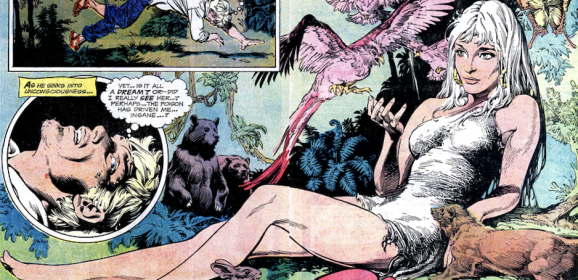
REEL RETRO CINEMA: New looks at old flicks — and their comics connections… By ROB KELLY As a child of the ’70s (Whip Inflation Now!), my relationship to Rima, The Jungle Girl was informed solely by the fact that she had her own DC Comics series and later showed up on various iterations of Super Friends. That told me that she was an official Big Deal, a member of the DC stable on par with the likes of Aquaman, Green Arrow, Hawkgirl, etc. And while all that might not exactly be true, her history in many ways is even more grand and impressive. Rima was one of the many characters DC adapted from other media in the 1970s and tried to turn into a comic-book star, like her fellow jungle adventurer Tarzan, the Shadow, the Avenger (in Justice, Inc.) and, for one glorious, treasury-sized month, Dick Tracy. While I kinda sorta knew Tarzan wasn’t a DC character, exactly, I always assumed Rima was their attempt to combine the Lord of the Apes with Wonder Woman. In fact, in one of those, “Wait, Buck Rogers came before Flash Gordon?” kind of things, Rima actually predates Tarzan by a full decade. She made her debut in the 1904 novel Green Mansions, written by W.H. Hudson, while Lord Greystoke didn’t debut until 1912. Hudson was a naturalist who moved from his home country of Argentina to the United Kingdom, where he found success as an author of both fiction and non-fiction. His most famous work concerns Abel, a failed revolutionary who escapes into the jungle to evade capture. There he meets various denizens of the forest, including a young, wraith-like girl who seems to not only survive in the harsh climate, but possesses supernatural powers. Green Mansions as a book is a fine enough read, if you can put aside the numerous Lolita-like mentions of how attractive this small, very young girl is to this much older man. Abel is undoubtedly the main character (Rima actually dies near the end of the book), but I will mention that the paperback version I read (published in 1959), does feature some quite beautiful illustrations by artist Sheilah Beckett. The reason the book was republished in 1959 was as a tie-in to a big-budget movie adaptation, also called Green Mansions. Starring Audrey Hepburn as Rima,...
Think comics movies are cool now? You ain’t seen nothin …