Kirby, Toth, Ditko — and MORE!
By PETER BOSCH
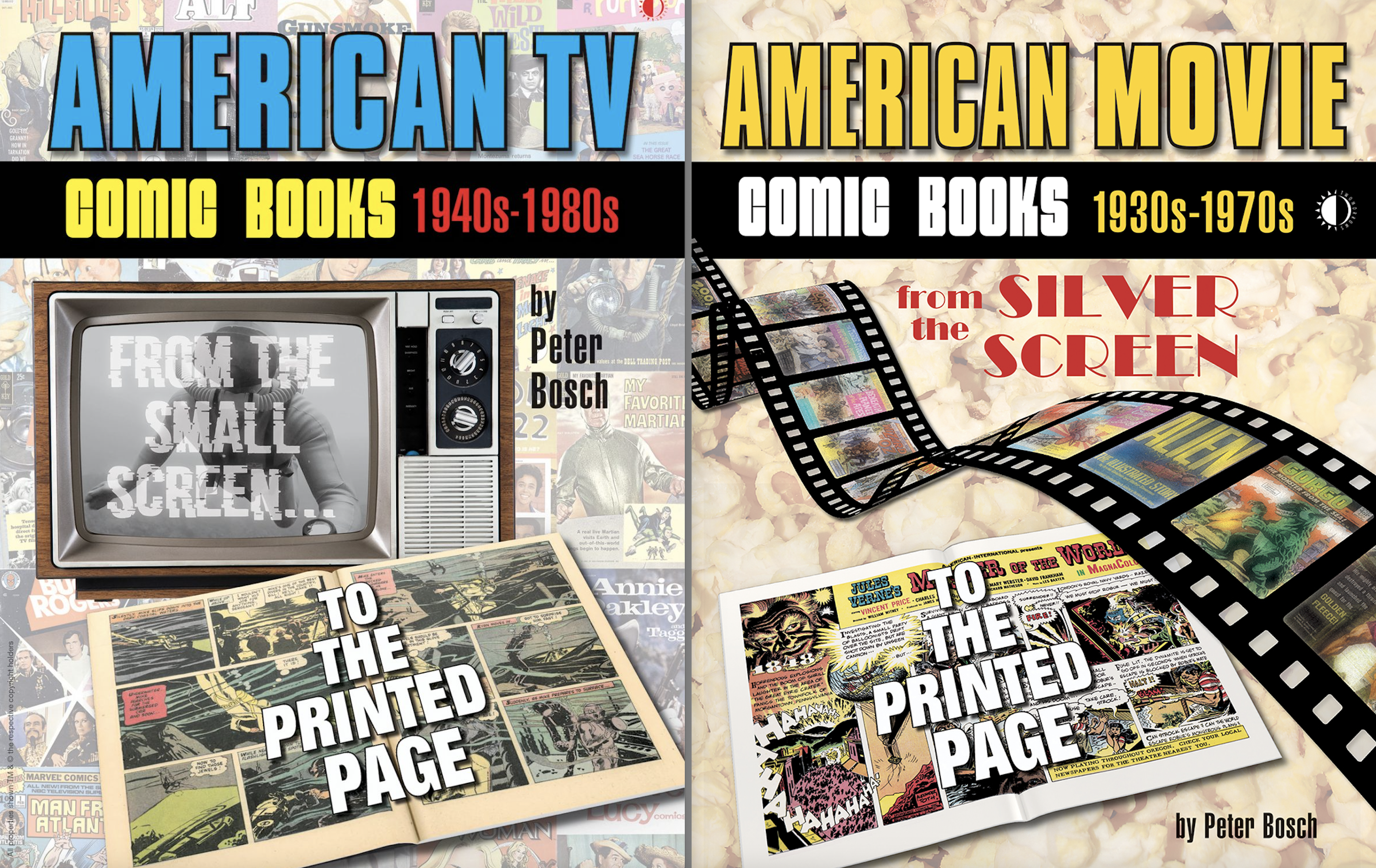
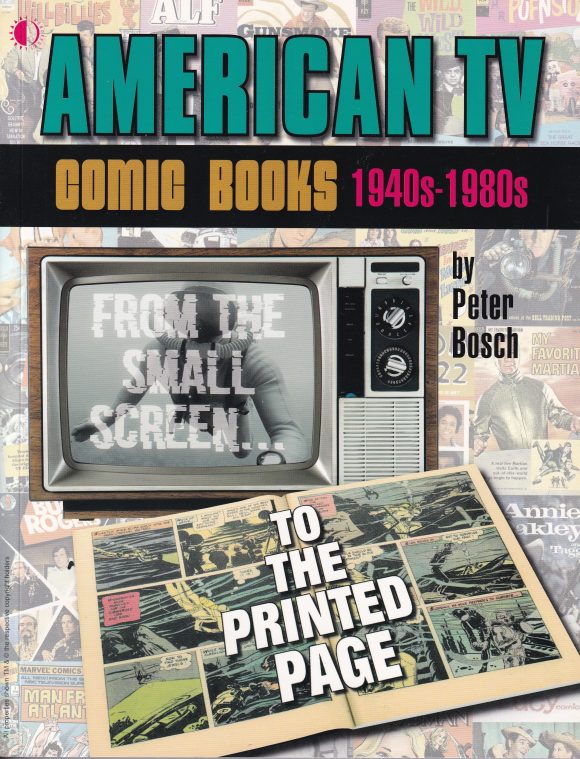
Once upon a time, I had an idea. There were plenty of books on comics that had been adapted into movies and TV series, but there wasn’t anything about the reverse — movies and TV shows that were adapted into comic books. From that thought — and years of research –– came American TV Comic Books – 1940s to 1980s: From the Small Screen to the Printed Page (TwoMorrows, 2022).
Naturally, though, there had to be a follow-up and, as you’ve likely guessed, I call it American Movie Comic Books – 1930s-1970s: From the Silver Screen to the Printed Page (of course, also published by TwoMorrows and out now!)
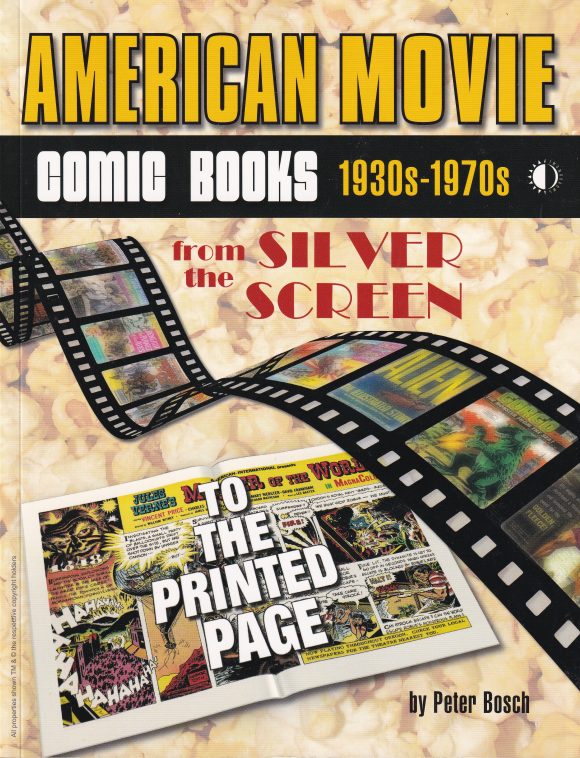
I am again following a year-by-year approach over five decades, starting with the first movie adapted into comic form, Police Car 17 (1934), and then covering each film-to-comic adaptation that followed it.
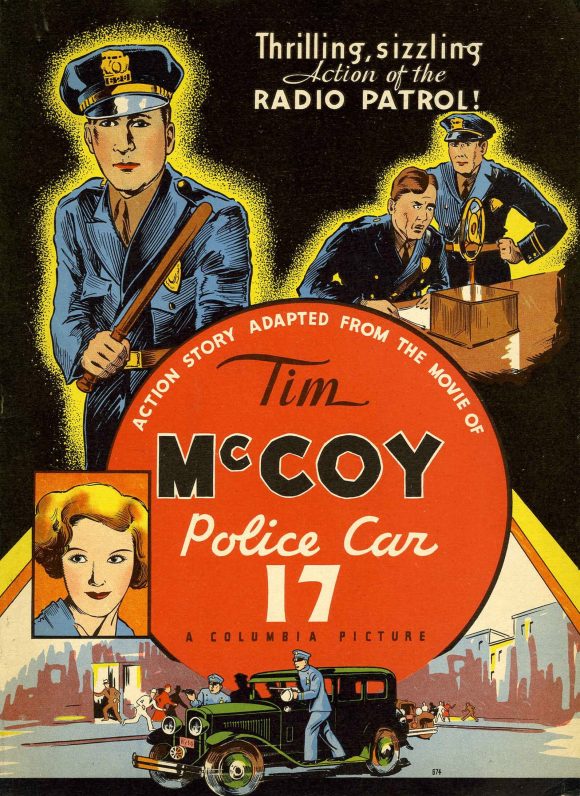
Police Car 17 (1934)
Movie adaptations were new territory for comic publishers during the 1930s and 1940s, but by the 1950s they had perfected them. In 1950 itself, there were four new anthology comic book series dedicated to just adapting motion pictures. Added to that, there were 17 individual movie star comic book titles! Couldn’t wait to see your favorite star’s next movie? Go buy their comic book!
By the end of the 1950s, there had been nearly 190 movies adapted to comic form… and it was during that decade that the artists came to prominence. One of the great joys I had during my research years was discovering how many giants of the comics industry also drew movie adaptations. (Not to forget the writers, scribes like Paul S. Newman and the team of Robert Schaefer and Eric Freiwald are given their due in the book, too.)
Here’s a sampling of 13 names you may recognize:
—
Wallace Wood. Near the beginning of his extraordinary career, Wood was drawing for Fox Publications’ line of movie-star comics. In 1950, Wood art could be found in the titles Dorothy Lamour, Sabu “Elephant Boy,” Judy Canova, Hoot Gibson, and big-game-hunter-turned-actor Frank Buck. However, as we know so well, Wood’s greatest achievements occurred during his EC Comics era just a year or two later. And part of those achievements were the hilarious movie spoofs he drew for Mad and Panic. Serious popular films of the day, such as On the Waterfront, The Caine Mutiny, Julius Caesar, and The Wild One became bust-a-gut satires under his pencil (with Harvey Kurtzman writing the scripts).
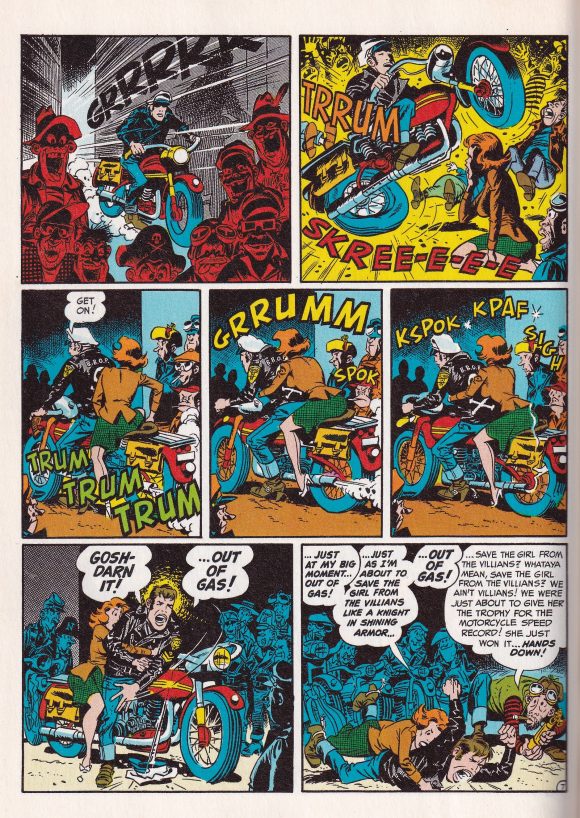
The Wild One (1953), which starred Marlon Brando, appeared in Mad #15 (Sept. 1954) as “Wild 1” starring Marlon Branflakes. Art by Wallace Wood and script by Harvey Kurtzman.
A decade later, Wood and Russ Jones provided a straight adaptation of the classic 1932 film The Mummy for Monster World #1 (Nov. 1964, Warren) and, working with Dan Adkins, Wood did the film adaptation of the thriller Fantastic Voyage (1966) for Gold Key.
—
Frank Frazetta. Years before Frazetta was painting movie posters, he was a contributor to Hollywood tie-ins in the early ’50s, including Buster Crabbe (Eastern) and John Wayne Adventure Comics (Toby Press). He also worked with Al Williamson on a six-page illustrated bio of actor William Holden in Movie Love #8 (Apr. 1951, Eastern) and drew one himself of the rise-to-stardom tale of Burt Lancaster in Movie Love #10 (Aug. 1951, Eastern).
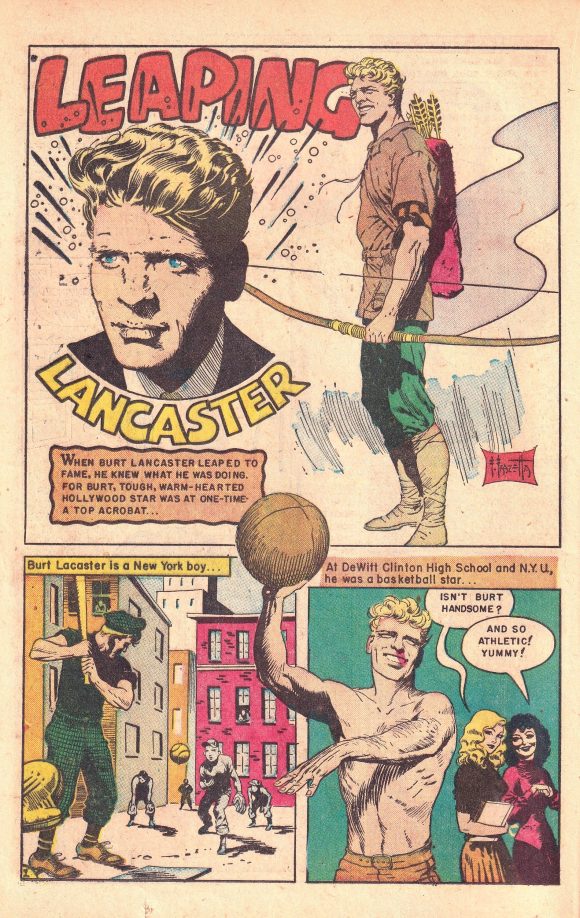
Movie Love #10 (Aug. 1951, Eastern). Art by Frank Frazetta. Unknown writer.
—
Al Williamson: Speaking of Williamson, after working with Frazetta on the aforementioned Buster Crabbe, John Wayne Adventure Comics, and Movie Love in the 1950s, his career hit high gear drawing science fiction comics for EC and other publishers. He was especially perfect for any Flash Gordon project, resembling as his work did to that of Alex Raymond, Flash Gordon’s creator — and Williamson’s greatest artistic influence.
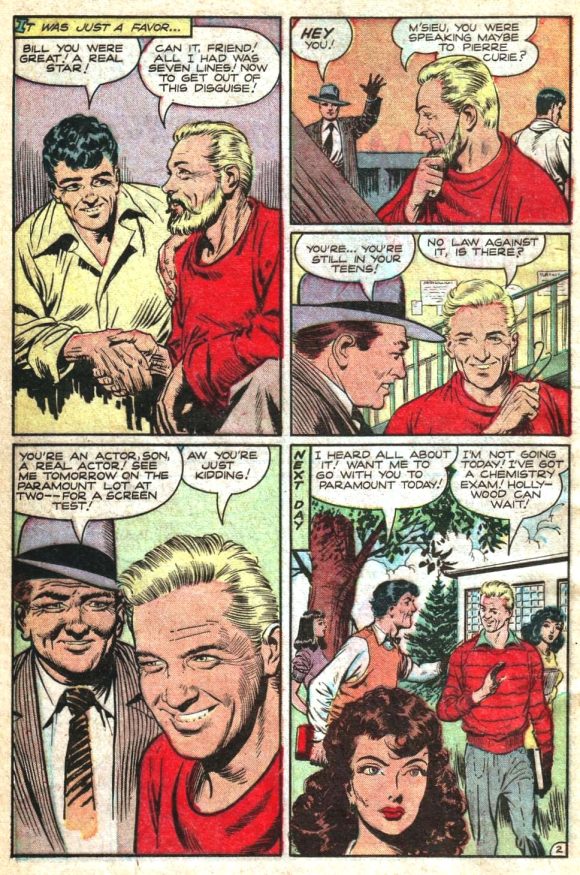
Movie Love #8 (April 1951), with Al Williamson collaborating with Frank Frazetta on a bio of actor William Holden.
In the 1960s, he got the chance to draw several issues of a Flash Gordon series, as well as some ads featuring Flash, but project-wise they paled in comparison to the graphic novel he was called upon to illustrate for the Dino De Laurentiis production of Flash Gordon in 1980. Following this, he would also draw adaptations of Blade Runner, The Empire Strikes Back, and Return of the Jedi for Marvel. In 1981, he would start drawing the Star Wars newspaper strip (taking over from Alfredo Alcala after Russ Manning had to bow out due to ill health).
—
Dan Spiegle. Far more prolific than the previous three combined, Dan Spiegle was the go-to artist when it came to adapting Walt Disney’s live-action motion pictures for Dell and, later, Gold Key. In total, he drew over 30 Disney film adaptations, including Mary Poppins, In Search of the Castaways, Old Yeller, The Adventures of Bullwhip Griffin, The Parent Trap, and The Love Bug.
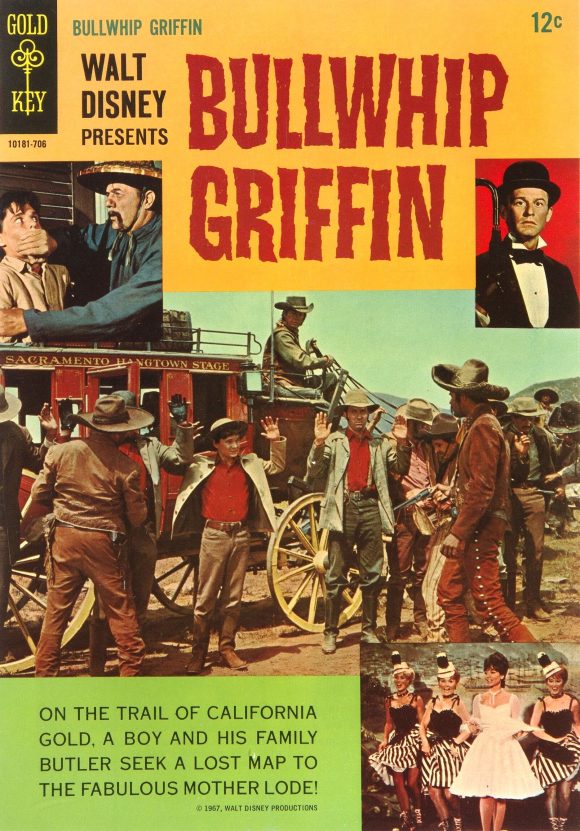
1967
This was in addition to his non-Disney movie adaptations for Mutiny on the Bounty, John Paul Jones, PT 109, and others.
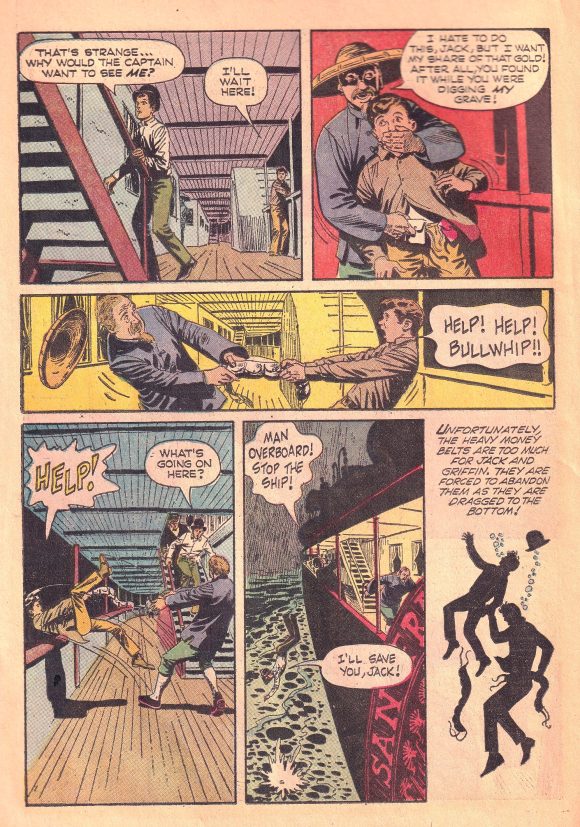
Bullwhip Griffin (June 1967, Gold Key). Art by Dan Spiegle. Scripter: Unknown.
—
Alex Toth. When Alex Toth’s name is mentioned in any conversation about the best in comics, it is followed by a reverential silence and a nodding in absolute agreement. Toth turned his talent to movie adaptations less than a dozen times, but the ones he did were some of the finest ever done for the genre. Among those classics were The Wings of Eagles, No Time for Sergeants, Darby O’Gill and the Little People, The FBI Story, and The Time Machine.
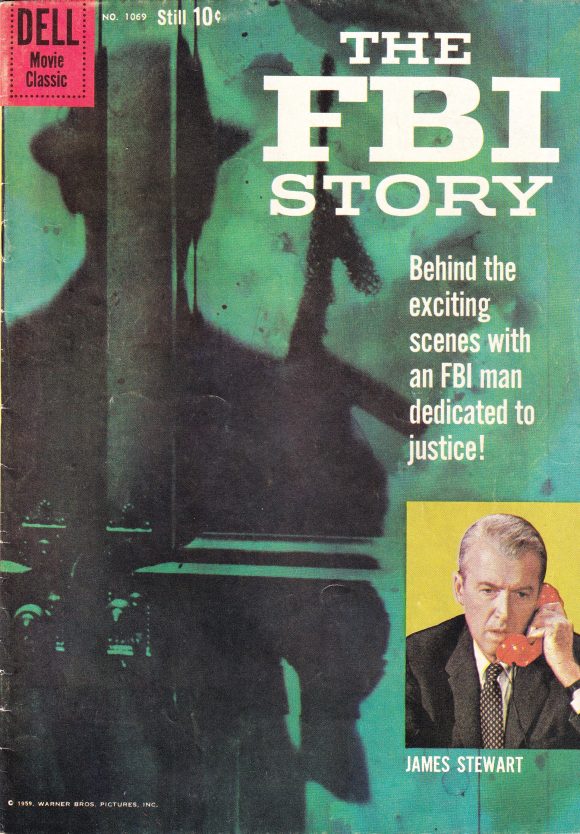
Four Color #1069, 1959
He also did one magnificent issue based on events in the Disney Johnny Tremain movie, but not a straight adaptation. Walt Disney’s Paul Revere’s Ride with Johnny Tremain (Four Color #822, 1957, Dell) featured Toth’s amazing use of solid black shading in panel after panel.
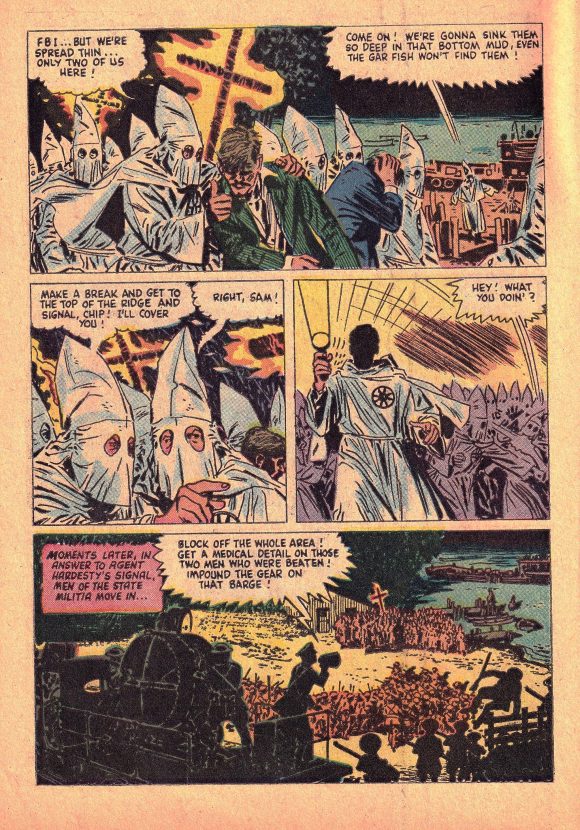
A strong art page from the Alex Toth adaptation of The FBI Story.
—
Russ Manning. What is that saying — “A thing of beauty is a joy forever”? Well, Russ Manning’s movie adaptations were things of beauty. There was elegance in Manning’s every line. Women were never more beautiful than under his pen and heroes were never more handsome — and that was evident from his very first adaptation, Walt Disney’s Rob Roy: The Highland Rogue in Four Color #544 (1954, Dell). Manning’s attention to detail was reflected in capturing every actor’s face, every costume, and every background detail.
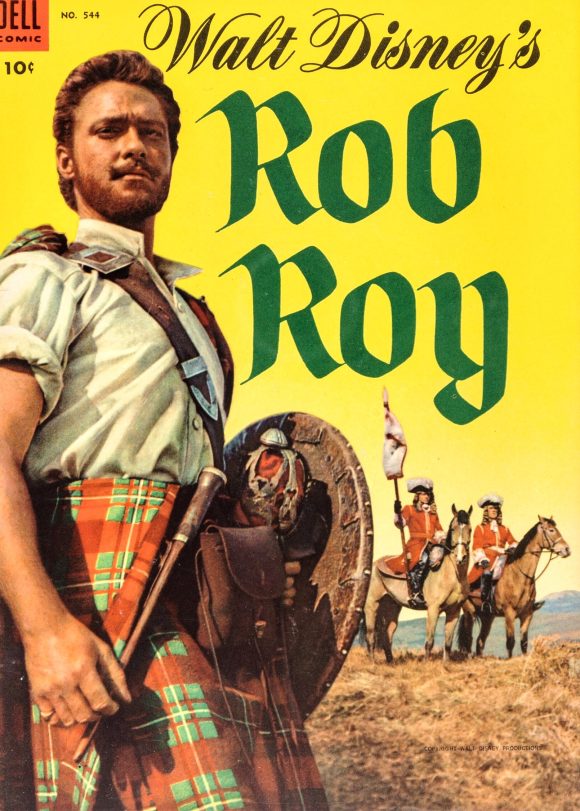
Four Color #544, 1954
If there is anything to regret about his adaptations, it is that there were not enough of them. The only other movies he drew comic book tie-ins to were for Ben-Hur, Captain Sindbad, and Disney’s Summer Magic, with the latter two featuring some of the finest art out of all the nearly 160 film adaptations done by many artists in the ’60s. Manning also drew a few advertising pieces for Luana: the Girl Tarzan, a very low-budget adventure picture in 1978. However, his fans had reason to celebrate when he was given the new Star Wars daily and Sunday newspaper strip in 1979 (which, as mentioned earlier, he had to withdraw from in 1980 because of his health).
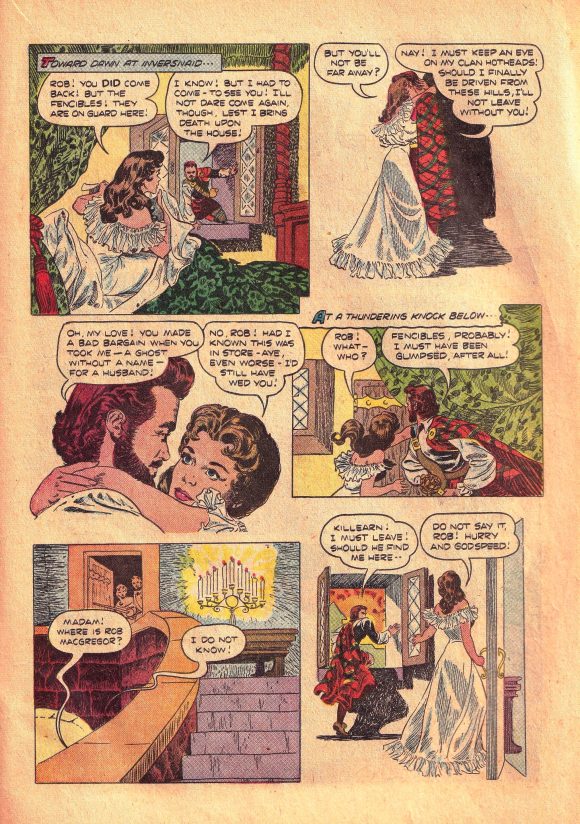
Russ Manning’s first film adaptation, Rob Roy: The Highland Rogue.
—
Steve Ditko. Ditko brought his special talent to the film adaptations of two 1961 monster movies, Konga and Gorgo. And, need it be said, in both circumstances his versions were far better than the actual movies!
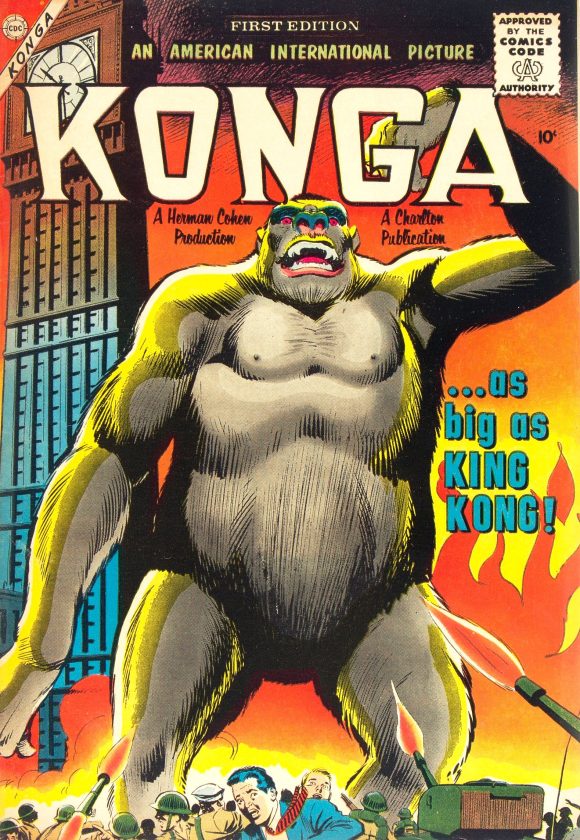
1960, Dick Giordano art
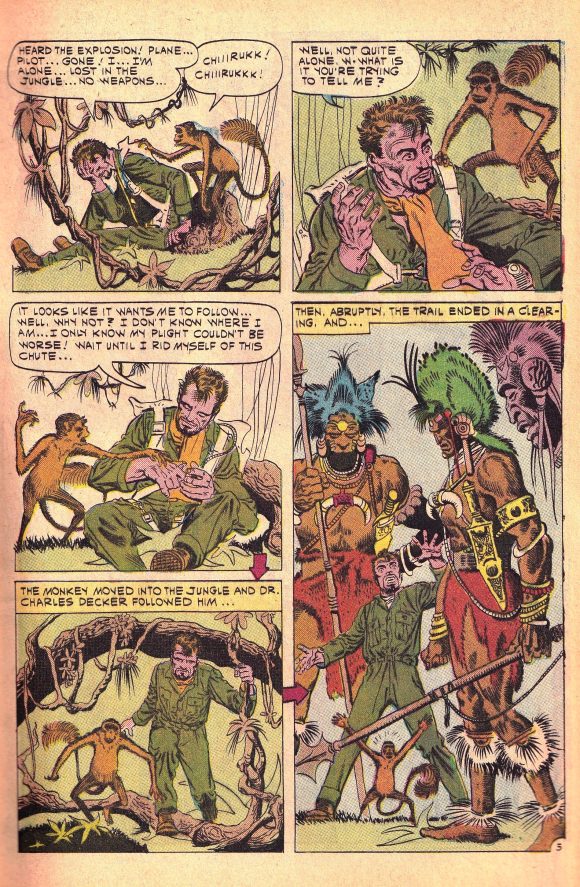
Konga by Steve Ditko
—
George Evans. Another former EC artist, George Evans worked on several film adaptations and he did extremely well no matter the genre, which included When Worlds Collide (science fiction),The Underwater City (adventure), Tales of Terror (horror), and The Thief of Baghdad (Arabian Nights fantasy).
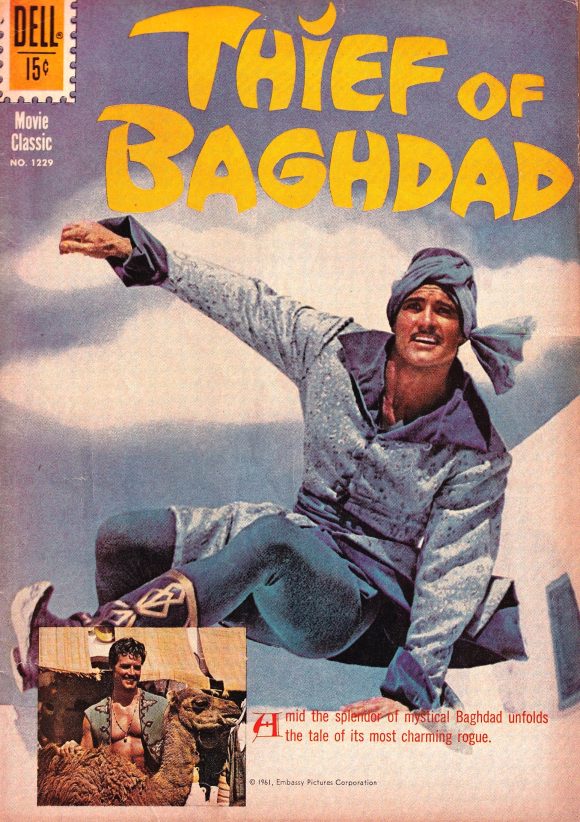
Four Color #1229, 1961
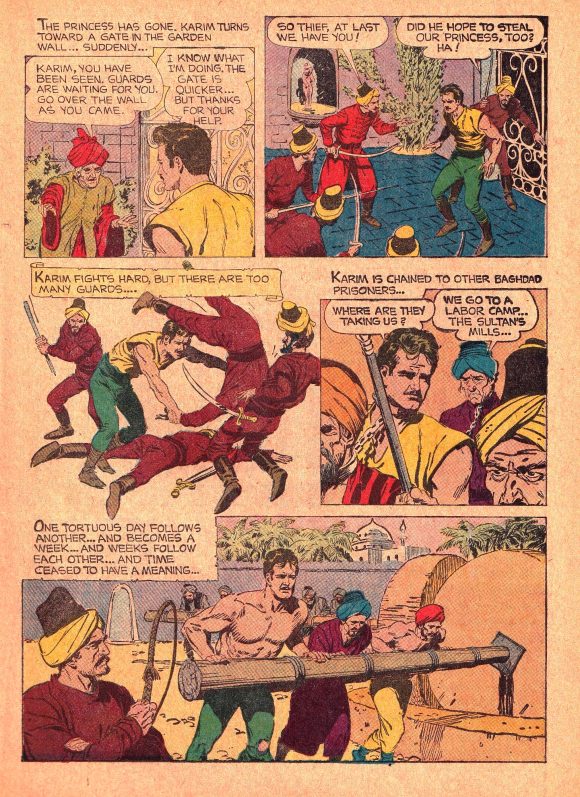
The Thief of Baghdad (1961) received an exceptional adaptation by the teaming of Reed Crandall and George Evans.
—
John Buscema. Years before he became one of Marvel Comics’ most important artists, John Buscema was drawing film tie-ins in the 1950s and early 1960s, including exceptional work on Helen of Troy, Spartacus, Hercules, The 7th Voyage of Sinbad, and The Vikings.
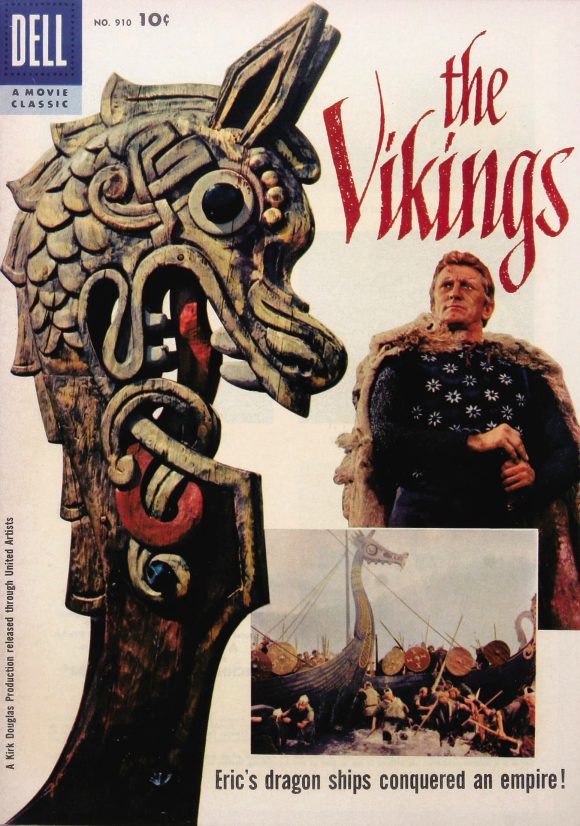
Four Color #910, 1958
Jump ahead to 1975 and, far removed from his drawing style for Conan the Barbarian, he pencilled (with Tony DeZuniga inking) the special assignment of MGM’s Marvelous Wizard of Oz, a DC/Marvel collaboration adapting 1939’s classic The Wizard of Oz. (Of course, when it came time for Marvel to adapt the 1982 Conan the Barbarian movie, the artist chosen was Buscema.)
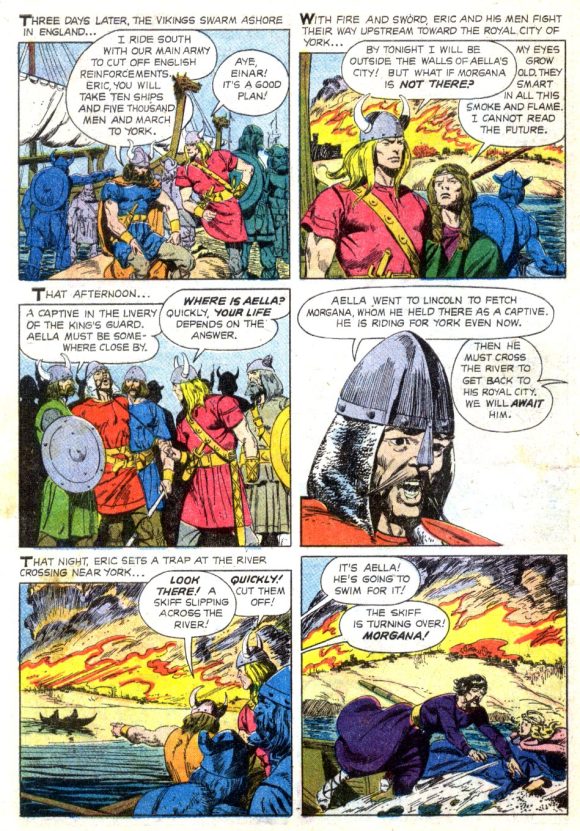
The Vikings comic adaptation by John Buscema was largely his own creation, with no one looking like the actors in the film. Script: Leo Dorfman.
—
Mike Sekowsky. While many know Mike Sekowsky only from his DC work, he was also freelancing at Dell and, later, at Gold Key. His art always had a special strength of its own, often filled with many action panels practically bursting at the seams — and that made him just right to adapt films like The 3 Worlds of Gulliver, Solomon and Sheba, Around the World in 80 Days, 55 Days at Peking, McLintock!, and The Horse Soldiers.
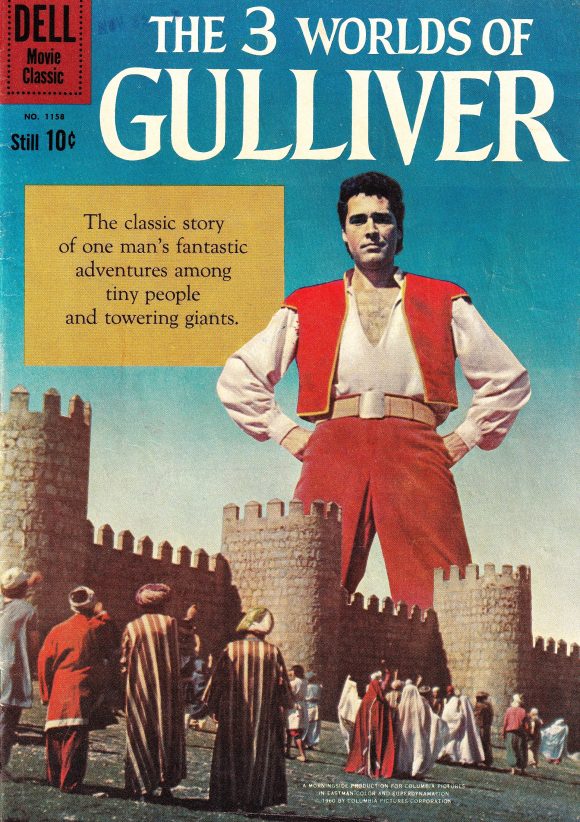
Four Color #1158, 1960
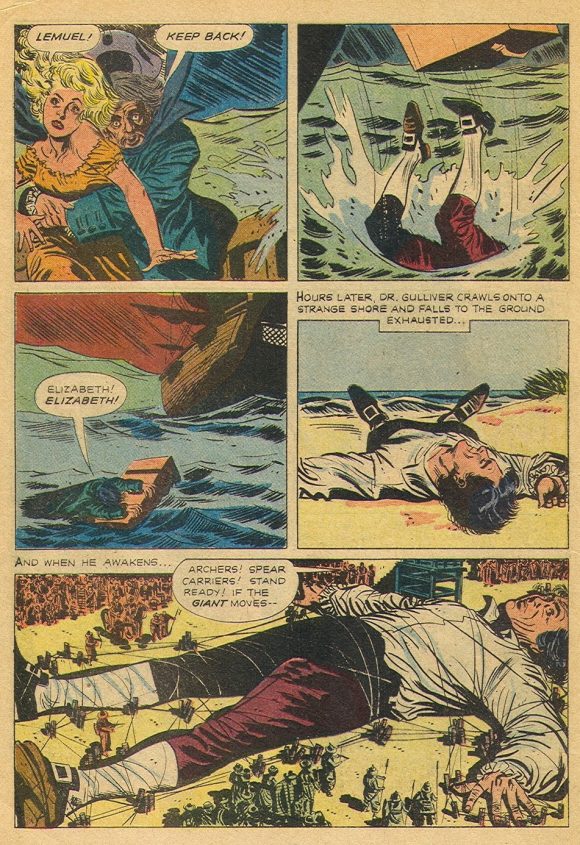
Mike Sekowsky’s artwork was a perfect fit for The 3 Worlds of Gulliver. Inker: Mike Peppe.
—
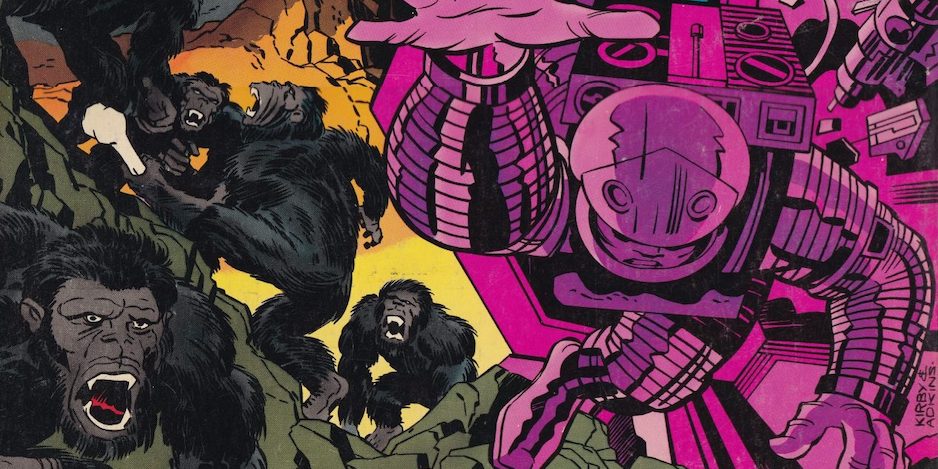
Jack Kirby, George Pérez, and Walt Simonson. We come to a near wrap-up for the book — but not the end of movie adaptations by any means! The 1970s saw a change in the comics industry: There were cutbacks everywhere and that extended into movie-to-comics adaptations. Where 1960 started with 18 different movie tie-ins, including The Time Machine, Pollyanna, Spartacus, and Swiss Family Robinson, 1970 began the decade with just three: Goodbye, Mr. Chips, Beneath the Planet of the Apes, and The Boatniks. But, as with all great adventure stories, when things look bad, a hero would arise from the masses! And it was from a publisher who had never done even one film adaptation before — Marvel Comics.
Marvel entered the field for the first time in 1974 with an adaptation of The Golden Voyage of Sinbad, followed a few months later by the first issue of their Planet of the Apes magazine, which began an ambitious undertaking of adapting the original five movies of the franchise (it took 28 issues to complete). Marvel also licensed the rights to a number of other noteworthy films, including Logan’s Run, Star Wars, Close Encounters of the Third Kind, and 2001: A Space Odyssey.
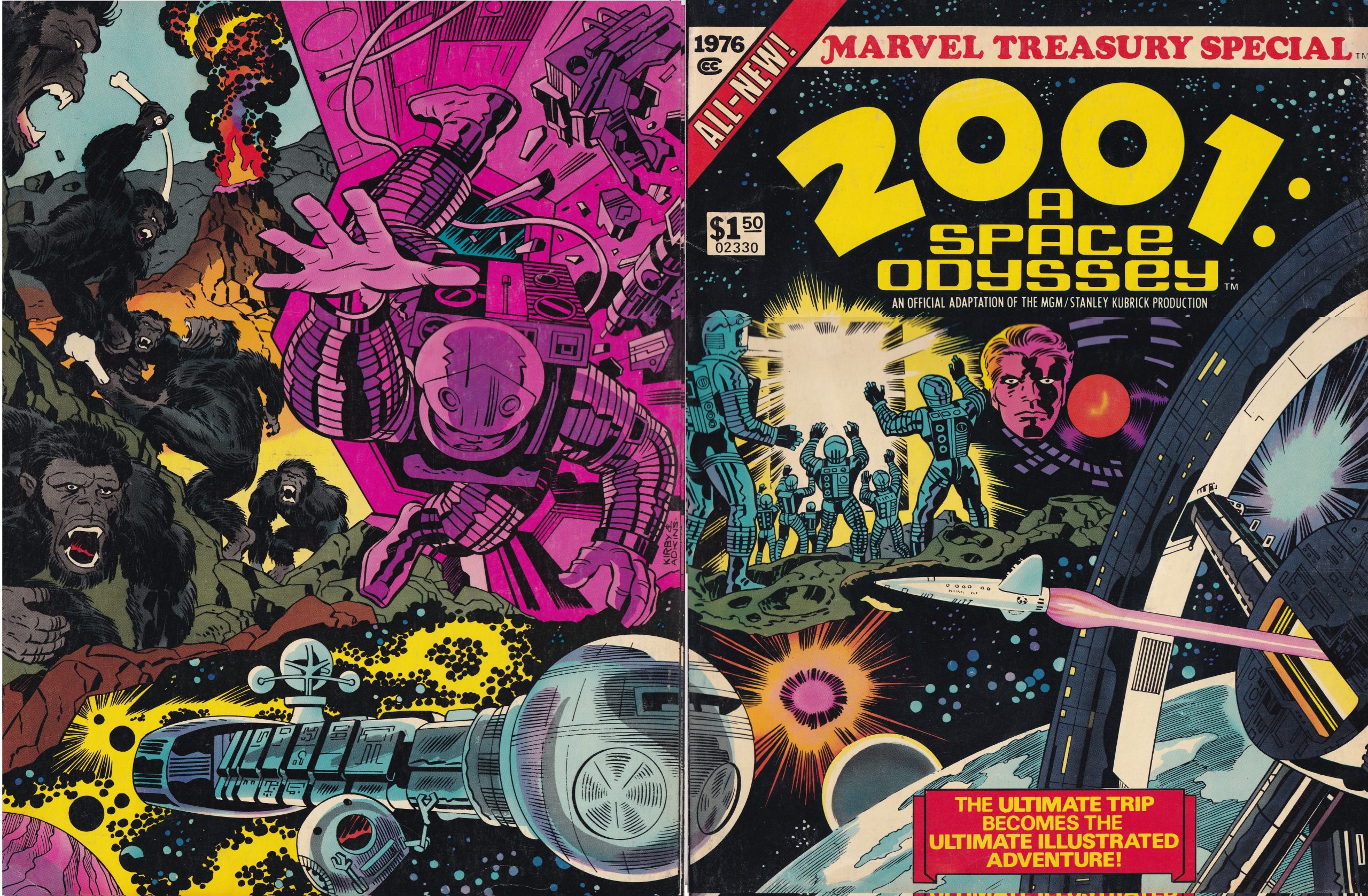
1976. Jack Kirby pencils, Dan Adkins inks.
And it fell to three newcomers to help carry on the tradition.
While it is hard to call Jack Kirby a newcomer to anything, he was that with 2001: A Space Odyssey, doing his first film adaptation. However, he did tackle it head on, producing 70 pages of outstanding artwork (with exceptional inking by Frank Giacoia) and also edited and wrote the entire thing. A few years later, he also drew a 26-week Sunday newspaper strip adaptation of Disney’s The Black Hole (with scripting by Carl Fallberg) as part of the syndicated feature Walt Disney’s Treasury of Classic Tales from September 2, 1979, through February 24, 1980.
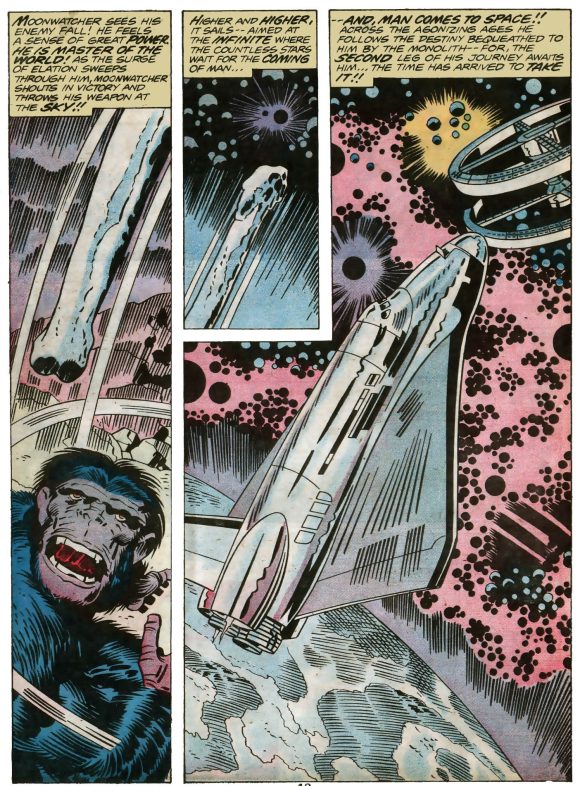
2001: A Space Odyssey. Writing and pencils by Jack Kirby; inks by Frank Giacoia.
Up-and-comer George Pérez drew Marvel’s five-issue version of Logan’s Run in 1977. His drawing style was still developing at the time but it was easy to see Pérez was improving with each subsequent issue. He also drew (with Jim Mooney inking) an adaptation of Sgt. Pepper’s Lonely Hearts Club Band (1978), planned for Marvel Comics Special #7 but never published within the United States. (It did see the light of day abroad in foreign-language editions.)
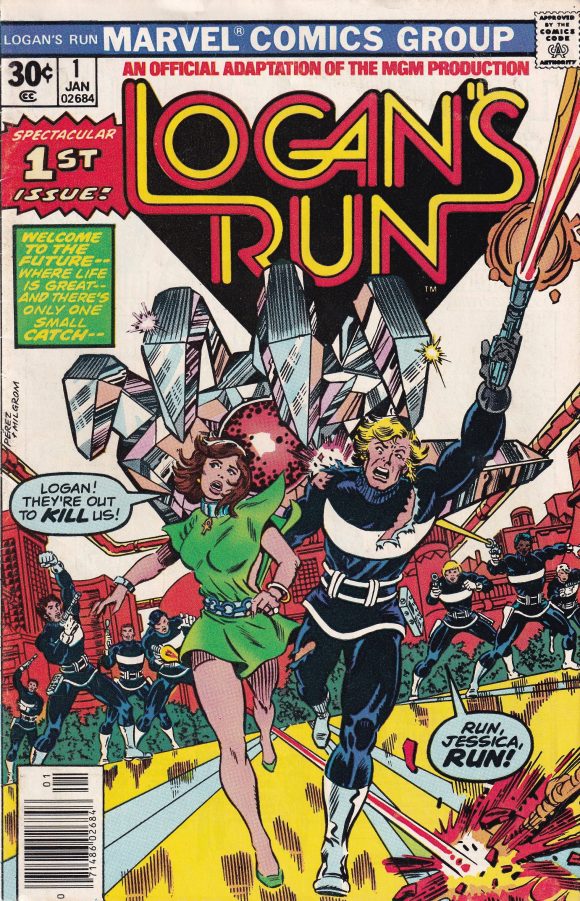
1976. George Perez pencils, Al Milgrom inks.
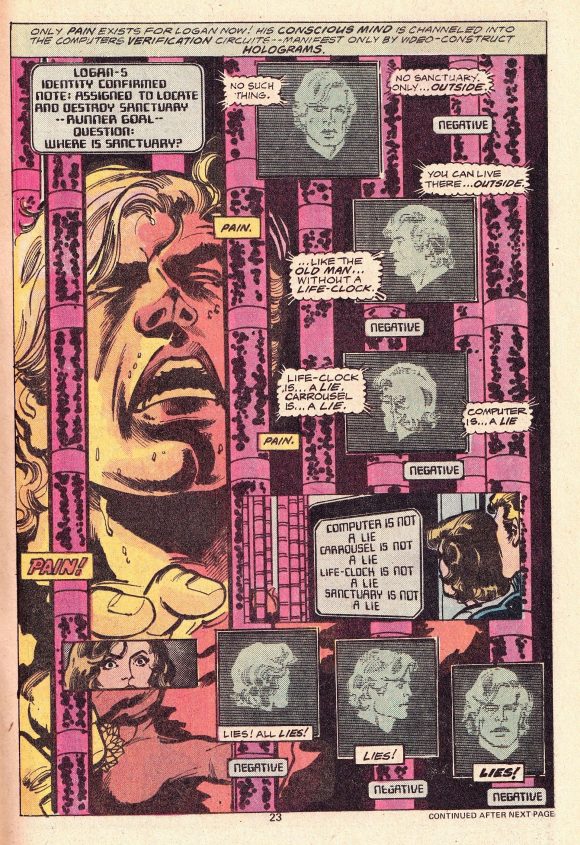
Logan’s Run #5 (May 1977, Marvel). Script by David Anthony Kraft. Pencils by George Pérez, inks by Klaus Janson.
And to round this off at 13… Walt Simonson drew two remarkable movie adaptations in the late ’70s, Alien and Close Encounters of the Third Kind. Close Encounters was published in 1978’s Marvel Comics Super Special #3 and had several remarkable moments, but Simonson’s truly outstanding work of the time was Alien: The Illustrated Story, a graphic novel published in 1979 by Heavy Metal, with art that stunned the reader from the first page until the very end.
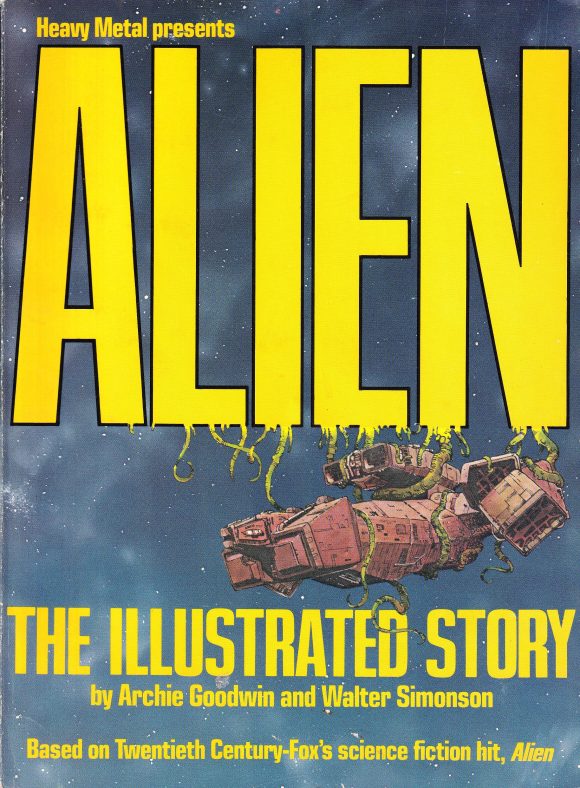
1979. Art by Walt Simonson.
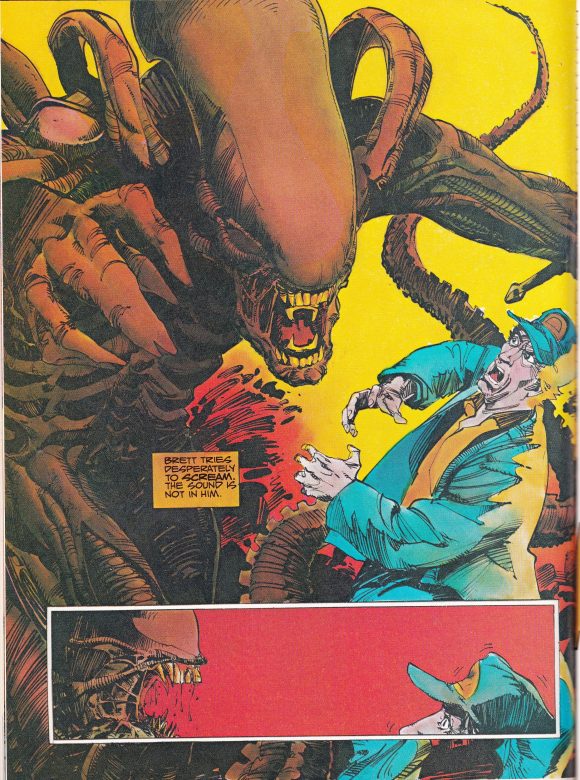
Walt Simonson’s astonishing art for Alien: The Illustrated Story. Script by Archie Goodwin.
Those and many other artists can be found in the new book. By the way, speaking of “other artists,” let me also mention Neal Adams, Alberto Giolitti, Gene Colan, Bob Lubbers, Curt Swan, Carmine Infantino, Sam Glanzman, Dick Giordano, Everett Raymond Kinstler, Frank Springer, Jesse Marsh, John Bolton, and Warren Tufts. What films did they adapt? Click here to find out!
—
American Movie Comic Books (1930s-1970s) is a 192-page, full-color, oversize paperback. It lists for $34.95 and is due in comics shops Aug. 20. You can also order it directly from TwoMorrows. Click here.
American TV Comic Books (1940s-1980s) is a 192-page, full-color, oversize paperback. It lists for $29.95 and is available now from TwoMorrows. Click here.
—
MORE
— AMERICAN MOVIE COMIC BOOKS: 13 MORE Artists Who Helped Make Them Great. Click here.
— EXCLUSIVE PREVIEW: Peter Bosch’s Fab AMERICAN MOVIE COMIC BOOKS. Click here.
—
13th Dimension contributor-at-large PETER BOSCH’s first book, American TV Comic Books: 1940s-1980s – From the Small Screen to the Printed Page, was published by TwoMorrows. (You can buy it here.) A sequel, American Movie Comic Books: 1930s-1970s — From the Silver Screen to the Printed Page, is out now. (Buy it here.) Peter has written articles and conducted celebrity interviews for various magazines and newspapers. He lives in Hollywood.